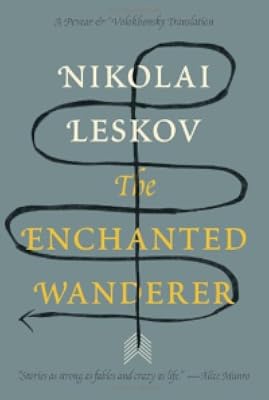
The Enchanted Wanderer: and Other Stories
by Nikolai Leskov
On This Page
Description
Presents newly translated verions of seventeen of Leskov's short stories, inspired by oral storytelling traditions, that range from the fantastical to the satirical to the tragic.Tags
Recommendations










Member Reviews
A collection of short stories by Nikolai Leskov (1831-1895) translated by the prolific husband/wife duo of Pevear and Volokhonsky. Leskov is a lesser known author today, but he was praised in his day by Tolstoy and Chekhov, among others. In general he tried to paint a picture of the Russian life he saw, one which lagged behind the West and which was full of contradictions, and he did this in a folksy way.
There is a mysticism that pervades these stories: they describe a world where madmen are consulted as oracles, superstition floats like a mist on daily lives, and demons and spirits are accepted. The book offers a glimpse into the 19th century, where serfs are brutally treated and tortured, conservatives bemoan the railroad as a show more harmful factor to literature, marriage is decided in a first meeting, and corruption abounds. It is hard to read at times, such as when a puppy’s appetite is reduced by having it drink melted tin or lead in “The Spook”, but those types of things aren’t dwelt upon.
The five stories I really liked were “The Lady Macbeth of Mtsensk”, “Lefty”, “The Toupee Artist”, “The Pearl Necklace”, and “The Spook”, but I won’t try to describe their plots. The strongest, “Lefty”, works because of its honesty, which reflected both praise for the Russian craftsman as well as a criticism of life in Russia, leaving interpretation open to the observer, as all great art does. Unfortunately for Leskov, in the charged political times he was living in, it left him open to attacks from both conservatives and liberals.
And unfortunately there were twelve other stories in this collection which, while not horrible, were less interesting to me, and this made the overall 575 page book a bit of a slog to get through. It’s uneven, and if you were ever to have an interest in Leskov, I would suggest a much smaller volume to start with, focusing on the works above.
Quotes:
On corruption, from “Singlemind”:
“…the mayor judged that in a Russian way: ‘The law is like a horse: wherever you want to go, you turn its head so.’”
On cruelty, from “The Toupee Artist”, no it’s not unique to modern times:
“There were secret cellars under the whole house where people lived chained up like bears. Going past, you could sometimes hear the chains clank and the fettered people moan. They probably wanted news of them to reach us or for the authorities to hear it, but the authorities did not dare even to think of intervening.”
On kissing, and a comment on the dryness of marriage, from “The Lady Macbeth of Mtsensk”:
“’Then why did you kiss me that way?’
Sergei said nothing at all.
‘It’s only husbands and wives,’ Katerian Lvovna went on, playing with his curls, ‘who shake the dust off each other’s lips like that. Kiss me so that these young apple blossoms over us fall to the ground. Like this, like this,’ Katerian Lvovna whispered, twining around her lover and kissing him with passionate abandon.”
Followed later by:
“The old clerk, asleep in the shed, began to hear through his sound sleep, in the stillness of the night, now whispering and quiet laughter, as if mischievous children were discussing some wicked way to mock feeble old age; now ringing and merry laughter, as if mermaids were tickling somebody. It was all Katerina Lvovna frolicking and playing with her husband’s young clerk, basking in the moonlight and rolling on the soft rug. White young blossoms from the curly apple tree poured down on them, poured down, and then stopped pouring down. Meanwhile, the short summer night was passing; the moon hid behind the steep roofs of the tall storehouses and looked askance at the earth, growing dimmer and dimmer; a piercing cat duet came from the kitchen roof, then spitting, angry snarling, after which two or three cats, losing hold, tumbled noisily down a bunch of boards leaning against the roof.”
On love, from “The Pearl Necklace”:
“You think that when you’re in love with a woman you look at her in a reasoning way, but in fact you only gaze in wonder all the day.”
On love lost, from “The Enchanted Wanderer”:
“Who am I going to sing for! You’ve turned cold, and I want my song to make someone’s soul burn and suffer.”
On melancholy, and 19th century cures, from “Deathless Golovan”:
“…his daughter, who suffered from ‘the disease of melancholy’ and was to be cured. All the known remedies of folk poetry and creativity had been tried on her: she had been made to drink stimulating elecampane, had had powdered peony root poured all over her for repulsing phantoms, had been given wild garlic to sniff, so as to straighten the brain in her head, but nothing helped, and now she was being taken to saint…”
On psychoses, and 19th century treatment, from “The Toupee Artist”:
“She wound up in the cattle yard, because there were suspicions that she might have gone a bit crazy. People who became like beasts were tested among beasts, because cattlemen were elderly and sedate, and it was thought they could ‘look after’ psychoses.”
On religion, from “Singlemind”:
“’He’s read up the Bible.’
‘What a fool thing to do!’
‘Yes, he read it out of boredom and can’t forget it.’
‘A real fool! Now what are we to do with him?’
…
All Orthodox people in Russia know that, if someone has read through the Bible and ‘gone as far as Christ,’ he cannot very well be expected to act reasonably; such people are rather like holy fools – they behave oddly, but harm nobody, and are not to be feared.” show less
There is a mysticism that pervades these stories: they describe a world where madmen are consulted as oracles, superstition floats like a mist on daily lives, and demons and spirits are accepted. The book offers a glimpse into the 19th century, where serfs are brutally treated and tortured, conservatives bemoan the railroad as a show more harmful factor to literature, marriage is decided in a first meeting, and corruption abounds. It is hard to read at times, such as when a puppy’s appetite is reduced by having it drink melted tin or lead in “The Spook”, but those types of things aren’t dwelt upon.
The five stories I really liked were “The Lady Macbeth of Mtsensk”, “Lefty”, “The Toupee Artist”, “The Pearl Necklace”, and “The Spook”, but I won’t try to describe their plots. The strongest, “Lefty”, works because of its honesty, which reflected both praise for the Russian craftsman as well as a criticism of life in Russia, leaving interpretation open to the observer, as all great art does. Unfortunately for Leskov, in the charged political times he was living in, it left him open to attacks from both conservatives and liberals.
And unfortunately there were twelve other stories in this collection which, while not horrible, were less interesting to me, and this made the overall 575 page book a bit of a slog to get through. It’s uneven, and if you were ever to have an interest in Leskov, I would suggest a much smaller volume to start with, focusing on the works above.
Quotes:
On corruption, from “Singlemind”:
“…the mayor judged that in a Russian way: ‘The law is like a horse: wherever you want to go, you turn its head so.’”
On cruelty, from “The Toupee Artist”, no it’s not unique to modern times:
“There were secret cellars under the whole house where people lived chained up like bears. Going past, you could sometimes hear the chains clank and the fettered people moan. They probably wanted news of them to reach us or for the authorities to hear it, but the authorities did not dare even to think of intervening.”
On kissing, and a comment on the dryness of marriage, from “The Lady Macbeth of Mtsensk”:
“’Then why did you kiss me that way?’
Sergei said nothing at all.
‘It’s only husbands and wives,’ Katerian Lvovna went on, playing with his curls, ‘who shake the dust off each other’s lips like that. Kiss me so that these young apple blossoms over us fall to the ground. Like this, like this,’ Katerian Lvovna whispered, twining around her lover and kissing him with passionate abandon.”
Followed later by:
“The old clerk, asleep in the shed, began to hear through his sound sleep, in the stillness of the night, now whispering and quiet laughter, as if mischievous children were discussing some wicked way to mock feeble old age; now ringing and merry laughter, as if mermaids were tickling somebody. It was all Katerina Lvovna frolicking and playing with her husband’s young clerk, basking in the moonlight and rolling on the soft rug. White young blossoms from the curly apple tree poured down on them, poured down, and then stopped pouring down. Meanwhile, the short summer night was passing; the moon hid behind the steep roofs of the tall storehouses and looked askance at the earth, growing dimmer and dimmer; a piercing cat duet came from the kitchen roof, then spitting, angry snarling, after which two or three cats, losing hold, tumbled noisily down a bunch of boards leaning against the roof.”
On love, from “The Pearl Necklace”:
“You think that when you’re in love with a woman you look at her in a reasoning way, but in fact you only gaze in wonder all the day.”
On love lost, from “The Enchanted Wanderer”:
“Who am I going to sing for! You’ve turned cold, and I want my song to make someone’s soul burn and suffer.”
On melancholy, and 19th century cures, from “Deathless Golovan”:
“…his daughter, who suffered from ‘the disease of melancholy’ and was to be cured. All the known remedies of folk poetry and creativity had been tried on her: she had been made to drink stimulating elecampane, had had powdered peony root poured all over her for repulsing phantoms, had been given wild garlic to sniff, so as to straighten the brain in her head, but nothing helped, and now she was being taken to saint…”
On psychoses, and 19th century treatment, from “The Toupee Artist”:
“She wound up in the cattle yard, because there were suspicions that she might have gone a bit crazy. People who became like beasts were tested among beasts, because cattlemen were elderly and sedate, and it was thought they could ‘look after’ psychoses.”
On religion, from “Singlemind”:
“’He’s read up the Bible.’
‘What a fool thing to do!’
‘Yes, he read it out of boredom and can’t forget it.’
‘A real fool! Now what are we to do with him?’
…
All Orthodox people in Russia know that, if someone has read through the Bible and ‘gone as far as Christ,’ he cannot very well be expected to act reasonably; such people are rather like holy fools – they behave oddly, but harm nobody, and are not to be feared.” show less
If you thought that with Pushkin, Gogol, Tourgenev, Dostoevsky, Tolstoy, and Chekhov, you knew practically all of 19th-century Russian literature, you'd be disappointed. This Nikolai Leskov (1831-1895) may not have belonged to the eminent circle, but he's apparently a striking, entirely idiosyncratic voice in the company. This story proves it. Leskov has an (unlikely) monk recount his adventurous life at length. The most improbable events pass by, sometimes in the style of a classic picaresque novel, sometimes as a series of magical realist incidents (now I know where Michael Bulgakov got his inspiration for The Master and Margarita), and so on. There's no real focus or plot, certain twists are very far-fetched, and in several places show more the novel feels unfinished (certain incidents are repeated several times in an adapted version). This makes for a frequently frustrating read. But Leskov clearly wasn't lacking in storytelling. And indirectly, you get glimpses of Russian society in the second half of the 19th century. show less
I thoroughly enjoyed Nikolai Leskov's "The Enchanted Wanderer and Other Stories," a great collection of Russian short stories. Most of the stories tell tales of the working class in the time of Tsar Nicholas I -- they read almost as a collection of old folk tales. Good solid writing and interesting plots made this a quick and easy read.
I think I enjoyed the title story the least in this fine collection, which told the story of an old monk and horse handler. I particularly enjoyed "Lefty" a story of Russian ingenuity... and the "Lady MacBeth of Mtsensk," a tragic tale of a lovelorn and bored woman.
I think I enjoyed the title story the least in this fine collection, which told the story of an old monk and horse handler. I particularly enjoyed "Lefty" a story of Russian ingenuity... and the "Lady MacBeth of Mtsensk," a tragic tale of a lovelorn and bored woman.
This is an essential collection of Russian short stories from the pen of Nikolai Leskov. The translations by Pevear and Volokhonsky make this a welcome addition to the library of all who enjoy classic Russian literature.
Although I wanted to enjoy the Enchanted Wanderer and would have, this translation and print of this book was absolutely terrible. My copy had dozens of print errors and translation errors. I will reread this book, but in a different translation. Do NOT buy this copy!
Ratings
Members
- Recently Added By
Lists

1001 Books You Must Read Before You Die
1,448 works; 1,134 members

Russian Literature
184 works; 35 members

Philip Ward's Lifetime Reading Plan
592 works; 22 members

Western World's Greatest Books - Project Gutenberg
295 works; 15 members

1,001 BYMRBYD Concensus
723 works; 27 members
Author Information

337+ Works 2,986 Members
Common Knowledge
- Original language
- Russian
- Disambiguation notice
- Do not combine books called The Enchanted Wanderer without careful checking. Virtually every Leskov collection used to be lumped together; I have done my best to separate them. Note that there are four separate colle... (show all)ctions called The Enchanted Wanderer, the 1958 Hanna translation, the 1961 Magarshack one (subtitled Selected Tales, and not to be confused with his earlier 1946 translation of a separate group of stories, called The Enchanted Pilgrim: And Other Stories), and the Pevear-Volokhonsky and Dreiblatt ones (both 2013), all of which are very different and should not be combined. Furthermore, there is the 1924 A.G. Paschkoff translation of the story by itself, published as a separate book.
Classifications
- Genres
- General Fiction, Fiction and Literature
- DDC/MDS
- 891.73 — Literature & rhetoric Literatures of other languages East Indo-European and Celtic literatures Russian and East Slavic languages Russian fiction
- LCC
- PG3337 .L5 .A255 — Language and Literature Slavic languages and literatures. Baltic languages. Albanian language Slavic. Baltic. Albanian Russian literature Individual authors and works 1800-1870
- BISAC
Statistics
- Members
- 292
- Popularity
- 110,188
- Reviews
- 5
- Rating
- (3.67)
- Languages
- English
- Media
- Paper, Ebook
- ISBNs
- 5