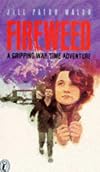
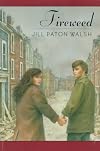
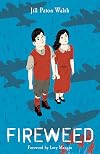
Fireweed
by Jill Paton Walsh
On This Page
Description
Two teen-age runaways who refuse to be evacuated from London struggle to survive the blitz of 1940.Tags
Recommendations






















Member Recommendations



Member Reviews
This short bittersweet novel from 1969 is about two runaway evacuees living on the streets of London during the Blitz. It’s very vivid, particularly the details about wartime London -- but there’s also a thread of ambiguity, because the narrator is looking back on a time he doesn’t fully remember and didn’t always understand. In the end, that ambiguity becomes a bit unsatisfying, yet I like the way the story allows one to fill in some of the gaps for oneself.
I wish I had discovered this when I was thirteen or so, because I think I would have appreciated it even more then -- been fascinated by the experience of fending for oneself, with having independence and therefore having responsibility.
We saw London getting knocked apart. show more We knew where there was ruin, and we knew that it wasn’t all in the papers. We saw a lot of terrible things. But the strangest thing, in a way, was the way things were the same. It sounds silly to say that the oddest thing was that the leaves turned gold, and fell off, while Hitler’s bombers filled the sky; of course they would, and they did. But in all that disruption, in the the midst of so much destruction, when everyone’s life was changed, and we were alone, standing on our own feet for the first time, looking after ourselves, familiar things seemed as exotic and unlikely as hothouse flowers. show less
I wish I had discovered this when I was thirteen or so, because I think I would have appreciated it even more then -- been fascinated by the experience of fending for oneself, with having independence and therefore having responsibility.
We saw London getting knocked apart. show more We knew where there was ruin, and we knew that it wasn’t all in the papers. We saw a lot of terrible things. But the strangest thing, in a way, was the way things were the same. It sounds silly to say that the oddest thing was that the leaves turned gold, and fell off, while Hitler’s bombers filled the sky; of course they would, and they did. But in all that disruption, in the the midst of so much destruction, when everyone’s life was changed, and we were alone, standing on our own feet for the first time, looking after ourselves, familiar things seemed as exotic and unlikely as hothouse flowers. show less
After a slowish start, this story of two young people who have, for different reasons, fled the arrangements their families have made for them during the blitz in WWII London. The idyll of two unsupervised teens ("Yet all around us death and ruin rained out if the sky. We saw it everywhere, and we were afraid like everybody else, and yet it cast no shadow in our hearts.") is short-lived. They each make decisions that change the course of their lives and, especially that of a young child orphaned by a bomb near the basement where they hide.
Walsh evokes the smells and sights and shocks of wartime London all the while developing the characters and providing unpredictable but believable plot twists.
I will recommend this title to my readers show more of WWII fiction. It's a worthy, intimate balance to battle stories and triumphant tales of heroes. show less
Walsh evokes the smells and sights and shocks of wartime London all the while developing the characters and providing unpredictable but believable plot twists.
I will recommend this title to my readers show more of WWII fiction. It's a worthy, intimate balance to battle stories and triumphant tales of heroes. show less
I was ten when I read this book for the first time. It was recommended for me by my elementary school librarian, who knew I was into military history at the time, and who in hindsight was very clever to use this book's setting during the London Blitz to get me to read a story I otherwise never would have. Smart lady.
For me, this book was the beginning of knowing and appreciating the painful beauty of a sad (not how you might imagine, so I can say that without spoiling anything) ending. It was also the first book that exposed me to the essential unfairness of life, and the way people face it, in a deeper sense than "Travis having to shoot Old Yeller." At first, I hated it. It was the first book I ever read that wasn't wrapped up with a show more neat little bow at the end, and as such was a shock to the ten year old Ben, whose literary diet of the time mostly consisted of non-fiction and Judy Blume-level kid lit. And oh, how I hated that ending. I writhed, pinned under it. I thought about it for weeks, fantasizing it turning out differently, composing a dozen alternate fanfic endings in my head, until one day I just stopped. Something in my preadolescent mind just clicked, and all of the sudden I was okay with it. In time, I even came to appreciate it.
I've been in love with the bittersweet ever since. show less
For me, this book was the beginning of knowing and appreciating the painful beauty of a sad (not how you might imagine, so I can say that without spoiling anything) ending. It was also the first book that exposed me to the essential unfairness of life, and the way people face it, in a deeper sense than "Travis having to shoot Old Yeller." At first, I hated it. It was the first book I ever read that wasn't wrapped up with a show more neat little bow at the end, and as such was a shock to the ten year old Ben, whose literary diet of the time mostly consisted of non-fiction and Judy Blume-level kid lit. And oh, how I hated that ending. I writhed, pinned under it. I thought about it for weeks, fantasizing it turning out differently, composing a dozen alternate fanfic endings in my head, until one day I just stopped. Something in my preadolescent mind just clicked, and all of the sudden I was okay with it. In time, I even came to appreciate it.
I've been in love with the bittersweet ever since. show less
Short but effective young adult novel with a somewhat pointless and unnecessarily emotional ending. Evokes life during the London Blitz very powerfully.
After a slowish start, this story of two young people who have, for different reasons, fled the arrangements their families have made for them during the blitz in WWII London. The idyll of two unsupervised teens ("Yet all around us death and ruin rained out if the sky. We saw it everywhere, and we were afraid like everybody else, and yet it cast no shadow in our hearts.") is short-lived. They each make decisions that change the course of their lives and, especially that of a young child orphaned by a bomb near the basement where they hide.
Walsh evokes the smells and sights and shocks of wartime London all the while developing the characters and providing unpredictable but believable plot twists.
I will recommend this title to my readers show more of WWII fiction. It's a worthy, intimate balance to battle stories and triumphant tales of heroes. show less
Walsh evokes the smells and sights and shocks of wartime London all the while developing the characters and providing unpredictable but believable plot twists.
I will recommend this title to my readers show more of WWII fiction. It's a worthy, intimate balance to battle stories and triumphant tales of heroes. show less
Walsh tells story of two children trying to survive during the Blitz in London. Originally alone, the pair work together to stay alive amidst the dangers of bombs, as well as evading the threat of being evacuated to the countryside. Although this friendship was first one of convenience, it strengthens as the story progresses, and it is clear that the two characters begin to mean more to each other.
A quick but good read and a different view of life in London during the blitz. A great wrap up to the story.
Members
- Recently Added By
Lists

Children's Books about World War II (1939-1945)
143 works; 12 members

Reading history in Children's Books
78 works; 3 members
Talk Discussions
Past Discussions
Found: 1970s Book about Homeless Children in London Blitz in Name that Book (April 2021)
Author Information

59+ Works 8,502 Members
Jill Paton Walsh was born Gillian Bliss on April 29, 1937 in London. She graduated from St. Anne's College in Oxford. She taught at the Enfield Girls' Grammar School for three years and was a permanent visiting faculty member for the Center for Children's Literature at Simmons College in Boston, Massachusetts. She was also an adjunct British board show more member of Children's Literature New England. She has written more than 15 books for children. She has won numerous awards including the Book World Festival Award for Fireweed in 1970, the Whitbread Prize for The Emperor's Winding Sheet in1974, the Universe Prize for A Parcel of Patterns in 1984, and the Smarties Grand Prix for Gaffer Samson's Luck in 1984. She has also written adult novels, including completing an unfinished Dorothy Sayers manuscript. Her adult works include Knowledge of Angels, The Serpentine Cave, and A School for Lovers. She is the author of the Imogen Quy Mystery series and the Lord Peter Wimsey Mystery series. She was elected as fellow of the Royal Society of Literature in 1996. (Bowker Author Biography) show less
Awards and Honors
Common Knowledge
- Canonical title
- Fireweed
- Original publication date
- 1969
- Important places
- London, England, UK
- Important events
- World War II (1939 | 1945); World War II, British Home Front; Battle of Britain (1940); London Blitz [1940|1941]
- Original language
- English
Classifications
- Genres
- Fiction and Literature, Children's Books, Young Adult
- DDC/MDS
- 823.914 — Literature & rhetoric English & Old English literatures English fiction 1900- 1901-1999 1945-1999
- LCC
- PZ7 .P2735 .F — Language and Literature Fiction and juvenile belles lettres Fiction and juvenile belles lettres Juvenile belles lettres
- BISAC
Statistics
- Members
- 211
- Popularity
- 155,010
- Reviews
- 7
- Rating
- (4.03)
- Languages
- English, French, Swedish
- Media
- Paper, Audiobook, Ebook
- ISBNs
- 17
- ASINs
- 6