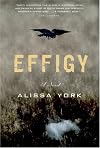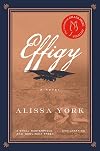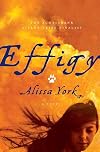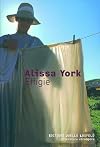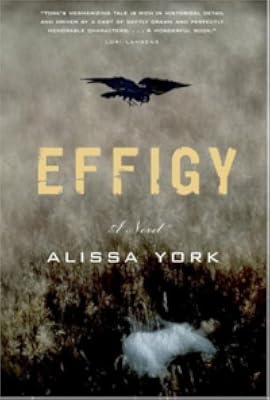
Effigy
by Alissa York
On This Page
Description
A stunning novel of loss, memory, despair and deliverance by one of Canada's best young fiction writers, set on a Mormon ranch in nineteenth-century Utah. Dorrie, a shock-pale child with a mass of untameable black hair, cannot recall anything of her life before she recovered from an illness at seven. A solitary child, she spends her spare time learning the art of taxidermy, completely fascinated by the act of bringing new and eternal life to the bodies of the dead. At fourteen, her parents show more marry her off to Erastus Hammer, a polygamous horse breeder and renowned hunter, who does not want to bed her. The role he has in mind for his fourth and youngest wife is creator of trophies of his most impressive kills, an urgent desire in him as he is slowly going blind. Happy to be given this work, Dorrie secludes herself in her workshop, away from Mother Hammer's watchful eyes and the rivalry between the elder wives. But as the novel opens, Hammer has brought Dorrie his latest kills, a family of wolves, and for the first time in her short life she struggles with her craft, dreaming each night of crows and strange scenes of violence. The new hand, Bendy Drown, is the only one to see her dilemma and to offer her help, a dangerous game in a Mormon household. Outside, a lone wolf prowls the grounds looking for his lost pack, and his nighttime searching will unearth the tensions and secrets of this complicated and conflicted family. Inspired by the real events of the Mountain Meadows Massacre in 1857, Alissa York blends fact with fiction in a haunting story of a family separated by secrets and united by faith. show lessTags
Recommendations






Member Recommendations
Member Reviews
Set on a Mormon ranch in 19th century Utah, this multi-faceted, vignette-styled story is a dense, complicated and rewarding read, at least for this reader. Inspired by the real events of the Mountain Meadows Massacre of 1857, York's story is a complicated weave of the hard scrabble of western settlement, the harm inflicted through religious righteousness, and the impact of settlement on the lives of the original people of the land. Dense topics are wound through this story that, at is center, is a story of a polygamous family. As York passes the narrator baton from character to character - including Dorrie's mom in the form of letters written to her daughter and a raven/crow that haunts Dorrie's dreams - we come to learn the horrifying show more details of the 1857 massacre and uncover various secrets each character conceals.
Personally, I loved this story for its evocative, lyrical style and the depth to which York bears open her characters. Yes, with the story continually shifting between 10 narrators, it never settles for too long on one character or point of view. Thankfully, York gives her characters very unique personalities and passions, making them memorable. The story also conveys a fair bit of detail about taxidermy, raising silkworms and horse breeding. If that is not enough, the details about the Hammer ranch hand John James "Bendy" Drown's experiences as an abandoned child in gold-rush era San Francisco to contortionist with a traveling circus and then rider with the Pony Express, while fascinating - left this reader wondering if York was trying to cram too much into one story. Sadly, the ending came off rather rushed and left me unsatisfied after such a brilliant lead up. I can see why this book was a finalist (but not winner) for the 2007 Giller Prize.
Overall, a well researched and beautifully written story that, while complicated and at time dense with information, give a very evocative experience of 19th century Utah ranch life. show less
Personally, I loved this story for its evocative, lyrical style and the depth to which York bears open her characters. Yes, with the story continually shifting between 10 narrators, it never settles for too long on one character or point of view. Thankfully, York gives her characters very unique personalities and passions, making them memorable. The story also conveys a fair bit of detail about taxidermy, raising silkworms and horse breeding. If that is not enough, the details about the Hammer ranch hand John James "Bendy" Drown's experiences as an abandoned child in gold-rush era San Francisco to contortionist with a traveling circus and then rider with the Pony Express, while fascinating - left this reader wondering if York was trying to cram too much into one story. Sadly, the ending came off rather rushed and left me unsatisfied after such a brilliant lead up. I can see why this book was a finalist (but not winner) for the 2007 Giller Prize.
Overall, a well researched and beautifully written story that, while complicated and at time dense with information, give a very evocative experience of 19th century Utah ranch life. show less
Effigy is a historical novel about a polygamous Mormon family living on a Utah farm during the nineteenth century. Although larger historical events play a role in the story (particularly the Mountain Meadows Massacre of 1857), the focus remains firmly on Erastus Hammer and his four wives. York creates distinct identities and voices for Erastus, each of his four wives, his eldest son, and two of the farm workers. As the story unfolds, the point of view shifts subtly from character to character, revealing to the reader the larger picture that is hidden from the individual characters. While nothing changes in the family’s external world for the majority of the book, the inner turmoil revealed by the ever-shifting perspectives keeps the show more story moving. The only real action occurs at the very end of the book, but when it happens, it seems like the inevitable outcome of the combined forces and frictions built up over time. At its core, Effigy explores the link between actions and their consequences, hinting at a greater power that metes out deserved outcomes based on prior decisions.
York’s prose is poetic and oblique, requiring careful attention to glean its full meaning. This passage, describing one the Tracker’s perceived encounters with his dead wife, is indicative of York’s complex style:
"She came to him for the first time then, his whirlwind wife, cool and drilling in the runnel of his spine. He knew her instantly, and the knowing nearly choked him with grief. Whether it was jealousy or something finer that had summoned her, the Tracker couldn’t know. Sorrow, perhaps, or rage at having been forgotten, even for a moment, when she was barely six moons gone. He reached behind him with both hands to comfort her. Felt a shock like mountain runoff and then she was gone."
The above passage is written in the voice of the Tracker, a Native American employed by Erastus to help with hunting game for the family’s table. Seemingly without effort, York employs a different voice for each of the eight primary characters. The below passage captures Erastus’s voice, which is brasher and less sensitive than the Tracker’s:
"He’s a Missourian born and bred, the cruelest persecutors of God’s people thus far. Never mind how he hated that river-soaked swatch of land. Not the river itself, though, the silty Grand muscling its way through his childhood, calling out to him from its catfishy snags. He only rarely penetrated its depths. He was too busy coughing up yellow batter in the Hammer Gristmill, or getting bitten raw by mosquitoes when he was lucky enough to work outside."
York masterfully weaves these diverse voices and plot lines together to create a dark and beautifully crafted novel.
This review also appears on my literary blog Literary License. show less
York’s prose is poetic and oblique, requiring careful attention to glean its full meaning. This passage, describing one the Tracker’s perceived encounters with his dead wife, is indicative of York’s complex style:
"She came to him for the first time then, his whirlwind wife, cool and drilling in the runnel of his spine. He knew her instantly, and the knowing nearly choked him with grief. Whether it was jealousy or something finer that had summoned her, the Tracker couldn’t know. Sorrow, perhaps, or rage at having been forgotten, even for a moment, when she was barely six moons gone. He reached behind him with both hands to comfort her. Felt a shock like mountain runoff and then she was gone."
The above passage is written in the voice of the Tracker, a Native American employed by Erastus to help with hunting game for the family’s table. Seemingly without effort, York employs a different voice for each of the eight primary characters. The below passage captures Erastus’s voice, which is brasher and less sensitive than the Tracker’s:
"He’s a Missourian born and bred, the cruelest persecutors of God’s people thus far. Never mind how he hated that river-soaked swatch of land. Not the river itself, though, the silty Grand muscling its way through his childhood, calling out to him from its catfishy snags. He only rarely penetrated its depths. He was too busy coughing up yellow batter in the Hammer Gristmill, or getting bitten raw by mosquitoes when he was lucky enough to work outside."
York masterfully weaves these diverse voices and plot lines together to create a dark and beautifully crafted novel.
This review also appears on my literary blog Literary License. show less
 This review was written for LibraryThing Early Reviewers.
Set on a ranch in Utah in the 19th century, Effigy is the story of . . . well, I found it to be such a jumble that I'm not really sure what it's about. I've actually written several descriptions here and then erased them. I'll just say it's about a polygamous Mormon family where the youngest wife is a taxidermist (and more interesting to me, but not a focus, another wife raises silkworms).
Effigy was shortlisted for the Giller Prize and nominated for the IMPAC Dublin award. My sister-in-law loved this book, and it has very strong reviews here at LT.
Unfortunately, Effigy didn't work for me at all. I often enjoy non-linear novels, but this one pushed that technique too far. The story jumped between a large number of characters, and then show more jumped again by telling each character's story in non-chronological order. This made it very difficult to connect with the characters or settle in to the book. To exacerbate this problem, York writes a flowery, poetic style that seemed to try to obscure the meaning of sentences for no reason than to be arty. Between the disjointed timeline, the quick switches between characters, and the trying-to-hard language, Effigy was too choppy to enjoy. As Publisher's Weekly says, "Ungainly florid prose and a plodding narrative mar York's latest."
Rating: Disappointed. show less
Effigy was shortlisted for the Giller Prize and nominated for the IMPAC Dublin award. My sister-in-law loved this book, and it has very strong reviews here at LT.
Unfortunately, Effigy didn't work for me at all. I often enjoy non-linear novels, but this one pushed that technique too far. The story jumped between a large number of characters, and then show more jumped again by telling each character's story in non-chronological order. This made it very difficult to connect with the characters or settle in to the book. To exacerbate this problem, York writes a flowery, poetic style that seemed to try to obscure the meaning of sentences for no reason than to be arty. Between the disjointed timeline, the quick switches between characters, and the trying-to-hard language, Effigy was too choppy to enjoy. As Publisher's Weekly says, "Ungainly florid prose and a plodding narrative mar York's latest."
Rating: Disappointed. show less
This is a lovely novel, set on a Mormon ranch in Utah in 1867 -- with numerous flashbacks giving us the background on the interesting, complicated characters. The center is the family of Erastus Hammer, a horse dealer and avid hunter who is losing his vision. He has four wives, the youngest of whom he married for her taxidermy skills. Besides Erastus and his wives, we get the stories of his oldest son, his Native American employee (called Tracker) whom Hammer pays to shoot the prey he wants but can no longer sight (although Hammer still claims credit), and his new farmhand, a doublejointed young man who has worked as a contortionist and stable boy. There's a lot going on, a lot of it tracing back to the Mountain Meadows Massacre (an show more actual historical event) but the story unfolds beautifully. show less
This review was written for LibraryThing Early Reviewers.While cruising the stacks at the local library, I ran across 'Effigy' by Alissa York. I was immediately drawn to the cover and pleased to see it was a Giller Prize finalist. Historical fiction - inspired by the Mountain Meadows Massacre of 1857; and polygamy - very interesting subject; throw in a little weirdness with the fourth wife who spends all of her time in the barn practicing the art of taxidermy and it all should add up to a compelling read. (For those of you who commented on my Tuesday Teaser, it was a scene where Dorrie is preparing a wolf family for stuffing)
Sadly, I felt a little let down after reading this novel. Maybe I had built it up too much in my mind but I found it lacking. I didn't ever get close enough to the show more characters to care much about their experiences. Their personalities were all just too bizarre, which made it hard to think of the characters as real. There was also a lot of jumping around in the story and that tends to lose me as a reader unless there are definite separations - like different font or chapter titles that explain who is speaking. I always felt like I was finally drawn into one plot line when I was, unexpectedly tossed into another.
All in all Ms York's 'Effigy' is a dark portrayal of a strange time - maybe just a little too dark and strange. show less
Sadly, I felt a little let down after reading this novel. Maybe I had built it up too much in my mind but I found it lacking. I didn't ever get close enough to the show more characters to care much about their experiences. Their personalities were all just too bizarre, which made it hard to think of the characters as real. There was also a lot of jumping around in the story and that tends to lose me as a reader unless there are definite separations - like different font or chapter titles that explain who is speaking. I always felt like I was finally drawn into one plot line when I was, unexpectedly tossed into another.
All in all Ms York's 'Effigy' is a dark portrayal of a strange time - maybe just a little too dark and strange. show less
The book takes place in Utah ten years after the Mountain Meadows massacre, around which it loosely revolves. All the characters in the book, members of a large, well-to-do polygamous Mormon family, are in some way connected to it.
The family is headed by a 50 year old Erastus Hammer, and consists of him and his four wives, the youngest of whom, Dorrie, is a teenager and an avid taxidermist- the producer of the title’s effigies. The remaining three are of different age, backgrounds, interests and dispositions. The big family is complete with a brood of children, a Native American man, and a contortionist and a horse whisperer. There is no fondness in the family; nobody really gets along with anybody else, but iron discipline is kept show more by the matriarch- the oldest wife, Ursula.
As the book progresses, the events of the Mountain Meadows massacre are presented as snatches of memories, reminiscences, dreams, pieced together as experienced by different participants. The events, which became one of blackest pages in the Mormon history, involved a mass slaughter of innocent and unsuspecting immigrants going to California in a wagon train by the local Mormon militia in September 1857, and became later known as the Mtn Meadows Massacre. All adults and older children from the convoy, around one hundred and twenty of them, were slain and their belongings looted. Seventeen younger children were spared and given to Mormon families in the area, and most of them were later reclaimed by their families. The Mormon militias were disguised as Native Americans, whom they subsequently blamed for the attack. The carnage was atrocious- human skeletons, dismembered bodies and bones scattered by wolves were left unburied for days.
We learn about it all through the retrospect memories of all the characters who are interesting and varied and presented with great detail. The language is quite beautiful and the scenes very evocative and well done. Yet, the book fails in one respect. For the most of it there is no plot. It somehow doesn’t progress beyond introduction for more than nine tenths of it. We are constantly presented with backgrounds to characters, and then more characters, and then more background. The plot occupies the last tenth of the book, and that’s probably not enough. Consequently, at no point, save for the last twenty pages or so, did I feel compelled to go on with it. show less
The family is headed by a 50 year old Erastus Hammer, and consists of him and his four wives, the youngest of whom, Dorrie, is a teenager and an avid taxidermist- the producer of the title’s effigies. The remaining three are of different age, backgrounds, interests and dispositions. The big family is complete with a brood of children, a Native American man, and a contortionist and a horse whisperer. There is no fondness in the family; nobody really gets along with anybody else, but iron discipline is kept show more by the matriarch- the oldest wife, Ursula.
As the book progresses, the events of the Mountain Meadows massacre are presented as snatches of memories, reminiscences, dreams, pieced together as experienced by different participants. The events, which became one of blackest pages in the Mormon history, involved a mass slaughter of innocent and unsuspecting immigrants going to California in a wagon train by the local Mormon militia in September 1857, and became later known as the Mtn Meadows Massacre. All adults and older children from the convoy, around one hundred and twenty of them, were slain and their belongings looted. Seventeen younger children were spared and given to Mormon families in the area, and most of them were later reclaimed by their families. The Mormon militias were disguised as Native Americans, whom they subsequently blamed for the attack. The carnage was atrocious- human skeletons, dismembered bodies and bones scattered by wolves were left unburied for days.
We learn about it all through the retrospect memories of all the characters who are interesting and varied and presented with great detail. The language is quite beautiful and the scenes very evocative and well done. Yet, the book fails in one respect. For the most of it there is no plot. It somehow doesn’t progress beyond introduction for more than nine tenths of it. We are constantly presented with backgrounds to characters, and then more characters, and then more background. The plot occupies the last tenth of the book, and that’s probably not enough. Consequently, at no point, save for the last twenty pages or so, did I feel compelled to go on with it. show less
Effigy is set in Utah, primarily in 1867. It tells the story of a Mormon household: Erastus Hammer, his four wives, six children, hired man and Indian guide. It is a story about family secrets, love, betrayal and loss.
The characters are all wonderfully developed. Erastus is losing his sight and wants to preserve his hunting "trophies". This is why he marries, as his fourth wife, 14-year-old Dorrie: she is an exceptional taxidermist. Dorrie comes from a troubled past and has no memory of the first seven years of her life. The third wife is Erastus's favourite: an actress who refuses to integrate with the family until she becomes involved with the eldest son, Lal. Lal covets the second wife, Ruth, who is the natural mother of his five show more siblings. The first wife, Ursula, runs the household and raises the children.
The hired man, Bendy Drown, also has a powerful back story and he comes to the aid of Dorrie when she struggles to continue her assigned role.
And the Indian guide, Tracker, faces his own dilemmas of dealing with loss.
This is a powerful story of faith and faithfulness. Excellent. show less
The characters are all wonderfully developed. Erastus is losing his sight and wants to preserve his hunting "trophies". This is why he marries, as his fourth wife, 14-year-old Dorrie: she is an exceptional taxidermist. Dorrie comes from a troubled past and has no memory of the first seven years of her life. The third wife is Erastus's favourite: an actress who refuses to integrate with the family until she becomes involved with the eldest son, Lal. Lal covets the second wife, Ruth, who is the natural mother of his five show more siblings. The first wife, Ursula, runs the household and raises the children.
The hired man, Bendy Drown, also has a powerful back story and he comes to the aid of Dorrie when she struggles to continue her assigned role.
And the Indian guide, Tracker, faces his own dilemmas of dealing with loss.
This is a powerful story of faith and faithfulness. Excellent. show less
Members
- Recently Added By
Author Information
8 Works 425 Members
Awards and Honors
Awards
Common Knowledge
- Original publication date
- 2007
- Epigraph
- There are sins that can be atoned for by an offering made upon an altar, as in ancient days, and there are sins that the blood of a lamb, of a calf, or of turtle doves, cannot remit, but they must be atoned for by the blood o... (show all)f the man.
--Brigham Young, Journal of Discourses, Vol. 4
How I would like to believe in tenderness--
The face of the effigy, gentled by candles,
Bending, on me in particular, its mild eyes.
--Sylvia Plath, "The Moon and the Yew Tree" - Dedication
- for my father, Allen,
and as always
for Clive - First words
- She's been looking out for them since the sun still hung over the Stansbury Range.
- Blurbers
- Lansens, Lori; Stenson, Fred
Classifications
- Genres
- Fiction and Literature, General Fiction, Historical Fiction
- DDC/MDS
- 813.54 — Literature & rhetoric American literature in English American fiction in English 1900-1999 1945-1999
- LCC
- PR9199.3 .Y523 .E34 — Language and Literature English English Literature English literature: Provincial, local, etc.
- BISAC
Statistics
- Members
- 207
- Popularity
- 158,323
- Reviews
- 9
- Rating
- (3.49)
- Languages
- Dutch, English, French, Italian
- Media
- Paper, Ebook
- ISBNs
- 10
- ASINs
- 2