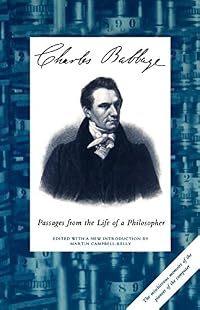
Passages from the Life of a Philosopher
by Charles Babbage
On This Page
Description
The mathematician and engineer Charles Babbage (1791-1871) is best remembered for his 'calculating machines', which are considered the forerunner of modern computers. Over the course of his life he wrote a number of books based on his scientific investigations, but in this volume, published in 1864, Babbage writes in a more personal vein. He points out at the beginning of the work that it 'does not aspire to the name of autobiography', though the chapters sketch out the contours of his life, show more beginning with his family, his childhood and formative years studying at Cambridge, and moving through various episodes in his scientific career. However, the work also diverges into his observations on other topics, as indicated by chapter titles such as 'Street Nuisances' and 'Wit'. Babbage's colourful recollections give an intimate portrait of the life of one of Britain's most influential inventors. show lessTags
Recommendations










Member Reviews
Charles Babbage seems like a pretty exciting guy. 19th century scientist, mathematician, inventor, and bitter enemy of street musicians.
I was drawn to this autobiography after reading the "comic book" (it's so much more than a comic book) "The Thrilling Adventures of Lovelace and Babbage." It's very satisfying to make the connections between Babbage's own account of himself and the beautifully imagined drawings of Sydney Padua, the comic illustrator.
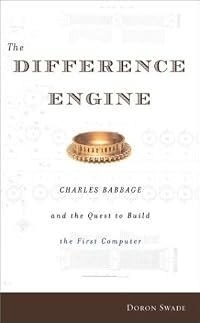
Charles Babbage (and his friend Ada Lovelace) did a lot of work on the Difference Engine and the Analytical Engine, devices that we would recognize as early computers. Only, they were about 100 years before their time, so everything they worked on was mechanical, not electrical, and mostly show more just existed in theory. Still, pretty awesome.
But there's more to Babbage than just that. He's fascinatingly all over the place. One chapter he is DEMOLISHING the Trinity doctrine (he thinks the people who formalized it were either having a huge joke, or else drunk), the next chapter he's communing with the spirit of a block of cheese. (Literally, these are adjoining chapters.)
He has himself lowered into an Italian volcano and times how long he can poke around before the next eruption. He is kind of in love with a dancing automaton and dresses her with all the care of a young girl with her first Barbie. Etc., etc., etc.
Now, honestly, there were dull bits, and I did skim some of the machine and math talk. But overall I enjoyed this pretty well. I'd like to meet this charming madman. He lived vigorously. show less
I was drawn to this autobiography after reading the "comic book" (it's so much more than a comic book) "The Thrilling Adventures of Lovelace and Babbage." It's very satisfying to make the connections between Babbage's own account of himself and the beautifully imagined drawings of Sydney Padua, the comic illustrator.
Charles Babbage (and his friend Ada Lovelace) did a lot of work on the Difference Engine and the Analytical Engine, devices that we would recognize as early computers. Only, they were about 100 years before their time, so everything they worked on was mechanical, not electrical, and mostly show more just existed in theory. Still, pretty awesome.
But there's more to Babbage than just that. He's fascinatingly all over the place. One chapter he is DEMOLISHING the Trinity doctrine (he thinks the people who formalized it were either having a huge joke, or else drunk), the next chapter he's communing with the spirit of a block of cheese. (Literally, these are adjoining chapters.)
He has himself lowered into an Italian volcano and times how long he can poke around before the next eruption. He is kind of in love with a dancing automaton and dresses her with all the care of a young girl with her first Barbie. Etc., etc., etc.
Now, honestly, there were dull bits, and I did skim some of the machine and math talk. But overall I enjoyed this pretty well. I'd like to meet this charming madman. He lived vigorously. show less
A decent book, but nothing too out of the ordinary. I was not wowed or surprised by any of its contents.
Nevertheless, not bad.
Nevertheless, not bad.
Delightful chapters interspersed with some gnatterings about local body politics.
Ratings
Members
- Recently Added By
Lists

Books in the bibliography of Godel, Escher, Bach by Douglas Hofstadter
97 works; 3 members

Works referenced in The Turk by Tom Standage
37 works; 1 member
Author Information

35 Works 259 Members
Mathematician, inventor, and prolific writer, Charles Babbage is best known for his conception of the first automatic digital computer. He was born in England in 1791 and educated in mathematics at Cambridge University. Babbage helped found the British Analytical Society, which aimed at incorporating European developments into English mathematics. show more From the time he was a student, Babbage was drawn to the idea of mechanizing the production of values in mathematical tables. His difference engine of 1822 was to be an all-purpose calculating machine. Although he received government funding to build a large-scale working model of the difference engine, the project never was completed. By 1834 he had developed his ideas for an analytical engine, a computing device consisting of a processing area of wheels and racks, called a mill, for the calculation of decimals. Borrowing the idea of the punch card from the Jacquard mill, he proposed the use of separate card sets, one for controlling procedures and one for storing information that would make the engine "programmable." Lady Lovelace, the daughter of Lord Byron might have contributed some programming ideas. P> Babbage's analytic engine was never successfully built. Although his design was forgotten until his unpublished notebooks were discovered in 1937, his intellectual distinction is that he was the first person to plan a flexible modern mechanical computing device. (Bowker Author Biography) show less
Common Knowledge
- Canonical title
- Passages from the Life of a Philosopher
- Original publication date
- 1864
- People/Characters
- Charles Babbage
- Epigraph
- "I'm a philosopher. Confound them all—
Birds, beasts, and men; but no, not womankind."—Don Juan
"I now gave my mind to philosophy: the great object of my ambition was to make out a complete system of the universe, including and comprehending the origin, causes, consequences, and termination of all things. Instead of cou... (show all)ntenance, encouragement, and applause, which I should have received from every one who has the true dignity of an oyster at heart, I was exposed to calumny and misrepresentations. While engaged in my great work on the universe, some even went so far as to accuse me of infidelity;—such is the malignity of oysters."—"Autobiography of an Oyster" deciphered by the aid of photography in the shell of a philosopher of that race,—recently scalloped. - Dedication
- TO VICTOR EMMANUEL II, KING OF ITALY
Sire,
In dedicating this volume to your Majesty, I am also doing an act of justice to the memory of your illustrious father.
In 1840, the King, Charles Albert, invited the lea... (show all)rned of Italy to assemble in his capital. At the request of her most gifted analyst, I brought with me the drawings and explanations of the Analytical Engine. These were thoroughly examined and their truth acknowledged by Italy's choicest sons.
To the King, your father, I am indebted for the first public and official acknowledgement of this invention.
I am happy in thus expressing my deep sense of that obligation to his son, the Sovereign of united Italy, the country of Archimedes and of Galileo.
I am, Sire,
With the highest respect,
Your Majesty's faithful servant,
CHARLES BABBAGE - First words
- Some men write their lives to save themselves from ennui, careless of the amount they inflict on their readers.
Classifications
Statistics
- Members
- 78
- Popularity
- 404,793
- Reviews
- 3
- Rating
- (3.60)
- Languages
- English, German, Italian
- Media
- Paper, Audiobook, Ebook
- ISBNs
- 15
- ASINs
- 6