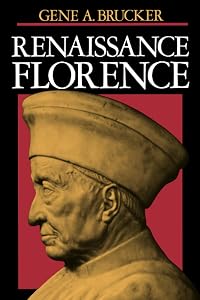
Renaissance Florence
by Gene A. Brucker
On This Page
Description
In the fourteenth and fifteenth centuries, the city of Florence experienced the most creative period in her entire history. This book is an in-depth analysis of that dynamic community, focusing primarily on the years 1380-1450 in an examination of the city's physical character, its economic and social structure and developments, its political and religious life, and its cultural achievement. For this edition, Mr. Brucker has added Notes on Florentine Scholarship and a Bibliographical Supplement.Tags
Recommendations



















Member Reviews
Renaissance Florence is a solid and very readable synthesis of one of the great cities. Drawing on post-war scholarship, and his own PhD work in the archivio de stato, Brucker describes the city in terms of its daily life, dipping through personal letters, business ledgers, and official pronouncements to render the proud and industrious people of Florence at a time when they were the leading city in Europe.
Renaissance Florence was a densely packed urban warren. The city's wealth came from mastery of cloth manufacture, which became the foundation of a European mercantile and banking network. Social life was defined by dense ties between classes, ranging from living on the same street, to rents and patronage, to the complexities of the show more largely unincorporated laborers and farmers, to the twenty one official guilds and their control of public offices, to the wealthy magnate families who dominated the apex of power but were officially banned from office. It's a complex web who's form shifted a lot over the nearly 200 years covered by the book, but out of this arose the scholarship and artistic creativity that birthed the renaissance. Conversely, the 14th century was also a dark time for the city, marked by the Black Death, recurrent war, and economic stagnation. It's odd that this period, in many ways objectively less prosperous than the ones that preceded and followed it, came to be the Renaissance.
Brucker has a keen awareness for social history, and for the ways in which his sources are representative or unrepresentative of their larger community. He gently chides Marxists for trying to fit the Florentines into a strictly orthodox structure of revolutionary classes, while maintaining an awareness of how birth defined the largely conservative order of his subjects world. This book would make a great major text for a undergraduate class focused on Renaissance Florence, supported by some context for the world and a few chosen primary sources. The biggest strike against it is that published in 1969, it's old, and I'm not sure what new scholarship has revealed. show less
Renaissance Florence was a densely packed urban warren. The city's wealth came from mastery of cloth manufacture, which became the foundation of a European mercantile and banking network. Social life was defined by dense ties between classes, ranging from living on the same street, to rents and patronage, to the complexities of the show more largely unincorporated laborers and farmers, to the twenty one official guilds and their control of public offices, to the wealthy magnate families who dominated the apex of power but were officially banned from office. It's a complex web who's form shifted a lot over the nearly 200 years covered by the book, but out of this arose the scholarship and artistic creativity that birthed the renaissance. Conversely, the 14th century was also a dark time for the city, marked by the Black Death, recurrent war, and economic stagnation. It's odd that this period, in many ways objectively less prosperous than the ones that preceded and followed it, came to be the Renaissance.
Brucker has a keen awareness for social history, and for the ways in which his sources are representative or unrepresentative of their larger community. He gently chides Marxists for trying to fit the Florentines into a strictly orthodox structure of revolutionary classes, while maintaining an awareness of how birth defined the largely conservative order of his subjects world. This book would make a great major text for a undergraduate class focused on Renaissance Florence, supported by some context for the world and a few chosen primary sources. The biggest strike against it is that published in 1969, it's old, and I'm not sure what new scholarship has revealed. show less
Orig. publ. 1969; reprinted with supplements 1983
Ratings
Members
- Recently Added By
Author Information

19+ Works 1,063 Members
Series
Belongs to Publisher Series
Common Knowledge
- Canonical title
- Renaissance Florence
- Original publication date
- 1969
- People/Characters
- Lorenzo de' Medici; Cosimo de' Medici, the Elder
- Important places
- Florence, Tuscany, Italy
- Important events
- Renaissance
- Dedication
- For MARK, WENDY and FRANCESCA and for Harriet
Classifications
Statistics
- Members
- 320
- Popularity
- 99,633
- Reviews
- 2
- Rating
- (3.98)
- Languages
- English, German
- Media
- Paper
- ISBNs
- 7
- ASINs
- 2