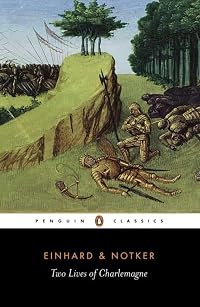
Two Lives of Charlemagne
by Einhard (Author), Notker the Stammerer (Author)
On This Page
Description
This work contains two separate biographical accounts of Charlemagne, or Charles the Great, the man considered to be the father of Europe. One account was penned by the French, medieval biographer, Einhard, who in 791 joined the royal court to serve as an epic poet, grammarian, mathematician and architect, and ultimately a confidante to the King. Einhard's work is believed to be the most accurate portrayal of Charlemagne, and perhaps more importantly, as the finest biography of its time. show more This edition also contains the highly anecdotal "life" of Charlemagne, penned by the Monk of Saint Gall, who is now commonly believed to be Notker the Stammerer. This monk, a native-German speaker, wrote the volume at the request of Charles the Fat, great-grandson of Charlemagne. Although its accuracy has been scorned by historians, several of the monk's amusing and witty tales have been revived in modern biographies of this powerful monarch. show lessTags
Recommendations






Member Reviews
This is an interesting read as you have two writers presenting their version of the life of Charlemagne. They could be called biographies but that does not seem to really characterise what that they write. The first is written by Einhard who was present in Charlemagne's reign and the second some years later by a monk named Notker the Stammerer.
Charlemagne also known as Charles the Great or Charles I, was the King of the Franks from 768, the King of Italy from 774, and from 800 the first emperor in western Europe since the collapse of the Western Roman Empire three centuries earlier. The expanded Frankish state he founded is called the Carolingian Empire.
Charlemagne was the oldest son of Pepin the Short and Bertrada of Laon and was show more initially co-ruler with his brother Carloman I. Carloman's sudden death in 771 under unexplained circumstances left Charlemagne as the undisputed ruler of the Frankish Kingdom. Charlemagne continued his father's policy towards the papacy and became its protector, removing the Lombards from power in northern Italy, and leading an incursion into Muslim Spain. He also campaigned against the peoples to his east, Christianizing them upon penalty of death, at times leading to events such as the Massacre of Verden. Charlemagne reached the height of his power in 800 when he was crowned as "Emperor" by Pope Leo III on Christmas Day at Old St. Peter's Basilica.
That is the historical side of Charlemagne and a bit droll. Mind you Einhard is extremely droll in his explantion and you have no sense of who the King was. Notker does not provide any real insight into Charlemagne either but his anecdotes about priests and bishops in the order is the best parts.
What I found really interesting was both author's focus was on Charlemagne's pious nature and his work for the Church, anytime there was an incident that cast doubt on his character the behaviour was blamed on the influence of a woman.
Both documents expose no fault in Charlemagne's character and he is almost portrayed as a Saint.
I enjoyed the read and I am always amazed that these words exist after all these years. show less
Charlemagne also known as Charles the Great or Charles I, was the King of the Franks from 768, the King of Italy from 774, and from 800 the first emperor in western Europe since the collapse of the Western Roman Empire three centuries earlier. The expanded Frankish state he founded is called the Carolingian Empire.
Charlemagne was the oldest son of Pepin the Short and Bertrada of Laon and was show more initially co-ruler with his brother Carloman I. Carloman's sudden death in 771 under unexplained circumstances left Charlemagne as the undisputed ruler of the Frankish Kingdom. Charlemagne continued his father's policy towards the papacy and became its protector, removing the Lombards from power in northern Italy, and leading an incursion into Muslim Spain. He also campaigned against the peoples to his east, Christianizing them upon penalty of death, at times leading to events such as the Massacre of Verden. Charlemagne reached the height of his power in 800 when he was crowned as "Emperor" by Pope Leo III on Christmas Day at Old St. Peter's Basilica.
That is the historical side of Charlemagne and a bit droll. Mind you Einhard is extremely droll in his explantion and you have no sense of who the King was. Notker does not provide any real insight into Charlemagne either but his anecdotes about priests and bishops in the order is the best parts.
What I found really interesting was both author's focus was on Charlemagne's pious nature and his work for the Church, anytime there was an incident that cast doubt on his character the behaviour was blamed on the influence of a woman.
Both documents expose no fault in Charlemagne's character and he is almost portrayed as a Saint.
I enjoyed the read and I am always amazed that these words exist after all these years. show less
Sure, I could have googled and learned the 'facts' about Charlemagne in about 5 minutes; but then I wouldn't have found the pleasure in reading about greedy monks or stupid nobles being embarrassed in front of the court, ha ha; nor would I have learned how Charlemagne chastized his soldiers for wearing wimpy Gallic cloaks in favor of the superior Frankish sort ("What is the use of these little napkins?.... When I go off to empty my bowels, I catch cold because my backside is frozen!"). Did you know that Charlemagne had a pet elephant named Abu-l-Abbas, received as a gift from the king of Persia?
Read the rest of my review of Two Lives of Charlemagne on my blog, The Nerd is the Word.
show more target="_top">http://nerdword.blogspot.com/2006/07/26-two-lives-of-charlemagne.html show less
Read the rest of my review of Two Lives of Charlemagne on my blog, The Nerd is the Word.
show more target="_top">http://nerdword.blogspot.com/2006/07/26-two-lives-of-charlemagne.html show less
This small volume contains two biographies of Charlemagne, one by a man who knew him, the other written within 100 years of his death. The translated biographies are interesting for their style, attitudes and anecdotes. The commentary points out when the biographies make factual errors or omissions and the sources of some of the references to sources like the Bible or the Aeneid. The personalities of both writers and of the translator come through, which I sometimes found amusing and sometimes found annoying.
Penguin Books’ Two Lives of Charlemagne collects Einhard’s Vita Karoli Magni (Life of Charles the Great), written between 817-833 CE, and the Gesta Karoli (“deeds of Charlemagne”) written by the Monk of Saint Gall in the 880s, whom scholars believe to be Notker the Stammerer. Charlemagne lived between 2 April 748 and 28 January 814, and was King of the Franks from 768, King of the Lombards from 774, and the Holy Roman Emperor from 800, uniting most of Western Europe for the first time since the fall of the Roman Empire in 476.
Einhard sought to evoke classical works, specifically Suetonius’s Lives of the Caesars. He worked in Charlemagne’s court and so had good knowledge of his source, drawing upon first-hand accounts while show more using his book to promote education. Unlike other biographies from the Middle Ages that focus on their subjects’ good deeds, scholars such as F.A. Ogg (1907) and Thomas Hodgkin (1897) consider the work a faithful account and a starting point for modern biographers.
Notker wrote his account of Charlemagne’s life for Charles III, known as “The Fat,” the great-grandson of Charlemagne who visited Gall in 833. The work demonstrates the effect of that patronage, as Charles III sought to emulate his great-grandfather, even modeling his palace at Sélestate in Alsace after Charlemagne’s Palace at Aachen. Notker’s work compiles anecdotes of Charlemagne rather than attempt to offer a proper biography, invoking the virtues of Charlemagne in order to please his patron. At times, he cites nonexistent sources or mistakes dates, using parables to teach lessons while criticizing the pride of high-born bishops.
Taken together, the two biographies offer insight into the Middle Ages as well as the process of historical writing at this time. They resemble Plutarch’s Roman Lives or some other European sagas, like that of Egil or Snorri Sturluson’s saga of King Harald. Historians and classicists will find this particularly useful, but Penguin’s paperback editions also help make this history available to laypeople seeking to broaden their own reading. show less
Einhard sought to evoke classical works, specifically Suetonius’s Lives of the Caesars. He worked in Charlemagne’s court and so had good knowledge of his source, drawing upon first-hand accounts while show more using his book to promote education. Unlike other biographies from the Middle Ages that focus on their subjects’ good deeds, scholars such as F.A. Ogg (1907) and Thomas Hodgkin (1897) consider the work a faithful account and a starting point for modern biographers.
Notker wrote his account of Charlemagne’s life for Charles III, known as “The Fat,” the great-grandson of Charlemagne who visited Gall in 833. The work demonstrates the effect of that patronage, as Charles III sought to emulate his great-grandfather, even modeling his palace at Sélestate in Alsace after Charlemagne’s Palace at Aachen. Notker’s work compiles anecdotes of Charlemagne rather than attempt to offer a proper biography, invoking the virtues of Charlemagne in order to please his patron. At times, he cites nonexistent sources or mistakes dates, using parables to teach lessons while criticizing the pride of high-born bishops.
Taken together, the two biographies offer insight into the Middle Ages as well as the process of historical writing at this time. They resemble Plutarch’s Roman Lives or some other European sagas, like that of Egil or Snorri Sturluson’s saga of King Harald. Historians and classicists will find this particularly useful, but Penguin’s paperback editions also help make this history available to laypeople seeking to broaden their own reading. show less
The lives are well served by their translator. The prose seems lively, and the introduction is very informative. These lives were originally written by Einhard between 824 and 836, and by Notker in 883 84. Einhard's work was a personal memoir, as he spent at least twenty-three years in the service of the Frankish king.
Translations of two mediaeval works on the great emperor.
I just can't write a review better than the one that "a customer" wrote over at Amazon:
As the title suggests, this book reveals the incredible 'two lives' of Charlemagne. By day, Emperor of the Franks - by night, a nightclub singer in the sleazy joints of downtown Aachen.
As the title suggests, this book reveals the incredible 'two lives' of Charlemagne. By day, Emperor of the Franks - by night, a nightclub singer in the sleazy joints of downtown Aachen.
Members
- Recently Added By
Author Information

Some Editions
Series
Belongs to Publisher Series
Penguin Classics (L213)
Work Relationships
Contains
Common Knowledge
- Canonical title
- Two Lives of Charlemagne
- Original title
- Vita Karoli Magni; Gesta Karoli Magni
- Original publication date
- 829x836 (Einhard's life) (Einhard's life); 884x887 (Notker's life) (Notker's life); 1969 (Lewis Thorpe's translation) (Lewis Thorpe's translation)
- People/Characters
- Charlemagne
- Important places
- France
- Dedication
- For Adrian Thorpe
- First words
- Charles the Great, King of the Franks and later ruler of the Carolingian Empire, may at first sight seem comparable with that other famous medieval figure, Arthur of Britain, for in both cases the fictional hero into which ea... (show all)ch later developed tends to obscure the original historical personage.
Introduction.
It is generally accepted that it was Einhard who wrote this life of the most glorious Emperor Charlemagne, together with the description of the historical events which form the background to the life.
Einhard : Wal... (show all)ahfrid Strabo's prologue.
Having once made up my mind to describe the life and the day-to-day habits of Charlemagne, my lord and patron, and to write the public history of this distinguished and deservedly most famous king, I have determined to be as ... (show all)succinct as possible.
Einhard's introduction.
The Merovingian dynasty, from which the Franks were accustomed to choose their Kings, is thought to have lasted down to King Childeric III, who was deposed on the order of Stephen II, the Pope of Rome.
Einhard : Bo... (show all)ok I. The early Carolingians.
He who ordains the fate of kingdoms and the march of the centuries, the all-powerful Disposer of events, having destroyed one extraordinary image, that of the Romans, which had, it was true, feet of iron, or even feet of clay... (show all), then raised up, among the Franks, the golden head of a second image, equally remarkable, in the person of the illustrious Charlemagne.
Notker : Book I. The piety of Charlemagne and his care of the Church. - Last words
- (Click to show. Warning: May contain spoilers.)Charlemagne's son Lewis, who succeeded him by divine right, read this statement and acted upon it with complete scrupulousness as soon as he possibly could after his father's death.
(Einhard).
(Click to show. Warning: May contain spoilers.)'You can keep your lordly office,' said they, 'but . . .'
(Notker). - Publisher's editor
- Radice, Betty
- Original language
- Latin
Classifications
- Genres
- History, Nonfiction, Biography & Memoir, General Nonfiction
- DDC/MDS
- 944.010924 — History & geography History of Europe France and Monaco France Early history -987
- LCC
- DC73.32 .T45 — History of Europe, Asia, Africa and Oceania France – Andorra – Monaco History of France History By period Early and medieval to 1515 476-1328. Merovingians. Carlovingians. Capetians
- BISAC
Statistics
- Members
- 1,515
- Popularity
- 15,276
- Reviews
- 9
- Rating
- (3.58)
- Languages
- English
- Media
- Paper, Ebook
- ISBNs
- 12
- ASINs
- 24
