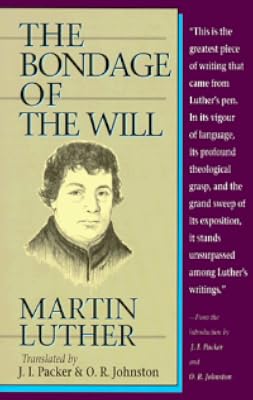
The Bondage of the Will
by Martin Luther
On This Page
Description
First published in 1525, Luther's masterpiece was written in a unique style that combines deep spirituality and humor, while powerfully displaying man's depravity and God's sovereignty. Focusing on the key issue of whether man can save himself vs. salvation being the work of divine grace, this is an essential text for understanding the primary doctrines of the Reformation. 336 pages, softcover from Hendrickson.Tags
Recommendations








Member Reviews
Luther’s, The Bondage of the Will, is a doctrinal treatise first arguing against Erasmus’ doctrine of free will, and then arguing for the Bible doctrine of the will’s bondage. Luther argues that, counter to Erasmus’ view, man is not able to freely choose Christ for his salvation. Man is enslaved in his sin and unable to act in any way towards his own salvation. Apart from divinely initiated grace, man is incapable of not only meriting salvation through his works, but of even choosing God. Luther’s style leaves little doubt as to what he believes. He argues boldly with passion and logic, first detailing the holes in Erasmus’ argument, before presenting a comprehensive response detailing Luther’s understanding of the bondage show more of the will.
Luther is direct and to the point. He doesn’t pull any punches. And he begins his argument by defending this approach. While Erasmus is critical of Luther for being overly bold in his assertions, Luther counters by stating that a true Christian delights in making assertions. Mockingly, Luther points out the problem of asserting one should make no assertions. The flow of his argument in chapter one begins with arguing that though Scripture can be read, discussed, quoted and even memorized it cannot be truly understand apart from the Spirit revealing the meaning. Then, responding to Erasmus’ charge that this subject is at best unnecessary and superfluous, and at worst incomprehensible, Luther charges that is indeed of great importance to know whether or not our salvation is contingent on our will or God’s.
Continuing deeper into this thought Luther then argues that God foreknows nothing contingently or depending on man’s choice as open theists assert today. Instead God plans and purposes all things according to his free will independent of man’s will. Further, Luther argues that if you take any other position the very promises of God are imperiled because if God’s will is dependant on what man chooses how could we trust that what He promises will come to pass. Luther concludes his first salvo with a passionate discourse responding to Erasmus’ argument that even if total depravity and election are true as Luther teaches they are liable to be misunderstood and create harmful results to the church. Luther responds that there are manifold benefits to his teaching including a humbling of man’s pride, a deepening understanding and appreciation for the grace of God, and a more accurate understanding of true Christian faith. Additionally, Luther argues that God does not force men’s wills to do evil, but that man willingly chooses sin over God and cannot choose anything else owing to his depravity unless God saves him. Luther then does not object to men having wills at all, only the term “free will” which seems to indicate a far more grandiose and powerful state of being then the Bible or observation indicate.
Luther begins his second part by arguing that even those who argue for free-will do not practice it in their relationship with God. He uses prayer as an example of this that men when praying come, not boasting of their free choice of God, but come in self-despair crying for his grace to save them. Luther than argues that if free will and the mind alone are able to discover salvation of their own strength, why didn’t the ancient Greeks who were certainly great minds and pursued truth with all that was in them, discover the true Gospel of Jesus Christ? Yet not one of them did. Their will, their search for truth, and their great minds availed them nothing towards the discovery of The Truth – Jesus Christ.
Part three begins with Luther taking issue with Erasmus’ definition of free will namely that man “may apply himself to those things that lead to eternal salvation…” Luther again declares that while certainly man has a will, calling it and defining it as free when it is actually a slave is a misnomer of the worst kind. He allows that calling man’s will a vertible-will or mutable-will would be more accurate. Luther then argues that no man apart from the Spirit of God ever understands much less longs for or believes in the salvation of Jesus Christ. Next, Luther takes up Erasmus’ argument that God would not command individuals to do something they could not do. Luther argues that God does in fact command men to do what they are unable to do with the express purpose of revealing to man his inability. He uses the example of a doctor telling a patient, who is in denial over his illness, to do something that he is physically incapable of doing to prove his weakness and need of treatment. So the law is not given because man is able to keep it or do it on his own, but to reveal to man his proud heart, sickness and need of a Savior. Continuing with this thought, Luther then argues that biblical statements that begin with “if you are willing” and the like serve not show man his ability, as Erasmus argues, but his duty. The commands of Scripture serve not to show man what he can do with the proper amount of effort, but what he ought to do, but cannot owing to his sinful flesh.
In Luther’s last section against Erasmus’ view, Luther points out where Erasmus has stretch the allowable understanding of Scripture. For example Luther points to Erasmus stating that the command to believe on Christ means “you can believe on Christ.” Or when Scripture says Pharaoh’s heart was hardened it only means “give an occasion of hardening, by not correcting the sinner at once.” These distortions are required according to Luther because of Erasmus’ insistence on free-will. Luther then addresses the issue of God being contaminated by evil if he is sovereign. If God is sovereign and man incapable of choosing righteousness, is not then God culpable for the evil in the world? Yet by faith, Luther argues, we should trust the goodness of God, understanding that though God works evil through evil men, it is man’s own bent towards evil not God’s forcing of evil upon them that produces this evil, and even this is used by God for his glory and our salvation. Luther than shows the audacity of trying to harmonize a wholly free human will with a free will of God and to deny the freedom of God’s will if it conflicts with man’s. He also states that though we cannot make it all work together, we cannot and must not deny that if God is omnipotent and if God is omniscient the doctrine of free-will is utterly destroyed. Indeed, all of Paul’s argument in Romans 9 is futile if God as the potter is not sovereign above man (the clay) and his will. Luther concludes his argument against Erasmus by stating he holds nothing personally against Erasmus, but is arguing so stridently because the cause of Christ is jeopardized by Erasmus’ argument.
Luther’s concludes his book with a positive statement of the doctrine of the bondage of the will. The basics of this argument are as follows. 1) The bible states all are sinners. No one escapes this designation. All are guilty. 2) All men according to scripture are dominated or controlled by sin, unable and unwilling even were they able to escape the corruption of sin. 3) The perfect law of God is out of reach for every man. 4) The law was given, not because man is able to do it, but to show man his sin and need and thus point him to Christ alone for his righteousness. 5) Man’s works and ability’s are totally denied as a basis for acceptance with God. Faith alone in Christ alone given by the grace of God alone is man’s only hope for salvation. Towards the end of his book Luther states that he is glad that salvation is not by his will, for if it were he could never be certain of his of salvation. But as God saves by His mercy and His grace apart from our own ability or works, we can place our trust fully on the grace of God for our salvation and eternal happiness.
Luther clearly is reacting against the claims of Erasmus. His writing is passionate and poignant. There is not a hint of political correctness in his writing. He says exactly what he thinks. Today, we often consider passion compelling, but often not logical. Like the sports fan, who says his team is the greatest though they have lost every game, we may appreciate his passion, but think him deluded by his passion. This is not the case with Luther. Though he clearly argues from a passionate, gut level, he marries his passion perfectly with reason and Biblical analysis. His view is well informed by Scripture and he repeatedly argues compellingly for God’s sovereignty and man’s bondage. Luther’s prose is intelligent, but not out of reach for the layman. His passionate rather than academic treatment of his subject creates an easy to read and compelling case for the bondage of man’s will. show less
Luther is direct and to the point. He doesn’t pull any punches. And he begins his argument by defending this approach. While Erasmus is critical of Luther for being overly bold in his assertions, Luther counters by stating that a true Christian delights in making assertions. Mockingly, Luther points out the problem of asserting one should make no assertions. The flow of his argument in chapter one begins with arguing that though Scripture can be read, discussed, quoted and even memorized it cannot be truly understand apart from the Spirit revealing the meaning. Then, responding to Erasmus’ charge that this subject is at best unnecessary and superfluous, and at worst incomprehensible, Luther charges that is indeed of great importance to know whether or not our salvation is contingent on our will or God’s.
Continuing deeper into this thought Luther then argues that God foreknows nothing contingently or depending on man’s choice as open theists assert today. Instead God plans and purposes all things according to his free will independent of man’s will. Further, Luther argues that if you take any other position the very promises of God are imperiled because if God’s will is dependant on what man chooses how could we trust that what He promises will come to pass. Luther concludes his first salvo with a passionate discourse responding to Erasmus’ argument that even if total depravity and election are true as Luther teaches they are liable to be misunderstood and create harmful results to the church. Luther responds that there are manifold benefits to his teaching including a humbling of man’s pride, a deepening understanding and appreciation for the grace of God, and a more accurate understanding of true Christian faith. Additionally, Luther argues that God does not force men’s wills to do evil, but that man willingly chooses sin over God and cannot choose anything else owing to his depravity unless God saves him. Luther then does not object to men having wills at all, only the term “free will” which seems to indicate a far more grandiose and powerful state of being then the Bible or observation indicate.
Luther begins his second part by arguing that even those who argue for free-will do not practice it in their relationship with God. He uses prayer as an example of this that men when praying come, not boasting of their free choice of God, but come in self-despair crying for his grace to save them. Luther than argues that if free will and the mind alone are able to discover salvation of their own strength, why didn’t the ancient Greeks who were certainly great minds and pursued truth with all that was in them, discover the true Gospel of Jesus Christ? Yet not one of them did. Their will, their search for truth, and their great minds availed them nothing towards the discovery of The Truth – Jesus Christ.
Part three begins with Luther taking issue with Erasmus’ definition of free will namely that man “may apply himself to those things that lead to eternal salvation…” Luther again declares that while certainly man has a will, calling it and defining it as free when it is actually a slave is a misnomer of the worst kind. He allows that calling man’s will a vertible-will or mutable-will would be more accurate. Luther then argues that no man apart from the Spirit of God ever understands much less longs for or believes in the salvation of Jesus Christ. Next, Luther takes up Erasmus’ argument that God would not command individuals to do something they could not do. Luther argues that God does in fact command men to do what they are unable to do with the express purpose of revealing to man his inability. He uses the example of a doctor telling a patient, who is in denial over his illness, to do something that he is physically incapable of doing to prove his weakness and need of treatment. So the law is not given because man is able to keep it or do it on his own, but to reveal to man his proud heart, sickness and need of a Savior. Continuing with this thought, Luther then argues that biblical statements that begin with “if you are willing” and the like serve not show man his ability, as Erasmus argues, but his duty. The commands of Scripture serve not to show man what he can do with the proper amount of effort, but what he ought to do, but cannot owing to his sinful flesh.
In Luther’s last section against Erasmus’ view, Luther points out where Erasmus has stretch the allowable understanding of Scripture. For example Luther points to Erasmus stating that the command to believe on Christ means “you can believe on Christ.” Or when Scripture says Pharaoh’s heart was hardened it only means “give an occasion of hardening, by not correcting the sinner at once.” These distortions are required according to Luther because of Erasmus’ insistence on free-will. Luther then addresses the issue of God being contaminated by evil if he is sovereign. If God is sovereign and man incapable of choosing righteousness, is not then God culpable for the evil in the world? Yet by faith, Luther argues, we should trust the goodness of God, understanding that though God works evil through evil men, it is man’s own bent towards evil not God’s forcing of evil upon them that produces this evil, and even this is used by God for his glory and our salvation. Luther than shows the audacity of trying to harmonize a wholly free human will with a free will of God and to deny the freedom of God’s will if it conflicts with man’s. He also states that though we cannot make it all work together, we cannot and must not deny that if God is omnipotent and if God is omniscient the doctrine of free-will is utterly destroyed. Indeed, all of Paul’s argument in Romans 9 is futile if God as the potter is not sovereign above man (the clay) and his will. Luther concludes his argument against Erasmus by stating he holds nothing personally against Erasmus, but is arguing so stridently because the cause of Christ is jeopardized by Erasmus’ argument.
Luther’s concludes his book with a positive statement of the doctrine of the bondage of the will. The basics of this argument are as follows. 1) The bible states all are sinners. No one escapes this designation. All are guilty. 2) All men according to scripture are dominated or controlled by sin, unable and unwilling even were they able to escape the corruption of sin. 3) The perfect law of God is out of reach for every man. 4) The law was given, not because man is able to do it, but to show man his sin and need and thus point him to Christ alone for his righteousness. 5) Man’s works and ability’s are totally denied as a basis for acceptance with God. Faith alone in Christ alone given by the grace of God alone is man’s only hope for salvation. Towards the end of his book Luther states that he is glad that salvation is not by his will, for if it were he could never be certain of his of salvation. But as God saves by His mercy and His grace apart from our own ability or works, we can place our trust fully on the grace of God for our salvation and eternal happiness.
Luther clearly is reacting against the claims of Erasmus. His writing is passionate and poignant. There is not a hint of political correctness in his writing. He says exactly what he thinks. Today, we often consider passion compelling, but often not logical. Like the sports fan, who says his team is the greatest though they have lost every game, we may appreciate his passion, but think him deluded by his passion. This is not the case with Luther. Though he clearly argues from a passionate, gut level, he marries his passion perfectly with reason and Biblical analysis. His view is well informed by Scripture and he repeatedly argues compellingly for God’s sovereignty and man’s bondage. Luther’s prose is intelligent, but not out of reach for the layman. His passionate rather than academic treatment of his subject creates an easy to read and compelling case for the bondage of man’s will. show less
June 2016 - It is a privilege to have the John Owen Centre (now The Pastors Academy) so near at hand and once again this week I was able to take advantage of what is on offer there. First there was the regular reading group (called the Theological Study Group) - one of the oldest elements in the centre's history. This time around the set book was Bondage of the will by Martin Luther. As it turned out, the person originally slated to lead us in discussion had to drop out and several others were unable to make it for various reasons and so I was leading a group of just three. That limited things a little but not over much and it was good to learn the impressions that others had gained. We were all glad to have read it, knowing its show more significance. We agreed that it is not an easy read (though the Packer translation clearly is a great help) and that Luther's style would be very unusual today. It was good, however, to see how he slices through Erasmus's semi-pelagianism so effectively.
There was a Greek study day the next day led by my fellow elder Robert Strivens on Philippians. show less
There was a Greek study day the next day led by my fellow elder Robert Strivens on Philippians. show less
Read this book for our book club, the Dead Theologians Society. Luther’s defining work on free-will. This book is a response to Erasmus’ work on Free Will, which Luther contends is completely wrong. This is his response. This is at a time in history when the Catholic Church was selling indulgences, and had taught everyone that they had to do things to earn their salvation. Luther argued against this, going through many verses in scripture to show that we can do nothing to earn our salvation, rather it is a gift from God.
Luther takes this to the extreme, even arguing that we do not have free-will to accept God’s offer of salvation, pointing to the idea of the elect and predestination. I’m having a hard to taking it to that show more degree, but he makes some excellent points, and overall I can see this being a great retort to the Catholic Church’s teaching of the day. show less
Luther takes this to the extreme, even arguing that we do not have free-will to accept God’s offer of salvation, pointing to the idea of the elect and predestination. I’m having a hard to taking it to that show more degree, but he makes some excellent points, and overall I can see this being a great retort to the Catholic Church’s teaching of the day. show less
Luther is writing this as a response to Erasmus, who was a well known humanist scholar. Erasmus decided to stay within the Roman Catholic church. Erasmus wants Luther to see the ramifications of saying, "there is no free will." However, Luther forcefully counters all the polemics made by Erasmus.
He says, everything is by God and if he is omniscient, his immutable will shall prevail no matter what. I could really feel Luther's caustic words. He quotes a lot of scriptures and simply shows that it does not support free will. It only says, "What ought to be done, not what can be done."
Luther is forceful, persuasive and writes in an abrasive tone. He had struggled with sin, even though he knew Christ died for his sins, He kept confessing show more and confessing. He felt horrible inside as he knew that he was not good enough, he tried everything to get rid of sin. It simply did not work, it won't work. It can be fought by the Spirit of God ––Romans 8:13.
Finally, It was an epiphany when he found his answer in the book of Ephesians, "By Grace you have been saved and not by works, so that no one can boast."
On Sovereignty of God,
Luther says, "That God foreknows nothing by contingency, but that he foresees, purposes and does all things according to his immutable, eternal and infallible will. By this thunderbolt, Free-will is thrown prostrate and utterly dashed to pieces. Those, therefore, who would assert Free will, must either deny this thunderbolt, or pretend not to see it, or push it from them."
In Bondage of the Will, Luther simply settles that Everything is by God and for his Glory.Nothing can be done by Man and if it is from Man, then it will be from the flesh. Whatever your position be in this topic, I would advise to be loving, gentle, warm and friendly. It seems that within the church, there's a lot of animosity, division as a result of this. A good book, I would recommend it to all Christians.
––Deus Vult––
Gottfried show less
He says, everything is by God and if he is omniscient, his immutable will shall prevail no matter what. I could really feel Luther's caustic words. He quotes a lot of scriptures and simply shows that it does not support free will. It only says, "What ought to be done, not what can be done."
Luther is forceful, persuasive and writes in an abrasive tone. He had struggled with sin, even though he knew Christ died for his sins, He kept confessing show more and confessing. He felt horrible inside as he knew that he was not good enough, he tried everything to get rid of sin. It simply did not work, it won't work. It can be fought by the Spirit of God ––Romans 8:13.
Finally, It was an epiphany when he found his answer in the book of Ephesians, "By Grace you have been saved and not by works, so that no one can boast."
On Sovereignty of God,
Luther says, "That God foreknows nothing by contingency, but that he foresees, purposes and does all things according to his immutable, eternal and infallible will. By this thunderbolt, Free-will is thrown prostrate and utterly dashed to pieces. Those, therefore, who would assert Free will, must either deny this thunderbolt, or pretend not to see it, or push it from them."
In Bondage of the Will, Luther simply settles that Everything is by God and for his Glory.Nothing can be done by Man and if it is from Man, then it will be from the flesh. Whatever your position be in this topic, I would advise to be loving, gentle, warm and friendly. It seems that within the church, there's a lot of animosity, division as a result of this. A good book, I would recommend it to all Christians.
––Deus Vult––
Gottfried show less
Luther is writing this as a response to Erasmus, who was a well known humanist scholar. Erasmus decided to stay within the Roman Catholic church. Erasmus wants Luther to see the ramifications of saying, "there is no free will." However, Luther forcefully counters all the polemics made by Erasmus.
He says, everything is by God and if he is omniscient, his immutable will shall prevail no matter what. I could really feel Luther's caustic words. He quotes a lot of scriptures and simply shows that it does not support free will. It only says, "What ought to be done, not what can be done."
Luther is forceful, persuasive and writes in an abrasive tone. He had struggled with sin, even though he knew Christ died for his sins, He kept confessing show more and confessing. He felt horrible inside as he knew that he was not good enough, he tried everything to get rid of sin. It simply did not work, it won't work. It can be fought by the Spirit of God ––Romans 8:13.
Finally, It was an epiphany when he found his answer in the book of Ephesians, "By Grace you have been saved and not by works, so that no one can boast."
On Sovereignty of God,
Luther says, "That God foreknows nothing by contingency, but that he foresees, purposes and does all things according to his immutable, eternal and infallible will. By this thunderbolt, Free-will is thrown prostrate and utterly dashed to pieces. Those, therefore, who would assert Free will, must either deny this thunderbolt, or pretend not to see it, or push it from them."
In Bondage of the Will, Luther simply settles that Everything is by God and for his Glory.Nothing can be done by Man and if it is from Man, then it will be from the flesh. Whatever your position be in this topic, I would advise to be loving, gentle, warm and friendly. It seems that within the church, there's a lot of animosity, division as a result of this. A good book, I would recommend it to all Christians.
––Deus Vult––
Gottfried show less
He says, everything is by God and if he is omniscient, his immutable will shall prevail no matter what. I could really feel Luther's caustic words. He quotes a lot of scriptures and simply shows that it does not support free will. It only says, "What ought to be done, not what can be done."
Luther is forceful, persuasive and writes in an abrasive tone. He had struggled with sin, even though he knew Christ died for his sins, He kept confessing show more and confessing. He felt horrible inside as he knew that he was not good enough, he tried everything to get rid of sin. It simply did not work, it won't work. It can be fought by the Spirit of God ––Romans 8:13.
Finally, It was an epiphany when he found his answer in the book of Ephesians, "By Grace you have been saved and not by works, so that no one can boast."
On Sovereignty of God,
Luther says, "That God foreknows nothing by contingency, but that he foresees, purposes and does all things according to his immutable, eternal and infallible will. By this thunderbolt, Free-will is thrown prostrate and utterly dashed to pieces. Those, therefore, who would assert Free will, must either deny this thunderbolt, or pretend not to see it, or push it from them."
In Bondage of the Will, Luther simply settles that Everything is by God and for his Glory.Nothing can be done by Man and if it is from Man, then it will be from the flesh. Whatever your position be in this topic, I would advise to be loving, gentle, warm and friendly. It seems that within the church, there's a lot of animosity, division as a result of this. A good book, I would recommend it to all Christians.
––Deus Vult––
Gottfried show less
Martin Luther's Bondage of the Will (1525) is a response to Desiderius Erasmus's "Diatribe on Free Will.’ The work is considered as one of the great masterpieces of the Reformation.
Luther writes powerfully about man's depravity and God's sovereignty in his direct style, which combines spirituality and humor. For Luther, the crucial issue was the ability of free will, and the extent to which it is subject to God's sovereignty. This key issue of free will is directly connected to the plan of salvation, in his view. Is man able to save himself, or is his salvation entirely a work of divine grace?
That sin incapacitates human beings from working out their own salvation, and that they are completely incapable of bringing themselves to show more God. As such, there is no free will for humanity because any will they might have is overwhelmed by the influence of sin.
Bondage of the Will is vital to understanding the primary doctrines of the Reformation. show less
Luther writes powerfully about man's depravity and God's sovereignty in his direct style, which combines spirituality and humor. For Luther, the crucial issue was the ability of free will, and the extent to which it is subject to God's sovereignty. This key issue of free will is directly connected to the plan of salvation, in his view. Is man able to save himself, or is his salvation entirely a work of divine grace?
That sin incapacitates human beings from working out their own salvation, and that they are completely incapable of bringing themselves to show more God. As such, there is no free will for humanity because any will they might have is overwhelmed by the influence of sin.
Bondage of the Will is vital to understanding the primary doctrines of the Reformation. show less
A wonderful exploration of the nature of our wills in relation with God. I finished this book more in awe than ever of God's wonderful grace, His patience, His sovereign plan, and His undying love.
It is through theology that learn to love God all the more. So many avoid theology, taking the idea of a personal relationship with God to mean that we shouldn't learn anything about Him. Of course, this statement never holds up in real life. I learn about my wife because I love her, and I love her more as I learn about her.
It is books like this that God will use to draw you closer to Him. If you begin to understand how helpless we truly are without Him, you will love Him all the more for saving you.
This is a Christian classic for a reason, show more and should be tackled by any true Christian. show less
It is through theology that learn to love God all the more. So many avoid theology, taking the idea of a personal relationship with God to mean that we shouldn't learn anything about Him. Of course, this statement never holds up in real life. I learn about my wife because I love her, and I love her more as I learn about her.
It is books like this that God will use to draw you closer to Him. If you begin to understand how helpless we truly are without Him, you will love Him all the more for saving you.
This is a Christian classic for a reason, show more and should be tackled by any true Christian. show less
Members
- Recently Added By
Lists

Trinity Norman Recommended Christian Readings
170 works; 5 members

Christian Classics (Old and Modern)
53 works; 3 members

Helps for the Reading Lutheran Layperson (Further On)
59 works; 1 member
Talk Discussions
Past Discussions
3 Unfortunate Ideas of Luther in “The Bondage of the Will” in Reformation Era: History and Literature (September 2023)
Notes on “Bondage of the Will” Editions in Reformation Era: History and Literature (July 2023)
Author Information

2,222+ Works 41,657 Members
Martin Luther (1483-1546) was the Father of the Reformation. Most famous possibly for his 95 theses, he wrote many works which sparked debate and helped shape thinking - not only in his own time, but ours as well.
Some Editions
Series
Belongs to Publisher Series
Work Relationships
Common Knowledge
- Canonical title*
- Über den geknechteten Willen
*Some information comes from Common Knowledge in other languages. Click "Edit" for more information.
Classifications
Statistics
- Members
- 3,154
- Popularity
- 5,519
- Reviews
- 22
- Rating
- (4.28)
- Languages
- 9 — Dutch, English, Finnish, French, German, Latin, Portuguese, Spanish, Swedish
- Media
- Paper, Audiobook, Ebook
- ISBNs
- 56
- ASINs
- 43