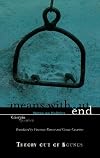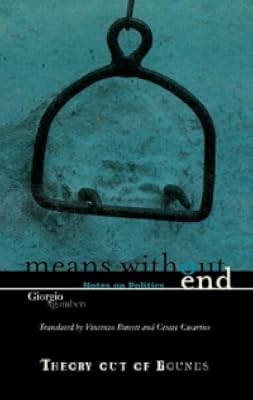
Means Without End: Notes on Politics
by Giorgio Agamben
On This Page
Description
An essential reevaluation of the proper role of politics in contemporary life. In this critical rethinking of the categories of politics within a new sociopolitical and historical context, the distinguished political philosopher Giorgio Agamben builds on his previous work to address the status and nature of politics itself. Bringing politics face-to-face with its own failures of consciousness and consequence, Agamben frames his analysis in terms of clear contemporary relevance. He proposes, show more in his characteristically allusive and intriguing way, a politics of gesture-a politics of means withou show lessTags
Recommendations









Member Reviews
"[Books] should be used rather as manuals, as instruments of resistance or exodus— much like those improper weapons that the fugitive picks up and inserts hastily under the belt (according to a beautiful image of Deleuze)"
I am coming more and more to appreciate this perspective - though better to extend Agamben's definition also to fiction. Abandoning, unfortunately, the concept of the 'final book' - Rescuing Thomas Bernhard from the compost heap...
The essays of the first and third sections border on plagiarism - frequently composed of direct quotation of earlier sections of the Homo Sacer project (how else would Agamben and Zizek sustain their productivity in the competitive environment of the pop-culture-intellectual) - therefore show more not much worth reading except as summary/review for one who has progressed this deeply into the oeuvre. Yet, as always, Agamben appears pellucid-correct, at least in the essays of the middle section on Gesture as Gag - though, characteristically, both over-extending himself and not coming far enough: the Word is also a gag - there is more to be said of image/film.
ON GESTURE:
If we understand the "word" as the means of communication, then to show a word does not mean to have at one's disposal a higher level (a metalanguage), starting from which we could make that word an object of communication; it means, rather, to expose the word in its own mediality, in its own being a means, without any transcendence. The gesture is, in this sense, communication of a communicability. It has precisely nothing to say because what it shows is the being-in-language of human beings as pure mediality. However, because being-in-language is not something that could be said in sentences, the gesture is essentially always a gesture of not being able to figure something out in language; it is always a gag in the proper meaning of the term, indicating first of all something that could be put in your mouth to hinder speech, as well as in the sense of the actor's improvisation meant to compensate a loss of memory or an inability to speak. From this point derives not only the proximity between gesture and philosophy, but also the one between philosophy and cinema. Cinema's essential "silence" (which has nothing to do with the presence or absence of a sound track) is, just like the silence of philosophy, exposure of the being-in-language of human beings: pure gesturality. The Wittgensteinian definition of the mystic as the appearing of what cannot be said is literally a definition of the gag. And every great philosophical text is the gag exhibiting language itself, being-in-language itself as a gigantic loss of memory, as an incurable speech defect.-->
The gesture is the exhibition of a mediality: it is the process of making a means visible as such. It allows the emergence of the being-in-a-medium of human beings and thus it opens the ethical dimension for them.
-->
if producing is a means in view of an end and praxis is an end without means, the gesture then breaks with the false alternative between ends and means that paralyzes morality.
-->
Nietzsche represents the specific moment in European culture when this polar tension between the obliteration and loss of gestures and their transfiguration into fate reaches its climax. The thought of the eternal return, in fact, is intelligible only as a gesture in which power and act, naturalness and manner, contingency and necessity become indiscernible (ultimately, in other words, only as theater).
-->
During the same years, Aby Warburg began those investigations, the main focus [of which] was the gesture intended as a crystal of historical memory, the process by which it stiffened and turned into a destiny, as well as the strenuous attempt of artists and philosophers (an attempt that, according to Warburg, was on the verge of insanity) to redeem the gesture from its destiny through a dynamic polarization.
-->
The atlas Mnemosyne that he left incomplete and that consists of almost a thousand photographs is not an immovable repertoire of images but rather a representation in virtual movement of Western humanity's gestures from classical Greece to Fascism. The single images should be considered more as film stills than as autonomous realities (at least in the same way in which Benjamin once compared the dialectical image to those little books, forerunners of cinematography, that gave the impression of movement when the pages were turned over rapidly).
THE FACE:
Inasmuch as it is nothing but pure communicability, every human face, even the most noble and beautiful, is always suspended on the edge of an abyss. This is precisely why the most delicate and graceful faces sometimes look as if they might suddenly decompose, thus letting the shapeless and bottomless background that threatens them emerge. But this amorphous background is nothing else than the opening itself and communicability itself inasmuch as they are constituted as their own presuppositions as if they were a thing. The only face to remain uninjured is the one capable of taking the abyss of its own communicability upon itself and of exposing it without fear or complacency.INTERSECTION WITH ART; idea for portraiture (face: eyes and mouth vs nose and ears); cinema (gesture: element of awakening)
-->
"Because human beings neither are nor have to be any essence, any nature, or any specific destiny, [...] what remains hidden from them is not something behind appearance, but rather appearing itself, that is, their being nothing other than a face. The task of politics is to return appearance itself to appearance, to cause appearance itself to appear."
Just as the Star mirrors its elements and the combination of the elements into one route in its two superimposed triangles, so too the organs of the countenance divide into two levels. For the life-points of the countenance are, after all, those points where the countenance comes into contact with the world above, be it passive or active contact. The basic level is ordered according to the receptive organs; they are the face, the mask, namely forehead and cheeks, to which belong respectively nose and ears. Nose and ears are the organs of pure receptivity.... This first triangle is thus formed by the midpoint of the forehead, as the dominant point of the entire face, and the midpoint of the cheeks. Over it is now imposed a second triangle, composed of the organs whose activity quickens the rigid mask of the first: eyes and mouth.1AGAMBEN JOINS THE DESPISERS OF GRIMACE:
Even the Mona Lisa could be seen not as immovable and eternal form, but as fragment of a gesture or as still of a lost film wherein it would regain its true meaning. And that is so because a certain kind of litigatio, a paralyzing power whose spell we need to break, is continuously at work in every image; it is as if a silent invocation calling for the liberation of the image into gesture arose from the entire history of art. This is what in ancient Greece was expressed by the legends in which statues break the ties holding them and begin to move.
-->
Cinema [...] is the dream of a gesture. The duty of the director is to introduce into this dream the element of awakening.
Visuddhimagga of the Theravada Canon: "One who has the habit of making grimaces is a grimacer. The grimacer's state is grimacery. - improper mode of bearing
Adorno and Horkheimer: The grimace is a lie because it admits too readily the complaint
Agamben: "it has nothing to express— thus withdrawing silently behind itself — it turns into a grimace, which is what one calls character."- making communicability into a character
QUOTES
"It is well known how peremptorily Spinoza bars repentance from any right of citizenship in his Ethics. The one who repents — he writes — is twice disgraceful: the first time because he committed an act of which he has had to repent, and the second time because he has repented of it."show less
"Benjamin once wrote that, at crucial moments of history, the final blow must be struck with the left hand"
"Cuando intentes hablas, recuerda que no puedes servirte de algunas palabras gratas al oído: libertad, progreso, Estado de derecho, democracia, derechos del hombre... Tendrás que describir lo intolerable sin tener nada para salir de ello." Tan exigente es la despiadada lucidez con la que Giorgio Agamben se mide con nuestro universo político. Mas la fidelidad a ese silencio es también fidelidad rigurosa al tiempo-acontecimiento en que se inscriben y se juegan nuestras vidas, a esa región opaca en que lo público y lo privado, el cuerpo biológico y el cuerpo político son ya indiscernibles.
Aug 13, 2011Spanish
Ratings
Members
- Recently Added By
Lists

Books Read in College
80 works; 5 members

Books I Wrote Essays on
34 works; 1 member
Author Information

135+ Works 8,013 Members
Giorgio Agamben is a contemporary Italian philosopher and political theorist whose original works have gained critical acclaim and have been translated into numerous Languages. His most recent books are Creation and Anarchy: The Work or Art and the Religion of Capitalism and What Is Real? Agamben is a frequent contributor to numerous international show more newspapers and other media. show less
Series
Belongs to Publisher Series
Common Knowledge
- Canonical title
- Means Without End: Notes on Politics
Classifications
- Genres
- Philosophy, Nonfiction, Politics and Government, General Nonfiction
- DDC/MDS
- 320.01 — Society, government, & culture Political science Types of Government Political Science Philosophy and Theory
- LCC
- JA71 .J3713 — Political Science Political science (General) Political science (General) Theory. Relations to other subjects
- BISAC
Statistics
- Members
- 263
- Popularity
- 123,144
- Reviews
- 2
- Rating
- (3.91)
- Languages
- 12 — Czech, Danish, English, Finnish, French, German, Greek, Italian, Japanese, Norwegian (Bokmål), Portuguese, Spanish
- Media
- Paper, Ebook
- ISBNs
- 20
- ASINs
- 2