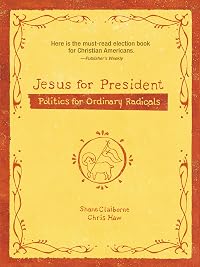
Jesus for President: Politics for Ordinary Radicals
by Shane Claiborne
On This Page
Description
Jesus for President is a radical manifesto to awaken the Christian political imagination, reminding us that our ultimate hope lies not in partisan political options but in Jesus and the incarnation of the peculiar politic of the church as a people "set apart" from this world. In what can be termed lyrical theology, Jesus for President poetically weaves together words and images to sing (rather than dictate) its message. It is a collaboration of Shane Claiborne's writing and stories, Chris show more Haw's reflections and research, and Chico Fajardo-Heflin's art and design. Drawing upon the work of biblical theologians, the lessons of church history, and the examples of modern-day saints and ordinary radicals, Jesus for President stirs the imagination of what the Church could look like if it placed its faith in Jesus instead of Caesar. A fresh look at Christianity and empire, Jesus for President transcends questions of "Should I vote or not?" and "Which candidate?" by thinking creatively about the fundamental issues of faith and allegiance. It's written for those who seek to follow Jesus, rediscover the spirit of the early church, and incarnate the kingdom of God. show lessTags
Recommendations































Member Reviews
Creatively and beautifully written and illustrated, this book calls you to redefine your idea of Jesus and his message, showing just how politically charged, and radical, it really is. This book, while written in a very enjoyable and easy to read way, challenges the reader to reconsider everything they’ve ever thought about Jesus and what it means to follow in his example in being set apart from the empires and establishments that perpetuate anything less than what the kingdom of God stands for.
Focusing on how Jesus’ message and example is something we’re supposed to be following and emulating in a way that is meaningful and relevant to this life, as opposed as a way to merely ensure us a seat in some hereafter (a concept I’m show more already familiar with, through authors like Brian McLaren, a concept I love and agree with, one that I find so much more meaningful than the idea of using Jesus as a mere ticket to some sort of exclusive VIP after-party), the authors show us just what that looks like, through numerous examples and explanations. They give insight into the mentality of Jesus and the Jews, as well as of the Romans, of his time, showing us just how dynamic and radical the actions, expressions, and phrases we’ve heard attributed to him our whole lives really are. The Jesus they reveal, the one with the political message and the call to the potential to live a better, more meaningful, life here and now is the Jesus I’ve always preferred and believed over every other version I’ve encountered, yet something in the way they present him resonated with me in such a way that made it almost seem like I was encountering the idea for the first time, like I was seeing it with new eyes…
I personally loved how they inserted quotes that complimented points they were making, as well as quotes from those who reflect another side of “Christianity”, or even the “empire”, ones that were so opposite of the points of the authors that it made those points that much more poignant.
I would recommend this to everyone – Christian and non-Christian, it doesn’t matter. This is a Jesus I think the world should see, and this is a book I think everyone should read – and make sure you take the time to read the appendixes online as well! All of it definitely makes you rethink things.
This isn’t just a book, it’s a manifesto. … show less
Focusing on how Jesus’ message and example is something we’re supposed to be following and emulating in a way that is meaningful and relevant to this life, as opposed as a way to merely ensure us a seat in some hereafter (a concept I’m show more already familiar with, through authors like Brian McLaren, a concept I love and agree with, one that I find so much more meaningful than the idea of using Jesus as a mere ticket to some sort of exclusive VIP after-party), the authors show us just what that looks like, through numerous examples and explanations. They give insight into the mentality of Jesus and the Jews, as well as of the Romans, of his time, showing us just how dynamic and radical the actions, expressions, and phrases we’ve heard attributed to him our whole lives really are. The Jesus they reveal, the one with the political message and the call to the potential to live a better, more meaningful, life here and now is the Jesus I’ve always preferred and believed over every other version I’ve encountered, yet something in the way they present him resonated with me in such a way that made it almost seem like I was encountering the idea for the first time, like I was seeing it with new eyes…
I personally loved how they inserted quotes that complimented points they were making, as well as quotes from those who reflect another side of “Christianity”, or even the “empire”, ones that were so opposite of the points of the authors that it made those points that much more poignant.
I would recommend this to everyone – Christian and non-Christian, it doesn’t matter. This is a Jesus I think the world should see, and this is a book I think everyone should read – and make sure you take the time to read the appendixes online as well! All of it definitely makes you rethink things.
This isn’t just a book, it’s a manifesto. … show less
I’m wondering if this book will somehow define a watershed in my faith. I hope so. Claiborne and Haw have come up with something that is potentially explosive where I live, a model of USAnian Republican Christianity. It’s not that they’re saying anything new, it’s the context in which it is said that makes this book dynamite.
No one who truly understands the character and teachings of Jesus Christ can fail to be disturbed by the political policies of the United States. Let me start out by staying that the US is no more or less corrupt than any other nation you might happen to brush with. But what makes the message broadcast by the superpower of the moment so insidious is the fact that it is presented with a sugar-coating of show more spiritualism that claims that it is a Christian nation with a president (at least of the time Jesus for President was written) who follows Jesus.
Claiborne and Haw describe what following Jesus looks like for the first third of the book. The second third is dedicated to showing that whatever the US follows, it isn’t Jesus. The final third of the book is a description of what society could look like if it did follow Jesus. I found the first third a bit boring, the second had me cheering from the stands and the third had me on my knees with a notepad. I found it exceedingly challenging.
Described here is a very compelling argument as to why the US versions of nationalism, democracy, capitalism and foreign policy are anything but comparable to the teachings of Jesus. It’s a message that I dearly wish my Republican-minded US colleagues and friends would engage with. Note, I didn’t say follow. We’re no more to follow Claiborne and Haw than Bush is to follow Wolfowitz. But in 90% of the conversations that I have with people who believe what this book challenges, I find there’s absolutely no room for argument. To be Christian is to be Republican and, perhaps more importantly, vice versa. But as the authors brilliantly point out in response to the question of whether the US is in fact a Christian nation:
The United States is Christian insomuch as it looks like Christ.
Now I have no problem with Christians taking a political view. In fact, I have problems with Christians who think you should not or, more naively, cannot take one. But we have been warned to be as wise as serpents and navigating political waters these days, as in Jesus’ day, requires great wisdom. As they say
the most important question for the church today isn’t whether Christianity is political but how is Christianity political
Those who leave no room for argument perhaps leave no room for God to speak to them through works like Jesus for President and that, for me, is a great tragedy. We need present-day prophets like Claiborne and Haw to remind us of what Jesus teaches and to remind us that he is the standard that we should measure ourselves by daily. Listen to this for a sample of what you’re in for here:
In [the fourth century church’s] pursuit of "making disciples of every nation" and baptizing all those within the [Roman] empire, they stumbled into baptizing the empire itself…. producing what so many liberal and conservative Christians want today – an empire run on the blood of Jesus Christ, a holy Christian state. Through inheriting all the "kingdoms of this world," the church became the kind of beast that Jesus worked and taught against. The history of the church has been largely a history of "believers" refusing to believe in the way of the crucified Nazarene and instead giving in to the very temptation he resisted – power, relevancy, spectacle. One says that we must love our enemies, the other says that we must kill them; one promotes the economics of competition, while the other admonishes the forgiveness of debts. To which do we pledge allegiance?
I’ve lent this book to someone else in the community now and it will be making its rounds. It will no doubt spark debate. I have a feeling though that Claiborne and Haw… and Jesus… are after repentance, not simply debate. show less
No one who truly understands the character and teachings of Jesus Christ can fail to be disturbed by the political policies of the United States. Let me start out by staying that the US is no more or less corrupt than any other nation you might happen to brush with. But what makes the message broadcast by the superpower of the moment so insidious is the fact that it is presented with a sugar-coating of show more spiritualism that claims that it is a Christian nation with a president (at least of the time Jesus for President was written) who follows Jesus.
Claiborne and Haw describe what following Jesus looks like for the first third of the book. The second third is dedicated to showing that whatever the US follows, it isn’t Jesus. The final third of the book is a description of what society could look like if it did follow Jesus. I found the first third a bit boring, the second had me cheering from the stands and the third had me on my knees with a notepad. I found it exceedingly challenging.
Described here is a very compelling argument as to why the US versions of nationalism, democracy, capitalism and foreign policy are anything but comparable to the teachings of Jesus. It’s a message that I dearly wish my Republican-minded US colleagues and friends would engage with. Note, I didn’t say follow. We’re no more to follow Claiborne and Haw than Bush is to follow Wolfowitz. But in 90% of the conversations that I have with people who believe what this book challenges, I find there’s absolutely no room for argument. To be Christian is to be Republican and, perhaps more importantly, vice versa. But as the authors brilliantly point out in response to the question of whether the US is in fact a Christian nation:
The United States is Christian insomuch as it looks like Christ.
Now I have no problem with Christians taking a political view. In fact, I have problems with Christians who think you should not or, more naively, cannot take one. But we have been warned to be as wise as serpents and navigating political waters these days, as in Jesus’ day, requires great wisdom. As they say
the most important question for the church today isn’t whether Christianity is political but how is Christianity political
Those who leave no room for argument perhaps leave no room for God to speak to them through works like Jesus for President and that, for me, is a great tragedy. We need present-day prophets like Claiborne and Haw to remind us of what Jesus teaches and to remind us that he is the standard that we should measure ourselves by daily. Listen to this for a sample of what you’re in for here:
In [the fourth century church’s] pursuit of "making disciples of every nation" and baptizing all those within the [Roman] empire, they stumbled into baptizing the empire itself…. producing what so many liberal and conservative Christians want today – an empire run on the blood of Jesus Christ, a holy Christian state. Through inheriting all the "kingdoms of this world," the church became the kind of beast that Jesus worked and taught against. The history of the church has been largely a history of "believers" refusing to believe in the way of the crucified Nazarene and instead giving in to the very temptation he resisted – power, relevancy, spectacle. One says that we must love our enemies, the other says that we must kill them; one promotes the economics of competition, while the other admonishes the forgiveness of debts. To which do we pledge allegiance?
I’ve lent this book to someone else in the community now and it will be making its rounds. It will no doubt spark debate. I have a feeling though that Claiborne and Haw… and Jesus… are after repentance, not simply debate. show less
A friend of mine recently pointed out the importance of discernment when choosing what books to read. Most of us will not complete more than a dozen or so books in a year, and with all the fantastic books out there, we need to be careful not to waste our time on dribble. Unfortunately, Jesus for President, by Shane Claiborne and Chris Haw, is not a fantastic book. It is a stunning example of what happens when Christians allow our political ideology and biases to affect how we approach the Bible. Billed as a “book to provoke the Christian political imagination,” the reader is left with more provocation than actual thought. Showing no understanding of the differing roles of the Church and the state, the authors conflate the two in a show more misguided attempt to shape Christians approach to politics. The end result is a work that only the most radical of the Christian left will find intriguing, while the rest of us are left wondering if it is Jesus they are following or the god of Liberalism. The book is replete with error, all of which fit into one or more of four different categories.
1. Bad Hermeneutics (Biblical Interpretation)
The most egregious and prevalent of all their errors, the authors blatantly rape Scripture in order to bend it to their ideology. For example, even though 1 Chronicles makes it quite clear that David was not to build the Temple because he had shed much blood, Claiborne and Haw argue that God didn’t want a temple because He likes sleeping in tents with poor people (pg. 35). Of course this doesn’t explain why God seems to have been pleased to dwell in the temple Solomon built. In another instance the authors state that the Israelites had laws for dealing with illegal immigrants (pg. 58). By choosing the phrase “illegal immigrants,” instead of what the text actually says “aliens,” the authors are trying to make a passage that has little relevance to our current immigration debate fit their own ideological purpose. At one point Claiborne and Haw state that Jesus was from a family of “peasants” (pg. 116), when we now know that the fact that he was a carpenter most likely put him in what we would know as the middle-class. In another instance, the authors say that the people were hungry for revolution, and thus chose for Barrabas to be freed instead of Jesus (pg. 76), when the Gospel account makes it clear that it was the prompting of the Pharisees that led to this decision. Finally, they state that the book of Revelation was written in code so the empire wouldn’t know what John was really saying (pg. 148), when it is commonly recognized that the genre of Revelation is apocalyptic and is thus written in such a mysterious manner.
2. Bad Theology
Despite the fact that Chris Haw is said to be working on a graduate degree in theology, the authors make some incredibly basic errors in theological understanding. In many cases they footnote their arguments by thanking some scholar for giving them “new eyes to see” on a particular issue, but due to the obscure nature of their argument, we are left feeling that they simply choose which eyes they like best. In one disturbing instance, they state that violence kills the image of God within a person (pg. 205). The doctrine of Imago Dei is one of the most foundational beliefs for Christian thinking, and no where does the Bible indicate that a person can have more or less of the image of God within them. The image of God is what gives each person their value, and, if the authors’ assertion were true, we would be left with some people that are intrinsically more valuable than others, hardly the traditional Christian understanding. Another instance where the authors show their ignorance is their understanding of the Trinity. In a poor attempt at humor, the authors tell a joke in which Jesus is letting people into Heaven whose names are not written in the Book of Life (pg. 290). This type of naiveté is easily repudiated when one recognizes that the Trinity cannot be divided, and thus would certainly know who is allowed into Heaven. Of course, this issue is further complicated by the authors seeming to indicate that they might not believe that Hell exists anyway. In another instance, Claiborne and Haw state that it is difficult to know whether or not Jesus would pay taxes if he lived in the U.S. (pg. 257), of course the simple phrase “render to Caesar the things that are Caesar’s” seems to answer that quandary. In still another case, the authors revel in the act of lying when it fits their political cause (pg. 297).
3. Bad Political Philosophy and Logic
In many places Claiborne and Haw show utter inconsistency in their logic, coupled with a radically naïve approach to politics. For instance, they state that capitalism is a yoke that we need to be freed from (pg. 113). And while they admit that writing a book participates in capitalism, they don’t seem to grasp the fact that without capitalism their book would not be able to be printed or distributed. In a truly confusing paragraph, the authors argue that the industrial revolution wasn’t really an advancement, an assertion so absurd it is difficult to even respond to (I’ll let the fact that you are reading this be my rebuttal). And in perhaps the most stunning example of the sheer absurdity of their logic, Claiborne states that, if faced with genocide, he would simply take his clothes off and squawk like a chicken (pg. 273). Such a simplistic assertion fails to grasp the fallen world we currently inhabit, and instead makes a joke of over a million deaths on one continent alone.
4. Bad Use of Historical Argument
Still another way that Claiborne and Haw mislead their readers is by a deceptive use of history. They state that the more the early Church lived out the Gospel, the more they collided with the Roman Empire (pg. 141), when even a cursory understanding of early Church history shows that persecution was sporadic and wholly contingent on who was running the empire, not the degree to which Christians lived the Gospel. In an attempt to show the futility of violence, the authors state that an attempted assassination plot against Hitler only galvanized his resolve and made any efforts towards peace impossible (pg. 203). What they fail to mention is that this happened mere months from the end of WWII, and there was no indication that Hitler was going to surrender under any circumstances.
There are many other examples of all these types of errors I could list, all with equally simple rebuttals. The point is that Claiborne and Haw do not contribute anything new to the discussion of how our faith should influence policy. Rather, they simply carry the water for the far left, attempting to argue that Jesus agrees with them. Personally I am tired of people trying to prove that Jesus agrees with their ideologies, instead, I believe, we should be trying to agree with Jesus. Admittedly this is incredibly difficult for any of us to do, especially since Christ didn’t have much to say about the role of the state (contra Claiborne and Haw). What He did address, however, is how we as Christians should act, and I think if we put those things into practice the politics will come naturally. show less
1. Bad Hermeneutics (Biblical Interpretation)
The most egregious and prevalent of all their errors, the authors blatantly rape Scripture in order to bend it to their ideology. For example, even though 1 Chronicles makes it quite clear that David was not to build the Temple because he had shed much blood, Claiborne and Haw argue that God didn’t want a temple because He likes sleeping in tents with poor people (pg. 35). Of course this doesn’t explain why God seems to have been pleased to dwell in the temple Solomon built. In another instance the authors state that the Israelites had laws for dealing with illegal immigrants (pg. 58). By choosing the phrase “illegal immigrants,” instead of what the text actually says “aliens,” the authors are trying to make a passage that has little relevance to our current immigration debate fit their own ideological purpose. At one point Claiborne and Haw state that Jesus was from a family of “peasants” (pg. 116), when we now know that the fact that he was a carpenter most likely put him in what we would know as the middle-class. In another instance, the authors say that the people were hungry for revolution, and thus chose for Barrabas to be freed instead of Jesus (pg. 76), when the Gospel account makes it clear that it was the prompting of the Pharisees that led to this decision. Finally, they state that the book of Revelation was written in code so the empire wouldn’t know what John was really saying (pg. 148), when it is commonly recognized that the genre of Revelation is apocalyptic and is thus written in such a mysterious manner.
2. Bad Theology
Despite the fact that Chris Haw is said to be working on a graduate degree in theology, the authors make some incredibly basic errors in theological understanding. In many cases they footnote their arguments by thanking some scholar for giving them “new eyes to see” on a particular issue, but due to the obscure nature of their argument, we are left feeling that they simply choose which eyes they like best. In one disturbing instance, they state that violence kills the image of God within a person (pg. 205). The doctrine of Imago Dei is one of the most foundational beliefs for Christian thinking, and no where does the Bible indicate that a person can have more or less of the image of God within them. The image of God is what gives each person their value, and, if the authors’ assertion were true, we would be left with some people that are intrinsically more valuable than others, hardly the traditional Christian understanding. Another instance where the authors show their ignorance is their understanding of the Trinity. In a poor attempt at humor, the authors tell a joke in which Jesus is letting people into Heaven whose names are not written in the Book of Life (pg. 290). This type of naiveté is easily repudiated when one recognizes that the Trinity cannot be divided, and thus would certainly know who is allowed into Heaven. Of course, this issue is further complicated by the authors seeming to indicate that they might not believe that Hell exists anyway. In another instance, Claiborne and Haw state that it is difficult to know whether or not Jesus would pay taxes if he lived in the U.S. (pg. 257), of course the simple phrase “render to Caesar the things that are Caesar’s” seems to answer that quandary. In still another case, the authors revel in the act of lying when it fits their political cause (pg. 297).
3. Bad Political Philosophy and Logic
In many places Claiborne and Haw show utter inconsistency in their logic, coupled with a radically naïve approach to politics. For instance, they state that capitalism is a yoke that we need to be freed from (pg. 113). And while they admit that writing a book participates in capitalism, they don’t seem to grasp the fact that without capitalism their book would not be able to be printed or distributed. In a truly confusing paragraph, the authors argue that the industrial revolution wasn’t really an advancement, an assertion so absurd it is difficult to even respond to (I’ll let the fact that you are reading this be my rebuttal). And in perhaps the most stunning example of the sheer absurdity of their logic, Claiborne states that, if faced with genocide, he would simply take his clothes off and squawk like a chicken (pg. 273). Such a simplistic assertion fails to grasp the fallen world we currently inhabit, and instead makes a joke of over a million deaths on one continent alone.
4. Bad Use of Historical Argument
Still another way that Claiborne and Haw mislead their readers is by a deceptive use of history. They state that the more the early Church lived out the Gospel, the more they collided with the Roman Empire (pg. 141), when even a cursory understanding of early Church history shows that persecution was sporadic and wholly contingent on who was running the empire, not the degree to which Christians lived the Gospel. In an attempt to show the futility of violence, the authors state that an attempted assassination plot against Hitler only galvanized his resolve and made any efforts towards peace impossible (pg. 203). What they fail to mention is that this happened mere months from the end of WWII, and there was no indication that Hitler was going to surrender under any circumstances.
There are many other examples of all these types of errors I could list, all with equally simple rebuttals. The point is that Claiborne and Haw do not contribute anything new to the discussion of how our faith should influence policy. Rather, they simply carry the water for the far left, attempting to argue that Jesus agrees with them. Personally I am tired of people trying to prove that Jesus agrees with their ideologies, instead, I believe, we should be trying to agree with Jesus. Admittedly this is incredibly difficult for any of us to do, especially since Christ didn’t have much to say about the role of the state (contra Claiborne and Haw). What He did address, however, is how we as Christians should act, and I think if we put those things into practice the politics will come naturally. show less
If you spend any time searching internet discussion boards for opinions about this book, you'll realize it's struck a chord. People either love it, believing it's the answer to the malaise facing the 21st Century church, or they'll hate it, believing it twists and distorts scripture to promote a pacifist, communist, anti-american agenda. Like a Rorschach test, reactions to this book probably say as much about the reader as they do the content of the book itself.
I should begin by saying the book isn't saying anything all that original. In other words, Claiborne and Haw aren't promoting anything they've discovered for themselves. Instead, they have ingested the work of people like Wendell Berry, Gregory Boyd, John Howard Yoder, Marva show more Dawn, and Walter Wink, they have listened carefully to the anabaptist voice within Christianity, they have synthesized the work of those thinkers and writers and theologians and peacemakers, and they have published a manifesto to the 21st Century Church - a call to the church to return to its roots as an alternative community, a seperate, holy people, called apart from the kingdoms of earth to live as the Kingdom of God on earth.
Two quick strenghts of the book:
1) This is biblical theology as opposed to systematic theology. In other words, the book focuses on the broad sweep of Judeo-Christian history, beginning in the garden and carrying on through Abraham, Israel, Jesus, the Church, up to the images of victory in Revelation. They then take the large sweep of biblical history to paint the full picture of rebellion and redemption in which we find ourselves. Thus, rather than nit-picking what "this verse over here" means up against "that verse over there," they instead ask "what has been God's plan all along?" This, to me, is the healthiest way to let the Scriptures speak into our lives.
2) It's a beautiful book. Literally. Shane and Chris employed the work of artists to craft a book that is fascinating to look at. Every page is a painting, a photo, a stitch-work, a challenge, a delight. Thus, the book challenges not just the intellectual side, but the artistic side, as well. Sometimes the pictures, the questions, the images speak even louder than the text on the page. This is obviously a labor of love for the authors.
My take on the book: For the most part, I think Shane and Chris are dead-on. Their critique of the 21st-Century American Church nails us all. They rightfully see the ways in which The Church has sold out to a culture of shopping, a culture of idolatry, a culture of power-play, and how the church has abandoned the call to "take up our cross" and follow Christ. At the same time, they don't stop at critique. In fact, most of the book is given to suggestions on how to move forward, and examples of communities of faith who come close to reflecting Christ in their lives. So they challenge the Church, but they challenge the individual Christian as well. How, exactly, do we follow in the pattern of Christ who had no home when we spend massive amounts of money on plasma televisions and name-brand sneakers? How exactly do we claim to follow the Prince of Peace when we so enjoy violence, when we so quickly call for retribution upon our enemies? How do we show love to our brothers and sisters when we participate in an economy that is so unequitable? How do we worship both the Father of All Nations and at the same time worship the country in which we live?
To read this book is to read a call to live a different kind of life. It challenges, it exhorts, it pushes on some tight spots. But I think it's a necessary read by any who would claim Jesus as Lord. So go read it. Then let's talk some more. show less
I should begin by saying the book isn't saying anything all that original. In other words, Claiborne and Haw aren't promoting anything they've discovered for themselves. Instead, they have ingested the work of people like Wendell Berry, Gregory Boyd, John Howard Yoder, Marva show more Dawn, and Walter Wink, they have listened carefully to the anabaptist voice within Christianity, they have synthesized the work of those thinkers and writers and theologians and peacemakers, and they have published a manifesto to the 21st Century Church - a call to the church to return to its roots as an alternative community, a seperate, holy people, called apart from the kingdoms of earth to live as the Kingdom of God on earth.
Two quick strenghts of the book:
1) This is biblical theology as opposed to systematic theology. In other words, the book focuses on the broad sweep of Judeo-Christian history, beginning in the garden and carrying on through Abraham, Israel, Jesus, the Church, up to the images of victory in Revelation. They then take the large sweep of biblical history to paint the full picture of rebellion and redemption in which we find ourselves. Thus, rather than nit-picking what "this verse over here" means up against "that verse over there," they instead ask "what has been God's plan all along?" This, to me, is the healthiest way to let the Scriptures speak into our lives.
2) It's a beautiful book. Literally. Shane and Chris employed the work of artists to craft a book that is fascinating to look at. Every page is a painting, a photo, a stitch-work, a challenge, a delight. Thus, the book challenges not just the intellectual side, but the artistic side, as well. Sometimes the pictures, the questions, the images speak even louder than the text on the page. This is obviously a labor of love for the authors.
My take on the book: For the most part, I think Shane and Chris are dead-on. Their critique of the 21st-Century American Church nails us all. They rightfully see the ways in which The Church has sold out to a culture of shopping, a culture of idolatry, a culture of power-play, and how the church has abandoned the call to "take up our cross" and follow Christ. At the same time, they don't stop at critique. In fact, most of the book is given to suggestions on how to move forward, and examples of communities of faith who come close to reflecting Christ in their lives. So they challenge the Church, but they challenge the individual Christian as well. How, exactly, do we follow in the pattern of Christ who had no home when we spend massive amounts of money on plasma televisions and name-brand sneakers? How exactly do we claim to follow the Prince of Peace when we so enjoy violence, when we so quickly call for retribution upon our enemies? How do we show love to our brothers and sisters when we participate in an economy that is so unequitable? How do we worship both the Father of All Nations and at the same time worship the country in which we live?
To read this book is to read a call to live a different kind of life. It challenges, it exhorts, it pushes on some tight spots. But I think it's a necessary read by any who would claim Jesus as Lord. So go read it. Then let's talk some more. show less
The term 'kingdom of God' is about as overtly political as it's possible to be. Jesus wasn't glossing over the political implications of his ministry so it's unfortunate that so many Christians today have learned not to hear them. Praying "thy kingdom come" in the Lord's Prayer is political subversion and a hope for radical overturn of present day politics. As the book points out, if the prayer meant God's support for current world leaders, then Jesus would have in fact just prayed for people in power. But Jesus was never a fan of people in power; he would much rather advocate for the dispossessed and marginalized at the mercy of unjust systems headed by the powerful. We hear that in the Beatitudes, another passage that Christians today show more certainly know but generally don't hear as a political message.
So Jesus for President is meant as a reclamation of the political overtones of Jesus' ministry, offering challenging considerations for what it means for Christians in the United States today to live under a hyper-capitalist republic (slash oligarchy). This does not mean that the authors are suggesting the US government should impose Christianity, nor should anyone be led to think that America is a "Christian nation" in any appreciable sense of the term. The title is rather tongue-in-cheek: the authors cite the adage that anyone who desires power isn't trustworthy enough to deserve it. And Jesus' most direct experience with the power of the state was when it executed him, so there's that. Ultimately they argue from a bottom-up involvement with people rather than a top-down involvement with systems. "No government can legislate love" in any case, but individuals can participate in the good of their country by being concerned for the good of one another.
For readers who are interested in biblical scholarship about Jesus' politics, please look elsewhere (I'd begin with Horsley's Jesus and Empire; this book relies heavily on Yoder's Politics of Jesus). Claiborne and Haw aren't scholars nor claim to be, so the academic sections of this book were the weakest. But once they hit their stride with reflection on present day issues of justice, with citations of Jesus as a tool to think with rather than an answer, this book invites readers into considerations of their own politics and responsibilities to their nation, fellow citizens, and God. show less
So Jesus for President is meant as a reclamation of the political overtones of Jesus' ministry, offering challenging considerations for what it means for Christians in the United States today to live under a hyper-capitalist republic (slash oligarchy). This does not mean that the authors are suggesting the US government should impose Christianity, nor should anyone be led to think that America is a "Christian nation" in any appreciable sense of the term. The title is rather tongue-in-cheek: the authors cite the adage that anyone who desires power isn't trustworthy enough to deserve it. And Jesus' most direct experience with the power of the state was when it executed him, so there's that. Ultimately they argue from a bottom-up involvement with people rather than a top-down involvement with systems. "No government can legislate love" in any case, but individuals can participate in the good of their country by being concerned for the good of one another.
For readers who are interested in biblical scholarship about Jesus' politics, please look elsewhere (I'd begin with Horsley's Jesus and Empire; this book relies heavily on Yoder's Politics of Jesus). Claiborne and Haw aren't scholars nor claim to be, so the academic sections of this book were the weakest. But once they hit their stride with reflection on present day issues of justice, with citations of Jesus as a tool to think with rather than an answer, this book invites readers into considerations of their own politics and responsibilities to their nation, fellow citizens, and God. show less
Shane Claiborne and Chris Haw’s Jesus for President lays out a sort of electoral strategy for making Jesus our President, if not in reality than at least in our hearts. Claiborne and Haw look at the prophetic templates for rulers in the Hebrew Bible, the teachings of Jesus, and the pre-Constantine church for inspiration on how to live into the politically subversive nature of the Christian message. The authors make it clear that no political party has a claim on the party of Jesus; in fact it would seem that Jesus’ politics would take a creative reimagining that would transform the way we live into our worldliness while acknowledging our other-worldliness.
In the Hebrew Bile the authors look to the warnings against becoming like the show more other nations and to the precedent of rulers being accompanied by a “critic on the margin” who could challenge the ruler to be more aligned with the will of God than with the will of humanity. The plenteous examples of rulers from the Hebrew Bible make it clear that kingly power is ultimately corruptive in human hands; even the great King David abused his power. The solution to the earthly kings came in the form of the marginal Jesus. The authors make the point that the Bible is ironic, with great power coming from the unexpected and lowly places. Jesus does not fall neatly into the political schism of the world, rather Jesus approaches the world in a “third way.” By suffering crucifixion, and encouraging his followers to suffer the path of the cross, Jesus preaches a “completely different way to view the world.”
The authors conclude by showing how this ‘third way’ of Jesus could look in the world. They describe the various hypothetical situations that people propose to them, and then show how a third way could be used to emulate Jesus’ actions. Rather than confronting or escaping evil, Jesus and the authors of this book propose doing the unexpected. Even though this third way may result in the same tragedies that traditional responses would, they would at least refuse to pay back violence for violence. The ultimate message of Jesus for President is trying to find a third way for dealing with the problems of the world by the people not of the world. show less
In the Hebrew Bile the authors look to the warnings against becoming like the show more other nations and to the precedent of rulers being accompanied by a “critic on the margin” who could challenge the ruler to be more aligned with the will of God than with the will of humanity. The plenteous examples of rulers from the Hebrew Bible make it clear that kingly power is ultimately corruptive in human hands; even the great King David abused his power. The solution to the earthly kings came in the form of the marginal Jesus. The authors make the point that the Bible is ironic, with great power coming from the unexpected and lowly places. Jesus does not fall neatly into the political schism of the world, rather Jesus approaches the world in a “third way.” By suffering crucifixion, and encouraging his followers to suffer the path of the cross, Jesus preaches a “completely different way to view the world.”
The authors conclude by showing how this ‘third way’ of Jesus could look in the world. They describe the various hypothetical situations that people propose to them, and then show how a third way could be used to emulate Jesus’ actions. Rather than confronting or escaping evil, Jesus and the authors of this book propose doing the unexpected. Even though this third way may result in the same tragedies that traditional responses would, they would at least refuse to pay back violence for violence. The ultimate message of Jesus for President is trying to find a third way for dealing with the problems of the world by the people not of the world. show less
A genuinely cool book.
I found Jesus for President under the New Non-Fiction section of the library and couldn't help but check it out when I read the title. I didn't know what to expect from the book (there's no summary on the back) and decided immediately that that was part of the overall allure it presented. What I got was not exactly what I expected, but instead was something more fascinating.
Firstly, I have to praise the formatting of the book. The pictures and somewhat interactive footnotes make it a fascinating read. The content, also, was excellent. The book at first is a political history of the Bible that ties the ancient politics to present ones and offers a good compare/contrast of the two times. The final section of the show more book is the best, where it talks about practically implicating what it means to be a good Christian into today's world.
Jesus For President was difficult to get through at times (any fact heavy book is) but overall was an excellent examination of contradictory Christianity that goes above and beyond the norm by actually providing examples of how to consolidate this contradiction. show less
I found Jesus for President under the New Non-Fiction section of the library and couldn't help but check it out when I read the title. I didn't know what to expect from the book (there's no summary on the back) and decided immediately that that was part of the overall allure it presented. What I got was not exactly what I expected, but instead was something more fascinating.
Firstly, I have to praise the formatting of the book. The pictures and somewhat interactive footnotes make it a fascinating read. The content, also, was excellent. The book at first is a political history of the Bible that ties the ancient politics to present ones and offers a good compare/contrast of the two times. The final section of the show more book is the best, where it talks about practically implicating what it means to be a good Christian into today's world.
Jesus For President was difficult to get through at times (any fact heavy book is) but overall was an excellent examination of contradictory Christianity that goes above and beyond the norm by actually providing examples of how to consolidate this contradiction. show less
Members
- Recently Added By
Lists

Mo's Reading List
218 works; 1 member
Author Information

33+ Works 5,065 Members
Shane Claiborne is an activist, a coauthor of Jesus for President and, Common Prayer, and a founder of The Simple Way, a community in inner-city Philadelphia that has helped birth and connect radical faith communities around the world. He is married to Katie Jo, and has a variety of circus skills, including fire-breathing.
Awards and Honors
Distinctions
Work Relationships
Has the adaptation
Common Knowledge
- Original publication date
- 2008-03-01
Classifications
- Genres
- Religion & Spirituality, Nonfiction, General Nonfiction
- DDC/MDS
- 261.70973 — Religion Christian organization, social work & worship Social theology and interreligious relations and attitudes Christianity and political affairs
- LCC
- BR526 .C567 — Philosophy, Psychology and Religion Christianity Christianity History By region or country
- BISAC
Statistics
- Members
- 897
- Popularity
- 30,006
- Reviews
- 16
- Rating
- (4.13)
- Languages
- English, German
- Media
- Paper, Audiobook, Ebook
- ISBNs
- 7
- UPCs
- 4
- ASINs
- 6