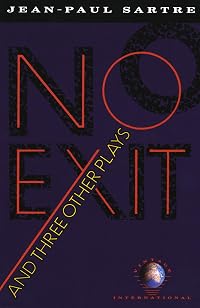
No Exit / Dirty Hands / The Flies / The Respectful Prostitute
by Jean-Paul Sartre
On This Page
Description
In these four plays, Jean-Paul Sartre, the great existentialist novelist and philosopher, displays his mastery of the drama. No Exit is an unforgettable portrayal of hell. The Flies is a modern reworking of the Electra-Orestes story. Dirty Hands is about a young intellectual torn between theory and praxis. The Respectful Prostitute is a scathing attack on American racism. 4 plays about an existential portrayal of Hell, the reworking of the Electra-Orestes story, the conflict of a young show more intellectual torn between theory and conflict and an arresting attack on American racism. show lessTags
Recommendations



























Member Recommendations

HollyMS I read both works in French class. Though Albert Camus denied being an existentialist, both L'Étranger (The Stranger) and Huis Clos (No Exit) have some common themes and are among some of the most important 20th century French works of literature.
40
wrmjr66 Absurdity of action to balance Sartre's absurdity of situation.
30
Member Reviews
Review just for "No Exit":
Jean-Paul Sartre’s play “No Exit” is an interesting look at human interactions when nothing else can distract them. The play involves three people, valeted into a room in Hell one at a time, and then coming to grips with what exactly Hell means. Sartre’s famous quote—“Hell is other people”—is the culmination of their interations. There’s Garcin, the serial philanderer who deserted the army and was executed by firing squad, Inez, the postal clerk whose affair with a woman led that woman to kill her husband, and Estelle, the aristocrat whose affair bore a child that she subsequently killed. Each firmly belongs where they are, but they squabble with other over petty things. The room they are in show more has no mirror, so each person must trust the other’s perception of how they look.
Sartre sets up the frenzied dialogue as a human analogue to the three-body problem in mechanical physics. If there were just two, they co-habitate amiably or destroy each other fully. The addition of a third, however, creates chaotic opinions and reactions whenever a new story is told or character is revealed. They are cruel, loving, tender, and distrusting all at the same time. I would actually like to see a production of this play, and watch how each actor relays the facial expressions lined out in the script. When it came out, the New Republic wrote that “It should be seen whether you like it or not.” I agree with them. If you get a chance, see it. If only for a little while, it may change the way you interact and perceive others around you. show less
Jean-Paul Sartre’s play “No Exit” is an interesting look at human interactions when nothing else can distract them. The play involves three people, valeted into a room in Hell one at a time, and then coming to grips with what exactly Hell means. Sartre’s famous quote—“Hell is other people”—is the culmination of their interations. There’s Garcin, the serial philanderer who deserted the army and was executed by firing squad, Inez, the postal clerk whose affair with a woman led that woman to kill her husband, and Estelle, the aristocrat whose affair bore a child that she subsequently killed. Each firmly belongs where they are, but they squabble with other over petty things. The room they are in show more has no mirror, so each person must trust the other’s perception of how they look.
Sartre sets up the frenzied dialogue as a human analogue to the three-body problem in mechanical physics. If there were just two, they co-habitate amiably or destroy each other fully. The addition of a third, however, creates chaotic opinions and reactions whenever a new story is told or character is revealed. They are cruel, loving, tender, and distrusting all at the same time. I would actually like to see a production of this play, and watch how each actor relays the facial expressions lined out in the script. When it came out, the New Republic wrote that “It should be seen whether you like it or not.” I agree with them. If you get a chance, see it. If only for a little while, it may change the way you interact and perceive others around you. show less
“Dirty Hands” is probably my favorite out of the four, with “The Respectful Prostitute” being my least favorite. All of the other three plays made me laugh and had wonderful writing. I think the setting of the South and all of the awful men that dominated most of the dialogue may have hit a little too close to home for me to enjoy what Sartre was doing with it. It made me wonder about French people. Everything else was extremely well done. “Dirty Hands” is something I would love to see performed live; one can really feel the tension between all the characters and what their motivations are. The politics of it all was like looking at the flat circle of time laid out on a nice, wooden table: all neat and cyclical. “The show more Flies” dragged on a little but most Ancient Greek play retellings are hard to pare down without removing key parts of the narrative. Still, I enjoyed reading Zeus be a big bitch to everyone. It’s fun to read his parts aloud as though he were a flamboyant homosexual. A fine addition to the mind palace. show less
Four masterpieces from one of the best known existentialist philosophers. Starting with No Exit is a great way to get into this collection; it is a great examination of how we interact with, and utimately torture, other people simply by the ordinary passage of our lives. To think of eternity unable to get away from the other people, even for a while, that is truly hell. He follows this with a reworking of the Electra/Orestes story, a long play about a dissident during the war and the moral decisions he's faced with, and ends up with a play about a young woman who is faced with her own moral dilemma, where she holds the fate of two men in her hands, one a "respected, worthwhile" member of the small community, the other merely a "nigger" show more - she is tormented as she tries to make the right decision, one that will be moral, honest, and fair. If she fails, her own self-worth will be at stake. Throughout all of it, the core of existentialist philosophy weaves and scampers, but the plays are not simply dry philsophical pieces. They are stories, with characters that catch you and bring you along. Yes, art can have a message (it always does) and that message does not need to be preachy, dull, or even obvious. People unfamiliar with existentialism will still be able to enjoy exploring the moral questions raised in these plays, and exploring the worlds he creates, and the characters he peoples them with. show less
Hell is--other people!
The premise of No Exit is simple to tell--three nogoodniks have died and gone to hell, locked together in a drawing-room to annoy each other for all eternity. Reduces the need for floggers and flayers, you know. Garcin, Inez, and Estelle slowly reveal their history, why they have come to this place and how each is exquisitely suited to torture the other. This eternal triangle is not quite equilateral, though. All is not well in this part of hell.
Garcin is the one who breaks the symmetry. He tries to avoid the role of torturer and fosters the hope that they can resolve their situation. He suggests that each should engage in self-examination, "that way we--we'll work out our salvation. Looking into ourselves." When show more that fails he suggests mutual examination of their sins, "if we bring our specters into the open, it may save us from disaster." This also fails, as Inez and Estelle embrace their hellish roles by being themselves. The two women, after all, are each complicit in murder/suicide, and are beyond hope. Garcin's transgressions are of another sort altogether. More about that below.
Three people tucked away for eternity--clever premise, well constructed character development and plot execution, but why do we care? It's not real, doesn't conform to any collective notion of an afterlife. What does strike us as real, though, and is closer to us than the two murderers, is Garcin. He considers his mistreatment of his wife the reason for consignment to hell, but says, "I regret nothing." It is not this issue that he needs to resolve. Rather, he agonizes over his cowardice, his desertion in time of war, for which he was shot. He cringes when he hears his colleagues denigrate him. He seeks and receives vindication from Estelle, then is made to understand by Inez that Estelle will say anything to assuage him. It is Inez who understands him completely, who knows his cowardice from exploring the depths of her own soul. It is she who must vindicate Garcin, else he suffer for eternity. When the door to the room opens unexpectedly, Garcin cannot leave while Inez remains behind, "gloating over [his] defeat."
Garcin is, using Sartre's terminology, both a being-for-itself (sentient) and a being-for-others (social). But in Garcin the being-for-others dominates, so that his life is totally controlled by what others think of him. Hence his extreme concern about his reputation as coward. Hence his treatment of his wife, whom he rescued from the gutter to serve as his vanity mirror. Garcin realizes that she, like Estelle, reflects not the truth, but Garcin as she needs to see him. Garcin punishes her either for her to become a faithful mirror or because she cannot.
Garcin is in hell, but we the living face his issue also. We are necessarily socially connected, we are a being-for-others, but we must be equally a being-for-itself. As a being-for-others we can see our own face only as reflected in the faces of others. As a being-for-itself we need to see our own independent image of ourselves--so that we can become the being that we imagine.
For Garcin, "no exit" may be too pessimistic, the original "huis clos" possibly more apt. Garcin could not escape the room when the door opened for him. Perhaps he still can if he realizes that his fate is not in Inez's hands, but in his own, by discounting her opinion and the opinion of others in favor of his own. Or, this being hell, perhaps not. But for us who are not yet arrived, the door is open to us, so to find ourselves on the other side, to see ourselves not as others see us. show less
The premise of No Exit is simple to tell--three nogoodniks have died and gone to hell, locked together in a drawing-room to annoy each other for all eternity. Reduces the need for floggers and flayers, you know. Garcin, Inez, and Estelle slowly reveal their history, why they have come to this place and how each is exquisitely suited to torture the other. This eternal triangle is not quite equilateral, though. All is not well in this part of hell.
Garcin is the one who breaks the symmetry. He tries to avoid the role of torturer and fosters the hope that they can resolve their situation. He suggests that each should engage in self-examination, "that way we--we'll work out our salvation. Looking into ourselves." When show more that fails he suggests mutual examination of their sins, "if we bring our specters into the open, it may save us from disaster." This also fails, as Inez and Estelle embrace their hellish roles by being themselves. The two women, after all, are each complicit in murder/suicide, and are beyond hope. Garcin's transgressions are of another sort altogether. More about that below.
Three people tucked away for eternity--clever premise, well constructed character development and plot execution, but why do we care? It's not real, doesn't conform to any collective notion of an afterlife. What does strike us as real, though, and is closer to us than the two murderers, is Garcin. He considers his mistreatment of his wife the reason for consignment to hell, but says, "I regret nothing." It is not this issue that he needs to resolve. Rather, he agonizes over his cowardice, his desertion in time of war, for which he was shot. He cringes when he hears his colleagues denigrate him. He seeks and receives vindication from Estelle, then is made to understand by Inez that Estelle will say anything to assuage him. It is Inez who understands him completely, who knows his cowardice from exploring the depths of her own soul. It is she who must vindicate Garcin, else he suffer for eternity. When the door to the room opens unexpectedly, Garcin cannot leave while Inez remains behind, "gloating over [his] defeat."
Garcin is, using Sartre's terminology, both a being-for-itself (sentient) and a being-for-others (social). But in Garcin the being-for-others dominates, so that his life is totally controlled by what others think of him. Hence his extreme concern about his reputation as coward. Hence his treatment of his wife, whom he rescued from the gutter to serve as his vanity mirror. Garcin realizes that she, like Estelle, reflects not the truth, but Garcin as she needs to see him. Garcin punishes her either for her to become a faithful mirror or because she cannot.
Garcin is in hell, but we the living face his issue also. We are necessarily socially connected, we are a being-for-others, but we must be equally a being-for-itself. As a being-for-others we can see our own face only as reflected in the faces of others. As a being-for-itself we need to see our own independent image of ourselves--so that we can become the being that we imagine.
For Garcin, "no exit" may be too pessimistic, the original "huis clos" possibly more apt. Garcin could not escape the room when the door opened for him. Perhaps he still can if he realizes that his fate is not in Inez's hands, but in his own, by discounting her opinion and the opinion of others in favor of his own. Or, this being hell, perhaps not. But for us who are not yet arrived, the door is open to us, so to find ourselves on the other side, to see ourselves not as others see us. show less
"No Exit" and "The Flies" really live up to their reputations. Nice and bleak, but wholly engaging. "Dirty Hands" and "The Respectful Prostitute," on the other hand, were okay, but most of the characters annoyed me so much I didn't really care when they reached their shock endings.
I read this because my daughter recently read "No Exit" in one of her high school classes, and I find piggybacking on her assignments a great way to catch up on classics I've always heard about but never got around to reading due to my intense comic book/graphic novel addiction.
I read this because my daughter recently read "No Exit" in one of her high school classes, and I find piggybacking on her assignments a great way to catch up on classics I've always heard about but never got around to reading due to my intense comic book/graphic novel addiction.
This collection includes four of Sartre’s plays, and it’s a bit difficult to give it an overall rating. Why? Here’s the issue in nutshell:
No Exit (46 pages) – brilliant account of three individuals in a very different kind of hell, with some devastating observations about love – 4.5 stars.
The Flies (78 pages) – solid and enjoyable version of the Electra/Orestes story – 4 stars.
Dirty Hands (118 pages) – extremely tedious story of political forces at work in the WWII era – 1 star.
The Respectful Prostitute (34 pages) – scathing indictment of racism in America, impressive for 1946 – 4 stars.
You see the problem? My apologies for being crass, but Vintage International slipped a real turd in the middle here, which is a show more shame. If you read this book, my advice is to simply skip that play in its entirety.
Quotes from ‘No Exit’:
On adoration:
“But, my poor little fallen nestling, you’ve been sheltering in my heart for ages, though you didn’t realize it. Don’t be afraid; I’ll keep looking at you for ever and ever, without a flutter of my eyelids, and you’ll live in my gaze like a mote in a sunbeam.”
And this one:
“I'm going to smile, and my smile will sink down into your pupils, and heaven knows what it will become.”
On death:
“One always dies too soon – or too late. And yet one’s whole life is complete at that moment, with a line drawn neatly under it, ready for the summing up. You are – your life, and nothing else.”
On desire:
“She wants a man – that far you can trust her – she wants a man’s arm round her waist, a man’s smell, a man’s eyes glowing with desire. And that’s all she wants. She’d assure you you were God Almighty if she thought it would give you pleasure.” show less
No Exit (46 pages) – brilliant account of three individuals in a very different kind of hell, with some devastating observations about love – 4.5 stars.
The Flies (78 pages) – solid and enjoyable version of the Electra/Orestes story – 4 stars.
Dirty Hands (118 pages) – extremely tedious story of political forces at work in the WWII era – 1 star.
The Respectful Prostitute (34 pages) – scathing indictment of racism in America, impressive for 1946 – 4 stars.
You see the problem? My apologies for being crass, but Vintage International slipped a real turd in the middle here, which is a show more shame. If you read this book, my advice is to simply skip that play in its entirety.
Quotes from ‘No Exit’:
On adoration:
“But, my poor little fallen nestling, you’ve been sheltering in my heart for ages, though you didn’t realize it. Don’t be afraid; I’ll keep looking at you for ever and ever, without a flutter of my eyelids, and you’ll live in my gaze like a mote in a sunbeam.”
And this one:
“I'm going to smile, and my smile will sink down into your pupils, and heaven knows what it will become.”
On death:
“One always dies too soon – or too late. And yet one’s whole life is complete at that moment, with a line drawn neatly under it, ready for the summing up. You are – your life, and nothing else.”
On desire:
“She wants a man – that far you can trust her – she wants a man’s arm round her waist, a man’s smell, a man’s eyes glowing with desire. And that’s all she wants. She’d assure you you were God Almighty if she thought it would give you pleasure.” show less
Providing a review of classics or a famous author’s work can be a fool’s game. That is why I tend to avoid it. (I think it started when a friend of mine read my review of A Tale of Two Cities which I had given four out of five stars. Why? I don’t remember. But the friend laughed at that appraisal and said, “Yeah, that Dickens guy might be good some day.”)
But this collection of Sartre’s plays deserves some notice. Partly because I believe it is easy to overlook these interesting contributions to his oeuvre. And partly because, in general, they are entertaining plays that deserve to be read.
It starts with “No Exit”, probably the most famous of his plays. Two very incompatible people are tied together in the afterlife. It show more is where the famous line “Hell is other people” comes from. (And, if you read the play, you will learn how this quote is so often misinterpreted.)
Next is “The Flies” a retelling of the Electra-Orestes story. (And, trust me, I had to look that one up.) A lot of discussion in this about the gods and our personal roles regarding freedom and inaction. The plot is secondary to discussions.
The next two are more plot driven. “Dirty Hands” is set in a fictional country during WWII and tells of a revolutionary/intellectual trying to decide if action or inaction is the proper approach in a potential assassination. “The Respectful Prostitute” speaks to racism and, again, how taking the easier route of inaction leads to an ethical downfall in spite of personal success.
Reading plays is not the easiest thing. And, particularly as Sartre goes into the important point of the plays – the discussion that is really about his philosophy, they can be even harder to read. But there is interesting stuff in here.
I can’t go more than four stars. But, yeah, some day that Sartre might be a good writer. show less
But this collection of Sartre’s plays deserves some notice. Partly because I believe it is easy to overlook these interesting contributions to his oeuvre. And partly because, in general, they are entertaining plays that deserve to be read.
It starts with “No Exit”, probably the most famous of his plays. Two very incompatible people are tied together in the afterlife. It show more is where the famous line “Hell is other people” comes from. (And, if you read the play, you will learn how this quote is so often misinterpreted.)
Next is “The Flies” a retelling of the Electra-Orestes story. (And, trust me, I had to look that one up.) A lot of discussion in this about the gods and our personal roles regarding freedom and inaction. The plot is secondary to discussions.
The next two are more plot driven. “Dirty Hands” is set in a fictional country during WWII and tells of a revolutionary/intellectual trying to decide if action or inaction is the proper approach in a potential assassination. “The Respectful Prostitute” speaks to racism and, again, how taking the easier route of inaction leads to an ethical downfall in spite of personal success.
Reading plays is not the easiest thing. And, particularly as Sartre goes into the important point of the plays – the discussion that is really about his philosophy, they can be even harder to read. But there is interesting stuff in here.
I can’t go more than four stars. But, yeah, some day that Sartre might be a good writer. show less
Members
- Recently Added By
Lists

Plays I Like
230 works; 31 members

Best of World Literature
435 works; 52 members

20th Century Literature
1,161 works; 55 members

Existentialism
90 works; 11 members
Author Information

716+ Works 57,534 Members
Sartre is the dominant figure in post-war French intellectual life. A graduate of the prestigious Ecole Normale Superieure with an agregation in philosophy, Sartre has been a major figure on the literary and philosophical scenes since the late 1930s. Widely known as an atheistic proponent of existentialism, he emphasized the priority of existence show more over preconceived essences and the importance of human freedom. In his first and best novel, Nausea (1938), Sartre contrasted the fluidity of human consciousness with the apparent solidity of external reality and satirized the hypocrisies and pretensions of bourgeois idealism. Sartre's theater is also highly ideological, emphasizing the importance of personal freedom and the commitment of the individual to social and political goals. His first play, The Flies (1943), was produced during the German occupation, despite its underlying message of defiance. One of his most popular plays is the one-act No Exit (1944), in which the traditional theological concept of hell is redefined in existentialist terms. In Red Gloves (Les Mains Sales) (1948), Sartre examines the pragmatic implications of the individual involved in political action through the mechanism of the Communist party and a changing historical situation. His highly readable autobiography, The Words (1964), tells of his childhood in an idealistic bourgeois Protestant family and of his subsequent rejection of his upbringing. Sartre has also made significant contributions to literary criticism in his 10-volume Situations (1947--72) and in works on Baudelaire, Genet, and Flaubert. In 1964 he was awarded the Nobel Prize in Literature and refused it, saying that he always declined official honors. (Bowker Author Biography) show less
Some Editions
Awards and Honors
Series
Belongs to Publisher Series
Work Relationships
Common Knowledge
- Canonical title
- No Exit / Dirty Hands / The Flies / The Respectful Prostitute
- Original title
- Huis Clos
- Original publication date
- 1946
- People/Characters
- Garcin; Estelle; Inez; Zeus; Orestes; Electra (show all 10); Aegistheus; Clytemnestra; Olga; Lizzie
- Important places
- Argos, Greece; Hell
- First words
- A drawing room in Second Empire style. A massive bronze ornament stands on the mantelpiece.
GARCIN [Enters, accompanied by the ROOM VALET, and glances aroud him]: Hmm! So here we are? • • No Exit
A publ... (show all)ic square in Argos, dominated by a statue of ZEUS, god of flies and death. The image has white eyes and blood smeared cheeks. • • The Flies
The ground floor of a small cottage along the highway. • • Dirty Hands
A room in a Southern town of the United States. • • The Respectful Prostitute - Quotations
- "L'enfer, c'est les autres."
- Last words
- (Click to show. Warning: May contain spoilers.)Garcin: Well, well, let's get on with it . . . • • No Exit
(Click to show. Warning: May contain spoilers.)[He strides out into the light.] Shrieking, the FURIES fling themselves after him. • • The Flies
(Click to show. Warning: May contain spoilers.)[A tap on the door] • • Dirty Hands
(Click to show. Warning: May contain spoilers.)Fred [patting her on the cheek]: Then everything is back to normal again. [A pause.] My name is Fred. • • The Respectful Prostitute - Disambiguation notice
- The three other plays are Dirty Hands; The Flies; The Desperate Prostitute
Classifications
Statistics
- Members
- 5,479
- Popularity
- 2,444
- Reviews
- 23
- Rating
- (3.97)
- Languages
- Dutch, English, Korean
- Media
- Paper, Ebook
- ISBNs
- 11
- ASINs
- 30