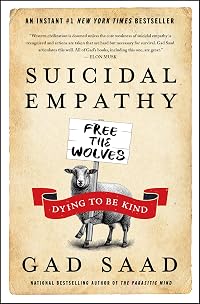
Suicidal Empathy: Dying to Be Kind
by Gad Saad
On This Page
Recommendations












































Member Reviews
For more reviews and bookish posts visit: https://www.ManOfLaBook.com
Suicidal Empathy: Dying to Be Kind by Dr. Gad Saad is a cultural critique on The West's overly sympathetic attitude towards those who clearly say they want to destroy it. Dr. Saad is a Lebanese refugee, now a Canadian physiologist and author.
The book's premise, that I happen to agree with, is that many Western countries are turning inward, actively working towards their own demise. The book challenges modern progressive policies, with wit, or attempted wit, and sensible reasoning.
Suicidal Empathy by Dr. Gad Saad argues that the strict guardrails needed for people and societies to remain functional have been broken in Western countries. These policies value offenders show more over victims, blaming society at large while stopping to be humane even though the intention is otherwise.
The book does not mince words, Dr. Saad diagnoses these policies with aggressiveness and I snot afraid to be confrontational. The narrative forces the reader to differentiate between feel-good polices and the realities of the world. The topics are not just about the Muslim takeover of Canada and Europe, as one would expect, but also touches on criminal reform, and activism at large.
What the good Dr. is implying, but not saying, is that often doing good does not feel good. Any parent who had to discipline a child, or a person walking by a beggar without giving money knows that feeling.
He feels that in this hyper-connected, globalized world, bad actors have effectively relabeled bad behavior as "victimhood", bypassing people's rational defense and survival mechanisms. Doing so people allow themselves to tolerate ideologies which degrade the safety of themselves, their families, and society. According to Dr. Saad, the compassionate policies do more damage than good, but they sure do feel good to support and implement.
The most interesting part of the book is when the author, an evolutionary psychologist, highlights the ideological echo chamber which goes into high gear whenever reality contradicts the empathetic narrative. If reality is not empathetic enough, people just ignore it guided by misplaced compassion making recovery almost impossible.
The last few sections of the book, however, had me puzzled. Dr. Saad starts complaining about unfair tax policies, Canada's healthcare system, and other personal vendettas I believe readers don't care about. I could feel Dr. Saad's passion about the subject though, he is very concerned about these policies and is not shy about them. If you're looking for a data-driven, clinical Il read this is not it. show less
Suicidal Empathy: Dying to Be Kind by Dr. Gad Saad is a cultural critique on The West's overly sympathetic attitude towards those who clearly say they want to destroy it. Dr. Saad is a Lebanese refugee, now a Canadian physiologist and author.
The book's premise, that I happen to agree with, is that many Western countries are turning inward, actively working towards their own demise. The book challenges modern progressive policies, with wit, or attempted wit, and sensible reasoning.
Suicidal Empathy by Dr. Gad Saad argues that the strict guardrails needed for people and societies to remain functional have been broken in Western countries. These policies value offenders show more over victims, blaming society at large while stopping to be humane even though the intention is otherwise.
The book does not mince words, Dr. Saad diagnoses these policies with aggressiveness and I snot afraid to be confrontational. The narrative forces the reader to differentiate between feel-good polices and the realities of the world. The topics are not just about the Muslim takeover of Canada and Europe, as one would expect, but also touches on criminal reform, and activism at large.
What the good Dr. is implying, but not saying, is that often doing good does not feel good. Any parent who had to discipline a child, or a person walking by a beggar without giving money knows that feeling.
He feels that in this hyper-connected, globalized world, bad actors have effectively relabeled bad behavior as "victimhood", bypassing people's rational defense and survival mechanisms. Doing so people allow themselves to tolerate ideologies which degrade the safety of themselves, their families, and society. According to Dr. Saad, the compassionate policies do more damage than good, but they sure do feel good to support and implement.
The most interesting part of the book is when the author, an evolutionary psychologist, highlights the ideological echo chamber which goes into high gear whenever reality contradicts the empathetic narrative. If reality is not empathetic enough, people just ignore it guided by misplaced compassion making recovery almost impossible.
The last few sections of the book, however, had me puzzled. Dr. Saad starts complaining about unfair tax policies, Canada's healthcare system, and other personal vendettas I believe readers don't care about. I could feel Dr. Saad's passion about the subject though, he is very concerned about these policies and is not shy about them. If you're looking for a data-driven, clinical Il read this is not it. show less
Amazon when it came out May 2026
Ratings
Members
- Recently Added By
Lists

Globe and Mail | Canadian Non-Fiction: May 23, 2026
10 works; 1 member
Globe and Mail | Canadian Non-Fiction: May 30, 2026
10 works; 1 member

Globe and Mail | Canadian Non-Fiction: Mid Year Recap, 2026
10 works; 1 member

Globe and Mail | Canadian Non-Fiction: June 13, 2026
10 works; 1 member
Globe and Mail | Canadian Non-Fiction: June 20, 2026
10 works; 1 member

Globe and Mail | Canadian Non-Fiction: June 27, 2026
10 works; 1 member

Globe and Mail | Canadian Non-Fiction: July 4, 2026
10 works; 1 member
Globe and Mail | Canadian Non-Fiction: July 11, 2026
10 works; 1 member
Author Information

7 Works 644 Members
Gad Saad, Ph.D., one of the best-known public intellectuals fighting the tyranny of political correctness, is a professor of marketing at the John Molson School of Business at Concordia University. A pioneer in the application of evolutionary psychology to consumer behavior, he is the author of The Evolutionary Bases of Consumption, The Consuming show more Instinct, and numerous scientific papers and the editor of the book Evolutionary Psychology in the Business Sciences. show less
Common Knowledge
- Canonical title
- Suicidal Empathy: Dying to Be Kind
- Original title
- Suicidal Empathy: Dying to Be Kind
- Original publication date
- 2026-05-12
- Original language
- English
Statistics
- Members
- 53
- Popularity
- 575,433
- Reviews
- 2
- Rating
- (4.00)
- Languages
- English
- Media
- Paper, Audiobook
- ISBNs
- 1
- ASINs
- 1