
Jason L. Riley
Author of Please Stop Helping Us: How Liberals Make It Harder for Blacks to Succeed
About the Author
Jason L. Riley is a senior fellow at the Manhattan Institute and a columnist for the Wall Street Journal, where he has published opinion pieces for more than 25 years. He is the author of several books, including Please Stop Helping Us (2014), False Black Power? (2017), and Maverick: A Biography of show more Thomas Sowell (2021). show less
Works by Jason L. Riley
Please Stop Helping Us: How Liberals Make It Harder for Blacks to Succeed (2014) 210 copies, 6 reviews
Tagged
Common Knowledge
- Gender
- male
- Relationships
- Riley, Naomi Schaefer (wife)
Members
Reviews
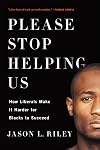
Yes, this one is non-fiction. But this shortish (175 pages) book is making me question some core beliefs I've held for decades. And it will be a while before I finish processing all the questions and alternative perspectives Author Jason L. Riley (a journalist, TV commentator, member of the Wall Street Journal editorial board, and Black American) has presented about liberals and the unintended consequences of their actions on race relations in the United States.
For non-fiction, let me say show more it's quite readable. While there ARE quite a few studies referenced, with relevant quotes cited, you won't feel inundated with too many numbers. Instead, Riley methodically looks at (and casts doubt upon) many of the basic assumptions we have been using for generations to guide public policy.
Like:
• Sub-standard public education can be improved with increased funding.
• Affirmative action in college admissions equates with greater employment opportunities and higher graduation rates for Black Americans and makes it easier for them to escape poverty.
• Civil Rights organizations work in the best interests of Black Americans.
• Charter schools and school voucher programs are bad because they shift money away from urban schools.
• Poor performance in schools and on standardized tests by minority students is an outcome of systematic racism.
• Teacher unions work for the best interests of their students.
• Labor unions help protect jobs.
• Increasing the minimum wage benefits poor people.
Quite a far reaching list! And Riley criticizes a broad range of people -- from Barack Obama to members of some of the most highly respected civil rights organizations in the country. It's not that I necessarily agree with all Riley's arguments, but the evidence he presents is compelling and, at the very least, adds yet another layer of complexity to race issues in this country. As if they weren't complex enough already!
This is one of the books that is important, should be widely read, and needs to become part of the conversation about how best to tackle racism. show less
For non-fiction, let me say show more it's quite readable. While there ARE quite a few studies referenced, with relevant quotes cited, you won't feel inundated with too many numbers. Instead, Riley methodically looks at (and casts doubt upon) many of the basic assumptions we have been using for generations to guide public policy.
Like:
• Sub-standard public education can be improved with increased funding.
• Affirmative action in college admissions equates with greater employment opportunities and higher graduation rates for Black Americans and makes it easier for them to escape poverty.
• Civil Rights organizations work in the best interests of Black Americans.
• Charter schools and school voucher programs are bad because they shift money away from urban schools.
• Poor performance in schools and on standardized tests by minority students is an outcome of systematic racism.
• Teacher unions work for the best interests of their students.
• Labor unions help protect jobs.
• Increasing the minimum wage benefits poor people.
Quite a far reaching list! And Riley criticizes a broad range of people -- from Barack Obama to members of some of the most highly respected civil rights organizations in the country. It's not that I necessarily agree with all Riley's arguments, but the evidence he presents is compelling and, at the very least, adds yet another layer of complexity to race issues in this country. As if they weren't complex enough already!
This is one of the books that is important, should be widely read, and needs to become part of the conversation about how best to tackle racism. show less
Yes, this one is non-fiction. But this shortish (175 pages) book is making me question some core beliefs I've held for decades. And it will be a while before I finish processing all the questions and alternative perspectives Author Jason L. Riley (a journalist, TV commentator, member of the Wall Street Journal editorial board, and Black American) has presented about liberals and the unintended consequences of their actions on race relations in the United States.
For non-fiction, let me say show more it's quite readable. While there ARE quite a few studies referenced, with relevant quotes cited, you won't feel inundated with too many numbers. Instead, Riley methodically looks at (and casts doubt upon) many of the basic assumptions we have been using for generations to guide public policy.
Like:
• Sub-standard public education can be improved with increased funding.
• Affirmative action in college admissions equates with greater employment opportunities and higher graduation rates for Black Americans and makes it easier for them to escape poverty.
• Civil Rights organizations work in the best interests of Black Americans.
• Charter schools and school voucher programs are bad because they shift money away from urban schools.
• Poor performance in schools and on standardized tests by minority students is an outcome of systematic racism.
• Teacher unions work for the best interests of their students.
• Labor unions help protect jobs.
• Increasing the minimum wage benefits poor people.
Quite a far reaching list! And Riley criticizes a broad range of people -- from Barack Obama to members of some of the most highly respected civil rights organizations in the country. It's not that I necessarily agree with all Riley's arguments, but the evidence he presents is compelling and, at the very least, adds yet another layer of complexity to race issues in this country. As if they weren't complex enough already!
This is one of the books that is important, should be widely read, and needs to become part of the conversation about how best to tackle racism. show less
For non-fiction, let me say show more it's quite readable. While there ARE quite a few studies referenced, with relevant quotes cited, you won't feel inundated with too many numbers. Instead, Riley methodically looks at (and casts doubt upon) many of the basic assumptions we have been using for generations to guide public policy.
Like:
• Sub-standard public education can be improved with increased funding.
• Affirmative action in college admissions equates with greater employment opportunities and higher graduation rates for Black Americans and makes it easier for them to escape poverty.
• Civil Rights organizations work in the best interests of Black Americans.
• Charter schools and school voucher programs are bad because they shift money away from urban schools.
• Poor performance in schools and on standardized tests by minority students is an outcome of systematic racism.
• Teacher unions work for the best interests of their students.
• Labor unions help protect jobs.
• Increasing the minimum wage benefits poor people.
Quite a far reaching list! And Riley criticizes a broad range of people -- from Barack Obama to members of some of the most highly respected civil rights organizations in the country. It's not that I necessarily agree with all Riley's arguments, but the evidence he presents is compelling and, at the very least, adds yet another layer of complexity to race issues in this country. As if they weren't complex enough already!
This is one of the books that is important, should be widely read, and needs to become part of the conversation about how best to tackle racism. show less

A good introduction to some of the problems facing black Americans today. It's not structural racism, or segregation, or the ill-effects of slavery or Jim Crow: it's (a) cultural and (b) a poorly functioning government. He did not hit the welfare state as much as he should, but he did go a long way to proving that there is a cultural problem in the black community: few fathers, ghetto culture, distrust of society, hatred of education (aka "acting white"). He lays the perpetuation of such show more poor cultural attitudes at the feet of civil rights hucksters and politicians who benefit from the status quo. Cui bono? No?
Of course, preaching to the choir and will have little effect but to make conservative whites and conservative blacks nod in agreement. show less
Of course, preaching to the choir and will have little effect but to make conservative whites and conservative blacks nod in agreement. show less
Once upon a time, the NYT released a list of Anti-Racist books to read. Like a good bibliophile and researcher, I wrote them down and added them to my Goodreads list. At some point during the process, this book came up on the "people who have read this also read this" suggestion box. Being a firm believer in reading both sides of the story (the truth usually, for me, seems somewhere in the middle) I added it and toddled off to the library, enormous To-Read list of call #s in tow.
All of the show more books I wanted were checked out.*
But, in that same section, was this book (because it wasn't on the NYT list). So, after waffling a bit, picking up a few of [a:Thomas Sowell|2056|Thomas Sowell|https://images.gr-assets.com/authors/1230424337p2/2056.jpg] and [a:Stephen L. Carter|43656|Stephen L. Carter|https://images.gr-assets.com/authors/1341951242p2/43656.jpg] books, I added it to my pile where it haunted me for the next four weeks.
After reading it, I have come to the conclusion that the title is misleading. It should be "How Well-meaning People make it harder for Blacks to Succeed."**
This book, as well as [b:The Souls of Black Folk|318742|The Souls of Black Folk|W.E.B. Du Bois|https://i.gr-assets.com/images/S/compressed.photo.goodreads.com/books/1309202855l/318742._SY75_.jpg|1137159], did a great deal for me in helping me to understand the ongoing ideological conflicts between [a:W.E.B. Du Bois|10710|W.E.B. Du Bois|https://images.gr-assets.com/authors/1211293877p2/10710.jpg] and [a:Booker T Washington|20155130|Booker T Washington|https://s.gr-assets.com/assets/nophoto/user/u_50x66-632230dc9882b4352d753eedf9396530.png]. In fact, that's how he started out. One of the best sections is, in fact, where he picks up where Du Bois leaves off(his history of racism in that book ends in 1903 when it was published) and gives you an in-depth look at facets throughout the 1940s that supported Jim Crow laws(in the working class and, more especially, in the North).
Some of these facets are still around today and effect, most noticeably, the public education system.
Gag.***
Also, his experiences of being stopped, frisked, racially-profiled are worth reading.
Anyway, as far as the writing is concerned, he needs to slow down and clarify in some chapters. There were times I had to flip back several pages to see what his original point was and several times I had to reread a sentence 3 times to get the meaning of it.
End Notes:
I really want to read his book [b:Let Them In: The Case for Open Borders|3243631|Let Them In The Case for Open Borders|Jason L. Riley|https://i.gr-assets.com/images/S/compressed.photo.goodreads.com/books/1433843788l/3243631._SY75_.jpg|3278362] now.
Like any good coward, because this isn't going to be a popular book to read (in light of the title, current popular writers, etc.) I am hugely afraid to write this next sentence but, here goes: I highly recommend reading this book if you want to see the opposing view, if you want to see stats on some recent studies, etc. You can hate me/unfriend me now if you want...
*It only took 3 hours for people to swipe them off the shelves. That's how fast this swept the nation.
** Sorry. But some of those names dropped were definitely not Liberals. And, after what Stephen Carter observed of FDR in [b:Invisible: The Forgotten Story of the Black Woman Lawyer Who Took Down America's Most Powerful Mobster|33898873|Invisible The Forgotten Story of the Black Woman Lawyer Who Took Down America's Most Powerful Mobster|Stephen L. Carter|https://i.gr-assets.com/images/S/compressed.photo.goodreads.com/books/1532468031l/33898873._SX50_.jpg|54863805] one is reminded that hypocrisy is a worldwide epidemic. :)
*** I don't need sources on this one. I have friends who confirm it. show less
All of the show more books I wanted were checked out.*
But, in that same section, was this book (because it wasn't on the NYT list). So, after waffling a bit, picking up a few of [a:Thomas Sowell|2056|Thomas Sowell|https://images.gr-assets.com/authors/1230424337p2/2056.jpg] and [a:Stephen L. Carter|43656|Stephen L. Carter|https://images.gr-assets.com/authors/1341951242p2/43656.jpg] books, I added it to my pile where it haunted me for the next four weeks.
After reading it, I have come to the conclusion that the title is misleading. It should be "How Well-meaning People make it harder for Blacks to Succeed."**
This book, as well as [b:The Souls of Black Folk|318742|The Souls of Black Folk|W.E.B. Du Bois|https://i.gr-assets.com/images/S/compressed.photo.goodreads.com/books/1309202855l/318742._SY75_.jpg|1137159], did a great deal for me in helping me to understand the ongoing ideological conflicts between [a:W.E.B. Du Bois|10710|W.E.B. Du Bois|https://images.gr-assets.com/authors/1211293877p2/10710.jpg] and [a:Booker T Washington|20155130|Booker T Washington|https://s.gr-assets.com/assets/nophoto/user/u_50x66-632230dc9882b4352d753eedf9396530.png]. In fact, that's how he started out. One of the best sections is, in fact, where he picks up where Du Bois leaves off(his history of racism in that book ends in 1903 when it was published) and gives you an in-depth look at facets throughout the 1940s that supported Jim Crow laws(in the working class and, more especially, in the North).
Some of these facets are still around today and effect, most noticeably, the public education system.
Gag.***
Also, his experiences of being stopped, frisked, racially-profiled are worth reading.
Anyway, as far as the writing is concerned, he needs to slow down and clarify in some chapters. There were times I had to flip back several pages to see what his original point was and several times I had to reread a sentence 3 times to get the meaning of it.
End Notes:
I really want to read his book [b:Let Them In: The Case for Open Borders|3243631|Let Them In The Case for Open Borders|Jason L. Riley|https://i.gr-assets.com/images/S/compressed.photo.goodreads.com/books/1433843788l/3243631._SY75_.jpg|3278362] now.
Like any good coward, because this isn't going to be a popular book to read (in light of the title, current popular writers, etc.) I am hugely afraid to write this next sentence but, here goes: I highly recommend reading this book if you want to see the opposing view, if you want to see stats on some recent studies, etc. You can hate me/unfriend me now if you want...
*It only took 3 hours for people to swipe them off the shelves. That's how fast this swept the nation.
** Sorry. But some of those names dropped were definitely not Liberals. And, after what Stephen Carter observed of FDR in [b:Invisible: The Forgotten Story of the Black Woman Lawyer Who Took Down America's Most Powerful Mobster|33898873|Invisible The Forgotten Story of the Black Woman Lawyer Who Took Down America's Most Powerful Mobster|Stephen L. Carter|https://i.gr-assets.com/images/S/compressed.photo.goodreads.com/books/1532468031l/33898873._SX50_.jpg|54863805] one is reminded that hypocrisy is a worldwide epidemic. :)
*** I don't need sources on this one. I have friends who confirm it. show less
Lists
You May Also Like


Statistics
- Works
- 6
- Members
- 518
- Popularity
- #47,944
- Rating
- 4.2
- Reviews
- 14
- ISBNs
- 22