
F. A. Hayek (1899–1992)
Author of The Road to Serfdom
About the Author
F. A. Hayek (1899-1992), recipient of the Medal of Freedom in 1991 and co-winner of the Nobel Memorial Prize in Economic Sciences in 1974, was a pioneer in monetary theory and one of the principal proponents of classical liberal thought in the twentieth century. He taught at the University of show more London, the University of Chicago, and the University of Freiburg. show less
Image credit: GFDL picture of F.A. Hayek to replace fair use images that are used in some articles. Released by the Mises Institute.
Series
Works by F. A. Hayek
Law, Legislation and Liberty: A new statement of the liberal principles of justice and political economy (Routledge Classics) (1982) 164 copies, 2 reviews
The Fortunes of Liberalism: Essays on Austrian Economics and the Ideal of Freedom (The Collected Works of F. A. Hayek) (1992) 87 copies
Denationalisation of Money: The Argument Refined (An Analysis of the Theory and Practice of Concurrent Currencies Series)) (1976) 86 copies, 1 review
Hayek on Hayek: An Autobiographical Dialogue (The Collected Works of F. A. Hayek) (1994) 73 copies, 2 reviews
The Trend of Economic Thinking: Essays on Political Economists and Economic History (The Collected Works of F. A. Hayek) (1991) 68 copies
Contra Keynes and Cambridge: Essays, Correspondence (The Collected Works of F. A. Hayek) (1995) 52 copies
Prices and Production and Other Works On Money, the Business Cycle, and the Gold Standard (2008) 51 copies
Unemployment and Monetary Policy: Government As Generator of the "Business Cycle (Cato Paper ; No. 3) (1979) 30 copies
Profits, interest, and investment: And other essays on the theory of industrial fluctuations (Reprints of economic classics) (1975) 11 copies
The Road to Serfdom: Illustrated Edition (The Road to Serfdom - Condensed Version - Illustrated) (2014) 9 copies, 1 review
Hayek on Mill: The Mill-Taylor Friendship and Related Writings (The Collected Works of F. A. Hayek) (2015) 9 copies
Unfinished Agenda: Essays on the Political Economy of Government Policy in Honour of Arthur Seldon (1986) 5 copies
Beiträge zur Geldtheorie von Marco Fanno, Marius W. Holtrop, Johan G. Koopmans, Gunar Myrdal, Knut Wicksell (2007) 4 copies
Toward Liberty Volume II of Two Volumes: Essays in Honor of Ludwig von Mises on the Occasion of His 90th Birthday, September 29, 1971 (1971) 4 copies
O Caminho da Servidão: 2ª Edição 4 copies
Nineteen Eighties Unemployment and the Unions: Essays on the Impotent Price Structure of Britain and Monopoly in the Lab (1980) 4 copies
A Discussion With Friedrich A. Von Hayek: Held at the American Enterprise Institute on April 9, 1975 (Domestic Affairs Studies ; 39) (1975) 3 copies
Los fundamentos de la libertad. 3 copies
AUSTRIAN AND NEOCLASSICAL ECONOMICS: ANY GAINS FROM TRADE?: LEGACY OF FRIEDRICH VON HAYEK VOL 1 DVD (2008) 3 copies
Obras Completas. Volumen I. Hayek Sobre Hayek: Un Dialogo Autobiográfico . La Fatal Arrogancia: Los Errores Del Socialismo (1997) 3 copies
HAYEK AND THE FATE OF LIBERTY IN THE TWENTIETH CENTURY: LEGACY OF FRIEDRICH VON HAYEK DVD VOL 6 (2000) 2 copies
Responsibility and Freedom 2 copies
Studies on the Abuse & Decline of Reason: Text and Documents (The Collected Works of F.A. Hayek Book 13) (2010) 2 copies
Conversation with Friedrich A. von Hayek: Science and Socialism (Studies in Economic Policy) (1979) 2 copies
The Legacy of Friedrich von Hayek Audio Tapes: Seven-Volume Set (Audio Tapes 7 Vol Set (USA)) (2000) 2 copies
Desestatização do dinheiro 2 copies
MORALITY AND COMMUNITY IN THE EXTENDED MARKET ORDER: LEGACY OF FRIEDRICH VON HAYEK DVD VOL 7 (2009) 2 copies
Verdict on rent control : essays on the economic consequences of political action to restrict rents in five countries (1972) 1 copy
Collected Works V6 1 copy
Collected Works V5 1 copy
Scambio e democrazia 1 copy
Keynes 1 copy
Essays on Liberalism and the Economy, Volume 18 (Volume 18) (The Collected Works of F. A. Hayek) (2022) 1 copy
Droit législation et liberté 1 copy
LIBERTAD BAJO LA LEY 1 copy
Intellectuals and Socialism 1 copy
Constitutia libertatii 1 copy
Freiburger Studien; 1 copy
The Life of John Stuart Mill 1 copy
New Studies 1 copy
The Pretense of Knowledge 1 copy
The Errors of Socialism 1 copy
Associated Works
The Austrian Theory of the Trade Cycle and Other Essays (1996) — Contributor — 113 copies, 2 reviews
The Critical Approach to Science and Philosophy : In Honor of Karl R. Popper (1964) — Contributor — 19 copies
Tagged
Common Knowledge
- Canonical name
- Hayek, F. A.
- Legal name
- Hayek, Friedrich August von
- Birthdate
- 1899-05-08
- Date of death
- 1992-03-23
- Gender
- male
- Education
- University of Vienna (Ph.D|Law|1921) (Ph.D|Political Science|1923)
- Occupations
- economist
professor - Organizations
- Mont Pelerin Society
Institute of Economic Affairs
Austro-Hungarian Army
London School of Economics
University of Chicago
University of Freiburg (show all 7)
University of Salzburg - Awards and honors
- Nobel Prize (Economics, 1974)
Order of the Companions of Honour (1984)
Presidential Medal of Freedom (1991)
Fellow, British Academy (1944)
Pour le mérite für Wissenschaft und Künste (1977)
Honorary Ring of Vienna (1983) (show all 9)
Grand Gold Medal with Star for Services to the Republic of Austria (1990)
Econometric Society, Fellow (1947)
Austrian Decoration for Science and Art (1974) - Relationships
- Popper, Karl (friend, colleague)
Mises, Ludwig von (mentor, colleague) - Nationality
- Austria
- Birthplace
- Vienna, Austria
- Places of residence
- London, Middlesex, England, UK
Cambridge, Cambridgeshire, England, UK
Chicago, Illinois, USA - Place of death
- Freiburg, Germany
- Burial location
- Neustift am Wald cemetery, Vienna, Austria
Members
Discussions
Hayek, Keynes, and two mics in Pro and Con (May 2011)
The Hayek Interviews in Pro and Con (July 2010)
Reviews

Summary: An argument that collectivist, planned economies lead to the erosion of individual liberties, the rule of law, and result in the rise of totalitarian governments.
It is probably not insignificant that F. A. Hayek, an economist who grew up and was educated in Austria, emigrated to England in 1938 and wrote this work during World War Two. He later moved to the United States. This book, less a work on economics than political philosophy, is an argument for the classic (not contemporary) show more liberal ideal that emphasized the rights and initiative of the individual, a limited role for government, a relatively unrestrained marketplace, and the rule of law. His basic argument is that the shift he was seeing from this liberal ideal to socialist, planned economies in England reflected the same course that he witnessed in the rise of National Socialism in Nazi Germany and Communism in the Stalinist Russia.
He argues that planned economies can never plan for all the variables of the marketplace, that those who buy and sell goods and services can more nimbly respond to. Planning undercuts the initiative of the individual and leads to increasingly authoritarian forms of government, required to enforce the efforts needed toward economic plans. Instead of seeking equality in liberty, the collectivist system achieves equality through restraint and servitude. These increasing coercive efforts result in the arbitrary use of authority rather than the rule of law. Paradoxically, even the poor are less free under such a system.
The question is who ultimately occupies the role of planners. Hayek offers a telling critique of the idea of the “common good,” which often remains undefined. And often, this happens to be the worst among us, those who are not constrained by moral restraints or concerns about truth. Perhaps the most chilling chapter in this work is the one titled, “The End of Truth,” reminding one of the “Post-truth era” in which we live. Authoritarian rulers develop their own myths to justify their rise to power and rule. Instead, all the channels used to spread knowledge are pressed into service to “strengthen the belief in the rightness of the decisions taken by the authority” (p. 175).
Hayek does allow a role for government in a capitalist economy, not in restricting trade but in regulating methods of legal production, sanitary and safe practices, the protection of environmental resources, and preventing fraud. He also allows a basic level of economic and health security as a concern of government.
It strikes me that Hayek’s fears of planned economies have not been realized in the socialist countries of Europe. My own sense is that what has occurred instead is an enlarged role of government to protect us from recessions, economic cycles, the consequences of shifts in the marketplace, and even personal misfortunes. This diminishment of the individual and dependency does leave us vulnerable to Hayek’s feared authoritarianism and the eclipse of the rule of law.
What troubles me in Hayek’s liberal ideal of individual liberty is that such systems are often blind to the inequities baked into the system, protecting individual liberty for only some who are citizens. Furthermore, these systemic inequities leave capitalist economies vulnerable to being supplanted by more planned economies that offer a vision of equality for the disadvantaged.
Nevertheless, Hayek’s critique of “planning,” of the rise of coercion, of the justification of means to achieve ends, the rise of authority and the suspension of rule of law, and the jettisoning of truth are all important to consider in our day. Hayek’s concern in looking at Nazi Germany was the recognition that it could happen in socialist England. While I suspect that there are more variant roads to totalitarian, Hayek’s recognition of the important elements of liberal democracy are worth attending to, as is the recognition that should we neglect these elements, it can happen here as well. show less
It is probably not insignificant that F. A. Hayek, an economist who grew up and was educated in Austria, emigrated to England in 1938 and wrote this work during World War Two. He later moved to the United States. This book, less a work on economics than political philosophy, is an argument for the classic (not contemporary) show more liberal ideal that emphasized the rights and initiative of the individual, a limited role for government, a relatively unrestrained marketplace, and the rule of law. His basic argument is that the shift he was seeing from this liberal ideal to socialist, planned economies in England reflected the same course that he witnessed in the rise of National Socialism in Nazi Germany and Communism in the Stalinist Russia.
He argues that planned economies can never plan for all the variables of the marketplace, that those who buy and sell goods and services can more nimbly respond to. Planning undercuts the initiative of the individual and leads to increasingly authoritarian forms of government, required to enforce the efforts needed toward economic plans. Instead of seeking equality in liberty, the collectivist system achieves equality through restraint and servitude. These increasing coercive efforts result in the arbitrary use of authority rather than the rule of law. Paradoxically, even the poor are less free under such a system.
The question is who ultimately occupies the role of planners. Hayek offers a telling critique of the idea of the “common good,” which often remains undefined. And often, this happens to be the worst among us, those who are not constrained by moral restraints or concerns about truth. Perhaps the most chilling chapter in this work is the one titled, “The End of Truth,” reminding one of the “Post-truth era” in which we live. Authoritarian rulers develop their own myths to justify their rise to power and rule. Instead, all the channels used to spread knowledge are pressed into service to “strengthen the belief in the rightness of the decisions taken by the authority” (p. 175).
Hayek does allow a role for government in a capitalist economy, not in restricting trade but in regulating methods of legal production, sanitary and safe practices, the protection of environmental resources, and preventing fraud. He also allows a basic level of economic and health security as a concern of government.
It strikes me that Hayek’s fears of planned economies have not been realized in the socialist countries of Europe. My own sense is that what has occurred instead is an enlarged role of government to protect us from recessions, economic cycles, the consequences of shifts in the marketplace, and even personal misfortunes. This diminishment of the individual and dependency does leave us vulnerable to Hayek’s feared authoritarianism and the eclipse of the rule of law.
What troubles me in Hayek’s liberal ideal of individual liberty is that such systems are often blind to the inequities baked into the system, protecting individual liberty for only some who are citizens. Furthermore, these systemic inequities leave capitalist economies vulnerable to being supplanted by more planned economies that offer a vision of equality for the disadvantaged.
Nevertheless, Hayek’s critique of “planning,” of the rise of coercion, of the justification of means to achieve ends, the rise of authority and the suspension of rule of law, and the jettisoning of truth are all important to consider in our day. Hayek’s concern in looking at Nazi Germany was the recognition that it could happen in socialist England. While I suspect that there are more variant roads to totalitarian, Hayek’s recognition of the important elements of liberal democracy are worth attending to, as is the recognition that should we neglect these elements, it can happen here as well. show less
Hayek is a difficult and controversial subject for review. He and Milton Friedman are heroes to advocates of free market economics, and they are villains to others. I’ll say a little more about contemporary relevance at the end, but I’ll do my best to stay focused on Hayek’s thought as expressed in The Road to Serfdom.
Hayek originally wrote The Road to Serfdom during World War II, for a British audience. He was warning his readers that the seeds of Nazi Germany were not exclusively show more German, that the danger was widespread throughout England itself and was coming to fulfillment in the Soviet Union, in a different form but still from the same seeds.
The seeds that Hayek identified have to do with “central planning.” Actually he uses three terms, “socialism,” “collectivism,” and “central planning” to identify different perspectives on what he regards as a dangerous way of thinking about and organizing a nation’s economy.
“Planning” is, I think, the core concept. Hayek views planning or “central planning” as essential to socialism. The insight behind socialism, as he discusses it, is that a rational economy is a planned economy, one organized efficiently toward some end by a central governing power. Coercion then becomes, in Hayek’s view, as essential as planning itself, in so far as the aspirations and activities of individuals must, for planning to succeed, be subservient to the decisions of the central governing power.
Given the importance of planning as the object of Hayek’s thinking, we need to know what “planning” means. Hayek distinguishes two types of economic rules or legislation on economic matters. “Formal rules” are instrumental. They have to do with that system of laws that establish and maintain the playing ground of economic activity, rules of competition for example. In one illustration, Hayek refers to such instrumental rules as “rules of the road” analogous to rules for highways — speed limits, rights of way, etc.
By contrast to rules of the road there are rules that would prescribe destinations — call them rules pertaining to ends rather than means or instrumental rules. As opposed to rules regarding speed limits and rights of way, these would be rules regarding where one should travel.
The latter rules would constitute “planning” or “central planning” if they have to do with the direction of the economic activities of a state toward a chosen particular goal or a set of goals.
Note that the means of legislation is not the crux of the matter for Hayek. Although he certainly favors democratic institutions, rules can be legislated by democratic bodies, or they could be set in place by dictatorships. In either case, for this discussion what matters is their scope and whether they constitute planning. Hayek is not blind of course to the greater likelihood that a dictatorship (or a select group of decision-makers) will pursue ends of its own choosing as opposed to a democratic body reaching agreement on those ends. But he expresses his opposition to democratic bodies engaging in planning, just as he does for dictatorial governments doing so.
In understanding this point, keep in mind that Hayek is writing this book during the reign of Hitler in Germany, and that the question of whether Hitler’s rise to power and securing of broad governmental power was achieved legally and even democratically was in debate. It's also worthwhile to keep in mind that Hayek’s objections to planning may override the value he places on democratic self-determination when we consider his much later embrace of non-democratically established governments like Pinochet’s in Chile (and its overthrow of a democratically elected socialist government).
Overstepping formal rules to engage in planning could happen in lots of ways. The most straightforward, and the one that Hayek gives most attention to, is when governments take it upon themselves to plan, to organize economies toward particular goals. This is “state socialism.” He criticizes both the very idea of a government organizing the economy toward specific goals and what he regards as the emptiness or vagueness of goals such as “the common good” or “the general welfare.”
Other ways, though, in which central planning might develop involve exertion of influence by particular individuals or entities in their own interests, to serve their particular economic ends. Thus corporations or wealthy individuals who exert influence over the legislative process to further their own advantages and ends would be guilty of “planning.” That sort of corruption (or “crony capitalism”) isn’t Hayek’s concern so much in this book, but it does fit his conception of governmental overstepping, or ‘planning” by his terms, and results likewise in coercion of some to support the goals of others.
Of course, all government is in some sense coercive. Laws coerce behavior. But a contrast between central planning and how Hayek understands “liberalism” will help.
Remember that “liberalism” for Hayek is meant in its nineteenth century use, not in its current popular use, especially in American politics. “Liberalism” is an organization of economic behavior in which Individuals are left free to pursue their own ambitions in a competitive environment. It is not an entirely unplanned economy — that competitive environment is maintained by “a carefully thought out legal framework.”
The key elements are individualism and competition. Hayek is proposing a legally maintained arena of competitive individuals each pursuing their own ambitions and plans, as opposed to a centrally planned economy, rationally organized to some end (e.g., general welfare, a high standard of living, or, I suppose, simply an egalitarian distiribution of goods).
Hayek is not a proponent of laissez faire economics. In rejecting that term, he says, “An effective competitive system is an intelligently designed and continuously adjusted legal framework as much as any other.” The role he allots to government and the legal system is to assure that “competition should work beneficially.” Laws to regulate monopolistic power, barriers to entry to markets, manipulation of prices, etc. are all fair game, in so far as they promote competition as a “beneficial” engine of economic activity.
Nor does he exclude from that legal framework provisions for minimum wages and other labor-facing protections so long as they do the same, that is, promote competition as a beneficial force.
He also does not think that prices (and here he may disagree with Friedman) provide a universal mechanism for preventing and controlling such things as environmental damage (Hayek specificaly calls out deforestation) or other harmful effects of economic production. These, he says, do require other mechanisms, namely legal authority and regulation.
It’s worth pointing out some of these points on which Hayek favors government action, not only just to get his position correct, but also to dissociate him from others who may take more extreme positions. Hayek is not an opponent of the welfare state per se. As he says, “ . . . there can be no doubt that some minimum of food, shelter, and clothing, sufficient to preserve health and the capacity to work, can be assured to everyone.” He would also include the provision of something he terms “social insurance” — “Nor is there any reason why the state should not assist the individuals in providing for those common hazards of life against which, because of their uncertainty, few individuals can make adequate provision.” He includes “sickness and accident” as examples.
He also discusses, in the same passage, the damages to individuals that arise from economic fluctuations. Hayek after all was writing in the aftermath of the Great Depression. He considers monetary policy interventions as well as large scale public works programs as measures that do not reach into the kind of planning he believes a threat to freedom, although he regards public works programs as experiments to be watched carefully.
He specifically rules out any kind of insurance or security that would protect individuals from a competitive loss of value in their trade or their products. That kind of intervention, like price or wage controls, he believes, would imperil the function of competition as the engine of free economic activity.
The key criteria that Hayek leans on to distinguish a healthy economic structure from an unhealthy one are competition and economic freedom (as distinct from central planning and coercion in the senses we’ve discussed).
Given that, let’s look more closely at Hayek’s central claim regarding freedom and coercion.
Hayek’s claim that central planning (“socialism” in his understanding of the term) inevitably leads to political fascism or totalitarianism is a claim about the interplay of political and economic freedom and power.
Hayek (and others) distinguish political freedom, e.g., the freedoms protected by the American Bill of Rights, from economic freedoms. The former provide for participation in self-determination (voting), speech or expression, etc. The latter provide for participation in specifically economic activities — buying, selling, practicing a trade, etc.
It is critical for Hayek that the two, economic and political power, are kept separate. Where political power assumes economic power, you have central planning and coercion.
The two are certainly distinguishable, but they also interact, even are entwined in practice. Hayek’s attention is more strongly focused on political power crossing the boundary to assume economic power. But the reverse is also dangerous.
In our own American system, the influence of economic power on political power is obvious. Manipulation of the rules of competition via political power, based on economic power, is in play. As is a vicious cycle in which economic power drives political power to tilt competition in the favor of powerful economic players (large companies), which contributes to gains for those players in economic terms, which drives more political influence, and so on. The kinds of political influence that economic players may exercise, it should be unnecessary to mention, include lobbying to push favorable legislation, influence over appointments to executive government positions, campaign finance and its regulation or deregulation, etc.
That argument in fact suggests a similar tendency to Hayek’s own argument for the inevitability of coercion in socialist economies, a tendency toward corruption in economies where economic and political power are not kept separate. In an economy grounded on competition, competitive advantage is prized. And if economic power, once attained, can be used to gain political power and skew the competitive playing field in someone’s favor, that’s presumably what they will do — an argument for the “inevitability” of corruption unless prevented by adequate laws or political structures like checks and balances.
So far as I see, Hayek does not address that danger here in this book, although his insistence on the separation of political and economic power implies its presence.
Bringing Hayek’s thinking here into the context of our own contemporary concerns is going to require close attention to the finer points of political and economic power relationships.
The boundary between harmful and beneficial economic regulation, or intervention in general isn’t always going to be clear. Hayek thinks that the engine that drives healthy economic activity is competition. Interventions that limit competition are harmful, and ones that promote competition are healthy. But it’s not always going to be clear which is which.
It’s also not clear that he would rule out public management of some areas of economic activity, where competition does not serve a beneficial purpose. Although, relevant to our contemporary concerns, it is clear that he sees some role for intervention in healthcare, for example, it’s not clear what that role is, whether it should be confined for example to catastrophic “social insurance” or something broader. And of course that’s for us to debate.
He does not favor government management of parts of the economy where monopolies develop organically, as in utilities where infrastructure investments or other factors favor the emergence of a dominant player. In such cases, he favors what he calls the “American” approach to regulation rather than public takeover.
Hayek himself doesn’t focus on these finer points of political and economic power in this book. At the time of writing this book, he was less concerned with the finer points than the larger ones — his concerns were more directly focused on Nazi Germany and the centrally planned economy of the Soviet Union.
He does mention, in a preface written later, economies like Sweden’s that do contain some elements of what he would consider central planning, and he warns that such countries will find their way inevitably to a broadening of central planning and coercion. Whether that is true of Sweden, for example, is something we could debate as well, although it seems a stretch to claim that Sweden is, or is on a trajectory toward, a totalitarian state.
Hayek’s own later work will fill in some holes from The Road to Serfdom, in particular, his theory of local knowledge and self-organization as the basis for stability in a competitive economy. That theory is also historically interesting in the light of Hayek’s peripheral participation in the Vienna Circle prior to World War II. The Vienna Circle, especially as influenced by Ludwig Wittgenstein (a second cousin to Hayek), often took anti-theoretical positions, the kinds that would support a rejection of the kind of knowledge presumed by central planning economic models.
Hayek mentions in The Road to Serfdom the claim that the kind of knowledge necessary to central planning is inaccessible, given the complexity and dynamism of a national economy, but he doesn’t flesh out his arguments here.
We could go on to much larger discussions of planning, economic and political freedom, competition, the “free market system”, the role of government, and more. I think, if you want to read something that furthers your thinking after reading Hayek, one contemporary book that would be helpful is Joseph Stiglitz’s recent book, The Road to Freedom. Stiglitz challenges Hayek’s notion of freedom, in fact arguing that that notion is unexamined and undeveloped, proposing his own conception of freedom as “opportunity sets.” He also challenges assumptions he believes necessary to the beneficial workings of a free market, assumptions not met by actual economies.
Hayek and Stiglitz are economists. If you want to pursue a more philosophical vein, Robert Nozick’s Anarchy, State, and Utopia is an updated (although now itself about 50 years old) argument for libertarianism and minimalistic government. And, by counterpoint to both Hayek and Nozick, John Rawls’ A Theory of Justice presents and defends a more active role for the state in providing for a just distribution of resources, while also respecting and enabling individualiastic life plans and conceptions of a good life. Rawls’ book is a classic and a touchstone for any modern discussion of political philosophy.
All grist for thought, and all the more needed at a time when political talk so far outpaces political thought. show less
Hayek originally wrote The Road to Serfdom during World War II, for a British audience. He was warning his readers that the seeds of Nazi Germany were not exclusively show more German, that the danger was widespread throughout England itself and was coming to fulfillment in the Soviet Union, in a different form but still from the same seeds.
The seeds that Hayek identified have to do with “central planning.” Actually he uses three terms, “socialism,” “collectivism,” and “central planning” to identify different perspectives on what he regards as a dangerous way of thinking about and organizing a nation’s economy.
“Planning” is, I think, the core concept. Hayek views planning or “central planning” as essential to socialism. The insight behind socialism, as he discusses it, is that a rational economy is a planned economy, one organized efficiently toward some end by a central governing power. Coercion then becomes, in Hayek’s view, as essential as planning itself, in so far as the aspirations and activities of individuals must, for planning to succeed, be subservient to the decisions of the central governing power.
Given the importance of planning as the object of Hayek’s thinking, we need to know what “planning” means. Hayek distinguishes two types of economic rules or legislation on economic matters. “Formal rules” are instrumental. They have to do with that system of laws that establish and maintain the playing ground of economic activity, rules of competition for example. In one illustration, Hayek refers to such instrumental rules as “rules of the road” analogous to rules for highways — speed limits, rights of way, etc.
By contrast to rules of the road there are rules that would prescribe destinations — call them rules pertaining to ends rather than means or instrumental rules. As opposed to rules regarding speed limits and rights of way, these would be rules regarding where one should travel.
The latter rules would constitute “planning” or “central planning” if they have to do with the direction of the economic activities of a state toward a chosen particular goal or a set of goals.
Note that the means of legislation is not the crux of the matter for Hayek. Although he certainly favors democratic institutions, rules can be legislated by democratic bodies, or they could be set in place by dictatorships. In either case, for this discussion what matters is their scope and whether they constitute planning. Hayek is not blind of course to the greater likelihood that a dictatorship (or a select group of decision-makers) will pursue ends of its own choosing as opposed to a democratic body reaching agreement on those ends. But he expresses his opposition to democratic bodies engaging in planning, just as he does for dictatorial governments doing so.
In understanding this point, keep in mind that Hayek is writing this book during the reign of Hitler in Germany, and that the question of whether Hitler’s rise to power and securing of broad governmental power was achieved legally and even democratically was in debate. It's also worthwhile to keep in mind that Hayek’s objections to planning may override the value he places on democratic self-determination when we consider his much later embrace of non-democratically established governments like Pinochet’s in Chile (and its overthrow of a democratically elected socialist government).
Overstepping formal rules to engage in planning could happen in lots of ways. The most straightforward, and the one that Hayek gives most attention to, is when governments take it upon themselves to plan, to organize economies toward particular goals. This is “state socialism.” He criticizes both the very idea of a government organizing the economy toward specific goals and what he regards as the emptiness or vagueness of goals such as “the common good” or “the general welfare.”
Other ways, though, in which central planning might develop involve exertion of influence by particular individuals or entities in their own interests, to serve their particular economic ends. Thus corporations or wealthy individuals who exert influence over the legislative process to further their own advantages and ends would be guilty of “planning.” That sort of corruption (or “crony capitalism”) isn’t Hayek’s concern so much in this book, but it does fit his conception of governmental overstepping, or ‘planning” by his terms, and results likewise in coercion of some to support the goals of others.
Of course, all government is in some sense coercive. Laws coerce behavior. But a contrast between central planning and how Hayek understands “liberalism” will help.
Remember that “liberalism” for Hayek is meant in its nineteenth century use, not in its current popular use, especially in American politics. “Liberalism” is an organization of economic behavior in which Individuals are left free to pursue their own ambitions in a competitive environment. It is not an entirely unplanned economy — that competitive environment is maintained by “a carefully thought out legal framework.”
The key elements are individualism and competition. Hayek is proposing a legally maintained arena of competitive individuals each pursuing their own ambitions and plans, as opposed to a centrally planned economy, rationally organized to some end (e.g., general welfare, a high standard of living, or, I suppose, simply an egalitarian distiribution of goods).
Hayek is not a proponent of laissez faire economics. In rejecting that term, he says, “An effective competitive system is an intelligently designed and continuously adjusted legal framework as much as any other.” The role he allots to government and the legal system is to assure that “competition should work beneficially.” Laws to regulate monopolistic power, barriers to entry to markets, manipulation of prices, etc. are all fair game, in so far as they promote competition as a “beneficial” engine of economic activity.
Nor does he exclude from that legal framework provisions for minimum wages and other labor-facing protections so long as they do the same, that is, promote competition as a beneficial force.
He also does not think that prices (and here he may disagree with Friedman) provide a universal mechanism for preventing and controlling such things as environmental damage (Hayek specificaly calls out deforestation) or other harmful effects of economic production. These, he says, do require other mechanisms, namely legal authority and regulation.
It’s worth pointing out some of these points on which Hayek favors government action, not only just to get his position correct, but also to dissociate him from others who may take more extreme positions. Hayek is not an opponent of the welfare state per se. As he says, “ . . . there can be no doubt that some minimum of food, shelter, and clothing, sufficient to preserve health and the capacity to work, can be assured to everyone.” He would also include the provision of something he terms “social insurance” — “Nor is there any reason why the state should not assist the individuals in providing for those common hazards of life against which, because of their uncertainty, few individuals can make adequate provision.” He includes “sickness and accident” as examples.
He also discusses, in the same passage, the damages to individuals that arise from economic fluctuations. Hayek after all was writing in the aftermath of the Great Depression. He considers monetary policy interventions as well as large scale public works programs as measures that do not reach into the kind of planning he believes a threat to freedom, although he regards public works programs as experiments to be watched carefully.
He specifically rules out any kind of insurance or security that would protect individuals from a competitive loss of value in their trade or their products. That kind of intervention, like price or wage controls, he believes, would imperil the function of competition as the engine of free economic activity.
The key criteria that Hayek leans on to distinguish a healthy economic structure from an unhealthy one are competition and economic freedom (as distinct from central planning and coercion in the senses we’ve discussed).
Given that, let’s look more closely at Hayek’s central claim regarding freedom and coercion.
Hayek’s claim that central planning (“socialism” in his understanding of the term) inevitably leads to political fascism or totalitarianism is a claim about the interplay of political and economic freedom and power.
Hayek (and others) distinguish political freedom, e.g., the freedoms protected by the American Bill of Rights, from economic freedoms. The former provide for participation in self-determination (voting), speech or expression, etc. The latter provide for participation in specifically economic activities — buying, selling, practicing a trade, etc.
It is critical for Hayek that the two, economic and political power, are kept separate. Where political power assumes economic power, you have central planning and coercion.
The two are certainly distinguishable, but they also interact, even are entwined in practice. Hayek’s attention is more strongly focused on political power crossing the boundary to assume economic power. But the reverse is also dangerous.
In our own American system, the influence of economic power on political power is obvious. Manipulation of the rules of competition via political power, based on economic power, is in play. As is a vicious cycle in which economic power drives political power to tilt competition in the favor of powerful economic players (large companies), which contributes to gains for those players in economic terms, which drives more political influence, and so on. The kinds of political influence that economic players may exercise, it should be unnecessary to mention, include lobbying to push favorable legislation, influence over appointments to executive government positions, campaign finance and its regulation or deregulation, etc.
That argument in fact suggests a similar tendency to Hayek’s own argument for the inevitability of coercion in socialist economies, a tendency toward corruption in economies where economic and political power are not kept separate. In an economy grounded on competition, competitive advantage is prized. And if economic power, once attained, can be used to gain political power and skew the competitive playing field in someone’s favor, that’s presumably what they will do — an argument for the “inevitability” of corruption unless prevented by adequate laws or political structures like checks and balances.
So far as I see, Hayek does not address that danger here in this book, although his insistence on the separation of political and economic power implies its presence.
Bringing Hayek’s thinking here into the context of our own contemporary concerns is going to require close attention to the finer points of political and economic power relationships.
The boundary between harmful and beneficial economic regulation, or intervention in general isn’t always going to be clear. Hayek thinks that the engine that drives healthy economic activity is competition. Interventions that limit competition are harmful, and ones that promote competition are healthy. But it’s not always going to be clear which is which.
It’s also not clear that he would rule out public management of some areas of economic activity, where competition does not serve a beneficial purpose. Although, relevant to our contemporary concerns, it is clear that he sees some role for intervention in healthcare, for example, it’s not clear what that role is, whether it should be confined for example to catastrophic “social insurance” or something broader. And of course that’s for us to debate.
He does not favor government management of parts of the economy where monopolies develop organically, as in utilities where infrastructure investments or other factors favor the emergence of a dominant player. In such cases, he favors what he calls the “American” approach to regulation rather than public takeover.
Hayek himself doesn’t focus on these finer points of political and economic power in this book. At the time of writing this book, he was less concerned with the finer points than the larger ones — his concerns were more directly focused on Nazi Germany and the centrally planned economy of the Soviet Union.
He does mention, in a preface written later, economies like Sweden’s that do contain some elements of what he would consider central planning, and he warns that such countries will find their way inevitably to a broadening of central planning and coercion. Whether that is true of Sweden, for example, is something we could debate as well, although it seems a stretch to claim that Sweden is, or is on a trajectory toward, a totalitarian state.
Hayek’s own later work will fill in some holes from The Road to Serfdom, in particular, his theory of local knowledge and self-organization as the basis for stability in a competitive economy. That theory is also historically interesting in the light of Hayek’s peripheral participation in the Vienna Circle prior to World War II. The Vienna Circle, especially as influenced by Ludwig Wittgenstein (a second cousin to Hayek), often took anti-theoretical positions, the kinds that would support a rejection of the kind of knowledge presumed by central planning economic models.
Hayek mentions in The Road to Serfdom the claim that the kind of knowledge necessary to central planning is inaccessible, given the complexity and dynamism of a national economy, but he doesn’t flesh out his arguments here.
We could go on to much larger discussions of planning, economic and political freedom, competition, the “free market system”, the role of government, and more. I think, if you want to read something that furthers your thinking after reading Hayek, one contemporary book that would be helpful is Joseph Stiglitz’s recent book, The Road to Freedom. Stiglitz challenges Hayek’s notion of freedom, in fact arguing that that notion is unexamined and undeveloped, proposing his own conception of freedom as “opportunity sets.” He also challenges assumptions he believes necessary to the beneficial workings of a free market, assumptions not met by actual economies.
Hayek and Stiglitz are economists. If you want to pursue a more philosophical vein, Robert Nozick’s Anarchy, State, and Utopia is an updated (although now itself about 50 years old) argument for libertarianism and minimalistic government. And, by counterpoint to both Hayek and Nozick, John Rawls’ A Theory of Justice presents and defends a more active role for the state in providing for a just distribution of resources, while also respecting and enabling individualiastic life plans and conceptions of a good life. Rawls’ book is a classic and a touchstone for any modern discussion of political philosophy.
All grist for thought, and all the more needed at a time when political talk so far outpaces political thought. show less

T
APOLOGIA I recommended this book to Manny when I was only 1/4 of the way through, and had no idea where it was going. Here is a good example of why that is probably not a good idea. The first 1/2 of the book or so has to do with the evolution of scientific thinking. It seemed like it might be relevant to his ongoing project exploring the interface between science and religion (my words, not his). French socialist/utopian Henri de Saint-Simon viewed scientific thinking as the third step in show more mankind's evolution: from superstition/theism to coexistant religious and scientific thought, to a future ideal where religion is discarded and science becomes the basis of social policy and human interaction. Having finished the book, I doubt it will be that helpful.
Freemasonry and central banks will bring about the apocalypse, of course, but it's interesting to hear that from a book about the evolution of scientific thought from 1700 to 1825, isn't it?
The Enlightenment of the 1600's and 1700's saw more scientific advancement in the West in the space of 100 years than had been achieved by the preceeding seven centuries. Luminaries like Isaac Newton, Karl Gauss, Edmund Halley, Henry Cavendish, Antoine Lavoisier, and others demonstrated the power of observation and the scientific method to unravel nature's mysteries. The rapid developments in the natural sciences at this time is sometimes called "The Scientific Revolution" (in the company of the Agricultural Revolution and the Industrial Revolution). Two important consequences of this revolution were the advancement of technology (applied science), and its stimulation of market capitalism (and its political symbiote, democracy).
With most revolutions, there is a countercurrent of resistance- a counterrevolution. That's the topic of this book, although it wasn't what I thought it would be. I figured it would be reactionary forces of the Church, or feudalism rebelling against Science. According to Hayek, the counterrevolution is represented by social philosophers who embraced, but misapplied the tools of science.
As the natural sciences rocketed by them, so-called "social philosophers" of the 18th century struggled to figure out how the scientific method could advance their own fields. These were the early beginnings of Sociology and Political Science. My apologies to any Sociologists or Political Scientists out there, but you should know this book completely rips into the foundations of your respective studies. I don't have a dog in that fight, but Hayek makes some interesting observations:
1) The natural sciences tend to observe behaviors of "the whole" (i.e. macroscopic bodies, such as chemical solutions, individual organisms, planets, etc) and to use these observations to deduce information about the "the components" (i.e. microscopic or molecular bodies, such as individual atoms, organs, etc) Conversely, social fields tend to observe the behaviors of individual persons (i.e. components) to deduce overarching principles about greater society (i.e. "the whole").
2) One of the premises in studying nature is the assumption of uniformity. Under similar conditions, every hydrogen atom (or whatever) in Wisconsin, in 2014, should be expected to behave exactly the same as every hydrogen atom did in France three hundred years ago. The study of people is much different; observations made about senior citizens in California in the 1950's may have no relevance to observations about senior citizens in New Zealand in 2000. There can be no assumptions of uniformity when dealing with people, cultural values, social mores, etc... which is one of the things which makes "social philosophies" so interesting, but which may lead to flawed conclusions, when rigorous scientific methods are applied. Even the same individual may behave differently, if observed at different times. People are capable of illogical, novel, and inconsistent behavior -a complication which the natural sciences has never needed to control for.
3) Context. One of the great breakthroughs in science has been the practice of making objective observations about phenomena. Observers try to completely divorce themselves from extraneous associations which tend to complicate the formation of hypotheses. For example, when Newton describes the behavior of masses in motion, it doesn't particularly matter whether the mass is a stone or a box full of apples, etc. When studying the behavior of people, it is impossible to remove cultural context from the study, because behaviors are shaped by all sorts of associations which are in part the SUBJECT of the study.
Well, that's interesting and all, but so what? Who cares if humanistic studies aren't as well-suited to scientific analysis as the natural world?
That's what the second half of the book is about. Hayek develops his thesis that it was the misapplication of scientific thinking (or "scientistic thinking", as Hayek calls it) which led influential "social philosophers" like Henry Saint-Simon, Auguste Compte ("Father of Modern Sociology"), and Georg Wilhelm Friedrich Hegel to come to grotesque and flawed conclusions about the nature and fate of mankind. Worse still, just as technology is the practical application of hard science, social policies, "social engineering", governance, propaganda/advertising, and studies of social manipulation are the practical application of social sciences. Resting as they do on a flawed foundation, Hayek takes issue with how these fields have developed.
The idea of looking at individuals as uniform components of a "whole" (society) drew Saint-Simon's philosophies away from the Enlightenment ideals of individualism and liberty, and towards a worldview where individuals were themselves only consequential as being a medium for the greater forces of history to manifest. His utopianism envisioned a society based entirely on the applied principles of scientistic social philosophy... policies and laws were to be the products a of "social technology", or applied social science, aimed at achieving "scientifically objective" social good (whatever that could possibly mean), with no regard for the desires or aptitudes of the individual, or for cultural values science could not incorporate or account for. What we end up with are grand social engineering schemes, which by their very nature cannot help but be authoritarian. Joseph Stalin's forced industrialization of the Soviet Union in the 1930's, and his disasterous forced collectivization of Ukranian farms (resulting in mass starvation) are but two examples of this.
Sure enough, Hayek links the scientistic misunderstanding of man to 20th century totalitarianism, by showing how profoundly Karl Marx was affected by Compte, Hegel and Saint-Simon. To a lesser degree, "secular humanism" and other philosophical spinoffs of scientistic Sociology are observed in the liberal democratic/capitalistic West.
It's fascinating stuff... a bit out of my area, and very dry reading in parts, but worthwhile food for thought. I'm sure some of this is bound to be controversial, but don't expect me to respond to comments below; I'm not sure how I feel about parts of this book, and I'm definitely not versed in it well enough to engage anybody in debate. Just read the book and post your own review, if you please.
One part of the book which I found interesting- although it was not central to the thesis- was the author's discussion of faith. In a discussion about the Scientific Revolution, and the emergance of Western thought from domination by the Church, isn't there is a natural tendency to square faith and scientific conclusion off against each other, as if they are diametric opposites? No so for Hayek, who sees the two as existing on the same continuum of certainty: scientific conclusions being more certain than matters of faith, but always issued with a proviso that "these conclusions are subject to change, as future evidence may cause us to revise our hypotheses". Faith is a conclusion of sorts too, and sometimes has sustaining evidence, but not the sort which can stand to rigorous skeptical scrutiny. In a way, Faith (the non-fundamentist kind, at least) may even be subject to change, as more information comes to light. Witness Bible-belt churches who try to explain the fossil record within the context of Creationism. It may not be very satisfying to skeptics, but they're modifying their original theorems to accomodate new evidence. The point isn't that Faith and Science are equivalents; far from it, but that they aren't as opposite as commonly thought, and that makes the origins of the Scientific Revolution a little more understandable; a little less revolutionary.
Oh yeah- the part about Freemasons and central banks bringing about the apocalypse: it's veiled, but it's in there. show less
APOLOGIA I recommended this book to Manny when I was only 1/4 of the way through, and had no idea where it was going. Here is a good example of why that is probably not a good idea. The first 1/2 of the book or so has to do with the evolution of scientific thinking. It seemed like it might be relevant to his ongoing project exploring the interface between science and religion (my words, not his). French socialist/utopian Henri de Saint-Simon viewed scientific thinking as the third step in show more mankind's evolution: from superstition/theism to coexistant religious and scientific thought, to a future ideal where religion is discarded and science becomes the basis of social policy and human interaction. Having finished the book, I doubt it will be that helpful.
Freemasonry and central banks will bring about the apocalypse, of course, but it's interesting to hear that from a book about the evolution of scientific thought from 1700 to 1825, isn't it?
The Enlightenment of the 1600's and 1700's saw more scientific advancement in the West in the space of 100 years than had been achieved by the preceeding seven centuries. Luminaries like Isaac Newton, Karl Gauss, Edmund Halley, Henry Cavendish, Antoine Lavoisier, and others demonstrated the power of observation and the scientific method to unravel nature's mysteries. The rapid developments in the natural sciences at this time is sometimes called "The Scientific Revolution" (in the company of the Agricultural Revolution and the Industrial Revolution). Two important consequences of this revolution were the advancement of technology (applied science), and its stimulation of market capitalism (and its political symbiote, democracy).
With most revolutions, there is a countercurrent of resistance- a counterrevolution. That's the topic of this book, although it wasn't what I thought it would be. I figured it would be reactionary forces of the Church, or feudalism rebelling against Science. According to Hayek, the counterrevolution is represented by social philosophers who embraced, but misapplied the tools of science.
As the natural sciences rocketed by them, so-called "social philosophers" of the 18th century struggled to figure out how the scientific method could advance their own fields. These were the early beginnings of Sociology and Political Science. My apologies to any Sociologists or Political Scientists out there, but you should know this book completely rips into the foundations of your respective studies. I don't have a dog in that fight, but Hayek makes some interesting observations:
1) The natural sciences tend to observe behaviors of "the whole" (i.e. macroscopic bodies, such as chemical solutions, individual organisms, planets, etc) and to use these observations to deduce information about the "the components" (i.e. microscopic or molecular bodies, such as individual atoms, organs, etc) Conversely, social fields tend to observe the behaviors of individual persons (i.e. components) to deduce overarching principles about greater society (i.e. "the whole").
2) One of the premises in studying nature is the assumption of uniformity. Under similar conditions, every hydrogen atom (or whatever) in Wisconsin, in 2014, should be expected to behave exactly the same as every hydrogen atom did in France three hundred years ago. The study of people is much different; observations made about senior citizens in California in the 1950's may have no relevance to observations about senior citizens in New Zealand in 2000. There can be no assumptions of uniformity when dealing with people, cultural values, social mores, etc... which is one of the things which makes "social philosophies" so interesting, but which may lead to flawed conclusions, when rigorous scientific methods are applied. Even the same individual may behave differently, if observed at different times. People are capable of illogical, novel, and inconsistent behavior -a complication which the natural sciences has never needed to control for.
3) Context. One of the great breakthroughs in science has been the practice of making objective observations about phenomena. Observers try to completely divorce themselves from extraneous associations which tend to complicate the formation of hypotheses. For example, when Newton describes the behavior of masses in motion, it doesn't particularly matter whether the mass is a stone or a box full of apples, etc. When studying the behavior of people, it is impossible to remove cultural context from the study, because behaviors are shaped by all sorts of associations which are in part the SUBJECT of the study.
Well, that's interesting and all, but so what? Who cares if humanistic studies aren't as well-suited to scientific analysis as the natural world?
That's what the second half of the book is about. Hayek develops his thesis that it was the misapplication of scientific thinking (or "scientistic thinking", as Hayek calls it) which led influential "social philosophers" like Henry Saint-Simon, Auguste Compte ("Father of Modern Sociology"), and Georg Wilhelm Friedrich Hegel to come to grotesque and flawed conclusions about the nature and fate of mankind. Worse still, just as technology is the practical application of hard science, social policies, "social engineering", governance, propaganda/advertising, and studies of social manipulation are the practical application of social sciences. Resting as they do on a flawed foundation, Hayek takes issue with how these fields have developed.
The idea of looking at individuals as uniform components of a "whole" (society) drew Saint-Simon's philosophies away from the Enlightenment ideals of individualism and liberty, and towards a worldview where individuals were themselves only consequential as being a medium for the greater forces of history to manifest. His utopianism envisioned a society based entirely on the applied principles of scientistic social philosophy... policies and laws were to be the products a of "social technology", or applied social science, aimed at achieving "scientifically objective" social good (whatever that could possibly mean), with no regard for the desires or aptitudes of the individual, or for cultural values science could not incorporate or account for. What we end up with are grand social engineering schemes, which by their very nature cannot help but be authoritarian. Joseph Stalin's forced industrialization of the Soviet Union in the 1930's, and his disasterous forced collectivization of Ukranian farms (resulting in mass starvation) are but two examples of this.
Sure enough, Hayek links the scientistic misunderstanding of man to 20th century totalitarianism, by showing how profoundly Karl Marx was affected by Compte, Hegel and Saint-Simon. To a lesser degree, "secular humanism" and other philosophical spinoffs of scientistic Sociology are observed in the liberal democratic/capitalistic West.
It's fascinating stuff... a bit out of my area, and very dry reading in parts, but worthwhile food for thought. I'm sure some of this is bound to be controversial, but don't expect me to respond to comments below; I'm not sure how I feel about parts of this book, and I'm definitely not versed in it well enough to engage anybody in debate. Just read the book and post your own review, if you please.
One part of the book which I found interesting- although it was not central to the thesis- was the author's discussion of faith. In a discussion about the Scientific Revolution, and the emergance of Western thought from domination by the Church, isn't there is a natural tendency to square faith and scientific conclusion off against each other, as if they are diametric opposites? No so for Hayek, who sees the two as existing on the same continuum of certainty: scientific conclusions being more certain than matters of faith, but always issued with a proviso that "these conclusions are subject to change, as future evidence may cause us to revise our hypotheses". Faith is a conclusion of sorts too, and sometimes has sustaining evidence, but not the sort which can stand to rigorous skeptical scrutiny. In a way, Faith (the non-fundamentist kind, at least) may even be subject to change, as more information comes to light. Witness Bible-belt churches who try to explain the fossil record within the context of Creationism. It may not be very satisfying to skeptics, but they're modifying their original theorems to accomodate new evidence. The point isn't that Faith and Science are equivalents; far from it, but that they aren't as opposite as commonly thought, and that makes the origins of the Scientific Revolution a little more understandable; a little less revolutionary.
Oh yeah- the part about Freemasons and central banks bringing about the apocalypse: it's veiled, but it's in there. show less
The Road to Serfdom: Text And Documents--The Definitive Edition: Text and Documents--The Definitive Edition Volume 2 (The Collected Works of F. A. Hayek) by F. A. Hayek
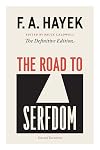
Hayek’s classic defense of classical liberalism is a political and moral tour de force. Considering that it was written by an Austrian Jew who’d emigrated to Britain early in the Nazi era, its grace and generosity towards national enemies and ideological opponents is remarkable. His main argument isn’t so much that individual liberty, limited government, the rule of law, and competitive markets constitute the most efficient economic system producing the greatest general prosperity and show more the greatest personal freedom. Hayek makes this argument powerfully, but he’s most concerned to show that the then-current disdain for classical liberalism and the clamor for centralized economic planning would inevitably lead to arbitrary, coercive government, destruction of individual liberties and of the rule of law, greater class or interest group resentments, and also to economic inefficiency with less general prosperity. At least if the movement toward collectivism goes unchecked, it leads to totalitarianism, which necessarily is anti-democratic, anti-rational, dangerously amoral with the concept of truth largely inverted, and it consequently attracts the most unscrupulous people to positions of power. Hayek also points out the essential equivalence of collectivism of the Right and of the Left.
Although widely panned by the intelligentsia of the time, the book has always gotten a lot of attention and it’s been very influential. I believe history has amply demonstrated the soundness of the overall arguments. Considering history and the stakes, I find it difficult to be as generous as Hayek was toward those whose ideological rigidity prevents them from learning its lessons. If the book has any weaknesses, perhaps the most important one is that it doesn’t systematically outline the appropriate roles of government in a capitalist democracy. The book could be construed as being anti-government, which it isn’t; Hayek clearly says that an extensive welfare state isn’t incompatible with a competitive market economy, and that wealthy nations can and even should provide some forms of social insurance. He especially emphasizes the importance of government establishing the rule of law – based on general principles and applied equally to all – along with effective enforcement of contracts and administration of justice generally, as critical to the context in which markets operate properly. He’s also very much concerned with prevention of monopolies, or their minimization where elimination isn’t possible, something equally applicable to private enterprise as to government (except in the few areas where government monopolies are necessary, e.g. the military, some public utilities, etc.), but in particular a critical function of government in free markets.
Hayek just touches on monetary policy, he doesn’t deal directly with government fiscal policy, he doesn’t describe the appropriate role of central banks in economies, and he only briefly touches on what we’d call Keynesian approaches to downturns and unemployment (to say that they’re generally not effective and there are better ways to deal with those problems, without elaborating much). I think it would have clarified and strengthened his arguments if he had provided a systematic treatment of the appropriate functions of the state in a society founded on principles of classical liberalism. But it also would have made a compact and pointed book much less so – a book he considered to be urgently needed, and I think rightly. A careful reader can grasp enough of Hayek’s picture of government in a capitalist democracy to see its essential functions and limitations, and that they’re sensible. The book as is keeps the focus on the less-than-obvious but potentially great and possibly imminent danger, and it does a superb job of tracing its history and development (particularly in Germany over several decades prior to the Nazis’ rise), of describing the dreadful society it leads to, and of showing how and why this happens. It’s a fairly detailed 20th c. way of saying, like Franklin, “A Republic, if you can keep it.” Basically, economic and political freedom are inseparable, both of which require private property and free, competitive markets with the state ensuring the rule of law. show less
Although widely panned by the intelligentsia of the time, the book has always gotten a lot of attention and it’s been very influential. I believe history has amply demonstrated the soundness of the overall arguments. Considering history and the stakes, I find it difficult to be as generous as Hayek was toward those whose ideological rigidity prevents them from learning its lessons. If the book has any weaknesses, perhaps the most important one is that it doesn’t systematically outline the appropriate roles of government in a capitalist democracy. The book could be construed as being anti-government, which it isn’t; Hayek clearly says that an extensive welfare state isn’t incompatible with a competitive market economy, and that wealthy nations can and even should provide some forms of social insurance. He especially emphasizes the importance of government establishing the rule of law – based on general principles and applied equally to all – along with effective enforcement of contracts and administration of justice generally, as critical to the context in which markets operate properly. He’s also very much concerned with prevention of monopolies, or their minimization where elimination isn’t possible, something equally applicable to private enterprise as to government (except in the few areas where government monopolies are necessary, e.g. the military, some public utilities, etc.), but in particular a critical function of government in free markets.
Hayek just touches on monetary policy, he doesn’t deal directly with government fiscal policy, he doesn’t describe the appropriate role of central banks in economies, and he only briefly touches on what we’d call Keynesian approaches to downturns and unemployment (to say that they’re generally not effective and there are better ways to deal with those problems, without elaborating much). I think it would have clarified and strengthened his arguments if he had provided a systematic treatment of the appropriate functions of the state in a society founded on principles of classical liberalism. But it also would have made a compact and pointed book much less so – a book he considered to be urgently needed, and I think rightly. A careful reader can grasp enough of Hayek’s picture of government in a capitalist democracy to see its essential functions and limitations, and that they’re sensible. The book as is keeps the focus on the less-than-obvious but potentially great and possibly imminent danger, and it does a superb job of tracing its history and development (particularly in Germany over several decades prior to the Nazis’ rise), of describing the dreadful society it leads to, and of showing how and why this happens. It’s a fairly detailed 20th c. way of saying, like Franklin, “A Republic, if you can keep it.” Basically, economic and political freedom are inseparable, both of which require private property and free, competitive markets with the state ensuring the rule of law. show less
Lists
Awards


You May Also Like


Associated Authors
Statistics
- Works
- 168
- Also by
- 11
- Members
- 10,076
- Popularity
- #2,356
- Rating
- 4.1
- Reviews
- 112
- ISBNs
- 535
- Languages
- 23
- Favorited
- 48


