
Thomas Sowell
Author of Basic Economics: A Citizen's Guide to the Economy
About the Author
Thomas Sowell is the Rose and Milton Friedman Senior Fellow on Public Policy at the Hoover Institution, Stanford University.
Series
Works by Thomas Sowell
A Conflict of Visions: Ideological Origins of Political Struggles (1987) — Author — 1,085 copies, 18 reviews
Barbarians inside the Gates and Other Controversial Essays (Hoover Institution Press Publication) (1999) 144 copies
Social Justice faracies 2 copies
Weber and Bakke 1 copy
History of Fort Bend County 1 copy
Oni wiedzą lepiej 1 copy
Heroes of Texas John R. Fenn 1 copy
Associated Works
On the Firing Line: The Public Life of Our Public Figures (1989) — Contributor — 128 copies, 1 review
DDT, Silent Spring, and the Rise of Environmentalism: Classic Texts (2008) — Contributor — 19 copies
Tagged
Common Knowledge
- Canonical name
- Sowell, Thomas
- Birthdate
- 1930-06-30
- Gender
- male
- Education
- University of Chicago (Ph.D|1968)
Columbia University (MA|1959)
Harvard College (BA|1958)
Howard University
Stuyvesant High School - Occupations
- professor
economist - Organizations
- Stanford University (Hoover Institution)
Creators Syndicate
Howard University
Rutgers University
Cornell University
Brandeis University (show all 10)
Amherst College
University of California, Los Angeles
United States Department of Labor
United States Marine Corps - Awards and honors
- National Humanities Medal (2002)
Francis Boyer Award (1990)
Sydney Hook Award (1998)
American Philosophical Society (1998)
Bradley Prize (2003)
Lysander Spooner Award (2004) (show all 7)
International Book Award (2008) - Relationships
- Brown, Sterling Allen (teacher)
- Nationality
- USA
- Birthplace
- Gastonia, North Carolina, USA
- Places of residence
- Charlotte, North Carolina, USA
Harlem, New York, USA
Washington, D.C., USA - Map Location
- North Carolina, USA
Members
Reviews
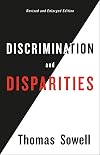
Discrimination and Disparities is the first book by Thomas Sowell that I've read, and I will definitely be reading more by him.
I might have been a little annoying while reading this book: around friends and family, I was self-conscious of frequently saying, "listen to this [data]!" Well, they seemed very interested, at least. It is incredibly refreshing to read a book on the topic of social conditions which is so evidence-based. Every claim is thoroughly supported by a description of show more evidence: Sowell is very careful that his claims are not stronger than the evidence he has at hand. As one educated by critical-social-justice theories, heavier in poetry than empiricism, I had the additional delight of learning fact-based arguments which call into serious doubt many of the dogmas I had received in college.
Of particular interest is the methodology that Sowell uses. Clear, simple, yet rigorous, it is a model that I wish more intellectuals could adopt. In the 2nd (enlarged) edition, Sowell goes into greater detail into this methodology of social research, and justifies its importance: that we should be committed more to truth and testing claims than to action and programs: for in the latter we have no guarantee of benefit and risk of harm, but in the former we can learn what really works. This simple piece of wisdom is one which might be expected to be common sense in our historically scientific culture, and yet seems to be increasingly abandoned with the spread of what I might call "post-scientism".
Also of interest is his straightforward economic analysis. Having never formally studied economics except Marx, finally reading sound economic arguments was delightful and illuminating for me. I look forward to reading more from Sowell. show less
I might have been a little annoying while reading this book: around friends and family, I was self-conscious of frequently saying, "listen to this [data]!" Well, they seemed very interested, at least. It is incredibly refreshing to read a book on the topic of social conditions which is so evidence-based. Every claim is thoroughly supported by a description of show more evidence: Sowell is very careful that his claims are not stronger than the evidence he has at hand. As one educated by critical-social-justice theories, heavier in poetry than empiricism, I had the additional delight of learning fact-based arguments which call into serious doubt many of the dogmas I had received in college.
Of particular interest is the methodology that Sowell uses. Clear, simple, yet rigorous, it is a model that I wish more intellectuals could adopt. In the 2nd (enlarged) edition, Sowell goes into greater detail into this methodology of social research, and justifies its importance: that we should be committed more to truth and testing claims than to action and programs: for in the latter we have no guarantee of benefit and risk of harm, but in the former we can learn what really works. This simple piece of wisdom is one which might be expected to be common sense in our historically scientific culture, and yet seems to be increasingly abandoned with the spread of what I might call "post-scientism".
Also of interest is his straightforward economic analysis. Having never formally studied economics except Marx, finally reading sound economic arguments was delightful and illuminating for me. I look forward to reading more from Sowell. show less
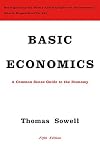
"Basic Economics" is generally smart and engaging, but it's often intellectually dishonest.
Thomas Sowell does a great job of explaining the basic principles of economics with salient examples. There are multiple "aha" moments while reading, because the author captures the dynamics of the field so well. Unfortunately, Sowell manifests a strongly libertarian perspective throughout the book, to the point that some sections read more like propaganda than a textbook.
For example, Sowell show more attributes US gasoline shortages during the 1970s to motorist hoarding—without even mentioning OPEC's oil embargo in 1973—to support his repeated argument that price controls are always bad. The book doesn't seem to evaluate the successes and failures of a free market, but it assumes instead that the market is always more effective than government.
To learn more about basic economics, I have put this book aside. Instead, I will be reading "Naked Economics" by Charles Wheelan. show less
Thomas Sowell does a great job of explaining the basic principles of economics with salient examples. There are multiple "aha" moments while reading, because the author captures the dynamics of the field so well. Unfortunately, Sowell manifests a strongly libertarian perspective throughout the book, to the point that some sections read more like propaganda than a textbook.
For example, Sowell show more attributes US gasoline shortages during the 1970s to motorist hoarding—without even mentioning OPEC's oil embargo in 1973—to support his repeated argument that price controls are always bad. The book doesn't seem to evaluate the successes and failures of a free market, but it assumes instead that the market is always more effective than government.
To learn more about basic economics, I have put this book aside. Instead, I will be reading "Naked Economics" by Charles Wheelan. show less

Though Thomas Sowell's MARXISM: PHILOSOPHY AND ECONOMICS is in spots helpful in understanding Karl Marx's thought, and, like always with Sowell's books is clearly written, the author is simply wrong on the Marxian theory of value. Dead wrong. I have read enough of DAS KAPITAL to know that Boehm-Bawerk's criticism of Marx is spot on, contrary to Sowell. A quick search of Marx's big book can yield quotations from Marx that disprove Sowell's odd (and oddly defensive) thesis on Marxian value. show more Sowell's exposition is way too easy on Marx, especially regarding value theory, of which Marx adapted the biggest error of the classical economists and turned it into the lynchpin of his system.
Sowell's worst - or, at any rate, least reliable - book. show less
Sowell's worst - or, at any rate, least reliable - book. show less

I am 25 years late reading Thomas Sowell's “The Vision of the Anointed” (1995), yet his main points could have been written yesterday. That's because what he terms the "vision of the anointed" hasn't changed, not just since 1995 but for hundreds of years.
By anointed he means those people — mostly in government, academia, the arts and the media — who consider themselves not just smarter than the common rabble but on a higher moral plane, as well. Those who disagree with them, Sowell show more writes, "are seen as being not merely in error, but in sin." If you disagree with them you are not just wrong, but evil.
Thus democracy, in which their votes count no more than those of ordinary people, is viewed as an error in need of correction. To accomplish this requires a crisis of some kind. Almost anything will do — a pandemic, climate change, racism, poverty, forest fires, whatever happens to be handy.
Often, Sowell points out, problems are already in the process of correction when the anointed identifies them as crises. Then they advocate corrective measures that tend to make these problems worse, not better. Sowell mentions Lyndon Johnson's War on Poverty, which came at a time when poverty in the United States was shrinking. The Great Society programs led to significantly more poverty, a trend that continues to this day. More recently the furor over racism in the country came at a point when racism was less evident than at any time in history.
Despite their presumption of intellectual superiority, both facts and logic mean little to the anointed, Sowell says. In today's world, the anointed preach the importance of following science, while ignoring any science that conflicts with their vision.
Sowell says the anointed speak of solutions, while more sensible people speak of trade-offs. Attempting to correct one problem can cause another, something the anointed refuse to accept. Any new problems just create new crises for the anointed, in their wisdom, to solve. And something new to blame on somebody else.
The anointed, the author writes, focus on what he calls mascots and targets. The mascots are those, such as women, blacks or transexuals, whom the anointed choose to patronize, while the targets are those they choose to blame.
Perhaps the statement Sowell makes in 1995 that most sounds like it could have been written in 2020 is this one: "Those who have most consistently undermined the police and other elements of law enforcement are among those most shocked by the escalation of crime and violence." show less
By anointed he means those people — mostly in government, academia, the arts and the media — who consider themselves not just smarter than the common rabble but on a higher moral plane, as well. Those who disagree with them, Sowell show more writes, "are seen as being not merely in error, but in sin." If you disagree with them you are not just wrong, but evil.
Thus democracy, in which their votes count no more than those of ordinary people, is viewed as an error in need of correction. To accomplish this requires a crisis of some kind. Almost anything will do — a pandemic, climate change, racism, poverty, forest fires, whatever happens to be handy.
Often, Sowell points out, problems are already in the process of correction when the anointed identifies them as crises. Then they advocate corrective measures that tend to make these problems worse, not better. Sowell mentions Lyndon Johnson's War on Poverty, which came at a time when poverty in the United States was shrinking. The Great Society programs led to significantly more poverty, a trend that continues to this day. More recently the furor over racism in the country came at a point when racism was less evident than at any time in history.
Despite their presumption of intellectual superiority, both facts and logic mean little to the anointed, Sowell says. In today's world, the anointed preach the importance of following science, while ignoring any science that conflicts with their vision.
Sowell says the anointed speak of solutions, while more sensible people speak of trade-offs. Attempting to correct one problem can cause another, something the anointed refuse to accept. Any new problems just create new crises for the anointed, in their wisdom, to solve. And something new to blame on somebody else.
The anointed, the author writes, focus on what he calls mascots and targets. The mascots are those, such as women, blacks or transexuals, whom the anointed choose to patronize, while the targets are those they choose to blame.
Perhaps the statement Sowell makes in 1995 that most sounds like it could have been written in 2020 is this one: "Those who have most consistently undermined the police and other elements of law enforcement are among those most shocked by the escalation of crime and violence." show less
Lists
Awards


You May Also Like


Associated Authors
Statistics
- Works
- 77
- Also by
- 7
- Members
- 15,403
- Popularity
- #1,477
- Rating
- 4.2
- Reviews
- 252
- ISBNs
- 413
- Languages
- 8
- Favorited
- 55