

Charles A. Murray
Author of The Bell Curve: Intelligence and Class Structure in American Life
About the Author
Works by Charles A. Murray
Human Accomplishment: The Pursuit of Excellence in the Arts and Sciences, 800 B.C. to 1950 (2003) 589 copies, 6 reviews
Real Education: Four Simple Truths for Bringing America's Schools Back to Reality (2008) 233 copies, 9 reviews
The curmudgeon's guide to getting ahead : dos and don'ts of right behavior, tough thinking, clear writing, and living a good life (2014) 223 copies, 10 reviews
Gaining Ground: New Approaches to Poverty and Dependency (Ethics and Public Policy Essay - 60) (1985) 18 copies
Taking religion seriously 5 copies
Associated Works
On the Firing Line: The Public Life of Our Public Figures (1989) — Contributor — 126 copies, 1 review
Tagged
Common Knowledge
- Legal name
- Murray, Charles Alan
- Birthdate
- 1943-01-08
- Gender
- male
- Nationality
- USA
- Associated Place (for map)
- USA
Members
Discussions
Charles Murray and The Bell Curve in Combiners! (June 2023)
Reviews
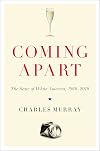
As a time travel thriller, Stephen King’s “11/22/63” draws a lot of contrasts between America just before the Kennedy assassination and America of the early 2010s. King doesn’t whitewash problems of the era such as endemic racism; but his novel left me feeling that, in the half century following Kennedy’s death, the country lost something deeply good in terms of social cohesion and community.
The year after King published his tribute to the past, Charles Murray published his show more sociological work on the same conceit: that between 1960 and 2010, American social cohesion disintegrated at an alarming pace. Murray even uses the fixed point of November 21, 1963 to describe the nation’s social landscape just before the Texas School Book Depository became the most infamous warehouse in the world.
The Gen X in me wants to crack a joke about Boomer nostalgia. However, it’s worth acknowledging that two ideologically divergent authors who lived through these decades do converge on a consensus that something has changed, and not for the better. No doubt this is where their agreement ends, but for Murray that something is the gutting of four civic virtues that the American experiment needs to survive.
His thesis is that America requires a specific set of virtues to survive as the Founders intended: marriage, industriousness, honesty, and religion. He attempts through survey data, census records, and longitudinal studies to demonstrate that these virtues are increasingly concentrated in self-selected upper-class ghettos and increasingly gone from lower-class wastelands.
In affluent enclaves of privilege and power, elites still enjoy strong marriages, work incredibly hard, and trust each other. Outside these walls, families are shattered, young and able men drift from welfare check to welfare check, and rampant crime destroys trust. (Interestingly enough, Murray charts comparable declines in religiosity regardless of class. Church just ain’t what it used to be.)
He attributes this to two primary drivers: the dual-action sorting machine of the knowledge economy and university system, and the rise of the welfare state. For elites, the sorting machine privileges the creation of a small but dominant class of affluent elites, who cluster in cultural cocoons from which emerge next-generation butterflies utterly detached from the other 90+ percent of America.
For the lower class, the welfare state kneecaps the four virtues by making life too easy. If you aren’t incentivized by adversity to roll up your sleeves and get to work, you won’t be incentivized toward the kind of self-discipline that produces the virtues. This gap between an out-of-touch ruling class and an eviscerated lower class will destroy the American experiment if it keeps widening.
Murray’s book generated enormous controversy, and I don’t know how much of it I agree with. I’m not a social scientist, but I’m always cautious with sociological work. Human dynamics are so complex that it’s easy to cherry-pick data, even for the most self-aware sociologist who tries really hard to control the variables. We don’t reduce easily to graphs.
I’m also not sure what solution he offers. He clearly thinks the welfare state should be replaced by a universal basic income, but it’s not clear to me how that solves his problem. He also thinks the last bastion of traditional American civic virtues (the rich upper class) need to get off its postmodern horse and, in his words, preach what they practice. Even if Murray were completely and totally right, I don’t believe educated elites are going to start shaming those who transgress traditional morality.
I do think Murray’s book is valuable in that it requires you to think about his data and conclusions. Even if you agree with the Southern Poverty Law Center and believe he’s a racist pig, you should grapple with his charts of lower-class decline. Even if you bristle at his agnostic shoulder shrugging about religion and at his portrait of a virtuous elite, you should wrestle with his stats on upper-class stability.
That America is coming apart at the level of class feels intuitively correct. Why it’s coming apart or whether it’s unstoppable is up to you to decide. Murray offers one possible perspective, perhaps partially right and partially wrong. We won’t know if we never think about it, and I’m glad he made me think about it. show less
The year after King published his tribute to the past, Charles Murray published his show more sociological work on the same conceit: that between 1960 and 2010, American social cohesion disintegrated at an alarming pace. Murray even uses the fixed point of November 21, 1963 to describe the nation’s social landscape just before the Texas School Book Depository became the most infamous warehouse in the world.
The Gen X in me wants to crack a joke about Boomer nostalgia. However, it’s worth acknowledging that two ideologically divergent authors who lived through these decades do converge on a consensus that something has changed, and not for the better. No doubt this is where their agreement ends, but for Murray that something is the gutting of four civic virtues that the American experiment needs to survive.
His thesis is that America requires a specific set of virtues to survive as the Founders intended: marriage, industriousness, honesty, and religion. He attempts through survey data, census records, and longitudinal studies to demonstrate that these virtues are increasingly concentrated in self-selected upper-class ghettos and increasingly gone from lower-class wastelands.
In affluent enclaves of privilege and power, elites still enjoy strong marriages, work incredibly hard, and trust each other. Outside these walls, families are shattered, young and able men drift from welfare check to welfare check, and rampant crime destroys trust. (Interestingly enough, Murray charts comparable declines in religiosity regardless of class. Church just ain’t what it used to be.)
He attributes this to two primary drivers: the dual-action sorting machine of the knowledge economy and university system, and the rise of the welfare state. For elites, the sorting machine privileges the creation of a small but dominant class of affluent elites, who cluster in cultural cocoons from which emerge next-generation butterflies utterly detached from the other 90+ percent of America.
For the lower class, the welfare state kneecaps the four virtues by making life too easy. If you aren’t incentivized by adversity to roll up your sleeves and get to work, you won’t be incentivized toward the kind of self-discipline that produces the virtues. This gap between an out-of-touch ruling class and an eviscerated lower class will destroy the American experiment if it keeps widening.
Murray’s book generated enormous controversy, and I don’t know how much of it I agree with. I’m not a social scientist, but I’m always cautious with sociological work. Human dynamics are so complex that it’s easy to cherry-pick data, even for the most self-aware sociologist who tries really hard to control the variables. We don’t reduce easily to graphs.
I’m also not sure what solution he offers. He clearly thinks the welfare state should be replaced by a universal basic income, but it’s not clear to me how that solves his problem. He also thinks the last bastion of traditional American civic virtues (the rich upper class) need to get off its postmodern horse and, in his words, preach what they practice. Even if Murray were completely and totally right, I don’t believe educated elites are going to start shaming those who transgress traditional morality.
I do think Murray’s book is valuable in that it requires you to think about his data and conclusions. Even if you agree with the Southern Poverty Law Center and believe he’s a racist pig, you should grapple with his charts of lower-class decline. Even if you bristle at his agnostic shoulder shrugging about religion and at his portrait of a virtuous elite, you should wrestle with his stats on upper-class stability.
That America is coming apart at the level of class feels intuitively correct. Why it’s coming apart or whether it’s unstoppable is up to you to decide. Murray offers one possible perspective, perhaps partially right and partially wrong. We won’t know if we never think about it, and I’m glad he made me think about it. show less

If I'd made the connection with Murray's political reputation as "right-wing spawn of the Devil" I would probably never have picked this book up - I didn't realise that he was the Bell curve man until I'd finished reading it. Which perhaps just goes to show that we ought to be prepared to put our prejudices aside from time to time, since this book doesn't seem to have any very explicit political axe to grind at all.
Cox and Murray seem to have become interested in the history of the US show more manned space programme (which is well outside both their fields of study) largely by accident, and they approach it in the best tradition of American narrative non-fiction, the way books used to be written before everything had to be structured like a TV documentary. Their interest is focussed on the people who took up Kennedy's challenge and made it happen, in particular the engineers who built the launch vehicles and spacecraft, the flight operations people who made sure they completed their missions and got the crews back, and the NASA bosses who created the management structures that allowed such a colossal project to function at all. They obviously spent a lot of time talking to the people involved in Apollo, and they tell their story in a lively, fluent way. There's less about the actual engineering than I would have liked, but enough to allow readers to make sense of the story most of the time. And their account of the dynamics of the teams of scientists and engineers and the way they worked under pressure rings very true.
The book reminds us about the general questions that were raised (mostly afterwards - although they do argue that Kennedy was initially sceptical himself) about the utility and value-for-money of manned spaceflight, but it doesn't attempt to analyse these in detail: Apollo is presented, reasonably enough, as an outstanding human and technical achievement, and the interest is more in how it was done rather than why. Writing in the late 1980s, the authors obviously didn't have access to Soviet records, and they don't go into the question of whether there ever really was anyone else in the "race" to the Moon.
As always when I think about the Apollo programme, I'm astounded how they managed to do it all in feet and inches, with essentially no women engineers in the team at all, and with computers that had a fraction of the processing power of the modern washing-machine. It must all have been down to the pens in their shirt-pockets... show less
Cox and Murray seem to have become interested in the history of the US show more manned space programme (which is well outside both their fields of study) largely by accident, and they approach it in the best tradition of American narrative non-fiction, the way books used to be written before everything had to be structured like a TV documentary. Their interest is focussed on the people who took up Kennedy's challenge and made it happen, in particular the engineers who built the launch vehicles and spacecraft, the flight operations people who made sure they completed their missions and got the crews back, and the NASA bosses who created the management structures that allowed such a colossal project to function at all. They obviously spent a lot of time talking to the people involved in Apollo, and they tell their story in a lively, fluent way. There's less about the actual engineering than I would have liked, but enough to allow readers to make sense of the story most of the time. And their account of the dynamics of the teams of scientists and engineers and the way they worked under pressure rings very true.
The book reminds us about the general questions that were raised (mostly afterwards - although they do argue that Kennedy was initially sceptical himself) about the utility and value-for-money of manned spaceflight, but it doesn't attempt to analyse these in detail: Apollo is presented, reasonably enough, as an outstanding human and technical achievement, and the interest is more in how it was done rather than why. Writing in the late 1980s, the authors obviously didn't have access to Soviet records, and they don't go into the question of whether there ever really was anyone else in the "race" to the Moon.
As always when I think about the Apollo programme, I'm astounded how they managed to do it all in feet and inches, with essentially no women engineers in the team at all, and with computers that had a fraction of the processing power of the modern washing-machine. It must all have been down to the pens in their shirt-pockets... show less
Charles Murray could have spared writing this book simply by reading Elizabeth Warren's Two-income Trap, as it answers all the questions Murray should have asked if he had an open mind. His previous explanation that all of America's ills were caused by its supposedly less intelligent but pigment-rich co-citizens having obviously failed, he explores two new ideas, this time simply among white people (in its extended inclusion of formerly non-white whites). Murray's first explanation is show more eugenics: In Brave New World terms, it is about those damn Alphas unwilling to breed with Gammas and Deltas. Thank God for John Edwards impregnating his campaign worker. His action truly helps keeping up the non-Alpha gene pool.
Murray's second explanation is the loss of 1960s morals. Murray has found a mostly white trash neighborhood in Philadelphia, the Dickensian Fishtown with terrible social statistics. Out of touch, Murray fails to connect Fishtown to the hit comedy series "It's always sunny in Philadelphia" with its loutish characters (while otherwise judging America by its TV representations). The poor whites in Fishtown have started acting like Murray's despised black folks. The baby-daddy no longer marrying the mother. The true cause of this change is not, as Murray claims, a morale decline but the economic devastation endured by blue collar workers in the US. Their real incomes have declined since the 1970s. Marrying a working class male has become a losing proposition in the US. The public's decisions are relatively rational under those odious socio-economic constraints.
America's filthy rich, concentrated and segregated in a few Super-ZIPs, have looted the country's future, transferring more and more risk to the individual while socializing the losses of the rich. Murray, who lives among them, at least acknowledges the problematic nature of those Super-ZIPs but fails to discuss the obvious and simple solution: Tax the rich. Instead, he launches an unhelpful culture war petard.
An honest assessment was not to be expected of a paid pied piper of the 1%. Hopefully, this will be his last tune. The US desperately needs a new melody. Instead of this book, read Warren's Two-income Trap. She is a true conservative with a vision for the US. show less
Murray's second explanation is the loss of 1960s morals. Murray has found a mostly white trash neighborhood in Philadelphia, the Dickensian Fishtown with terrible social statistics. Out of touch, Murray fails to connect Fishtown to the hit comedy series "It's always sunny in Philadelphia" with its loutish characters (while otherwise judging America by its TV representations). The poor whites in Fishtown have started acting like Murray's despised black folks. The baby-daddy no longer marrying the mother. The true cause of this change is not, as Murray claims, a morale decline but the economic devastation endured by blue collar workers in the US. Their real incomes have declined since the 1970s. Marrying a working class male has become a losing proposition in the US. The public's decisions are relatively rational under those odious socio-economic constraints.
America's filthy rich, concentrated and segregated in a few Super-ZIPs, have looted the country's future, transferring more and more risk to the individual while socializing the losses of the rich. Murray, who lives among them, at least acknowledges the problematic nature of those Super-ZIPs but fails to discuss the obvious and simple solution: Tax the rich. Instead, he launches an unhelpful culture war petard.
An honest assessment was not to be expected of a paid pied piper of the 1%. Hopefully, this will be his last tune. The US desperately needs a new melody. Instead of this book, read Warren's Two-income Trap. She is a true conservative with a vision for the US. show less

Coming Apart shines an uncomfortable spotlight on the deep-rooted and often controversial problem of social class in 21st century America.
Contrasted here are two distinct lifestyles, the super-affluent and the impoverished under-class, and their differences are a lot more complicated than a simple widening of the income inequality gap. This disparity of social (and physical) separation is greater than ever. And note that the author specifically focuses on white Caucasians because the sample show more size from both groups is large enough for accurate statistical comparison.
The findings, illustrated through a series of charts and graphs, are disheartening, but should not be too surprising. Some would argue this is a result of not investing enough time and money into eradicating poverty, but I no longer believe that's the correct action. Fixing a problem like this will require something more—a fundamental shift in the attitude and character of its citizenry. I'm not sure what this would look like or if it's even possible. show less
Contrasted here are two distinct lifestyles, the super-affluent and the impoverished under-class, and their differences are a lot more complicated than a simple widening of the income inequality gap. This disparity of social (and physical) separation is greater than ever. And note that the author specifically focuses on white Caucasians because the sample show more size from both groups is large enough for accurate statistical comparison.
The findings, illustrated through a series of charts and graphs, are disheartening, but should not be too surprising. Some would argue this is a result of not investing enough time and money into eradicating poverty, but I no longer believe that's the correct action. Fixing a problem like this will require something more—a fundamental shift in the attitude and character of its citizenry. I'm not sure what this would look like or if it's even possible. show less
Lists
Awards


You May Also Like


Associated Authors
Statistics
- Works
- 32
- Also by
- 6
- Members
- 5,588
- Popularity
- #4,443
- Rating
- 3.8
- Reviews
- 116
- ISBNs
- 94
- Languages
- 2
- Favorited
- 1