
Jonah Goldberg
Author of Liberal Fascism
About the Author
Jonah Goldberg is the Editor-in-Chief of The Dispatch. He holds the Cliff Asness Chair in Applied Liberty at the American Enterprise Institute, and is a fellow at the National Review Institute. He is a Los Angeles Times columnist and member of the "Fox News All-Stars," and he appears regularly on show more NPR's Morning Edition. show less
Works by Jonah Goldberg
Suicide of the West: How the Rebirth of Populism, Nationalism, and Identity Politics Is Destroying American Democracy (2018) 322 copies, 6 reviews
Proud to Be Right: Voices of the Next Conservative Generation (2010) — Editor — 23 copies, 2 reviews
Associated Works
Tagged
Common Knowledge
- Legal name
- Goldberg, Jonah Jacob
- Birthdate
- 1969-03-21
- Gender
- male
- Education
- Goucher College
- Occupations
- writer
television producer - Organizations
- American Enterprise Institute
National Review
Fox News - Relationships
- Goldber, Lucianne (parent)
Gavora, Jessica (wife) - Nationality
- USA
- Associated Place (for map)
- USA
Members
Reviews
Liberal Fascism: The Secret History of the American Left, From Mussolini to the Politics of Change by Jonah Goldberg
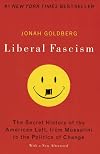
Preaching to the choir, alas. Author Jonah Goldberg is a National Review contributor and Liberal Fascism reads like a greatly elaborated version of a National Review article: erudite, extensively researched and documented, and never read by the people who should. Goldberg falls all over himself apologizing; he doesn’t really think Woodrow Wilson, Franklin Roosevelt, and Barack Obama are Fascists, just that their programs have some things in common with Fascist programs. He’s rather show more handicapped here because the John the Baptist of Fascism, Benito Mussolini, didn’t really have any programs – Mussolini said “Our program is to govern”. This has historically allowed Leftists to define Fascism as “anything we disagree with”. Lots of Fascist/NSDAP goals and accomplishments – guaranteed employment, abolition of interest, confiscation of war profits, nationalization of trusts, profit sharing, old-age pensions (all these come from the NSDAP party platform) – would be counted as “progressive” if they had come from any other political entity. In fact, as Goldberg points out, they were counted as progressive at various times by Lincoln Steffens, H.G. Wells, and George Bernard Shaw and others with impeccable leftist credentials.
Goldberg’s deconstruction of Woodrow Wilson is particularly enlightening and should be required reading for anybody who thinks George W. Bush was “the worst president ever”. The Wilson administration was responsible for the Espionage Act and Sedition Act, which allowed it to arrest anyone who criticized WWI. The Postmaster General was empowered to prohibit mailing any “seditious” publication (and did so for over 75), and the War Resources Board interdicted supplies of newsprint to any critical newspaper.
There are a lot of eyebrow raising quotes here. Cole Porter: “You’re the top, You’re the Great Houdini; You’re the top, You are Mussolini!” (original version). Woodrow Wilson: “I am an advocate of peace but there are some splendid things that come to a nation through the discipline of war”. Clarence Darrow (speaking of Wilson and WWI): “Any man who refuses to back the President in this crisis is worse than a traitor.” Walter Lippmann (speaking to FDR): “The situation is critical, Franklin. You may have no alternative but to assume dictatorial powers”. Völkischer Beobachter (about FDR): “A man of irreproachable, extremely responsible character and immovable will.” Mussolini: “Roosevelt is moving, acting, giving orders independently of the decisions or wishes of the Senate or Congress.” (They meant that as a compliment).
This just skims the surface of a 400+ page book. Every quote and claim is documented. The problem is nobody who needs to is going to pay any attention to this. This isn’t Goldberg’s fault; it’s just the way things are. You can explain all you want that Hitler was a Socialist, and what “Nazi” is short for, but all it invokes in the typical liberal is cognitive dissonance.
I have some gripes. From time to time Goldberg blames various liberal excesses on “Darwinism”, as if that were a political philosophy (what he actually means is “Social Darwinism”). And Goldberg goes a little overboard when he comments on McCarthyism: “…under McCarthyism a few Hollywood writers who’d supported Stalin and then lied about it lost their jobs in the 1950s.” – the problem being that they shouldn’t have been forced to lie about it in the first place. But on the whole, recommended. show less
Goldberg’s deconstruction of Woodrow Wilson is particularly enlightening and should be required reading for anybody who thinks George W. Bush was “the worst president ever”. The Wilson administration was responsible for the Espionage Act and Sedition Act, which allowed it to arrest anyone who criticized WWI. The Postmaster General was empowered to prohibit mailing any “seditious” publication (and did so for over 75), and the War Resources Board interdicted supplies of newsprint to any critical newspaper.
There are a lot of eyebrow raising quotes here. Cole Porter: “You’re the top, You’re the Great Houdini; You’re the top, You are Mussolini!” (original version). Woodrow Wilson: “I am an advocate of peace but there are some splendid things that come to a nation through the discipline of war”. Clarence Darrow (speaking of Wilson and WWI): “Any man who refuses to back the President in this crisis is worse than a traitor.” Walter Lippmann (speaking to FDR): “The situation is critical, Franklin. You may have no alternative but to assume dictatorial powers”. Völkischer Beobachter (about FDR): “A man of irreproachable, extremely responsible character and immovable will.” Mussolini: “Roosevelt is moving, acting, giving orders independently of the decisions or wishes of the Senate or Congress.” (They meant that as a compliment).
This just skims the surface of a 400+ page book. Every quote and claim is documented. The problem is nobody who needs to is going to pay any attention to this. This isn’t Goldberg’s fault; it’s just the way things are. You can explain all you want that Hitler was a Socialist, and what “Nazi” is short for, but all it invokes in the typical liberal is cognitive dissonance.
I have some gripes. From time to time Goldberg blames various liberal excesses on “Darwinism”, as if that were a political philosophy (what he actually means is “Social Darwinism”). And Goldberg goes a little overboard when he comments on McCarthyism: “…under McCarthyism a few Hollywood writers who’d supported Stalin and then lied about it lost their jobs in the 1950s.” – the problem being that they shouldn’t have been forced to lie about it in the first place. But on the whole, recommended. show less
Suicide of the West: How the Rebirth of Tribalism, Populism, Nationalism, and Identity Politics is Destroying American Democracy by Jonah Goldberg
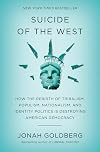
The title of this book might be off-putting to some, which is a shame, because I think it could be of interest to readers who wouldn't think they have much in common with Goldberg. Those who do read Goldberg on a weekly basis won't find anything drastically new, but it's a pretty good recapitulation of his thought over the past two years.
The book works on the assumption that nothing's foreordained. There is no "right side of history." Democracy, capitalism, and human rights are things we show more stumbled into as a society. Historically speaking, all this has emerged in the blink of an eye. The challenge today is coping with that abundance. Maintaining a civilization takes constant work, and if we're not grateful for what we've received, we're on a fast track to corruption. I found this theme of ingratitude to be slightly uneven throughout, and the mix of history, pop culture, and analysis felt almost too ambitious at times; however, I agree with Goldberg's overall thesis, that without an understanding of where we've come from, we'll cease to defend the ideals of the founders, seizing on shortcuts more and more (see tribalism and Trump).
Some significant points I noted throughout:
Goldberg gives an abbreviated history of the emergence of states and capitalism. The American project was a result of English cultural oddities that got written down, a "glorious accident."
Tribalism is our natural state. Romanticism is "a brilliant intellectual updating of the tribal instinct" that sees the modern world as alienating and wants to revert to finding meaning primarily in and through the tribe.
Governments are based on natural rights that the state has no right, under ordinary circumstances, to violate; states provisionally grant rights, and, according to the French Enlightenment view of the state, take an active role in the guidance of society. Under 20th century progressivism, the administrative state emerged--experts shaping society--"the state taking its own counsel on what society needed." It is revolutionary in this respect and operates outside of the constitutional framework and of democratic transparency. It is basically a new form of aristocracy.
The more complex government makes society, the more it rewards those (i.e., the upper class) with the resources to deal with that complexity, and the more it punishes those who do not. The children of the affluent are educated in how to maneuver in this system—and in the process, they’re learning “a profound and sophisticated ingratitude towards the country they grew up in.” The administrative state is deeply invested in the above. As it succeeds, elitism becomes a self-fulfilling prophecy. “If you start from the assumption that the people are too stupid to understand what’s in their interest and then proceed to make society a byzantine maze of hurdles, the more likely it is you’ll be able to claim you’re right.”
Trump has profoundly changed our civilizational conversation by reverting to tribalism in many ways.
Increasingly, American life has been reduced to either the individual or the state, flattening civil society (mediating institutions--see [b:The Fractured Republic: Renewing America's Social Contract in the Age of Individualism|26240786|The Fractured Republic Renewing America's Social Contract in the Age of Individualism|Yuval Levin|https://images.gr-assets.com/books/1463043125s/26240786.jpg|46232990]). When the state begins to occupy the place of civil society, it becomes toxic. The erosion of civil society has caused many Americans to flock to partisanship (and virtual communities) to find meaning. Adherence to political parties didn't always look like this.
When the president or the party in power is invested with so much meaning and significance, the “outs” feel like strangers in their own land. Then it’s payback when the other side gets power. “The only solution is to break the cycle by making the state less important and letting the dying reefs of civil society grow back to health.” show less
The book works on the assumption that nothing's foreordained. There is no "right side of history." Democracy, capitalism, and human rights are things we show more stumbled into as a society. Historically speaking, all this has emerged in the blink of an eye. The challenge today is coping with that abundance. Maintaining a civilization takes constant work, and if we're not grateful for what we've received, we're on a fast track to corruption. I found this theme of ingratitude to be slightly uneven throughout, and the mix of history, pop culture, and analysis felt almost too ambitious at times; however, I agree with Goldberg's overall thesis, that without an understanding of where we've come from, we'll cease to defend the ideals of the founders, seizing on shortcuts more and more (see tribalism and Trump).
Some significant points I noted throughout:
Goldberg gives an abbreviated history of the emergence of states and capitalism. The American project was a result of English cultural oddities that got written down, a "glorious accident."
Tribalism is our natural state. Romanticism is "a brilliant intellectual updating of the tribal instinct" that sees the modern world as alienating and wants to revert to finding meaning primarily in and through the tribe.
Governments are based on natural rights that the state has no right, under ordinary circumstances, to violate; states provisionally grant rights, and, according to the French Enlightenment view of the state, take an active role in the guidance of society. Under 20th century progressivism, the administrative state emerged--experts shaping society--"the state taking its own counsel on what society needed." It is revolutionary in this respect and operates outside of the constitutional framework and of democratic transparency. It is basically a new form of aristocracy.
The more complex government makes society, the more it rewards those (i.e., the upper class) with the resources to deal with that complexity, and the more it punishes those who do not. The children of the affluent are educated in how to maneuver in this system—and in the process, they’re learning “a profound and sophisticated ingratitude towards the country they grew up in.” The administrative state is deeply invested in the above. As it succeeds, elitism becomes a self-fulfilling prophecy. “If you start from the assumption that the people are too stupid to understand what’s in their interest and then proceed to make society a byzantine maze of hurdles, the more likely it is you’ll be able to claim you’re right.”
Trump has profoundly changed our civilizational conversation by reverting to tribalism in many ways.
Increasingly, American life has been reduced to either the individual or the state, flattening civil society (mediating institutions--see [b:The Fractured Republic: Renewing America's Social Contract in the Age of Individualism|26240786|The Fractured Republic Renewing America's Social Contract in the Age of Individualism|Yuval Levin|https://images.gr-assets.com/books/1463043125s/26240786.jpg|46232990]). When the state begins to occupy the place of civil society, it becomes toxic. The erosion of civil society has caused many Americans to flock to partisanship (and virtual communities) to find meaning. Adherence to political parties didn't always look like this.
When the president or the party in power is invested with so much meaning and significance, the “outs” feel like strangers in their own land. Then it’s payback when the other side gets power. “The only solution is to break the cycle by making the state less important and letting the dying reefs of civil society grow back to health.” show less
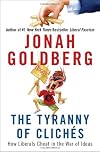
I normally do not read too often books which are TOO overtly political - often these are just distasteful and overdone exercises in rhetoric which whip up a loyal 'base' and leave all others annoyed or alienated. This is true for both right and left.
Ann Coulter, to use a prominent example, calls herself a "Polemicist" - one who deliberately deals with controversy, and that statement is quite accurate, to her credit. Such is their domain, leave them well alone.
But Goldberg is a new and show more insidious breed - he is a polemicist or rambler who thinks himself a serious intellectual, and attempts to write a book of 'ideas'. The book falls apart halfway through the title. Cliches are indeed tyrannical, but he falls victim to them. His first book, "Liberal Fascism", is filled with torturous and fallacious logic - "Hitler was a vegetarian, therefore all fascists are Vegetarians." I confess I have not read it entirely.
A main underlying theme is his conflation of the modern American Left with Totalitarian Communism. Liberals in his view, believe in government intervention in some economic matters. Totalitarians believe in total government control of all aspects of society. Because both of these actions involve government, therefore the two are the same. But Connecticut is not Cambodia. New York is not North Korea. San Francisco is not Stalinism. He does not even differentiate between parts of the left at all. They are all The Enemy, to be defeated.
I will not pretend that the modern American left is free of problems. But this 'criticism' is a cliche, and wholly meaningless.
And of course, Goldberg uses cliches of his own - the 'hippie liberal', multiculturalism is bad because immigrants and colored people are scary, "Dissent is the highest form of patriotism", that there are no compromise positions - "Either you're for me or against me!". And so forth. And so on. And so on.
The whole section on Ideology and Dogma is a farce. His own understanding of history is warped, distorted, and completely false. Any item which might support him is twisted to do so, and anything conflicting disappears. "The government does not produce jobs (External contracts, military, etc.), Jews were not killed during the Spanish Inquisition (Exiled, burned alive), and so on. It tires and numbs the mind.
Of course, attempting to deal with such large swaths of the complex American political spectrum can be difficult, and I confess that I fall prey to errors. But this is not a complex or rigorous argument at all. It is a child's wail - "Nuh uh! I'm not a stinky-face! YOU ARE!" Take away the punctuation, capitalization, spelling, and fancy quotes from respectable thinkers garnishing the edges, and it is a Youtube comment. It is not a 'book of ideas'. It is a polemic, something which will sell enough copies to get to the top of the New York Times, garner a few disdainful comments from real historians, and promptly fade into oblivion. show less
Ann Coulter, to use a prominent example, calls herself a "Polemicist" - one who deliberately deals with controversy, and that statement is quite accurate, to her credit. Such is their domain, leave them well alone.
But Goldberg is a new and show more insidious breed - he is a polemicist or rambler who thinks himself a serious intellectual, and attempts to write a book of 'ideas'. The book falls apart halfway through the title. Cliches are indeed tyrannical, but he falls victim to them. His first book, "Liberal Fascism", is filled with torturous and fallacious logic - "Hitler was a vegetarian, therefore all fascists are Vegetarians." I confess I have not read it entirely.
A main underlying theme is his conflation of the modern American Left with Totalitarian Communism. Liberals in his view, believe in government intervention in some economic matters. Totalitarians believe in total government control of all aspects of society. Because both of these actions involve government, therefore the two are the same. But Connecticut is not Cambodia. New York is not North Korea. San Francisco is not Stalinism. He does not even differentiate between parts of the left at all. They are all The Enemy, to be defeated.
I will not pretend that the modern American left is free of problems. But this 'criticism' is a cliche, and wholly meaningless.
And of course, Goldberg uses cliches of his own - the 'hippie liberal', multiculturalism is bad because immigrants and colored people are scary, "Dissent is the highest form of patriotism", that there are no compromise positions - "Either you're for me or against me!". And so forth. And so on. And so on.
The whole section on Ideology and Dogma is a farce. His own understanding of history is warped, distorted, and completely false. Any item which might support him is twisted to do so, and anything conflicting disappears. "The government does not produce jobs (External contracts, military, etc.), Jews were not killed during the Spanish Inquisition (Exiled, burned alive), and so on. It tires and numbs the mind.
Of course, attempting to deal with such large swaths of the complex American political spectrum can be difficult, and I confess that I fall prey to errors. But this is not a complex or rigorous argument at all. It is a child's wail - "Nuh uh! I'm not a stinky-face! YOU ARE!" Take away the punctuation, capitalization, spelling, and fancy quotes from respectable thinkers garnishing the edges, and it is a Youtube comment. It is not a 'book of ideas'. It is a polemic, something which will sell enough copies to get to the top of the New York Times, garner a few disdainful comments from real historians, and promptly fade into oblivion. show less
Liberal Fascism: The Secret History of the American Left, From Mussolini to the Politics of Meaning by Jonah Goldberg
Still haven't finished it (nor added to shelf the other books I'm reading instead), but I have read more than I read when I first reviewed it. This summary still goes: Seems to be an update and American perspective of the classic "The Road to Serfdom" by F.A. Hayek. Goldberg discusses the Progressive movement of 100 years ago, how it influenced modern liberalism and how much it admired Mussolini. ("Well, at least he made the trains run on time," was a great Progressivist cop out.) Goldberg show more like Hayek recognizes that a political spectrum that runs all the way from Communism to Fascism is like an alphabet that goes all the way from A to B.
My additional take: Goldberg recognizes that the chief difference between fascism and communism is, respectively, nationalism and internationalism. Beyond that, both promote socialist, centralized economic policies. Both can use coercive tactics to suppress dissent. He is on firm ground in pointing to the fascist tendencies of the early progressives and their heirs. Theodore Roosevelt embraced these tendencies but more so after he had already been president. T. Woodrow Wilson is probably rightly defined by Goldberg as the most fascistic president in U.S. history. As Goldberg points out to those who would say "It can't happen here," it already happened. He is also right to point out that the New Deal of FDR had its dark, fascistic side. This is one of the most interesting sections of the book. (Compare Vardis Fisher's autobiographical novel "Orphans in Gethsemane," which gives a first-hand account of the WPA by someone who was inside and found it oppressive.)
That JFK had a tendency toward fascism is a little more of a stretch, although I think there was that nationalistic, centralized tendency in his policies, which came out in various ways, especially in his rhetoric. He wasn't consistently fascistic, though, crushing the U.S. steel industry on the one hand and lowering taxes on the other. But certainly he was strongly nationalist if mildly socialist.
When Goldberg portrays sixties radicals as facists, however, he seems to be missing his own point. The most radical and violent of these people--Weathermen, Black Panthers, etc.--don't have to be compared to fascists because they were already communists; compare them to the Bolsheviks battling their opponents in the streets of St. Petersburg--that's how they saw themselves. The reason this makes a real difference is that these leftist radicals departed from the NATIONALIST fascism of their supposed predecessors. Wilson and maybe even FDR would have called out the troops and shot them long before Kent State. The sixties radical movement was not monolithic. There were various trends within it, including an instinctive individualist rebellion, but to the extent that they were socialists, most '60s rads got their socialism from their parents who had been '30s communists or other varieties of internationalist socialists. So Goldberg is straining his own conceit to make '60s internationalist socialists fit with earlier fascists. Not to say that the Kennedy/Johnson era did not lead to a climate in which socialist/communist radicals felt empowered and in which they could ally themselves with the Great Society as a platform for further radicalism, but they departed from nationalism, which you can't do and properly still be called a fascist.
Goldberg can always defend George Bush against charges of fascism by saying, at least he is not as bad as Woodrow Wilson. (One might as well say, at least he isn't as bad as Genghis Khan.) This is not for lack of trying on President Bush's part, however.
We live in an era in which even Wilson would be hard pressed to make everyone submit to his vision of nationalism. Each of us now tends to march to the beat of his own drummer, or failing that, we gravitate toward one of various drum-masters available in our fractious society. The president can't tell everyone what to think in the age of the Internet. He has too many competitors.
I would recommend reading this book in combination with "The Cult of the Presidency" by Gene Healy and "Nixonland" by Rick Perlstein, because they are dealing with some of the same material but spinning it according to different agendas. show less
My additional take: Goldberg recognizes that the chief difference between fascism and communism is, respectively, nationalism and internationalism. Beyond that, both promote socialist, centralized economic policies. Both can use coercive tactics to suppress dissent. He is on firm ground in pointing to the fascist tendencies of the early progressives and their heirs. Theodore Roosevelt embraced these tendencies but more so after he had already been president. T. Woodrow Wilson is probably rightly defined by Goldberg as the most fascistic president in U.S. history. As Goldberg points out to those who would say "It can't happen here," it already happened. He is also right to point out that the New Deal of FDR had its dark, fascistic side. This is one of the most interesting sections of the book. (Compare Vardis Fisher's autobiographical novel "Orphans in Gethsemane," which gives a first-hand account of the WPA by someone who was inside and found it oppressive.)
That JFK had a tendency toward fascism is a little more of a stretch, although I think there was that nationalistic, centralized tendency in his policies, which came out in various ways, especially in his rhetoric. He wasn't consistently fascistic, though, crushing the U.S. steel industry on the one hand and lowering taxes on the other. But certainly he was strongly nationalist if mildly socialist.
When Goldberg portrays sixties radicals as facists, however, he seems to be missing his own point. The most radical and violent of these people--Weathermen, Black Panthers, etc.--don't have to be compared to fascists because they were already communists; compare them to the Bolsheviks battling their opponents in the streets of St. Petersburg--that's how they saw themselves. The reason this makes a real difference is that these leftist radicals departed from the NATIONALIST fascism of their supposed predecessors. Wilson and maybe even FDR would have called out the troops and shot them long before Kent State. The sixties radical movement was not monolithic. There were various trends within it, including an instinctive individualist rebellion, but to the extent that they were socialists, most '60s rads got their socialism from their parents who had been '30s communists or other varieties of internationalist socialists. So Goldberg is straining his own conceit to make '60s internationalist socialists fit with earlier fascists. Not to say that the Kennedy/Johnson era did not lead to a climate in which socialist/communist radicals felt empowered and in which they could ally themselves with the Great Society as a platform for further radicalism, but they departed from nationalism, which you can't do and properly still be called a fascist.
Goldberg can always defend George Bush against charges of fascism by saying, at least he is not as bad as Woodrow Wilson. (One might as well say, at least he isn't as bad as Genghis Khan.) This is not for lack of trying on President Bush's part, however.
We live in an era in which even Wilson would be hard pressed to make everyone submit to his vision of nationalism. Each of us now tends to march to the beat of his own drummer, or failing that, we gravitate toward one of various drum-masters available in our fractious society. The president can't tell everyone what to think in the age of the Internet. He has too many competitors.
I would recommend reading this book in combination with "The Cult of the Presidency" by Gene Healy and "Nixonland" by Rick Perlstein, because they are dealing with some of the same material but spinning it according to different agendas. show less
Lists
Awards

You May Also Like


Associated Authors
Statistics
- Works
- 6
- Also by
- 2
- Members
- 1,914
- Popularity
- #13,442
- Rating
- 3.8
- Reviews
- 46
- ISBNs
- 34
- Languages
- 6
- Favorited
- 6

