
John McWhorter
Author of The Power of Babel: A Natural History of Language
About the Author
John H. McWhorter is Associate Professor of Linguistics at the University of California, Berkeley.
Series
Works by John McWhorter
Doing Our Own Thing: The Degradation of Language and Music and Why We Should, Like, Care (2003) 367 copies, 5 reviews
Words on the Move: Why English Won't—and Can't—Sit Still (Like, Literally) (2016) 345 copies, 26 reviews
The Story of Human Language: The Great Courses (Literature & English Language; 3 Volumes) (2004) 29 copies, 1 review
Language Interrupted: Signs of Non-Native Acquisition in Standard Language Grammars (2007) 15 copies
The Story of Human Language: The Great Courses (Literature & English Language; 3 Volumes) (2004) 13 copies
The Most Efficient Language 9 copies
Language Change and Language Contact in Pidgins and Creoles (Creole Language Library) (2000) 6 copies
How Artificial Languages Work 3 copies
The Alphabet Goes East 1 copy
"Talking With Your Fingers" 1 copy
"A Matter of Fashion" 1 copy
What is Language ? 1 copy
The Advent of A, E, and O 1 copy
The Invention of Alphabets 1 copy
When Language Began 1 copy
Why Texting is Misunderstood 1 copy
The Nature of Writing 1 copy
Associated Works
This Will Make You Smarter: New Scientific Concepts to Improve Your Thinking (Edge Question Series) (2012) — Contributor — 905 copies, 17 reviews
Degrees of Restructuring in Creole Languages (Creole Language Library) (2000) — Contributor — 9 copies
Tagged
Common Knowledge
- Canonical name
- McWhorter, John
- Legal name
- McWhorter, John Hamilton, V
- Birthdate
- 1965
- Gender
- male
- Education
- Friends Select School, Philadelphia, Pennsylvania
Bard College at Simon's Rock (AA)
Rutgers University (BA|French|1985)
New York University (MA|American Studies)
Stanford University (PhD|Linguistics|1993) - Occupations
- linguist
professor
author
political commentator - Organizations
- Manhattan Institute
University of California, Berkeley - Agent
- Katinka Matson
Dan Conaway - Short biography
- John McWhorter is a senior fellow at the Manhattan Institute and a contributing editor to The New Republic, he has taught linguistics at the University of California at Berkeley and has been widely profiled in the media. [adapted from loc.gov, Our Magnificent Bastard Tongue (2008)]
- Nationality
- USA
- Birthplace
- Philadelphia, Pennsylvania, USA
- Places of residence
- Philadelphia, Pennsylvania, USA
Oakland, California, USA - Associated Place (for map)
- USA
Members
Reviews
This originally appeared at The Irresponsible Reader.
---
What's key is that the stock of curses is ever self-refreshing, The fashions change, as always and everywhere, but what persists is taboo itself, a universal of human societies. What is considered taboo itself differs from one epoch to another, but the sheer fact of taboo does not. Language cannot help but reflect something so fundamental to our social consciousness, and thus there will always be words and expressions that are shot out show more of the right brain rather than gift-wrapped by the left one.
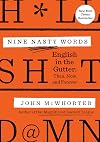
WHAT'S NINE NASTY WORDS ABOUT?
What's Nine Nasty Words About?
McWhorter looks at nine of the "bigger" profanities in English (with some asides to discuss related words), tracing their history, evolution, varying definitions, and contemporary usage. He points out periods where they were verboten, periods where they were perfectly acceptable—and what made them profane again.
The flow of the book comes from this thesis*:
On that matter of evolution, profanity has known three main eras—when the worst you could say was about religion, when the worst you could say was about the body, and when the worst you could say was about groups of people. The accumulation of those taboos is why “just words” like h***, s***, and n***** respectively harbor such sting.
I don't know how accurate that is, but it kind of makes sense—and it works pretty well as a framework for the book, too.
* The book uses the actual words, I wimped out and elided them.
The chapter headings give you a pretty good idea of what the book covers and shows how the framework is used (with the addendum at the end):
1 D*** and H***: English’s First Bad Words
2 What Is It About F***?
3 Profanity and S***
4 A Kick-A** Little Word
5 Those Certain Parts.
6 Why Do We Call It “The N-Word"?
7 The Other F-Word
8 Being in Total Control, Honey!
9 A M************ Addendum
SO, WHAT DID I THINK ABOUT NINE NASTY WORDS?
I largely enjoyed this book, I find the history and evolution of English fascinating—and while I try to eschew the use of profanity, I've found the development of those words very interesting—and I can appreciate a clever and inventive use of them in art.
This was a great look at those words—in particular, I enjoyed McWhorter's demonstration of how the words function as various parts of speech, as well as the varying nuances of meaning. It was a clever mix of entertainment and education.
McWhorter has a great style, too, throughout the book he sprinkles little gems like:
To understand how language changes without allowing a certain space for serendipity is to understand it not at all.
The [N-]word is indeed twenty-first-century English’s Voldemort term,
The chapters on slurs—"words about groups of people"—mixed in a bit too much contemporary social commentary for my taste, but I'm pretty sure most people won't agree.
On the whole, this was a great mix of entertainment and education, I doubt this is the definitive work on the subject (and McWhorter would likely agree), but it's a solid work and I'm glad I read it. show less
---
What's key is that the stock of curses is ever self-refreshing, The fashions change, as always and everywhere, but what persists is taboo itself, a universal of human societies. What is considered taboo itself differs from one epoch to another, but the sheer fact of taboo does not. Language cannot help but reflect something so fundamental to our social consciousness, and thus there will always be words and expressions that are shot out show more of the right brain rather than gift-wrapped by the left one.
WHAT'S NINE NASTY WORDS ABOUT?
What's Nine Nasty Words About?
McWhorter looks at nine of the "bigger" profanities in English (with some asides to discuss related words), tracing their history, evolution, varying definitions, and contemporary usage. He points out periods where they were verboten, periods where they were perfectly acceptable—and what made them profane again.
The flow of the book comes from this thesis*:
On that matter of evolution, profanity has known three main eras—when the worst you could say was about religion, when the worst you could say was about the body, and when the worst you could say was about groups of people. The accumulation of those taboos is why “just words” like h***, s***, and n***** respectively harbor such sting.
I don't know how accurate that is, but it kind of makes sense—and it works pretty well as a framework for the book, too.
* The book uses the actual words, I wimped out and elided them.
The chapter headings give you a pretty good idea of what the book covers and shows how the framework is used (with the addendum at the end):
1 D*** and H***: English’s First Bad Words
2 What Is It About F***?
3 Profanity and S***
4 A Kick-A** Little Word
5 Those Certain Parts.
6 Why Do We Call It “The N-Word"?
7 The Other F-Word
8 Being in Total Control, Honey!
9 A M************ Addendum
SO, WHAT DID I THINK ABOUT NINE NASTY WORDS?
I largely enjoyed this book, I find the history and evolution of English fascinating—and while I try to eschew the use of profanity, I've found the development of those words very interesting—and I can appreciate a clever and inventive use of them in art.
This was a great look at those words—in particular, I enjoyed McWhorter's demonstration of how the words function as various parts of speech, as well as the varying nuances of meaning. It was a clever mix of entertainment and education.
McWhorter has a great style, too, throughout the book he sprinkles little gems like:
To understand how language changes without allowing a certain space for serendipity is to understand it not at all.
The [N-]word is indeed twenty-first-century English’s Voldemort term,
The chapters on slurs—"words about groups of people"—mixed in a bit too much contemporary social commentary for my taste, but I'm pretty sure most people won't agree.
On the whole, this was a great mix of entertainment and education, I doubt this is the definitive work on the subject (and McWhorter would likely agree), but it's a solid work and I'm glad I read it. show less
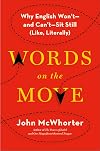
I first became aware of John McWhorter's work through a couple of the lectures series he does for the Teaching Company. He has an enthusiasm for all area of linguistics and language and he presents his materials in a compelling and often humorous way.
So I was excited to see this book offered through LTER. I'm glad to say that his written work is just as good as the courses he's given. In Words on the Move, McWhorter riffs a little bit on material he's presented through TC courses, exploring show more more thoroughly the idea of how and why language changes, and how that's not always a bad thing (contrary to what language prescriptivists say)! If it didn't change, we'd still be talking in the language of Beowulf. McWhorter also explores the grammar of English language by comparison with other languages (eg, the German love of compound words).
I like how he discusses the etymology of many words, and how they've evolved from old English. The book is funny at times, especially if you love language and its usage. One example among many: "When it first appeared in English, borrowed from Latin, audition indeed meant 'hearing.' When a doctor recommended a substance that 'draweth out all which is in the Eares and administreth good auditione,' he meant that having your ears clear of whatever the disgusting stuff was, your hearing got better, not that it got you a part in the latest production of Henry V." (p. 66). And then he continues for another page or so about how the word "audition" drifted to have the meaning it has today. It's a really smart book that describes how languages grows and evolves over time, either through design or accident. I highly recommend this one. show less
So I was excited to see this book offered through LTER. I'm glad to say that his written work is just as good as the courses he's given. In Words on the Move, McWhorter riffs a little bit on material he's presented through TC courses, exploring show more more thoroughly the idea of how and why language changes, and how that's not always a bad thing (contrary to what language prescriptivists say)! If it didn't change, we'd still be talking in the language of Beowulf. McWhorter also explores the grammar of English language by comparison with other languages (eg, the German love of compound words).
I like how he discusses the etymology of many words, and how they've evolved from old English. The book is funny at times, especially if you love language and its usage. One example among many: "When it first appeared in English, borrowed from Latin, audition indeed meant 'hearing.' When a doctor recommended a substance that 'draweth out all which is in the Eares and administreth good auditione,' he meant that having your ears clear of whatever the disgusting stuff was, your hearing got better, not that it got you a part in the latest production of Henry V." (p. 66). And then he continues for another page or so about how the word "audition" drifted to have the meaning it has today. It's a really smart book that describes how languages grows and evolves over time, either through design or accident. I highly recommend this one. show less
 This review was written for LibraryThing Early Reviewers.
In this book, John McWhorter takes on the Sapir-Whorf hypothesis, with vigor and enthusiasm, and his usual excellent research.
The Sapir-Whorf hypothesis says, basically, that language shapes the way we see and understand the world. One example, a fairly basic one, is that Japanese has one word that identifies both blue and green, while Russian has one word for dark blue and another word for light blue. Does this mean the Japanese can't see different shades of blue and green as clearly as show more Russians can?
No. The Japanese can see these colors just as well; they just describe them differently.
A more complex example is verb tenses. English has a future tense, a verb tense we use to refer to the future. "I will go out tomorrow." Many other languages, do too, but also many other languages don't have a future tense. Does this mean the speakers of those languages can't plan for the future?
No. Once again, they can anticipate the future, refer to it, plan for it. They just use other means of doing so, often context-dependent.
McWhorter explains this much better than I can, and takes on the idea not just as bad linguistics, but as bad linguistics that, while it originated in a desire to recognize the worth of non-Western or "primitive" cultures, has a pernicious tendency to promote condescension towards other cultures, and a certain ethnocentrism, accepting our own language and culture as obviously the standard.
While not having the lightness and well-used, intentional silliness that enlivens some of his other works, he makes excellent, informative, and entertaining use of the differences among languages in the course of explaining what he sees as wrong in much Sapir-Whorf analysis. And it should be noted, in this context, that English, far from being the obviously normal language we who speak it as our native tongue tend to assume, is in many ways downright weird, an outlier in many ways.
The same, of course, is true of other languages. Each language has evolved on its own path, and the changes are often happenstance, not response to anything to do with the environment of their speakers. Culture and language aren't all that closely related.
It's a fascinating listen, and well worth your time.
I bought this audiobook. show less
The Sapir-Whorf hypothesis says, basically, that language shapes the way we see and understand the world. One example, a fairly basic one, is that Japanese has one word that identifies both blue and green, while Russian has one word for dark blue and another word for light blue. Does this mean the Japanese can't see different shades of blue and green as clearly as show more Russians can?
No. The Japanese can see these colors just as well; they just describe them differently.
A more complex example is verb tenses. English has a future tense, a verb tense we use to refer to the future. "I will go out tomorrow." Many other languages, do too, but also many other languages don't have a future tense. Does this mean the speakers of those languages can't plan for the future?
No. Once again, they can anticipate the future, refer to it, plan for it. They just use other means of doing so, often context-dependent.
McWhorter explains this much better than I can, and takes on the idea not just as bad linguistics, but as bad linguistics that, while it originated in a desire to recognize the worth of non-Western or "primitive" cultures, has a pernicious tendency to promote condescension towards other cultures, and a certain ethnocentrism, accepting our own language and culture as obviously the standard.
While not having the lightness and well-used, intentional silliness that enlivens some of his other works, he makes excellent, informative, and entertaining use of the differences among languages in the course of explaining what he sees as wrong in much Sapir-Whorf analysis. And it should be noted, in this context, that English, far from being the obviously normal language we who speak it as our native tongue tend to assume, is in many ways downright weird, an outlier in many ways.
The same, of course, is true of other languages. Each language has evolved on its own path, and the changes are often happenstance, not response to anything to do with the environment of their speakers. Culture and language aren't all that closely related.
It's a fascinating listen, and well worth your time.
I bought this audiobook. show less
Linguist John McWhorter talks about the process of language change in general, and about the changes that English, in particular, has been through and continues to go through, and why that's normal and inevitable and nothing to panic over, and also kind of cool and interesting. I don't know that there was a whole lot here that was entirely new to me, if only because I regularly listen to his podcast, but McWhorter's writing is always fun to read. (Well, mostly. Even his weird sense of humor show more and tendency to come up with offbeat examples to illustrate the things he's talking about doesn't quite save an entire chapter on vowel shifts from making my eyes glaze over a little. But, really, you can't not talk about vowel shifts.)
And I do think it's an important and useful thing, the attempt that books like this make to bring a linguist's perspective to ordinary people, encouraging them to replace, or at least temper, the natural tendency to get all judgy and reactionary about language change with a genuine understanding of change as a fundamental part of what language does. Or possibly even what language is.
Although I will admit that even now, I still can't help but feel a bit annoyed at the use of "literally" as simply another intensifier. Just because, despite McWhorter's best attempts to reassure me otherwise, some part of my brain remains stubbornly convinced that one day I will use it to mean "not figuratively" -- because there is no other good word to use for that! -- and no one will understand what I mean. I'm working on chilling out about that, though. I really am. Because it's very clear to me at this point that if I never used a word in a way that hasn't been decried by someone, sometime, as a linguistic degeneracy of a type guaranteed to reduce us all to incomprehensibility, I'd never be able to say anything at all. show less
And I do think it's an important and useful thing, the attempt that books like this make to bring a linguist's perspective to ordinary people, encouraging them to replace, or at least temper, the natural tendency to get all judgy and reactionary about language change with a genuine understanding of change as a fundamental part of what language does. Or possibly even what language is.
Although I will admit that even now, I still can't help but feel a bit annoyed at the use of "literally" as simply another intensifier. Just because, despite McWhorter's best attempts to reassure me otherwise, some part of my brain remains stubbornly convinced that one day I will use it to mean "not figuratively" -- because there is no other good word to use for that! -- and no one will understand what I mean. I'm working on chilling out about that, though. I really am. Because it's very clear to me at this point that if I never used a word in a way that hasn't been decried by someone, sometime, as a linguistic degeneracy of a type guaranteed to reduce us all to incomprehensibility, I'd never be able to say anything at all. show less
Lists
Awards


You May Also Like


Associated Authors
Statistics
- Works
- 69
- Also by
- 6
- Members
- 7,102
- Popularity
- #3,455
- Rating
- 3.9
- Reviews
- 222
- ISBNs
- 121
- Languages
- 4
- Favorited
- 20

