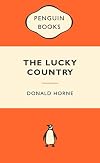
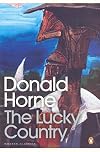
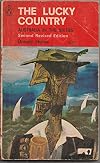
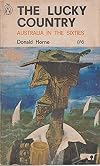
The Lucky Country
by Donald Horne
On This Page
Description
Although it's a study of the confident Australia of the 1960s, the book still remains illuminating and insightful decades later. It is valuable not only as a source of continuing truths and revealing snapshots of the past, but above all as a key to understanding the anxieties and discontents of Australian society today.Tags
Recommendations



















Member Recommendations

Member Reviews
"The lucky country" is a phrase any Australian is familiar with, one often applied with beaming happiness to things like Vegemite advertisements or Australia Day speeches. Yet few Australians would be able to quote the sentence it originally appeared in: "Australia is a lucky country, run mainly by second-rate people who share its luck."
Donald Horne wrote The Lucky Country in the early 1960s as a stark assessment of a nation he felt had lost its way. Australia possessed fabulous natural resources and enjoyed one of the highest standards of living in the world; yet, unlike other advanced nations, he felt it had done little to earn its success. It rested on its luck and was unimaginative, uninspired and unexceptional. It was almost a show more dependency, looking to Britain and the United States to tell it what to do and unable to shake the feeling that it was an unimportant backwater, albeit a pleasant one. It reminded me of an assessment by Ted Simon in Jupiter's Travels, when he visited Australia in the early 1970s:
Like most people everywhere they spent most of their time just getting by, but there was no collective dream or mythology that told them what it was they were supposed to be doing.
Now, The Lucky Country was written half a century ago and much of it is irrelevant today - the influence of the Australian Communist Party, the White Australia Policy, and the tension between Catholics and Protestants, to name a few things. But a larger portion of the book is surprisingly relevant.
The most striking thing to a modern reader is how little has changed. Horne knew Australia was at a tipping point in the 1960s, like much of the world, and that if it was ever going to seize its own destiny, that was the time. And indeed, the 1970s saw the election of Gough Whitlam, a prime minister who stood up to Washington, engaged with Asia, introduced universal healthcare and began the process of recognising Aboriginal land rights. But he was dismissed after only a few short years, and Australia sank back into a swamp of lazy complacency. And now here we are in 2012: still not a republic, still looking to America and Europe for guidance in cultural, political and economic matters, and still relying entirely on our natural resources to maintain our economy. Australia was renowned in 2008 for being the only OECD country which did not enter recession, but virtually the only reason this was so was because our economy is centred around selling ore to China. How lucky.
And our current leaders hardly inspire confidence - indeed, Julia Gillard and Tony Abbott regularly poll less than 40% as preferred prime ministers, among the lowest ratings of all time. Say what you will about John Howard and Kevin Rudd, but they were both titanic figures who led with vision (my vision of hell, in the case of Howard, but vision nonetheless) and imposed themselves mightily upon the Australian psyche. Gillard and Abbott, on the other hand, feel like understudies thrust into the spotlight. They might make able politicians, but in the grand narrative of history, they will never go down as great leaders.
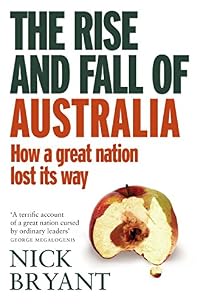
So the Australia of today is strikingly similar to the Australia of The Lucky Country. It reminded me of what Nick Bryant, the BBC's Sydney correspondent for many years, wrote upon leaving the job in 2011:
The anger and hostility [in Australian politics] is currently being compared with the mood in 1975 during the Gough Whitlam dismissal crisis. But it also has a late-60s feel - a post-Menzies, pre-Whitlam interlude when the country appeared to be treading water, and waiting for something to happen.
The curious thing when reading The Lucky Country is that Horne seemed to be optimistic, to believe that change really was around the corner, that the next generation - John Howard's generation - would prove to be far less stagnant and conservative than their predecessors and lead Australia into a bold new future. (He seemed particularly convinced that a republic would happen any year now.) That didn't happen. And while I myself am optimistic that Australia might grow up a little in the coming decades, in an era of global connectivity and an emerging Asia and a rising Green Party, I can't help but feel that perhaps we'll just see a repeat of the last 50 years.
The question is whether this time our luck will run out. show less
Donald Horne wrote The Lucky Country in the early 1960s as a stark assessment of a nation he felt had lost its way. Australia possessed fabulous natural resources and enjoyed one of the highest standards of living in the world; yet, unlike other advanced nations, he felt it had done little to earn its success. It rested on its luck and was unimaginative, uninspired and unexceptional. It was almost a show more dependency, looking to Britain and the United States to tell it what to do and unable to shake the feeling that it was an unimportant backwater, albeit a pleasant one. It reminded me of an assessment by Ted Simon in Jupiter's Travels, when he visited Australia in the early 1970s:
Like most people everywhere they spent most of their time just getting by, but there was no collective dream or mythology that told them what it was they were supposed to be doing.
Now, The Lucky Country was written half a century ago and much of it is irrelevant today - the influence of the Australian Communist Party, the White Australia Policy, and the tension between Catholics and Protestants, to name a few things. But a larger portion of the book is surprisingly relevant.
The most striking thing to a modern reader is how little has changed. Horne knew Australia was at a tipping point in the 1960s, like much of the world, and that if it was ever going to seize its own destiny, that was the time. And indeed, the 1970s saw the election of Gough Whitlam, a prime minister who stood up to Washington, engaged with Asia, introduced universal healthcare and began the process of recognising Aboriginal land rights. But he was dismissed after only a few short years, and Australia sank back into a swamp of lazy complacency. And now here we are in 2012: still not a republic, still looking to America and Europe for guidance in cultural, political and economic matters, and still relying entirely on our natural resources to maintain our economy. Australia was renowned in 2008 for being the only OECD country which did not enter recession, but virtually the only reason this was so was because our economy is centred around selling ore to China. How lucky.
And our current leaders hardly inspire confidence - indeed, Julia Gillard and Tony Abbott regularly poll less than 40% as preferred prime ministers, among the lowest ratings of all time. Say what you will about John Howard and Kevin Rudd, but they were both titanic figures who led with vision (my vision of hell, in the case of Howard, but vision nonetheless) and imposed themselves mightily upon the Australian psyche. Gillard and Abbott, on the other hand, feel like understudies thrust into the spotlight. They might make able politicians, but in the grand narrative of history, they will never go down as great leaders.
So the Australia of today is strikingly similar to the Australia of The Lucky Country. It reminded me of what Nick Bryant, the BBC's Sydney correspondent for many years, wrote upon leaving the job in 2011:
The anger and hostility [in Australian politics] is currently being compared with the mood in 1975 during the Gough Whitlam dismissal crisis. But it also has a late-60s feel - a post-Menzies, pre-Whitlam interlude when the country appeared to be treading water, and waiting for something to happen.
The curious thing when reading The Lucky Country is that Horne seemed to be optimistic, to believe that change really was around the corner, that the next generation - John Howard's generation - would prove to be far less stagnant and conservative than their predecessors and lead Australia into a bold new future. (He seemed particularly convinced that a republic would happen any year now.) That didn't happen. And while I myself am optimistic that Australia might grow up a little in the coming decades, in an era of global connectivity and an emerging Asia and a rising Green Party, I can't help but feel that perhaps we'll just see a repeat of the last 50 years.
The question is whether this time our luck will run out. show less
This book is as old to me as the federation of Australia was when it was written. It is a myth that the phrase comes from this book, he doesn't really mention the luckiness of the country at all but there is lot of other juicy shit to sink your greedy teeth into, guy knew what was going on mostly. Whole Menzies chunk is pretty boring like the man himself. I never knew how the Labor party functioned internally before this, still dont really understand the Liberzzzzz... there are dense slogs throughout, it took me 2 months to read the last 2 pages.
Mainly an interesting period piece, but always good to know where hackneyed phrases come from, particularly if, as in this case, they get misused: Australia is a lucky country, it turns out, because even though our politicians and other 'leadership' types are entirely incompetent, the state somehow struggles on. Horne writes well, and he's funny, but it's unclear to me whether his fundamental argument was true: was Australia really a country being held back by a lack of ambition and gusto at the highest levels? Was Australia really being held back at all? In cultural terms, yes, but keep in mind that when Horne published this, White had just published Voss and Riders in the Chariot, modernist art was getting going, and Peter Sculthorpe show more was about to publish Sun Music I. So things were really on the upswing. Horne's book itself might have been a part of that.
On the downside, it's very irritating to read a book this long that avoids proper nouns almost entirely. I say White had just published Voss, and Horne does mention that novel--but not in the section on literature. There are few to no names at all, regardless of the context. So one doesn't really learn much about who or what Horne thought was to blame, or who was helping, or even that there were people in Australia in the late '50s and early '60s at all.
More amusingly, he says the Young Liberals were energetic, while the other political parties were totally moribund. Somewhere, Whitlam is laughing. show less
On the downside, it's very irritating to read a book this long that avoids proper nouns almost entirely. I say White had just published Voss, and Horne does mention that novel--but not in the section on literature. There are few to no names at all, regardless of the context. So one doesn't really learn much about who or what Horne thought was to blame, or who was helping, or even that there were people in Australia in the late '50s and early '60s at all.
More amusingly, he says the Young Liberals were energetic, while the other political parties were totally moribund. Somewhere, Whitlam is laughing. show less
I bought this book on the strength of the editor's choice to include The lucky country by Donald Horne in Penguin's "Modern Classics" Series, which I assumed selected works of fiction and non-fiction of a certain lasting quality, a kind of portal to the pantheon of Classics. Reading the no less than 34 pages of prefaces, to the second, fifth and sixth editions, I started feeling uncomfortable, and I later found out that Penguin's criteria for inclusion of works in the series is based on strong and lasting sales.
Reading the book, which was first published in 1964, it becomes clear that it is horribly out-dated. Many of the insights, possibly first presented by Horne have trickled into the layer of general knowledge of every well-educated show more reader, and all of the contents and more can, nowadays, be found reflected on web pages, more up-to-date and more accurate on Wikipedia, and elsewhere.
The lucky country may have been a very good book, but it no longer is. Think twice before buying, is what I should have done. show less
Reading the book, which was first published in 1964, it becomes clear that it is horribly out-dated. Many of the insights, possibly first presented by Horne have trickled into the layer of general knowledge of every well-educated show more reader, and all of the contents and more can, nowadays, be found reflected on web pages, more up-to-date and more accurate on Wikipedia, and elsewhere.
The lucky country may have been a very good book, but it no longer is. Think twice before buying, is what I should have done. show less
2 February 2011
Update
One of the things that makes Australians feel so lucky is, having satisfactorily subjugated the indigenous population, it has never really faced an external threat. We have sent, I suspect, more than our fair share of men to fight other people's wars, if you like, but despite Japanese bombing of part of Australia in WWII, we are rarely concerned with such issues.
And yet.
We have this incredible balancing enemy within: the weather. To have watched the bushfires a couple of years ago in Victoria where two hundred died, whole towns razed to the ground; the devastating floods a couple of weeks ago in Queensland and then Victoria where a vast unnatural inland unanchored sea floated about; followed by what is happening show more this moment as I write:
The cyclone that is hitting Queensland, which sounds like it will be even worse when that is hard to imagine.
Natural enemies abound and they have their impact in unexpected ways. Julia Gillard's government is in a precarious position at the best of times. Evidently rallying together is not on the mind of the Liberal (ie conservative) Opposition leader. He is begging for donations to finance a fight against the idea of a national once off tax levy to pay for the rebuilding which must next take place. It is almost enough to make one laugh.
--------------------
So I'm sitting on the pavement at the Marion Shopping Centre, covered in blood and thinking, yes, indeed, Lucky Country.
My mother had caught her foot on some loose pavement, and fallen down hitting her head which bled horribly for a while.
Two lovely girls independently stop. One of them gives me her mobile so I can call a friend to come and get us. The other one gives me a packet of tissues. Shane, Security from the Shopping Centre comes out and deals with phoning an ambulance while dishing out sensible advice and first aid.
The ambulance comes and a couple of great guys give my mother a thorough examination, the bleeding has stopped, they think she can go home as long as she is happy to.
Honestly. We are the luckiest people in the world to live in this country.
I'm with Mikael on this one: 'who cares if donald horne meant it ironically, it bloody is a fucken lucky cuntree' http://www.goodreads.com/review/show/16234175 show less
Update
One of the things that makes Australians feel so lucky is, having satisfactorily subjugated the indigenous population, it has never really faced an external threat. We have sent, I suspect, more than our fair share of men to fight other people's wars, if you like, but despite Japanese bombing of part of Australia in WWII, we are rarely concerned with such issues.
And yet.
We have this incredible balancing enemy within: the weather. To have watched the bushfires a couple of years ago in Victoria where two hundred died, whole towns razed to the ground; the devastating floods a couple of weeks ago in Queensland and then Victoria where a vast unnatural inland unanchored sea floated about; followed by what is happening show more this moment as I write:
The cyclone that is hitting Queensland, which sounds like it will be even worse when that is hard to imagine.
Natural enemies abound and they have their impact in unexpected ways. Julia Gillard's government is in a precarious position at the best of times. Evidently rallying together is not on the mind of the Liberal (ie conservative) Opposition leader. He is begging for donations to finance a fight against the idea of a national once off tax levy to pay for the rebuilding which must next take place. It is almost enough to make one laugh.
--------------------
So I'm sitting on the pavement at the Marion Shopping Centre, covered in blood and thinking, yes, indeed, Lucky Country.
My mother had caught her foot on some loose pavement, and fallen down hitting her head which bled horribly for a while.
Two lovely girls independently stop. One of them gives me her mobile so I can call a friend to come and get us. The other one gives me a packet of tissues. Shane, Security from the Shopping Centre comes out and deals with phoning an ambulance while dishing out sensible advice and first aid.
The ambulance comes and a couple of great guys give my mother a thorough examination, the bleeding has stopped, they think she can go home as long as she is happy to.
Honestly. We are the luckiest people in the world to live in this country.
I'm with Mikael on this one: 'who cares if donald horne meant it ironically, it bloody is a fucken lucky cuntree' http://www.goodreads.com/review/show/16234175 show less
Written in the mid 1960s about Australia as it was then and how it came to be: political, societal, religious, cultural. Very interesting to read it 60 years on and learn what the attitudes were at that time and how some things could not be forecast at the time.
Ratings
Members
- Recently Added By
Lists

Australian Classics: Fifty Great Writers and Their Celebrated Works
43 works; 1 member

Australia's Greatest Books, as chosen by Geoffrey Dutton (1985)
97 works; 6 members
Author Information
46+ Works 760 Members
Awards and Honors
Notable Lists
Series
Belongs to Publisher Series
Common Knowledge
- Original publication date
- 1964
- Important places
- Australia
- Quotations
- Australia is a lucky country run mainly by second-rate people who share its luck.
- Last words
- (Click to show. Warning: May contain spoilers.)Many problems threaten the future of Australia. But we might have good luck. It's worth giving it a go.
Classifications
Statistics
- Members
- 288
- Popularity
- 111,400
- Reviews
- 6
- Rating
- (3.18)
- Languages
- English
- Media
- Paper, Ebook
- ISBNs
- 8
- ASINs
- 15