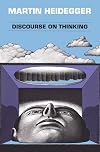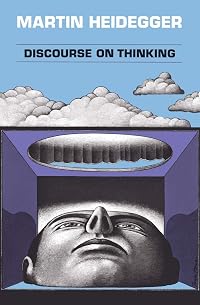
Discourse on Thinking
by Martin Heidegger
On This Page
Description
Discourse on Thinking questions that must occur to us the moment we manage to see a familiar situation in unfamiliar light.Tags
Recommendations











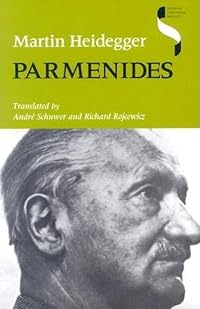



Member Reviews
I really respect Heidegger for bravely going at the crux of the ontological problem. While he fails to convince he has defined what thinking is, he convinces of the value of transcending, meditative thinking. Indeed, at the first phase of the atomic age, he has a warning against being forced into only narrow thinking:
There are three parts here, first a learned Introduction from John M. Anderson (July 29, 1914 – December 3, 1999), an American philosopher known for his expertise on post-Kantian philosophy, tying this together with Being and Time and other Heidegger writings. Then, there is a memorial lecture which mostly relates with the idea of meditative thinking. The final part is a three-way conversation by characters in the style of the ancient thinkers. This explores the hard to grasp concepts of regioning, "coming-into-the-nearness of distance", that-whichregions, etc. What mostly resonates with me on this reading is the "embrace the mystery" message of releasement.
...the approaching tide of technological revolution in the atomic age could so captivate, bewitch, dazzle, and beguile man that calculative thinking may someday come to be accepted and practiced as the only way of thinking.show more
What great danger then might move upon us? Then there might go hand in hand with the greatest ingenuity in calculative planning and inventing indifference toward meditative thinking, total
thoughtlessness. And then ? Then man would have denied and thrown away his own special
nature-that he is a meditative being. Therefore, the issue is the saving of man's essential nature. Therefore, the issue is keeping meditative thinking alive.
There are three parts here, first a learned Introduction from John M. Anderson (July 29, 1914 – December 3, 1999), an American philosopher known for his expertise on post-Kantian philosophy, tying this together with Being and Time and other Heidegger writings. Then, there is a memorial lecture which mostly relates with the idea of meditative thinking. The final part is a three-way conversation by characters in the style of the ancient thinkers. This explores the hard to grasp concepts of regioning, "coming-into-the-nearness of distance", that-whichregions, etc. What mostly resonates with me on this reading is the "embrace the mystery" message of releasement.
Teacher: . . . which higher acting is yet no activity.show less
Scientist: Then releasement lies-if we may use the word lie--beyond the distinction between activity and passivity. . .
Scholar: . . . because releasement does not belong to the
domain of the will.
Scientist : The transition from willing into releasement is
what seems difficult to me.
Teacher: And all the more, since the nature of releasement
is still hidden.
I'd forgotten how much fun reading philosophy could be....
Covers the importance of meditative thinking and the relation of thinking and debate.
Not Read
Ratings
Members
- Recently Added By
Author Information

461+ Works 23,563 Members
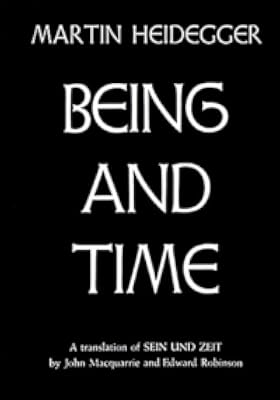
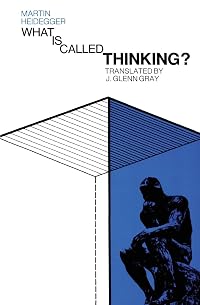
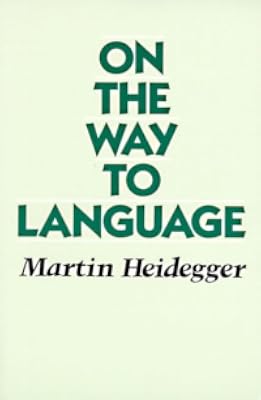
Martin Heidegger was born in Messkirch, Baden, Germany on September 22, 1889. He studied Roman Catholic theology and philosophy at the University of Frieburg before joining the faculty at Frieburg as a teacher in 1915. Eight years later Heidegger took a teaching position at Marburg. He taught there until 1928 and then went back to Frieburg as a show more professor of philosophy. As a philosopher, Heidegger developed existential phenomenology. He is still widely regarded as one of the most original philosophers of the 20th century. Influenced by other philosophers of his time, Heidegger wrote the book, Being in Time, in 1927. In this work, which is considered one of the most important philosophical works of our time, Heidegger asks and answers the question "What is it, to be?" Other books written by Heidegger include Basic Writings, a collection of Heidegger's most popular writings; Nietzsche, an inquiry into the central issues of Friedrich Nietzsche's philosophy; On the Way to Language, Heidegger's central ideas on the origin, nature and significance of language; and What is Called Thinking, a systematic presentation of Heidegger's later philosophy. Since the 1960s, Heidegger's influence has spread beyond continental Europe and into a number of English-speaking countries. Heidegger died in Messkirch on May 26, 1976. (Bowker Author Biography) show less
Common Knowledge
- Canonical title*
- Gelatenheid
- Original title
- Gelassenheit
*Some information comes from Common Knowledge in other languages. Click "Edit" for more information.
Classifications
Statistics
- Members
- 415
- Popularity
- 74,801
- Reviews
- 4
- Rating
- (3.85)
- Languages
- 7 — Dutch, English, Finnish, German, Italian, Portuguese, Spanish
- Media
- Paper
- ISBNs
- 17
- ASINs
- 6