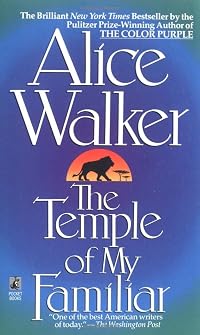
On This Page
Description
A visionary cast of characters weave together their past and present in a brilliantly intricate tapestry of tales. It is the story of the dispossessed and displaced, of peoples whose history is ancient and whose future is yet to come. Here we meet Lissie, a woman of many pasts; Arveyda the great guitarist and his Latin American wife who has had to flee her homeland; Suwelo, the history teacher, and his former wife Fanny who has fallen in love with spirits. Hovering tantalizingly above their show more stories are Miss Celie and Shug, the beloved characters from "The Color Purple". show lessTags
Recommendations






















Member Reviews
If ever there was a book I would have loved reading in a group or book club-type setting, this would be it. I felt like taking notes throughout the whole thing. I wanted to express my thoughts after certain chapters, and listen to other reactions, too. It has the depth to warrant this. I have come across several references to it as "a sequel to The Color Purple," but find that misleading. Some of the characters are the children or other family members of the main characters in TCP, but there is no pick up of that story at all. If you're looking for that, you'll be disappointed.
These people are living their own lives, finding their own way through their own adventures and circumstances. Beautiful prose, as I would expect from Ms. Walker, show more some of it magical and even surreal. It's dense, to be sure. Some of the characters grow long-winded, and in certain instances I agree with the comments that the monologue style of the book can be challenging - but in other instances, it's perfect.
I regret I had to read it alone, with no discussion or feedback. This is a fine novel, and Alice Walker is a genius. I'd give it 5 stars but for the certain long-winded sections. I wish I had placed sticky-flags while reading it, because parts I'd like to re-visit are hard to find. show less
These people are living their own lives, finding their own way through their own adventures and circumstances. Beautiful prose, as I would expect from Ms. Walker, show more some of it magical and even surreal. It's dense, to be sure. Some of the characters grow long-winded, and in certain instances I agree with the comments that the monologue style of the book can be challenging - but in other instances, it's perfect.
I regret I had to read it alone, with no discussion or feedback. This is a fine novel, and Alice Walker is a genius. I'd give it 5 stars but for the certain long-winded sections. I wish I had placed sticky-flags while reading it, because parts I'd like to re-visit are hard to find. show less
I have tried and failed many times over the several months I've been reading this book to describe effectively all that this book is and does, so I concede now that nothing I write in this review will do it justice. This book is a well-crafted consideration of human connection to each other and the world as a whole, systemic oppression and its emotional and physical effects, the way time/history shape the stories we tell and the stories we live, and ultimately healing. The nonlinear plot made the story feel more emotionally realistic for me, and the characters kept me rooted in the story, so I never felt lost. By the end of the book, I felt that this story is, in many ways, a declaration of what I assume to be Walker's personal show more philosophy. While I don't agree with every aspect of this philosophy, I do believe there is a lot that can be learned from it. I hope to make time to reread this book in years to come in order to continue learning from it. show less
Reason read: This is on the 1001 list and a randomizer selection for me in 2026 and it has been on my shelf for a long time. I paid 25 cents for it. In the introduction, the author states that this is her favorite novel. It is complex. The author explores themes of spirituality, history, oppression, healing across prehistory and modern era. It is non linear. honors tribal storytelling, healing from trauma, and bond with nature. A familiar is a loyal companion, protector, spiritual guide to humans, specifically women.
Characters: Miss Lissie--a timeless spirit, remembers past when she was a lion. Ancestral eternity.
Suivelo-- modern professor inheriits a house from Lissie -- her story changes him.
Fanny-- Suivelo's ex-wife, she seeks her show more own healing and bonds with Lissie.
This is a work of feminism. The companion animals vs Pets. A Familiar animal is a connection representing humanity's lost affinity with anture. Men have fake familiars (dogs). that are submissive to men. Symbolize patriarchal severing of the sacred bond of women and nature. The Temple is a spiritual structure, a metaphor for the books overarching goal to build a new inclusive structure of spiritual beliefs. One such, Elvis, a non European that represents the qualities within American culture. Spirituality in Alice Walker's novel is highly expansive, moving beyond traditional religious structures to embrace reincarnation, ancestral memory, nature-based veneration, and the sacredness of all living things.
"keep in mind the present you are constructing, it should be the future you want."
Cons: too much sexual details and expletives. Lack of plot, character development, excess magical realism. show less
Characters: Miss Lissie--a timeless spirit, remembers past when she was a lion. Ancestral eternity.
Suivelo-- modern professor inheriits a house from Lissie -- her story changes him.
Fanny-- Suivelo's ex-wife, she seeks her show more own healing and bonds with Lissie.
This is a work of feminism. The companion animals vs Pets. A Familiar animal is a connection representing humanity's lost affinity with anture. Men have fake familiars (dogs). that are submissive to men. Symbolize patriarchal severing of the sacred bond of women and nature. The Temple is a spiritual structure, a metaphor for the books overarching goal to build a new inclusive structure of spiritual beliefs. One such, Elvis, a non European that represents the qualities within American culture. Spirituality in Alice Walker's novel is highly expansive, moving beyond traditional religious structures to embrace reincarnation, ancestral memory, nature-based veneration, and the sacredness of all living things.
"keep in mind the present you are constructing, it should be the future you want."
Cons: too much sexual details and expletives. Lack of plot, character development, excess magical realism. show less
Title: The Temple of My Familiar
Author: Alice Walker
Publisher: Open Road Media
Series: The Color Purple Collection Book 2
Reviewed By: Arlena Dean
Rating: Five
Review:
"The Temple of My Familiar" by Alice Walker
My Insight:
I thoroughly enjoyed "The Temple of My Familiar"; it’s a captivating historical novel that intricately weaves together themes and narratives, making it a remarkable continuation of the author's poignant storytelling first introduced in "The Color Purple." For the most enriching experience, I highly recommend diving into that book first, as it lays a robust foundation for understanding the depth of the characters and their journeys.
While some sections are layered and complex, I assure you that if you persevere, show more everything will beautifully converge by the end. Prepare yourself to encounter a rich tapestry of fascinating characters, each with their own unique stories and insights, alongside thought-provoking themes that resonate long after you turn the last page. The unforgettable storyline is filled with emotional twists and turns that will keep you eagerly turning the pages, lost in its world. You're truly in for a literary treat! I thoroughly enjoyed "The Temple of My Familiar." It’s a captivating historical novel that intricately weaves together themes and narratives, serving as a remarkable continuation of the author's poignant storytelling first introduced in "The Color Purple." show less
Author: Alice Walker
Publisher: Open Road Media
Series: The Color Purple Collection Book 2
Reviewed By: Arlena Dean
Rating: Five
Review:
"The Temple of My Familiar" by Alice Walker
My Insight:
I thoroughly enjoyed "The Temple of My Familiar"; it’s a captivating historical novel that intricately weaves together themes and narratives, making it a remarkable continuation of the author's poignant storytelling first introduced in "The Color Purple." For the most enriching experience, I highly recommend diving into that book first, as it lays a robust foundation for understanding the depth of the characters and their journeys.
While some sections are layered and complex, I assure you that if you persevere, show more everything will beautifully converge by the end. Prepare yourself to encounter a rich tapestry of fascinating characters, each with their own unique stories and insights, alongside thought-provoking themes that resonate long after you turn the last page. The unforgettable storyline is filled with emotional twists and turns that will keep you eagerly turning the pages, lost in its world. You're truly in for a literary treat! I thoroughly enjoyed "The Temple of My Familiar." It’s a captivating historical novel that intricately weaves together themes and narratives, serving as a remarkable continuation of the author's poignant storytelling first introduced in "The Color Purple." show less
between 1 and 1.5 because i really want to like this and because i like (so much!) her point and what she's doing, i just really don't like the way she executed it. 97% of this book is written in monologue - the chapter starts with someone talking, the indicator ("_____ said") so you know which story we're hearing, and then the rest of the chapter is them monologuing, usually without even a sentence of interruption for exposition or dialogue exchange. then the next chapter is someone else talking but doing the same thing. this is one of my very least favorite ways for books to be written. i find it tedious and a hard slog, no matter if the story they're telling is a good one or not. i absolutely hate this kind of writing.
her book the show more color purple is one of my all-time favorite books but i also wonder if we shouldn't leave those characters to that book. she keeps coming back to them, and while i smile to hear more about their stories, i think i'd prefer to keep their lives contained in that masterpiece. (what she has to say in these books can be said without those characters, and might be better stated with new ones that don't have the history they do. or maybe not. maybe i missed so much of this book because this kind of writing is so hard for me to give focus to.)
"One night she said: 'If it is true that we commit adultery by thinking it, then is it also the same with committing murder? What about the way it is so easy, when you watch a plane take off, to imagine it blown to bits? Does this count? Are we collectively responsible for disasters because we image them and therefore shape them into consciousness? Do all human beings nowadays automatically have murder in their eyes?'" show less
her book the show more color purple is one of my all-time favorite books but i also wonder if we shouldn't leave those characters to that book. she keeps coming back to them, and while i smile to hear more about their stories, i think i'd prefer to keep their lives contained in that masterpiece. (what she has to say in these books can be said without those characters, and might be better stated with new ones that don't have the history they do. or maybe not. maybe i missed so much of this book because this kind of writing is so hard for me to give focus to.)
"One night she said: 'If it is true that we commit adultery by thinking it, then is it also the same with committing murder? What about the way it is so easy, when you watch a plane take off, to imagine it blown to bits? Does this count? Are we collectively responsible for disasters because we image them and therefore shape them into consciousness? Do all human beings nowadays automatically have murder in their eyes?'" show less
Alice Walker is reputedly one of the most well-known, yet most difficult post-modern authors to read, and The Temple of My Familiar makes both of these reputations known. Why is it difficult? In an effort to present life, and I mean life as in the history of man (and other creatures) in this world throughout time, there's no doubt that the result of this feat would be a difficult read. Walker's novel travels in a non-linear way through time, covering South America, North America, Africa, and England, among others. With such an all-encompassing focus on "human" history, Walker can focus neither on one time period or one character.
Walker achieves this by use of a different ordering principle than we normally use to recognize time, i.e., show more past lives. She takes fantastic liberties with the presentation of the past and human origins, telling a matriarchal creation story where the men attempt the emulate the perfect art form of female childbirth and pregnancy. Walker also presents an arboreal past that is possibly an evolutionary history, and the most utopic of all the worlds in the novel.
With these stories and multi-faceted characters, Walker communicates that in every other person, there is a piece of ourselves and our histories, that from within one person, our entire past exists. She communicates the Jungian philosophy of the collective unconscious being connected back through time and culture in significant ways. It is with this that one of the characters, Mary Jane, claims that "we all touch each other's lives in ways we can't begin to imagine."
Such off-the-wall stories and complicated concepts add to the difficulty of the read while at the same time encouraging the readers to swallow a world that is so unlike their "normal" ones. This world of magic realism, an art form perfected by Walker and fellow writer, [b:Toni Morrison|6149|Beloved|Toni Morrison|http://photo.goodreads.com/books/1165555299s/6149.jpg|736076], is one that makes for a refreshing and engrossing read. The characters are unforgettable, the historical and visual backdrops breathtaking. Names like Carlotta, Fanny, Hal, Lulu, Suwelo, and Lissie will forever remain portraits of amazing people that live in my mind beyond Walker's intricate telling.
Suwelo himself speaks of the "rare people...[who are:] connected directly with life and not with its reflection." It is this ultimate person that I believe Walker wants to present, create and/or reach with the readers of this story. With this, Walker's confusing journey becomes almost a dramatization of how she feels the universe itself works. show less
Walker achieves this by use of a different ordering principle than we normally use to recognize time, i.e., show more past lives. She takes fantastic liberties with the presentation of the past and human origins, telling a matriarchal creation story where the men attempt the emulate the perfect art form of female childbirth and pregnancy. Walker also presents an arboreal past that is possibly an evolutionary history, and the most utopic of all the worlds in the novel.
With these stories and multi-faceted characters, Walker communicates that in every other person, there is a piece of ourselves and our histories, that from within one person, our entire past exists. She communicates the Jungian philosophy of the collective unconscious being connected back through time and culture in significant ways. It is with this that one of the characters, Mary Jane, claims that "we all touch each other's lives in ways we can't begin to imagine."
Such off-the-wall stories and complicated concepts add to the difficulty of the read while at the same time encouraging the readers to swallow a world that is so unlike their "normal" ones. This world of magic realism, an art form perfected by Walker and fellow writer, [b:Toni Morrison|6149|Beloved|Toni Morrison|http://photo.goodreads.com/books/1165555299s/6149.jpg|736076], is one that makes for a refreshing and engrossing read. The characters are unforgettable, the historical and visual backdrops breathtaking. Names like Carlotta, Fanny, Hal, Lulu, Suwelo, and Lissie will forever remain portraits of amazing people that live in my mind beyond Walker's intricate telling.
Suwelo himself speaks of the "rare people...[who are:] connected directly with life and not with its reflection." It is this ultimate person that I believe Walker wants to present, create and/or reach with the readers of this story. With this, Walker's confusing journey becomes almost a dramatization of how she feels the universe itself works. show less
I'm ashamed to admit that this one sat on my shelves for perhaps 15 years. But clearly, there was a reason I held onto it: it is a beautiful, magical, devastating, lyrical treat! Even though the narrative drifts like a winding river among a cast of intertwined characters, plots, and settings, somehow they are all connected. I can't recommend this book highly enough, but I must warn you to be patient. I urge you to just pick it up and go with the flow. Not all questions are answered in the end, but...well, that's reality, isn't it? I'm sure the author would agree with me that, ultimately, all things are connected and the journey is its own goal.
Best treat of all: We get to spend more time hanging out with the delightful Misses Celie and show more Shug from The Color Purple. show less
Best treat of all: We get to spend more time hanging out with the delightful Misses Celie and show more Shug from The Color Purple. show less
Members
- Recently Added By
Lists

1001 Books You Must Read Before You Die
1,448 works; 1,136 members

Book Ideas
3 works; 1 member
Author Information

96+ Works 40,776 Members
Alice Walker won the Pulitzer Prize and the American Book Award for her novel The Color Purple. Her other bestselling novels include By the Light of My Father's Smile, Possessing the Secret of Joy, and The Temple of My Familiar. She is also the author of two collections of short stories, three collections of essays, five volumes of poetry, and show more several children's books. Her books have been translated into more than two dozen languages. Born in Eaton, Georgia, Walker now lives in Northern California. Like so many characters in her fiction, Alice Walker was born into a family of sharecroppers in Eaton, Georgia. She began Spelman College on a scholarship and graduated from Sarah Lawrence College in 1965. While still in college, Walker became active in the civil rights movement and continued her involvement after she graduated, serving as a voter registration worker in Georgia. She also worked in a Head Start program in Mississippi and was on the staff of the New York City welfare department. She has lectured and taught at several colleges and universities and currently operates a publishing house, Wild Trees Press, of which she is a co-founder. Walker began her literary career as a poet, publishing Once: Poems in 1968. The collection reflects her experiences in the civil rights movement and her travels in Africa. Her second collection of poetry, Revolutionary Petunias and Other Poems (1973), is a celebration of the struggle against oppression and racism. In between these two collections, she published her first novel, The Third Life of Grange Copeland (1970), the story of Ruth Copeland, a young black girl, and her grandfather, Grange, who brutalizes his own family out of the frustrations of racial prejudice and his own sense of inadequacy. Walker's first collection of short stories, In Love and Trouble: Stories of Black Women (1973), established her special concern for the struggles, hardships, loyalties, and triumphs of black women, a powerful force in the rest of her fiction. Meridian (1976), her second novel, is the story of Meridian Hill, a civil rights worker. In her second collection of short stories, You Can't Keep A Good Woman Down (1981), Walker again portrays black women struggling against sexual, racial, and economic oppression. Walker's third novel, The Color Purple (1982), brought her the national recognition denied her earlier works. Through this story of the sharecropper Celie and the abuses she endures, Walker draws together the themes that have run through her earlier work into a concentrated and powerful attack on racism and sexism, and produces a triumphant celebration of the spirit and endurance of black women. The book received the Pulitzer Prize and was made into a successful film. Walker describes her most recent novel, The Temple of My Familiar (1989) as "a romance of the last 500,000 years." The book is a blend of myth and history revolving around three marriages. As the married couples tell their stories, they explore both their origins and the inner life of modern African Americans. (Bowker Author Biography) show less
Some Editions
Awards and Honors
Notable Lists
Series

Belongs to Publisher Series
Work Relationships
Is contained in
Is abridged in
Is a commentary on the text of
Common Knowledge
- Original title
- The Temple of My Familiar
- Original publication date
- 1989
- Epigraph*
- Se hai mentito su di Me, / hanno mentito su tutto.
Lissie Lyles - Dedication
- To Robert, in whom the Goddess shines
- First words
- In the old country in South America, Carlotta's grandmother, Zede, had been a seamstress, but really more of a sewing magician.
- Last words
- (Click to show. Warning: May contain spoilers.)For on Lissie's left back paw, nearly obscured by her tawny, luxuriant tail, is a very gay, elegant, and shiny red high-heeled slipper.
- Publisher's editor
- Ferrone, John
*Some information comes from Common Knowledge in other languages. Click "Edit" for more information.
Classifications
Statistics
- Members
- 2,650
- Popularity
- 7,094
- Reviews
- 29
- Rating
- (3.79)
- Languages
- 8 — Danish, Dutch, English, German, Italian, Norwegian (Bokmål), Portuguese, Spanish
- Media
- Paper, Audiobook, Ebook
- ISBNs
- 39
- ASINs
- 27