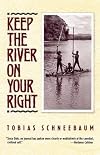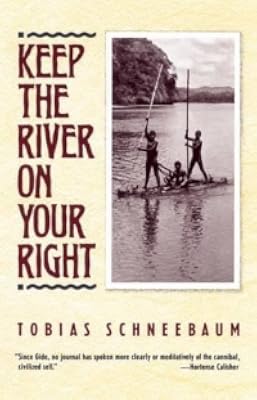
Keep the River on Your Right
by Tobias Schneebaum
On This Page
Description
In 1955, armed with a penknife and instructions to keep the river on his right, Brooklyn-born artist Tobias Schneebaum set off into the jungles of Peru in search of a tribe of cannibals. Forgoing all contact with civilization, he lived as a brother with the Akaramas -- shaving and painting his body, hunting with Stone Age weapons, sleeping in the warmth of the body-pile.Tags
Recommendations

























Member Reviews
I have mixed feelings about this book. The story is compelling and Schneebaum's nearly hypnotic style really conveys his sense of living in the moment. However, I wasn't sure that he quite understood his relationship with his adopted Arakmbut community. After all, he was able to turn up there one day and then, some years later, to just leave; his companions could no more turn up in Schneebaum's Manhattan than he himself could casually arrive on the moon. Schneebaum was respectful and admiring of his Amazonian family, but his insistence that the Arakmbut way of life reflected his true self is only possible because he had another, "modern", world to reject. He certainly understood that his cultural background set him apart from his show more adopted people, but he never seemed to grasp the full implications. show less
The synopsis sounded like semi-dry anthropology describing an undocumented tribe in the Peruvian jungle. But Schneebaum is not and anthropologist, he's an artist. Rather than objectively documenting a culture, he strips down and joins them and is welcomed into their life. He joined the Akaramas for seven months in 1955. He indulges in cannibalism, but it's not meant to shock. His story about self-exploration and discovery. His sexuality is a subtext throughout. With no interest in the '50s mainstream culture, he craves exploration and escape into a world with no familiar rules. One of the final chapters is the text of a letter from another man engaging in similar explorations with a much different result. Deeper than the cover suggests.
Completely dissatisfied with the 1999 documentary of the same name, I decided to pick up Tobias Schneebaum's book "Keep the River on Your Right" to learn more about his experiences in Peru myself.
In the mid-1950's Schneebaum walked into the jungle in search of acceptance and became a member of a tribe of cannibals. He lived amongst them, naked, painted and yes, eating flesh from their dead enemies, for more than seven months before he turned around and walked back out to civilization.
The book is less an interesting anthropological study than a look at Schneebaum himself -- he finds it easier to say that he was a cannibal than to say he is a gay man who fled a 1950's society that wouldn't accept him. His sexuality is very much up front show more throughout the book, but he never addresses it head on.
He paints a rather romantic view of the "noble savages" who accept him into their tribe, despite their raid of another camp, where they murder the men and kidnap women and children.
If you're looking for a ton of information about Peruvian tribes, this book isn't it. However, it is a fascinating look at the lengths a man will travel to find a place to fit in and belong. show less
In the mid-1950's Schneebaum walked into the jungle in search of acceptance and became a member of a tribe of cannibals. He lived amongst them, naked, painted and yes, eating flesh from their dead enemies, for more than seven months before he turned around and walked back out to civilization.
The book is less an interesting anthropological study than a look at Schneebaum himself -- he finds it easier to say that he was a cannibal than to say he is a gay man who fled a 1950's society that wouldn't accept him. His sexuality is very much up front show more throughout the book, but he never addresses it head on.
He paints a rather romantic view of the "noble savages" who accept him into their tribe, despite their raid of another camp, where they murder the men and kidnap women and children.
If you're looking for a ton of information about Peruvian tribes, this book isn't it. However, it is a fascinating look at the lengths a man will travel to find a place to fit in and belong. show less
A very detached, atmospheric, dream-like recollection of going native in the Peruvian jungle, this is an easy and engaging read. However, I wish the author has taken the time and effort to record and recall more detail of this experience non pareil.
Not as good as his Asmat writings.
Ratings
Members
- Recently Added By
Lists

Books I've Read
40 works; 2 members
Author Information

8+ Works 402 Members
Tobias Scheebaum: From 1973 to 1983 he was assistant to the curator of the Asmat Museum of Culture and Progress in Irian Jaya, Indonesia. Since then he has lectured widely and curated several exhibitions on Asmat art. Schneebaum is the subject of a documentary film, Keep the River on Your Right: A Modern Cannibal Tale It premiered at the Los show more Angeles Independent Film Festival in April 2000, where it received the Critic's Choice Award. show less
Series
Belongs to Publisher Series
GAY MEN'S PRESS (GMP) (GMP-?)
Common Knowledge
- People/Characters
- Tobias Schneebaum
- Important places
- Peru
- Related movies
- Keep the River on Your Right (1999)
- Epigraph
- Look at every path closely and deliberately. Try it as many times as you think necessary. Then ask yourself, and yourself alone, one question. This question is one that only a very old man asks. My benefactor told me about it... (show all) once when I was young, and myblood was too vigorous for me to understand it. Now I do understand it. I will tell you what it is: Does this path have a heart? All paths are the same: they lead nowhere. They are paths going through the bush, or into the bush. In my own life I could say I have traversed long, long paths but I am not anywhere. My benefactor's question has meaning now. Does this path have a heart? If it does, the path is good; if it doesn't it is of no use. Both paths lead nowhere; but one has a heart, the other doesn't. One makes for a joyful journey; as long as you follow it, you are one with it. The other will make you curse your life. One makes you strong; the other weakens you.
Don Juan
Quoted in "The Teachings of Don Juan"
By Carolos Castaneda - Dedication
- To Mary Britton Miller
- First words
- Manolo came into the clearing below me a little while ago, carrying in the crook of an elbow a basket of tomatoes he had gathered for supper.
- Last words
- (Click to show. Warning: May contain spoilers.)Now again I cannot answer questions but at this moment there is no need because I go where my legs will take me and if I look ahead, it seems like time gone by, for I see myself no matter where I go, forever there.
Classifications
- Genres
- Anthropology, Nonfiction, Biography & Memoir, Travel, LGBTQ+, General Nonfiction
- DDC/MDS
- 985.00498 — History & geography History of South America Peru History of Peru
- LCC
- F3424 .S43 — Local History of the United States, Canada and Latin America Latin America. Spanish America South America Peru
- BISAC
Statistics
- Members
- 219
- Popularity
- 149,370
- Reviews
- 5
- Rating
- (4.00)
- Languages
- 5 — Dutch, English, Finnish, French, Portuguese
- Media
- Paper
- ISBNs
- 9
- ASINs
- 6