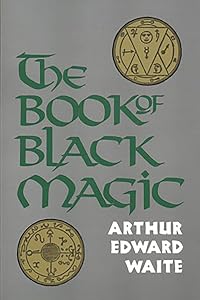
The Book of Black Magic
by Arthur Edward Waite
On This Page
Description
The Secret Tradition in Goetia, including the rites and mysteries of Goetic therugy, sorcery and infernal necromancy. Completely illustrated with the original magical figures. Partial Contents: Antiquity of Magical Rituals; Rituals of Transcendental Magic; Composite Rituals; Key of Solomon; Lesser Key of Solomon; Rituals of Black Magic; Complete Grimoire; Preparation of the Operator; Initial Rites and Ceremonies; Descending Hierarchy; Mysteries of Goetic Theurgy; Mystery of the Sanctum show more Regnum; Method of Honorius. show lessTags
Recommendations






Member Reviews
A compilation of the best/ worst of the popular grimoires from Middle Ages with a moralist agenda. Here Waite tries to, and not too nonchalantly, prove any real black magic as uneducated superstition compared to "high ceremonial magic". Possibly the very reason why Crowley mocked Waite as a self-righteous pomp (or something to same effect).
Partly very uneducated superstition and partly ceremonial black magic, though the substantial content remains by far even more uneven than that of Goetia (also included, though in part only, in this title) and Lemegeton. Not a bad compilation though, there is some quite seductive threads to follow for those who won't heed a warning and/ or contempt for such unruly magic.
Partly very uneducated superstition and partly ceremonial black magic, though the substantial content remains by far even more uneven than that of Goetia (also included, though in part only, in this title) and Lemegeton. Not a bad compilation though, there is some quite seductive threads to follow for those who won't heed a warning and/ or contempt for such unruly magic.
Similar to his book on Tarot, Waite presents a great deal of useful information in a slightly veiled way. Pay special attention to those points which he seems to mock in particular. Waite's dry humor was often his way of pointing toward a lightly hidden nugget of truth.
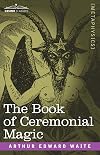
Arthur Edward Waite writes The Book of Ceremonial Magic as a newer and more accurate edition of his previous title The Book of Black Magic and of Pacts, written in 1898. As most ancient texts on magical literature are rare and hard to come by, it becomes very difficult for modern scholars to ascertain an accurate knowledge of ancient spells and rituals. Waite responds to this lack of accessible literature and approaches this text as a methodical and systematic account of magical procedures of the past. He remains faithful to the original sources before making any conclusions by way of his thorough research methods.
Part I provides the reader with essential passages from leading magical texts from the fourteenth, fifteenth, and sixteenth show more centuries. Part II is a more systematically organized version of these ancient texts, adapted by A.E. Waite to the ways of the modern academic. This volume remains one of the best sources of magical procedure, touching on such topics as gods, costume, and the planets and their relation to the supernatural. Although disapproving of the application of magic and the black arts in his introduction, Waite nonetheless defends those victims persecuted throughout history because of their participation in these superstitious beliefs. He also speaks positively about astrology and alchemy, noting them as more important categories of the magical arts. Through this volume, the contemporary reader can finally begin to understand the beliefs in the black arts that were so deeply rooted in our civilization's past. show less
Part I provides the reader with essential passages from leading magical texts from the fourteenth, fifteenth, and sixteenth show more centuries. Part II is a more systematically organized version of these ancient texts, adapted by A.E. Waite to the ways of the modern academic. This volume remains one of the best sources of magical procedure, touching on such topics as gods, costume, and the planets and their relation to the supernatural. Although disapproving of the application of magic and the black arts in his introduction, Waite nonetheless defends those victims persecuted throughout history because of their participation in these superstitious beliefs. He also speaks positively about astrology and alchemy, noting them as more important categories of the magical arts. Through this volume, the contemporary reader can finally begin to understand the beliefs in the black arts that were so deeply rooted in our civilization's past. show less
First published in 1911 as The Book of Ceremonial Magic, this classic work explains the rites, mysteries and secret traditions of Witchcraft, Sorcery, and "Infernal Necromancy", and also explores Theurgy, the White Magic which invokes beneficent spirits. Presented in two parts, the first 'contains an analytical and critical account of the chief magical rituals known to the writer'; the second 'forms a complete Grimoire of Black Magic'. With illustrations and diagrams throughout, the author's mission, 'to permit the rituals of White and Black Magic to speak for themselves', is brilliantly accomplished in this extraordinary text.
A much underappreciated classic of psychology and tradition connected to the ancient world.
Also known as the Book of Black Magic. This includes comprehensive descriptions of rituals from classic grimoires, including extensive illustrations of magical seals. Grimoires covered include the Greater and Lesser Keys of Solomon, the Grimorium Verum, and the Black Pullet.
This waite's "Book of ceremonial magic, and of Pacts" in the cheapest edition I could find.
Members
- Recently Added By
Author Information

213+ Works 5,649 Members
Arthur Edward Waite was born on October 2, 1857 in Brooklyn, New York. He was a poet and scholarly mystic who wrote extensively on occult and esoteric matters, and was the co-creator of the Rider-Waite Tarot deck. Waite joined the Outer Order of the Hermetic Order of the Golden Dawn in January 1891 after being introduced by E.W. Berridge. In 1899 show more he entered the Second order of the Golden Dawn. He became a Freemason in 1901, and entered the Societas Rosicruciana in Anglia in 1902. In 1903 Waite founded the Independent and Rectified Order R. R. et A. C. Waite was a prolific author and many of his works were well received in academic circles. He wrote occult texts on subjects including divination, esotericism, Rosicrucianism, Freemasonry, and ceremonial magic, Kabbalism and alchemy; he also translated and reissued several important mystical and alchemical works. His works on the Holy Grail, influenced by his friendship with Arthur Machen, were particularly notable. A number of his volumes remain in print, including The Book of Ceremonial Magic (1911), The Holy Kabbalah (1929), A New Encyclopedia of Freemasonry (1921), and his edited translation of Eliphas Levi's 1896 Transcendental Magic, its Doctrine and Ritual (1910), having seen reprints in recent years. Waite also wrote two allegorical fantasy novels, Prince Starbeam (1889) and The Quest of the Golden Stairs (1893). (Bowker Author Biography) show less
Some Editions
Series
Belongs to Publisher Series
Common Knowledge
- Original title
- The Book of Black Magic and Pacts
- Alternate titles
- The Book of Black Magic and Pacts; The Book of Ceremonial Magic; The Book of Black Magic and Ceremonial Magic; The Book of Black Magic; The Wordsworth Book of Spells
- Original publication date
- 1898
- Disambiguation notice
- Published under various titles:
The Book of Black Magic and Pacts (1898, 1971)
The Book of Ceremonial Magic (1911, 1961)
The Book of Black Magic and Ceremonial Magic (1973)
The Book of Blac... (show all)k Magic (1989)
The Wordsworth Book of Spells (1995)
Classifications
- Genres
- Religion & Spirituality, Nonfiction, General Nonfiction
- DDC/MDS
- 133.43 — Philosophy & psychology Parapsychology & occultism Specific topics in parapsychology and occultism Demonology and witchcraft Magic and witchcraft
- LCC
- BF1611 .W3 — Philosophy, Psychology and Religion Psychology Occult sciences Magic. Hermetics. Necromancy
- BISAC
Statistics
- Members
- 830
- Popularity
- 33,346
- Reviews
- 9
- Rating
- (3.12)
- Languages
- English, Hungarian
- Media
- Paper, Ebook
- ISBNs
- 42
- ASINs
- 25