On This Page
Description
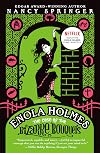
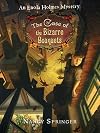
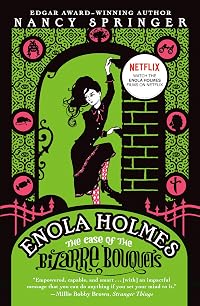
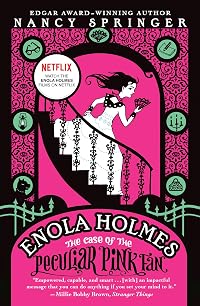
Fourteen-year-old Enola Holmes, disguised as a beautiful woman, finds clues in floral bouquets as she searches for the missing Doctor Watson, a companion of her famous older brother, Sherlock.Tags
Recommendations













Member Reviews
"Let me out," he demands for perhaps the hundredth time. "I am an Englishman! Such treatment of a British citizen simply cannot be tolerated." While his tone is angry, he doesn't curse, she'll give him that; even at his worst, when he fought with the keepers, when he blackened the director's eye, even then he hadn't cursed. Nor does he now, only complaining vehemently. "Let me out. I demand my right as a loyal subject of the queen. Let me out of this confounded coffin, I say!"
Mixing things up, Ms. Springer reveals vital information before Enola's narrative begins. (Perfect example of dramatic irony!) Dr. Watson, dear friend of Sherlock Holmes, is being held in an insane asylum in a case of mistaken identity. But who has put him there show more and how will Enola find and rescue him? (I could pretend that Sherlock might be the one to solve the mystery, but by now readers know it will be the indomitable Enola who will save the day.)
Unsure how much Sherlock knows about her disguises, Enola is trying to lie low in London. But then the newspapers announce that Dr. Watson has mysteriously disappeared. The draw to help the fatherly doctor and his sweet, but plain wife Mary is irresistible. When Enola visits Mary (in a new, ingenious disguise) to gather clues, she finds anonymous bouquets with unusual flowers that are clearly sending a sinister botanical message. Enola is convinced that tracking down the sender of the bouquets will lead her to the person responsible for Watson's disappearance.
This third installment in the series is every bit as delightful as the first two. show less
Mixing things up, Ms. Springer reveals vital information before Enola's narrative begins. (Perfect example of dramatic irony!) Dr. Watson, dear friend of Sherlock Holmes, is being held in an insane asylum in a case of mistaken identity. But who has put him there show more and how will Enola find and rescue him? (I could pretend that Sherlock might be the one to solve the mystery, but by now readers know it will be the indomitable Enola who will save the day.)
Unsure how much Sherlock knows about her disguises, Enola is trying to lie low in London. But then the newspapers announce that Dr. Watson has mysteriously disappeared. The draw to help the fatherly doctor and his sweet, but plain wife Mary is irresistible. When Enola visits Mary (in a new, ingenious disguise) to gather clues, she finds anonymous bouquets with unusual flowers that are clearly sending a sinister botanical message. Enola is convinced that tracking down the sender of the bouquets will lead her to the person responsible for Watson's disappearance.
This third installment in the series is every bit as delightful as the first two. show less
Enola is frozen with indecision, wondering what new identity to create for herself now that she thinks Sherlock might soon uncover "Ivy Meshle," when an article about the disappearance of Dr. John Watson catches her eye. No one, not even the famed detective Sherlock Holmes, knows what has happened to him. Although it puts her at risk of being captured by her older brothers, Enola knows she must do all she can to help Watson.
Readers know from the start that Watson has somehow been mistaken for someone else and committed to an insane asylum. The question is how it happened, and whether Enola, Sherlock, or both can find and free him.
I continue to read this series for the weird Holmes family dynamic, which may seem a little odd since show more they're almost never in the same room together. There's Enola, who desperately wants unambiguous displays of love and affection from her mother. She idolizes Sherlock but also fears what he and Mycroft would do if they tracked her down - she doesn't want to be trapped at boarding school and forced to live whatever sort of life they think is proper for a 14-year-old girl. There's Sherlock, who wants to be a good older brother but doesn't understand Enola at all (although maybe he's starting to?). And then there's Enola's mother, whose primary contact with Enola is through rare personal ads in the newspaper, written in code.
And also Mycroft, but he's barely had any on-page presence since the first book. I do think it's interesting that heapparently has a better grasp of his mother and Enola's shared code than Sherlock does, though.
The biggest problem with this series is that Springer's Sherlock is useless. He cannot track down his 14-year-old sister, despite having been in her presence multiple times. And in this particular book he can't even track down his long-time friend, Dr. Watson, supposedly because something as feminine as bouquets and flowers doesn't interest him enough for him to notice that there's something odd about one of the bouquets that was delivered to Mrs. Watson.
Granted, Enola got lucky. If one of the people involved had watched their mouth a little better, she'd have hit a dead end in her investigation. And she was super lucky that she wasn't caught while snooping and trying to get a little more information - I found that part to be incredibly difficult to believe.
This is a mystery series, and yet the mysteries continue to be weak and terrible. It's a shame, because I like Enola and find her strained family relationships to be interesting. I'll probably continue on because the books are quick reads and I really want to get to the point where Enola and Sherlock finally meet and talk to each other as themselves. (Which is what it would take for him to recognize her. I seriously cannot believe how unobservant this Sherlock is.)
Extras:
An excerpt from the next book, The Case of the Peculiar Pink Fan.
(Original review posted on A Library Girl's Familiar Diversions.) show less
Readers know from the start that Watson has somehow been mistaken for someone else and committed to an insane asylum. The question is how it happened, and whether Enola, Sherlock, or both can find and free him.
I continue to read this series for the weird Holmes family dynamic, which may seem a little odd since show more they're almost never in the same room together. There's Enola, who desperately wants unambiguous displays of love and affection from her mother. She idolizes Sherlock but also fears what he and Mycroft would do if they tracked her down - she doesn't want to be trapped at boarding school and forced to live whatever sort of life they think is proper for a 14-year-old girl. There's Sherlock, who wants to be a good older brother but doesn't understand Enola at all (although maybe he's starting to?). And then there's Enola's mother, whose primary contact with Enola is through rare personal ads in the newspaper, written in code.
And also Mycroft, but he's barely had any on-page presence since the first book. I do think it's interesting that he
The biggest problem with this series is that Springer's Sherlock is useless. He cannot track down his 14-year-old sister, despite having been in her presence multiple times. And in this particular book he can't even track down his long-time friend, Dr. Watson, supposedly because something as feminine as bouquets and flowers doesn't interest him enough for him to notice that there's something odd about one of the bouquets that was delivered to Mrs. Watson.
Granted, Enola got lucky. If one of the people involved had watched their mouth a little better, she'd have hit a dead end in her investigation. And she was super lucky that she wasn't caught while snooping and trying to get a little more information - I found that part to be incredibly difficult to believe.
This is a mystery series, and yet the mysteries continue to be weak and terrible. It's a shame, because I like Enola and find her strained family relationships to be interesting. I'll probably continue on because the books are quick reads and I really want to get to the point where Enola and Sherlock finally meet and talk to each other as themselves. (Which is what it would take for him to recognize her. I seriously cannot believe how unobservant this Sherlock is.)
Extras:
An excerpt from the next book, The Case of the Peculiar Pink Fan.
(Original review posted on A Library Girl's Familiar Diversions.) show less
2025: The 2021 version of myself was not wrong.
_______________________________________________
2021: Really very happy that it occurred to me to re-read this series.
The mystery in itself never makes much difference to me, in these books. This one was rather twisted and as bizarre as the bouquets of the title, but, no matter as I am here for the character of Enola first, and Sherlock and Mycroft second. Somehow, Nancy Springer has created an entirely believable 14-year-old girl who feels lonely and bereft in one moment, and in the next is stalking around London as if she owns it. She has also taken the aloof and coldly logical Sherlock and Mycroft, and made them somehow lovable. AND written a series that manages to be charming while show more never hiding the dark aspects, the filth, and the reality.
I hope I am never forced to choose my favorite girl detective but if I am, it might be Enola. show less
_______________________________________________
2021: Really very happy that it occurred to me to re-read this series.
The mystery in itself never makes much difference to me, in these books. This one was rather twisted and as bizarre as the bouquets of the title, but, no matter as I am here for the character of Enola first, and Sherlock and Mycroft second. Somehow, Nancy Springer has created an entirely believable 14-year-old girl who feels lonely and bereft in one moment, and in the next is stalking around London as if she owns it. She has also taken the aloof and coldly logical Sherlock and Mycroft, and made them somehow lovable. AND written a series that manages to be charming while show more never hiding the dark aspects, the filth, and the reality.
I hope I am never forced to choose my favorite girl detective but if I am, it might be Enola. show less
Dr. John Watson has gone missing, and Sherlock Holmes is at a loss as to his whereabouts. His younger sister, Enola, takes on the case in secret while continuing to hide from Sherlock and Mycroft. She knows that Watson is in grave danger, because Mrs. Watson has been receiving bizarre bouquets that in the language of flowers speak of death. But can she reveal Watson’s whereabouts without revealing her own?
I continue to enjoy this series very much. Given that it’s a middle-grade sort of read, it can be a touch predictable for an adult, but Enola is a dynamic, resourceful character and a lot of fun to read about. She has limitations imposed on her by Victorian society but is able to leverage those limitations to her advantage in some show more ways. And I feel that the portrayal of the Holmes brothers and of Watson is true to the spirit of the original stories, so the series is recommended if you’re looking for a pastiche. show less
I continue to enjoy this series very much. Given that it’s a middle-grade sort of read, it can be a touch predictable for an adult, but Enola is a dynamic, resourceful character and a lot of fun to read about. She has limitations imposed on her by Victorian society but is able to leverage those limitations to her advantage in some show more ways. And I feel that the portrayal of the Holmes brothers and of Watson is true to the spirit of the original stories, so the series is recommended if you’re looking for a pastiche. show less
The Case of the Bizarre Bouquets by Nancy Springer opens with John Watson going missing. Enola, meanwhile, feels she must close up shop because her brothers have gotten to close to finding her. She has no desire to let them run her life. But there's a new threat she needs to think about, the mad house, where women are being sent who don't play by Victorian rules.
Despite her own fears and joblessness, Enola decides to investigate Watson's disappearance. With the help of the disguise shop she knows Sherlock uses, she creates a new persona for herself and sets out to befriend Mrs. Watson.
The Case of the Bizarre Bouquets takes its name from a strange set of flowers delivered to Mrs. Watson's home upon the disappearance of her husband. show more Although Enola had a rather Bohemian childhood, she and her mother did enjoy sharing messages with the language of flowers. That shared hobby comes in handy here and she sees a message that her brother first misses.
In so many of the books set in Victorian times I've read the women are presented in a very narrow spectrum. They are prostitutes, aristocrats, maids or flower sellers. Enola's London has many more types of women, up and down the entire social ladder. These women make London seem more real and certainly more interesting.
And sometimes, more dangerous. Enola's adventures in this third volume are more dangerous than the typical tween mystery I've read. Her life is threatened. She gets hurt. Much of what happens to her is her own misjudgment. It's both shocking and refreshing to find a tween protagonist who is vulnerable. show less
Despite her own fears and joblessness, Enola decides to investigate Watson's disappearance. With the help of the disguise shop she knows Sherlock uses, she creates a new persona for herself and sets out to befriend Mrs. Watson.
The Case of the Bizarre Bouquets takes its name from a strange set of flowers delivered to Mrs. Watson's home upon the disappearance of her husband. show more Although Enola had a rather Bohemian childhood, she and her mother did enjoy sharing messages with the language of flowers. That shared hobby comes in handy here and she sees a message that her brother first misses.
In so many of the books set in Victorian times I've read the women are presented in a very narrow spectrum. They are prostitutes, aristocrats, maids or flower sellers. Enola's London has many more types of women, up and down the entire social ladder. These women make London seem more real and certainly more interesting.
And sometimes, more dangerous. Enola's adventures in this third volume are more dangerous than the typical tween mystery I've read. Her life is threatened. She gets hurt. Much of what happens to her is her own misjudgment. It's both shocking and refreshing to find a tween protagonist who is vulnerable. show less
Not recommended.
I enjoyed the first book, but the wheels of this elaborate Victorian conveyance have come off, and the reader is thrown bruised and dazed to the cobblestones.
In other words, the construction of Enola's tale is, to me, beginning to show its breaking points.
It requires Enola to interact with Sherlock and Dr. Watson a lot.
But since Enola is also hiding from Sherlock, it requires him to, basically, not notice things he should notice.
One can reimagine Sherlock Holmes in many ways, but noticing every detail is at the core of his personality. It strains credulity that the great Sherlock Holmes can't recognize his own sister.
Attention to detail also seems an issue overall. Enola, very conspicuously standing alone in the street, show more pretends to be looking in her pockets - but surely she wouldn't have pockets? She should be pretending to look in her reticule, her tiny purse where she would carry her calling cards. We already know the author knows about reticules, as one is mentioned in the first book.
And the plot also requires to Enola to do things so far out of the norm for a Victorian woman - particularly an aristocratic woman - that she would attract an incredible amount of attention, which seems counterproductive to the whole goal of being so invisible in London that Sherlock and Mycroft can't find her. Running - running! - down the street with her skirts hiked up and then sitting on the ground is, as the author pretty much acknowledges herself, more or less the definition of a Victorian madwoman.
A Victorian woman, constrained by corset and weighed down by Victorian dress, climbing to a rooftop?
Overheard conversations that reveal exactly the needed details?
Preposterous resolutions to plotline questions?
Mysteries may be about improbable events, but piling one improbable thing upon another causes the entire conveyance to collapse under its own baggage.
Unabridged audiobook:
Well read, with good variations in tone, by Katherine Kellgren.
The problem of the two sovereigns (with slight spoilers):
Enola Holmes' misadventures with Victorian money continue.
In book 1, she bribed an impoverished shopkeeper to hide her briefly, bribed her with a £100 note, which in the modern equivalent would be trying to bribe someone with a £10,000 bill (or a $10,000 bill; ten thousand pounds is about $17,000 Canadian).
In book 2, she bribes a street vendor with a guinea ("I'll give you a guinea for the whole lot"). Not long after, she bribes a cab driver with a sovereign ("The cabby looked askance at such an ill-clad fare, but I tossed him a sovereign"). Again this is a problem, as a sovereign (as best I can tell) is worth £1, which is a £100 bribe in modern money, which is way too much.
In book 3, again dressed as a poor woman, she bribes a cab driver with not one but two sovereigns. The idea that a cab driver would do anything but either drive off or go to the police when casually tossed a £100 gold coin (in modern money) - it just doesn't make sense. The idea that Enola who is trying to be invisible in the city would continue to offer gigantic bribes while memorably and incongruously dressed - it just doesn't make sense. show less
I enjoyed the first book, but the wheels of this elaborate Victorian conveyance have come off, and the reader is thrown bruised and dazed to the cobblestones.
In other words, the construction of Enola's tale is, to me, beginning to show its breaking points.
It requires Enola to interact with Sherlock and Dr. Watson a lot.
But since Enola is also hiding from Sherlock, it requires him to, basically, not notice things he should notice.
One can reimagine Sherlock Holmes in many ways, but noticing every detail is at the core of his personality. It strains credulity that the great Sherlock Holmes can't recognize his own sister.
Attention to detail also seems an issue overall. Enola, very conspicuously standing alone in the street, show more pretends to be looking in her pockets - but surely she wouldn't have pockets? She should be pretending to look in her reticule, her tiny purse where she would carry her calling cards. We already know the author knows about reticules, as one is mentioned in the first book.
And the plot also requires to Enola to do things so far out of the norm for a Victorian woman - particularly an aristocratic woman - that she would attract an incredible amount of attention, which seems counterproductive to the whole goal of being so invisible in London that Sherlock and Mycroft can't find her. Running - running! - down the street with her skirts hiked up and then sitting on the ground is, as the author pretty much acknowledges herself, more or less the definition of a Victorian madwoman.
A Victorian woman, constrained by corset and weighed down by Victorian dress, climbing to a rooftop?
Overheard conversations that reveal exactly the needed details?
Preposterous resolutions to plotline questions?
Mysteries may be about improbable events, but piling one improbable thing upon another causes the entire conveyance to collapse under its own baggage.
Unabridged audiobook:
Well read, with good variations in tone, by Katherine Kellgren.
The problem of the two sovereigns (with slight spoilers):
Enola Holmes' misadventures with Victorian money continue.
In book 1, she bribed an impoverished shopkeeper to hide her briefly, bribed her with a £100 note, which in the modern equivalent would be trying to bribe someone with a £10,000 bill (or a $10,000 bill; ten thousand pounds is about $17,000 Canadian).
In book 2, she bribes a street vendor with a guinea ("I'll give you a guinea for the whole lot"). Not long after, she bribes a cab driver with a sovereign ("The cabby looked askance at such an ill-clad fare, but I tossed him a sovereign"). Again this is a problem, as a sovereign (as best I can tell) is worth £1, which is a £100 bribe in modern money, which is way too much.
In book 3, again dressed as a poor woman, she bribes a cab driver with not one but two sovereigns. The idea that a cab driver would do anything but either drive off or go to the police when casually tossed a £100 gold coin (in modern money) - it just doesn't make sense. The idea that Enola who is trying to be invisible in the city would continue to offer gigantic bribes while memorably and incongruously dressed - it just doesn't make sense. show less
Here's Dr Watson! and a very Victorian use of flowers to send a message. Enola has to free Dr Watson from an insane asylum and she does it with a disguise no one would be expecting - her dressed and acting as a fine, well dressed young woman. I love the on-going overall arc of the missing mother, Enola's loneliness, and her cat and mouse play with her brothers.
Members
- Recently Added By
Lists

Books Read in 2021
5,361 works; 114 members

Books Read in 2022
5,226 works; 115 members

Books Read in 2015
3,299 works; 129 members
Author Information

122+ Works 14,583 Members
Nancy Springer was born in Montclair, New Jersey on July 5, 1948. She received a degree in English literature from Gettysburg College in 1970. She has written about 40 books for children, young adults, and adults including the Sea King Trilogy, the Tales of Rowan Hood series, the Book of Isle Trilogy, and the Enola Holmes Mystery series. She has show more won numerous awards including the James Tiptree, Jr. Award, the Joan Fassler Memorial Book Award, and two Edgar Allen Poe Awards. (Bowker Author Biography) show less
Some Editions
Awards and Honors
Awards
Distinctions
Series

Work Relationships
Is contained in
Has the adaptation
Common Knowledge
- Canonical title
- The Case of the Bizarre Bouquets
- Original publication date
- 2008-01-01
- People/Characters
- Enola Holmes; Sherlock Holmes; Mary Morstan (as Mary Morstan Watson); John H. Watson; Mycroft Holmes
- Important places
- London, England, UK
- Dedication
- To my mother
- First words
- Lunatics have no common sense, thinks the matron, but then, that's what deranges the faculties, isn't it, lack of common sense?
- Last words
- (Click to show. Warning: May contain spoilers.)"I think," he says at last, "that it is a great pity she will not trust in me."
- Original language
- English
Classifications
Statistics
- Members
- 944
- Popularity
- 28,187
- Reviews
- 35
- Rating
- (4.03)
- Languages
- 7 — English, French, German, Italian, Polish, Portuguese, Spanish
- Media
- Paper, Audiobook, Ebook
- ISBNs
- 40
- ASINs
- 9