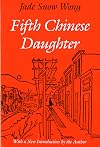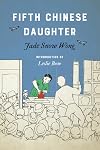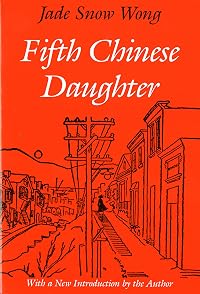
Fifth Chinese Daughter
by Jade Snow Wong
On This Page
Description
Reprint of the Harper edition of 1950. The narrative shows how members of a typical Chinese family in San Francisco adapt themselves to American conditions.Tags
Recommendations








Member Reviews
What I first thought might be a book strictly for the younger reader, has turned into one of my favorite books of all time. This is a story of a first generation Chinese American girl growing up in a traditionally conservative, materially disadvantaged Chinese family in 1920-1940's San Francisco Chinatown. Through her own will, perseverance, hard work and integrity, she charts her own course at a time in history when women had much less opportunity than today, and grows into a successful artist, author, and businesswoman. A true American success story, which left me wishing I had access to such a book earlier in my life. A warm, wonderful story which I highly recommend to readers of any age.
I came across this book via the 500 Great Books by Women Group on Goodreads. It’s a group that discusses the list in the book by Erica Bauermeister. It’s also a list on List Challenges if you like ticking off things online and that sort of thing.
And like in Family Trust by Kathy Wang, a book I was also reading at around the same time, it’s a book set in San Francisco. Unlike the 2018-published Family Trust, Fifth Chinese Daughter by Jade Snow Wong was originally published in 1945, and it’s quite telling of its time, with a 73 year difference between publication of these two books.
Fifth Chinese Daughter is an autobiography but is written more like a novel. And it has a rather educational tone to it, like it’s trying to teach show more the (presumably) white person reading it. So as a modern Chinese-Singaporean reading this book, it sometimes is amusing but more often it feels a bit heavy-handed and didactic.
I must admire Wong’s life and her determination to be educated and find a career. It wasn’t easy at that time for women, and I must imagine, even more so for a Chinese woman living in the US. Her father, while pushing education, especially Chinese-language education, when she was younger, is unwilling to pay for college, as he’s already paying for her brother’s medical school.
“You are quite familiar by now with the fact that it is the sons who perpetuate our ancestral heritage by permanently bearing the Wong family name and transmitting it through their blood line, and therefore the songs must have priority over the daughters when parental provision for advantages must be limited by economic necessity. Generations of sons, bearing our Wong name, are those who make pilgrimages to ancestral burial grounds and preserve them forever. Our daughters leave home at marriage to give sons to their husbands’ families to carry on the heritage for other names.”
She then begins working as a housekeeper for various families and manages to also find herself a scholarship to a college.
It’s an interesting account of various Chinese traditions, such as a funeral, a baby’s first full month with red eggs (which is something that Chinese families in Singapore still do) and pickled pigs’ feet (that was new to me).
Fifth Chinese Daughter may be a bit dated but it does offer an insight into the life of a young Chinese-American growing up in San Francisco at the time and trying to find a balance between her traditional Chinese upbringing and the more American lifestyle she’s becoming accustomed to as she goes to school and finds a career for herself. show less
And like in Family Trust by Kathy Wang, a book I was also reading at around the same time, it’s a book set in San Francisco. Unlike the 2018-published Family Trust, Fifth Chinese Daughter by Jade Snow Wong was originally published in 1945, and it’s quite telling of its time, with a 73 year difference between publication of these two books.
Fifth Chinese Daughter is an autobiography but is written more like a novel. And it has a rather educational tone to it, like it’s trying to teach show more the (presumably) white person reading it. So as a modern Chinese-Singaporean reading this book, it sometimes is amusing but more often it feels a bit heavy-handed and didactic.
I must admire Wong’s life and her determination to be educated and find a career. It wasn’t easy at that time for women, and I must imagine, even more so for a Chinese woman living in the US. Her father, while pushing education, especially Chinese-language education, when she was younger, is unwilling to pay for college, as he’s already paying for her brother’s medical school.
“You are quite familiar by now with the fact that it is the sons who perpetuate our ancestral heritage by permanently bearing the Wong family name and transmitting it through their blood line, and therefore the songs must have priority over the daughters when parental provision for advantages must be limited by economic necessity. Generations of sons, bearing our Wong name, are those who make pilgrimages to ancestral burial grounds and preserve them forever. Our daughters leave home at marriage to give sons to their husbands’ families to carry on the heritage for other names.”
She then begins working as a housekeeper for various families and manages to also find herself a scholarship to a college.
It’s an interesting account of various Chinese traditions, such as a funeral, a baby’s first full month with red eggs (which is something that Chinese families in Singapore still do) and pickled pigs’ feet (that was new to me).
Fifth Chinese Daughter may be a bit dated but it does offer an insight into the life of a young Chinese-American growing up in San Francisco at the time and trying to find a balance between her traditional Chinese upbringing and the more American lifestyle she’s becoming accustomed to as she goes to school and finds a career for herself. show less
Fifth Chinese Daughter is an autobiography written in simple and straightforward language in the proper Chinese third person. As a result I read it in two day's time. It covers the first 24 years of a Chinese-American girl, Jade Snow Wong. From the very beginning, growing up in San Francisco, California, Wong struggled with cultural differences between modern America and the Old World Chinese of her parents. Everything from food, physical contact, gender discrimination, mourning the dead & burials, order of names, to education was contradictory and Wong had to wade through it all during her most formative years. While she didn't mean to disrespect her parents she struggled with independence in a new world, especially when she sought an show more education normally expected of males in her culture. show less
Jade Snow Wong tells her story in third person, a tale of a young girl raised in San Francisco in a 1930s immigrant family, the father a new Christian and an overalls small factory owner, classically educated in Confucian mores and strictures of living. She describes a childhood filled with hard work, food, traditional life of obedience and discipline, and teen how her father taught her Chinese and the value of an education. Through her teen years, she straddles the American-Chinese divide, understanding that Americans see value in her differences that have caused her to fee pain and "less-than." Now a typical story of a young girl's struggle against tradition and toward independence, education and freedom, this story stands out as show more being a very early woman's account in this genre, and for its cultural details, especially around food and herbal treatments. The narrative remains dated, narrow, predictably linear and somewhat dry of emotion, which, as the author is a Confucian-trained Chinese daughter from early 20th century Amierca, is to be expected. show less
loved the book growing up. Lost my hardcover, called Jade Snow Wong and she sent me a paperback, signed, for 7.00 (sometime after 1983)
Ratings
Members
- Recently Added By
Lists

500 Great Books by Women
507 works; 60 members
Author Information

3+ Works 324 Members
Jade Snow Wong (1922-2006) is the author of Fifth Chinese Daughter and No Chinese Stranger. She was also an award-winning ceramicist and enamelist.
Awards and Honors
Notable Lists
Series
Belongs to Publisher Series
Common Knowledge
- Original publication date
- 1950
- People/Characters
- Jade Snow Wong
- Important places
- San Francisco, California, USA
- Dedication
- To my mother and father
- First words
- Hugging the eastern slope of San Francisco's famous Nob Hill is one of the unique spots of this continent.
[Introduction to the 1989 Edition] At the age of twenty-four, I was aware that my upbringing by the nineteenth-century standards of Imperial China, which my parents deemed correct, was quite different from that enjoyed by tw... (show all)entieth-century American s in San Francisco, where I had to find my identity and vocation.
[Author's Note to the Original Edition] A Chinese maxim often repeated to me by my parents is, "When you drink water, think of its source." - Last words
- (Click to show. Warning: May contain spoilers.)And when she came home now, it was to see Mama and Daddy look up from their work, and smile at her, and say, "It is good to have you home again!"
(Click to show. Warning: May contain spoilers.)[Introduction to the 1989 Edition] With the plus of our rich cultural heritage, to be an Asian in America is our distinction.
(Click to show. Warning: May contain spoilers.)[Author's Note to the Original Edition] The drawings are authentic and accurate in detail and represent many hours of careful research on the part of Kathryn Uhl Ball, who co-operated fully to make this book a careful record of an American Chinese girl's first twenty-four years.
Classifications
- Genres
- Biography & Memoir, Nonfiction
- DDC/MDS
- 738.092 — Arts & recreation Sculpture, ceramics & metalwork Ceramic arts modified standard subdivisions History and geography of pottery
- LCC
- NK4210 .W55 .A2 — Fine Arts 3600-(9990) Other arts and art industries Decorative arts Other arts and art industries Ceramics
- BISAC
Statistics
- Members
- 307
- Popularity
- 104,886
- Reviews
- 5
- Rating
- (3.96)
- Languages
- English
- Media
- Paper, Audiobook, Ebook
- ISBNs
- 8
- ASINs
- 18