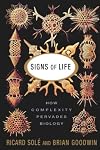
Signs of Life: How Complexity Pervades Biology
by Ricard V. Sole, Brian C. Goodwin
On This Page
Description
Signs of Life applies the mathematics of order and disorder, of entropy, chance, and randomness, of chaos and nonlinear dynamics to the various mysteries of the living world at all levels. This book is an entirely new approach to understanding living systems and will help set the agenda for biology in the coming century.Tags
Recommendations




























Member Reviews
If you’ve ever seen an array of beetles in a natural history museum or gone snorkeling, you have no doubt marveled at just how complex biology can be. There are millions upon millions of species on Earth, each following their own patterns. Those patterns encounter and interfere with other patterns to create the massive biosphere we have today. Ricard Sole and Brian Goodwin, in Signs of Life, try to parse out those patterns and how the science that occurs at the intersection of chaos, mathematics, and biology.
Sole and Goodwin’s investigation traverses almost the entire map of living creatures. From the patterns on mollusk shells to the swarm maps of invading ant populations to mutation rates in viruses to neural pathways, complexity show more is a large part of biological study. They even expand their research into stock market fluctuations and urban sprawl. This book is heavy in both illustrations and mathematical formulae, but you don’t have to be versed in the math to understand the concepts at hand. This book at what I would consider an advanced introductory level. The science is attainable, but the writing gets a little technical at times. All in all, a very intriguing book. show less
Sole and Goodwin’s investigation traverses almost the entire map of living creatures. From the patterns on mollusk shells to the swarm maps of invading ant populations to mutation rates in viruses to neural pathways, complexity show more is a large part of biological study. They even expand their research into stock market fluctuations and urban sprawl. This book is heavy in both illustrations and mathematical formulae, but you don’t have to be versed in the math to understand the concepts at hand. This book at what I would consider an advanced introductory level. The science is attainable, but the writing gets a little technical at times. All in all, a very intriguing book. show less
Ratings
Members
- Recently Added By
Author Information

9 Works 271 Members
2 Works 183 Members
Classifications
Statistics
- Members
- 181
- Popularity
- 177,294
- Reviews
- 1
- Rating
- (3.70)
- Languages
- English
- Media
- Paper
- ISBNs
- 2