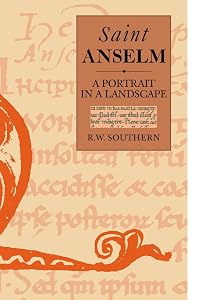
St. Anselm: A Portrait in a Landscape
by Richard W. Southern
On This Page
Description
In this magisterial account of the life and work of St Anselm, now in paperback, Sir Richard Southern provides a study in depth of one of the most fascinating minds in Christian history.Tags
Recommendations










Member Reviews
If Anselm is remembered today, it is usually for one of two of his teachings. One is the so-called ontological argument for the existence of God: God is that object of thought, greater than which cannot be conceived. An object of thought that has real existence is greater than one that does not, therefore . . . . Well, you see where this one is going. The other is his argument for the necessity of the incarnation, which is basically that sin requires an expiation. The collective sin of humanity throughout history is so great that only a sacrifice of infinitely great value could atone for it, therefore . . . . This is known as the satisfaction theory of atonement.
I’ve rendered these arguments in the form in which they are usually cited show more today, often in a condescending tone of voice, dripping with pity for this old archbishop’s naive medieval mind.
It was then a surprise to read this book, ostensibly a biography, but also a learned discussion of the thought of this philosopher and theologian, and find not only that Anselm's reasoning was more sophisticated than the form in which it is now known, but also that he anticipated many of the objections to his positions, and gave well-reasoned answers to them. With regard to the ontological argument, Southern points out: “It is a simplification to say that [it] aimed at proving the existence of God. What he sought to prove is that justice, goodness, and truth are necessarily united in a single Being, who by definition is God. And since justice, goodness, and truth exist, God cannot not exist” (p. 117)
The book is very much a “life and times”, filling in the background modern readers need to understand both Anselm’s actions and thought. He is repeatedly compared and contrasted with his mentor and predecessor, Lanfranc. His mysticism, his assiduous promotion of education and monastic life are explored, as well as his reflection on the nature of friendship, something he not only thought about, but practiced to an avid degree.
Why should we be interested in a monk who has been dead for 900 years? As Southern points out: “It can scarcely be too strongly emphasized that the span of Anselm’s life covered one of the most momentous periods of change in European history, comparable to the centuries of the Reformation or the Industrial Revolution. It is only against this background that his own balancing of the old and new, his mixture of political conservatism and intellectual and spiritual innovation can be justly measured” (pp. 3–4). The author goes so far as to place Anselm together with Gregory VII and William the Conqueror as the three greatest Europeans of the period. The achievement of this scholarly yet readable study is that this reader came away convinced of the justice of this daring claim.
Usually when I rate a book with five stars, I mean it to indicate that anyone interested in books should read it. That may be going a bit far for a book that might appeal to a limited range of readers, but it is so good that I find it impossible to award fewer than five stars. show less
I’ve rendered these arguments in the form in which they are usually cited show more today, often in a condescending tone of voice, dripping with pity for this old archbishop’s naive medieval mind.
It was then a surprise to read this book, ostensibly a biography, but also a learned discussion of the thought of this philosopher and theologian, and find not only that Anselm's reasoning was more sophisticated than the form in which it is now known, but also that he anticipated many of the objections to his positions, and gave well-reasoned answers to them. With regard to the ontological argument, Southern points out: “It is a simplification to say that [it] aimed at proving the existence of God. What he sought to prove is that justice, goodness, and truth are necessarily united in a single Being, who by definition is God. And since justice, goodness, and truth exist, God cannot not exist” (p. 117)
The book is very much a “life and times”, filling in the background modern readers need to understand both Anselm’s actions and thought. He is repeatedly compared and contrasted with his mentor and predecessor, Lanfranc. His mysticism, his assiduous promotion of education and monastic life are explored, as well as his reflection on the nature of friendship, something he not only thought about, but practiced to an avid degree.
Why should we be interested in a monk who has been dead for 900 years? As Southern points out: “It can scarcely be too strongly emphasized that the span of Anselm’s life covered one of the most momentous periods of change in European history, comparable to the centuries of the Reformation or the Industrial Revolution. It is only against this background that his own balancing of the old and new, his mixture of political conservatism and intellectual and spiritual innovation can be justly measured” (pp. 3–4). The author goes so far as to place Anselm together with Gregory VII and William the Conqueror as the three greatest Europeans of the period. The achievement of this scholarly yet readable study is that this reader came away convinced of the justice of this daring claim.
Usually when I rate a book with five stars, I mean it to indicate that anyone interested in books should read it. That may be going a bit far for a book that might appeal to a limited range of readers, but it is so good that I find it impossible to award fewer than five stars. show less
Ratings
Members
- Recently Added By
Author Information

20+ Works 3,058 Members
R. W. Southern was a Fellow of Balliol College from 1937 to 1961, Chichele Professor of History at Oxford from 1961 to 1969, and President of St. John's College, Oxford from 1969 to 1981.
Classifications
- Genres
- Nonfiction, Religion & Spirituality, History, Biography & Memoir, Philosophy
- DDC/MDS
- 282.092 — Religion Christian denominations Roman Catholic Church Catholic Biography And History Biography
- LCC
- BX4700 .A58 .S59 — Philosophy, Psychology and Religion Christian Denominations Christian Denominations Catholic Church Biography and portraits Individual Saints
- BISAC
Statistics
- Members
- 112
- Popularity
- 291,446
- Reviews
- 1
- Rating
- (4.00)
- Languages
- English
- Media
- Paper
- ISBNs
- 2
- ASINs
- 1