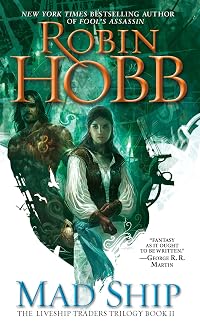
The Mad Ship
by Robin Hobb
The Liveship Traders (2), Realm of the Elderlings (05 (Liveship Traders 02))
On This Page
Description
Fantasy. Fiction. Literature. As the ancient tradition of Bingtown's Old Traders slowly erodes under the cold new order of a corrupt ruler, the Vestrits anxiously await the return of their liveship-a rare magic ship carved from sentient wizardwood, which bonds the ships mystically with those who sail them. And Althea Vestrit waits even more avidly, living only to reclaim the ship as her lost inheritance and captain her on the high seas. But the Vivacia has been seized by the ruthless pirate show more captain Kennit, who holds Althea's nephew and his father hostage. Althea and her onetime sea mate Brashen resolve to liberate the liveship-but their plan may prove more dangerous than leaving the Vivacia in Kennit's ambitious grasp. show lessTags
Recommendations

Member Reviews
Yet another book that has completely captured my attention. Few things that stood out in this one for me apart from Hobbs brilliant prose were :
1. I usually don't like nautical books ,but these so far just feel right. Robin Hob doesn't bog you down with her nautical knowledge on every single piece of the ship, or the commands being called out etc. It all just feels natural. It is also funny that books about ships feel much more about other things than just the ships and for me personally its a big plus!
2. Robin Hobb has this quality to her writing were you feel fully captured when reading a POV and when it switches in the next chapter it almost makes me angry. I go "HEEEY I want to know what happens , I don't care about X just now." show more but after few sentences I do care, and I am hooked again. I honestly was never interested in so many POVs at the same time . And all of them are VERY different , very good AND somehow connected in all of the plot that Robin has woven for us!
3. As always reading Robin Hobb I feel like watching one of those "Most satisfying Video Ever" where everything slowly and elaborately fits in places perfectly. Characters develop , grow, twist and change and slowly the puzzle pieces start to fall in places and the picture they create is looking more and more awesome with each entry.
I am truly blown away by these books, and this entry was on par with all previous entries, the satisfyingly deliberate pace , beautiful prose and excellent characters each feeling unique and walking their own path. LOVE LOVE LOVE this! Recommended show less
1. I usually don't like nautical books ,but these so far just feel right. Robin Hob doesn't bog you down with her nautical knowledge on every single piece of the ship, or the commands being called out etc. It all just feels natural. It is also funny that books about ships feel much more about other things than just the ships and for me personally its a big plus!
2. Robin Hobb has this quality to her writing were you feel fully captured when reading a POV and when it switches in the next chapter it almost makes me angry. I go "HEEEY I want to know what happens , I don't care about X just now." show more but after few sentences I do care, and I am hooked again. I honestly was never interested in so many POVs at the same time . And all of them are VERY different , very good AND somehow connected in all of the plot that Robin has woven for us!
3. As always reading Robin Hobb I feel like watching one of those "Most satisfying Video Ever" where everything slowly and elaborately fits in places perfectly. Characters develop , grow, twist and change and slowly the puzzle pieces start to fall in places and the picture they create is looking more and more awesome with each entry.
I am truly blown away by these books, and this entry was on par with all previous entries, the satisfyingly deliberate pace , beautiful prose and excellent characters each feeling unique and walking their own path. LOVE LOVE LOVE this! Recommended show less
Review of the Second Book in the Liveship Traders Trilogy
In the Realm of the Elderlings
The Mad Ship
Rating: 4.50⭐️
The world has grown broader, and our perspective on it has expanded significantly. We begin to see deeper layers of its history and feel its harshness, uncovering secrets of greater depth. Some of these secrets were hinted at back in the Farseer trilogy, but I understood them differently at the time. I used to think of the Elderlings as relics tied to ancient disasters tools from a bygone age. But this book redefined that perception, revealing dimensions that challenge everything I once assumed was fact. It made me wonder did the Farseer books tell the whole truth? Or is there another truth, slowly unraveling in this show more trilogy? If the events of Farseer were real, then who bears responsibility for what happened to the Elderlings? And were the known truths always incomplete from the start?
The plot here is legendary in both its pacing and the emotional beats that accompanied the characters’ reactions. Robin hit her mark again and again scene after scene striking the exact emotional chord I crave as a reader. Some moments were admittedly confusing, but I didn’t mind being lost for a while because the atmosphere and execution were superb. The interwoven events and their ripple effects were so satisfying I enjoyed every escalation and twist.
Chapter structure also felt lighter compared to book one. I wasn’t bored often on the contrary, I was so engaged I finished the book in just three days, unable to put it down. The prose seemed slightly changed too, and perhaps that shift made the pacing feel smoother and more fluid.
The book introduces many new characters, which was both frustrating and enjoyable. Frustrating because tracking so many people gets overwhelming but enjoyable because it enriched my view of the world and its moving parts.
I noticed Robin really toned down her tendency to rush into relationships, which made the new dynamics more believable and palatable. I’m not sure why she didn’t write them like this from the beginning with gradual buildup and clear logic. But as the saying goes, better late than never.
One issue I had, though, was with how the POV transitions were handled. Sometimes the switches between characters were smooth and clear, but other times, they felt abrupt like you’d suddenly find yourself in a different character’s mind without warning, realizing it only because the style changed. This inconsistency didn’t serve the narrative well, and I really wish Robin had stuck to a consistent, recognizable method for switching perspectives.
In my previous review, most of my criticism was about the characters particularly Althea, Brashen, and Malta. Now, I can say Malta has grown. Her writing improved, and she became one of the characters I enjoyed following.
Althea and Brashen, on the other hand, are still weak and shallow. It feels like they’ve experienced no real development. Their personalities remain broken and unconvincing. However, the events around them grew far more engaging, so I found myself invested in the unfolding story more than the people driving it. The strange part is that Robin is known for character-driven stories, where the plot emerges from internal struggles. But in this book, the plot itself leads the narrative. And while it sometimes succeeded in masking the ugliness or flatness of certain characters, I still couldn’t bring myself to care about Althea or Brashen. What drew me in was what happened around them not within them.
Althea, in particular, remains one of the weakest characters in the series. Every decision she makes must first be validated by someone else. She constantly asks, “What should I do?” and receives the same generic encouragement: “You’re strong. You can do this. Prove yourself.” Then magically, the problem is solved. At the very least, if the person advising her offered a new idea or strategy, it would be more tolerable. But it’s just empty cheerleading like something out of Powerpuff Girls and it doesn’t make for believable growth. Robin stuffed a lot into her character, but none of it was built properly. Here we are in book two, and I’ve yet to see her genuinely overcome anything on her own. As a reader, she feels like a burden on me and on everyone around her. The contrast with Malta is almost painful. I used to hate Malta, but she’s younger and manages to hold her own.
Some characters weren’t evil or good they were just written to be annoying, without depth or complexity. Their presence weighed the book down, as if their only role was to ruin the mood. Thankfully, they were either developed further or phased out, which was a relief. I don’t mind evil or noble characters if they’re written smartly, but writing someone as hateful for no reason adds nothing it just drains you.
Malta in book one felt like a bratty, villainous character with no clear motivation. But in this book, the narrative worked on her flaws and gave her depth that made me pay attention to every scene she appeared in. Her transformation felt realistic and well paced though it could’ve been even better with more time. Still, it wasn’t rushed, and its impact on the story felt earned and believable. And to be honest, I’m shocked to say this but I now care about her. I used to want her dead. Now I’m worried about her fate.
The new characters were excellent well written, thoughtfully flawed, and human. Cosgo surprised me. Based on book one, I expected a foolish, obnoxious character. Instead, I got someone driven by base desires but layered with cunning. He’s a ruler born to power and that legacy brought with it some intelligence and strategy, even if he’s corrupt. At least he’s not stupid. That alone redeemed Robin in my eyes.
As for Serilla, she’s sharp and manipulative in a believable way. Even when injured or humiliated, she maintains composure. Her pain and sorrow feel real or maybe I just don’t know how someone like her processes those emotions, which made her behavior seem authentic. What I appreciated most was how her plans didn’t always work. Sometimes they’d seem solid and then collapse. Other times, they’d succeed against the odds. That unpredictability made every scene she was in gripping. Despite limited appearances, her presence was powerful. The same applies to Reyn and the other newcomers they were written with care, no rushed arcs, no artificial depth. Every character was introduced naturally and developed in a way that felt earned.
Kennit remains the best written character in the book. The truths revealed about him were shocking. I initially thought he was just a charismatic madman. But Robin revealed that his sickness runs deep even infecting those closest to him. His character represents a layered evil born from deep psychological trauma. What impressed me most was that Robin didn’t just show us what he became she explained why he became that way. His past justifies, to a large extent, his present. It’s a haunting past, the kind that would shatter anyone and forge something monstrous in return. What I admire isn’t who he is now, but how he became this way. I’m fascinated by how a child becomes this man shaped by family, abuse, or outside forces. Trauma forges a person the way a blacksmith shapes iron, each strike leaving a mark. Even his current goals tie back to that past, which gives him real depth. He’s not just a man with a past his past still controls him. Just when you think he’s hit bottom, he finds a darker place to go.
Wintrow, like Kennit, retained his growth and gained even more complexity. I loved how he’s still the introspective boy, always questioning his actions and emotions. His internal dialogue continues, and the storm inside him reflects in his surroundings. He’s a consistent character at his core, but open to change and that’s the kind of character that sticks with you. He grows without losing his essence.
There was one moment I found especially weak. A character abruptly says, “Go on, I’ll stay behind. I’ve lost the will to live.” These kinds of scenes are often framed as noble sacrifices, but this one felt hollow and unconvincing. Some may justify it as trauma driven or dramatic, but I saw it as lazy. There was no good reason for him not to escape with the others. His presence mattered. He could’ve faced the consequences later there was no need for that sacrifice in that moment.
The ending was open ended it didn’t try to tie everything up. On the contrary, it introduced more questions and made the world richer and more complex. Some of those questions left me dizzy, but they raised anticipation to a new level. This is exactly how a second book in a trilogy should end not with finality, but with weight and momentum. I didn’t feel like anything was missing, but rather like I was being pulled eagerly into what comes next. show less
In the Realm of the Elderlings
The Mad Ship
Rating: 4.50⭐️
The world has grown broader, and our perspective on it has expanded significantly. We begin to see deeper layers of its history and feel its harshness, uncovering secrets of greater depth. Some of these secrets were hinted at back in the Farseer trilogy, but I understood them differently at the time. I used to think of the Elderlings as relics tied to ancient disasters tools from a bygone age. But this book redefined that perception, revealing dimensions that challenge everything I once assumed was fact. It made me wonder did the Farseer books tell the whole truth? Or is there another truth, slowly unraveling in this show more trilogy? If the events of Farseer were real, then who bears responsibility for what happened to the Elderlings? And were the known truths always incomplete from the start?
The plot here is legendary in both its pacing and the emotional beats that accompanied the characters’ reactions. Robin hit her mark again and again scene after scene striking the exact emotional chord I crave as a reader. Some moments were admittedly confusing, but I didn’t mind being lost for a while because the atmosphere and execution were superb. The interwoven events and their ripple effects were so satisfying I enjoyed every escalation and twist.
Chapter structure also felt lighter compared to book one. I wasn’t bored often on the contrary, I was so engaged I finished the book in just three days, unable to put it down. The prose seemed slightly changed too, and perhaps that shift made the pacing feel smoother and more fluid.
The book introduces many new characters, which was both frustrating and enjoyable. Frustrating because tracking so many people gets overwhelming but enjoyable because it enriched my view of the world and its moving parts.
I noticed Robin really toned down her tendency to rush into relationships, which made the new dynamics more believable and palatable. I’m not sure why she didn’t write them like this from the beginning with gradual buildup and clear logic. But as the saying goes, better late than never.
One issue I had, though, was with how the POV transitions were handled. Sometimes the switches between characters were smooth and clear, but other times, they felt abrupt like you’d suddenly find yourself in a different character’s mind without warning, realizing it only because the style changed. This inconsistency didn’t serve the narrative well, and I really wish Robin had stuck to a consistent, recognizable method for switching perspectives.
In my previous review, most of my criticism was about the characters particularly Althea, Brashen, and Malta. Now, I can say Malta has grown. Her writing improved, and she became one of the characters I enjoyed following.
Althea and Brashen, on the other hand, are still weak and shallow. It feels like they’ve experienced no real development. Their personalities remain broken and unconvincing. However, the events around them grew far more engaging, so I found myself invested in the unfolding story more than the people driving it. The strange part is that Robin is known for character-driven stories, where the plot emerges from internal struggles. But in this book, the plot itself leads the narrative. And while it sometimes succeeded in masking the ugliness or flatness of certain characters, I still couldn’t bring myself to care about Althea or Brashen. What drew me in was what happened around them not within them.
Althea, in particular, remains one of the weakest characters in the series. Every decision she makes must first be validated by someone else. She constantly asks, “What should I do?” and receives the same generic encouragement: “You’re strong. You can do this. Prove yourself.” Then magically, the problem is solved. At the very least, if the person advising her offered a new idea or strategy, it would be more tolerable. But it’s just empty cheerleading like something out of Powerpuff Girls and it doesn’t make for believable growth. Robin stuffed a lot into her character, but none of it was built properly. Here we are in book two, and I’ve yet to see her genuinely overcome anything on her own. As a reader, she feels like a burden on me and on everyone around her. The contrast with Malta is almost painful. I used to hate Malta, but she’s younger and manages to hold her own.
Some characters weren’t evil or good they were just written to be annoying, without depth or complexity. Their presence weighed the book down, as if their only role was to ruin the mood. Thankfully, they were either developed further or phased out, which was a relief. I don’t mind evil or noble characters if they’re written smartly, but writing someone as hateful for no reason adds nothing it just drains you.
Malta in book one felt like a bratty, villainous character with no clear motivation. But in this book, the narrative worked on her flaws and gave her depth that made me pay attention to every scene she appeared in. Her transformation felt realistic and well paced though it could’ve been even better with more time. Still, it wasn’t rushed, and its impact on the story felt earned and believable. And to be honest, I’m shocked to say this but I now care about her. I used to want her dead. Now I’m worried about her fate.
The new characters were excellent well written, thoughtfully flawed, and human. Cosgo surprised me. Based on book one, I expected a foolish, obnoxious character. Instead, I got someone driven by base desires but layered with cunning. He’s a ruler born to power and that legacy brought with it some intelligence and strategy, even if he’s corrupt. At least he’s not stupid. That alone redeemed Robin in my eyes.
As for Serilla, she’s sharp and manipulative in a believable way. Even when injured or humiliated, she maintains composure. Her pain and sorrow feel real or maybe I just don’t know how someone like her processes those emotions, which made her behavior seem authentic. What I appreciated most was how her plans didn’t always work. Sometimes they’d seem solid and then collapse. Other times, they’d succeed against the odds. That unpredictability made every scene she was in gripping. Despite limited appearances, her presence was powerful. The same applies to Reyn and the other newcomers they were written with care, no rushed arcs, no artificial depth. Every character was introduced naturally and developed in a way that felt earned.
Kennit remains the best written character in the book. The truths revealed about him were shocking. I initially thought he was just a charismatic madman. But Robin revealed that his sickness runs deep even infecting those closest to him. His character represents a layered evil born from deep psychological trauma. What impressed me most was that Robin didn’t just show us what he became she explained why he became that way. His past justifies, to a large extent, his present. It’s a haunting past, the kind that would shatter anyone and forge something monstrous in return. What I admire isn’t who he is now, but how he became this way. I’m fascinated by how a child becomes this man shaped by family, abuse, or outside forces. Trauma forges a person the way a blacksmith shapes iron, each strike leaving a mark. Even his current goals tie back to that past, which gives him real depth. He’s not just a man with a past his past still controls him. Just when you think he’s hit bottom, he finds a darker place to go.
Wintrow, like Kennit, retained his growth and gained even more complexity. I loved how he’s still the introspective boy, always questioning his actions and emotions. His internal dialogue continues, and the storm inside him reflects in his surroundings. He’s a consistent character at his core, but open to change and that’s the kind of character that sticks with you. He grows without losing his essence.
There was one moment I found especially weak. A character abruptly says, “Go on, I’ll stay behind. I’ve lost the will to live.” These kinds of scenes are often framed as noble sacrifices, but this one felt hollow and unconvincing. Some may justify it as trauma driven or dramatic, but I saw it as lazy. There was no good reason for him not to escape with the others. His presence mattered. He could’ve faced the consequences later there was no need for that sacrifice in that moment.
The ending was open ended it didn’t try to tie everything up. On the contrary, it introduced more questions and made the world richer and more complex. Some of those questions left me dizzy, but they raised anticipation to a new level. This is exactly how a second book in a trilogy should end not with finality, but with weight and momentum. I didn’t feel like anything was missing, but rather like I was being pulled eagerly into what comes next. show less
To read more reviews in this series and others, check out my blog keikii eats books!
100 points, 5 STARS!
Quote:
Review:
The Mad Ship... Where to even start with this review? I'm not certain. So much happens in The Mad Ship. Without reading Ship of Magic, you would be able to follow along, but you wouldn't have the context. You wouldn't know how things are so absolutely brilliant. So many things happen, yet nothing is solved. And nothing will be the same as it was in the beginning by the end of the series.
If I couldn't say with certainty that the best thing Robin Hobb does is her characters, show more I would say it is her worldbuilding. The Realm of the Elderlings is absolutely unreal. At the start of the Farseer trilogy and Liveship Traders we knew nothing about the Elderlings. And because we knew nothing, I instantly wanted to know everything. The Mad Ship is the start to us learning more about them. Like, holy fucking shit the revelations in this book are unreal and I honestly hurt inside trying to contain my amazement.
The Liveships are without a doubt the most unique thing I have ever read in fantasy. I have never seen their like. I haven't even seen anything close to the Liveships before. The revelations about them throughout the book, the hints that we have seen since the start. I'm absolutely amazed at the brilliance of the writing of the Liveships.
Liveships are people, too. They are as much characters in this series as everyone else. I talked about Althea and Malta, my beloved Wintrow, and Kennit and motherfucking Kyle in the previous review. But the ships are amazing characters. Vivacia is a young, impressionable girl. She is desperate for validation. And Kennit is trying to turn her into a pirate ship, because Kennit is a fucking asshole. Kennit is charming her as a man charms a woman, and I hate him. Also, what is he doing to my poor Wintrow?!
Then there is Paragon, the Mad Ship. Beached for years, bitter as hell. Paragon has killed his family again and again before returning home. Yet, what is the real story? What happened? Why can't he remember what he did? Paragon is quite mad, in fact. He throws tantrums. He wants to be accepted but he fears it as much as he wants it. He is a scared little boy, just trying to die. And Liveships don't die easy. Yet Althea and Brashen, with help from Amber, convince him to go after Vivacia and rescue her from the pirates. I love Paragon.
Oh, and Amber. Amber isn't a new character. And I love her to pieces. And boy was I in for a shock when I put some very elaborate pieces together about Amber. I'm still shocked.
Robin Hobb just knows how to write. I almost kind of hate myself for not reading her sooner. I don't understand how anything can be so damn good. I'm about to start the third and final Liveship Traders book, and I'm scared, and I'm hopeful, but I just have to get to the end. show less
100 points, 5 STARS!
Quote:
"Everything in my life that I was sure I would do someday has always been snatched away when it was almost within my reach. Perhaps it will again."
Review:
The Mad Ship... Where to even start with this review? I'm not certain. So much happens in The Mad Ship. Without reading Ship of Magic, you would be able to follow along, but you wouldn't have the context. You wouldn't know how things are so absolutely brilliant. So many things happen, yet nothing is solved. And nothing will be the same as it was in the beginning by the end of the series.
If I couldn't say with certainty that the best thing Robin Hobb does is her characters, show more I would say it is her worldbuilding. The Realm of the Elderlings is absolutely unreal. At the start of the Farseer trilogy and Liveship Traders we knew nothing about the Elderlings. And because we knew nothing, I instantly wanted to know everything. The Mad Ship is the start to us learning more about them. Like, holy fucking shit the revelations in this book are unreal and I honestly hurt inside trying to contain my amazement.
The Liveships are without a doubt the most unique thing I have ever read in fantasy. I have never seen their like. I haven't even seen anything close to the Liveships before. The revelations about them throughout the book, the hints that we have seen since the start. I'm absolutely amazed at the brilliance of the writing of the Liveships.
Liveships are people, too. They are as much characters in this series as everyone else. I talked about Althea and Malta, my beloved Wintrow, and Kennit and motherfucking Kyle in the previous review. But the ships are amazing characters. Vivacia is a young, impressionable girl. She is desperate for validation. And Kennit is trying to turn her into a pirate ship, because Kennit is a fucking asshole. Kennit is charming her as a man charms a woman, and I hate him. Also, what is he doing to my poor Wintrow?!
Then there is Paragon, the Mad Ship. Beached for years, bitter as hell. Paragon has killed his family again and again before returning home. Yet, what is the real story? What happened? Why can't he remember what he did? Paragon is quite mad, in fact. He throws tantrums. He wants to be accepted but he fears it as much as he wants it. He is a scared little boy, just trying to die. And Liveships don't die easy. Yet Althea and Brashen, with help from Amber, convince him to go after Vivacia and rescue her from the pirates. I love Paragon.
Oh, and Amber. Amber isn't a new character. And I love her to pieces. And boy was I in for a shock when I put some very elaborate pieces together about Amber. I'm still shocked.
Robin Hobb just knows how to write. I almost kind of hate myself for not reading her sooner. I don't understand how anything can be so damn good. I'm about to start the third and final Liveship Traders book, and I'm scared, and I'm hopeful, but I just have to get to the end. show less
I finished this today and overall, thought it was excellent. However, I almost feel like there are too many plot threads—an awful lot will have to come together in the next book to bring this arc of the overall series to a satisfying conclusion. It’s a mixed bag—on the one hand, I love the complexity, but on the other hand, just as one storyline moves forward, Hobb abandons it to take up another, and so, the book had a rather disjointed feel to it.
Having said all that, I really liked the way the characters are developing, maturing, gaining depth and nuances. The most obvious is Malta, but also Keffria, Wintrow, Brashen, and Etta.
I suspected a connection between the sea serpents and the dragons, but not the idea that wizardwood is show more made of the hardened cocoons of serpents becoming dragons. The visions/memories/dreams from the buried Elderling city were enchanting, and yet, so sad. Was it a volcanic eruption that burned the city, or a severe earthquake? And the tie-in with the Farseer trilogy (the dragon graveyard) was also enlightening, that those were created dragons, artistic sculptures with relatively brief lives, not true dragons born from the serpent-woven cocoons.
Amber continues to be my favorite character, and I think perhaps she may be the Fool. I always think of the Fool as being somewhat fragile, and I don’t see Amber that way, but maybe the Fool regained his/her strength after the events in the Farseer trilogy. The Fool was changing at the end of [b:Assassin's Quest|33396914|Assassin's Quest (Farseer Trilogy, #3)|Robin Hobb|https://images.gr-assets.com/books/1481883253s/33396914.jpg|503752]. When Paragon tells Amber there are two of him, Amber tells him that she has felt that way, too, and she says her “other one” was a friend with whom she used to talk a lot. She says, “Sometimes I hear myself still talking to him, and I know how he would answer.” Talking about Fitz?
I also think the change in Vivacia is so interesting—her role as a pirate ship seems to appeal to what we now know is her dragon nature. The Vivacia/Wintrow/Kennit/Etta quad is very intriguing, and one of my favorite storylines.
The next book should be quite a ride! show less
Having said all that, I really liked the way the characters are developing, maturing, gaining depth and nuances. The most obvious is Malta, but also Keffria, Wintrow, Brashen, and Etta.
I suspected a connection between the sea serpents and the dragons, but not the idea that wizardwood is show more made of the hardened cocoons of serpents becoming dragons. The visions/memories/dreams from the buried Elderling city were enchanting, and yet, so sad. Was it a volcanic eruption that burned the city, or a severe earthquake? And the tie-in with the Farseer trilogy (the dragon graveyard) was also enlightening, that those were created dragons, artistic sculptures with relatively brief lives, not true dragons born from the serpent-woven cocoons.
Amber continues to be my favorite character, and I think perhaps she may be the Fool. I always think of the Fool as being somewhat fragile, and I don’t see Amber that way, but maybe the Fool regained his/her strength after the events in the Farseer trilogy. The Fool was changing at the end of [b:Assassin's Quest|33396914|Assassin's Quest (Farseer Trilogy, #3)|Robin Hobb|https://images.gr-assets.com/books/1481883253s/33396914.jpg|503752]. When Paragon tells Amber there are two of him, Amber tells him that she has felt that way, too, and she says her “other one” was a friend with whom she used to talk a lot. She says, “Sometimes I hear myself still talking to him, and I know how he would answer.” Talking about Fitz?
I also think the change in Vivacia is so interesting—her role as a pirate ship seems to appeal to what we now know is her dragon nature. The Vivacia/Wintrow/Kennit/Etta quad is very intriguing, and one of my favorite storylines.
The next book should be quite a ride! show less
It would be safe to say Robin Hobb is a genius. Or at least possesses depths of imagination that is freakish in nature in any case. And the characterisation is phenomenal. I used to love her Fitz books, but I am becoming quite enamored with her Liveship Traders now as well.. I have the last of the trilogy sitting here beside me and though it's 4:30 am, my fingers are burning to pick it up and keep on the journey.
In this second part of the liveship traders trilogy, the story continues exactly as it left off before. Kennit's infected leg is soon amputated by Wintrow, saving his life. Either his infection also with Vivacia's personality, or some life triggers somehow turn Kennit's life around, and he becomes far more benevolent, warm, protective, even honourable. Wintrow in turn learns to admire him, as he strives to improve the lives of towns he is connected to, as well as continue to rescue slaves from their prisons inside slave ships.
Back at Bingtown, politics is boiling over with tensions created by the Satrap coming to a head, Malta is forced to grow up very quickly, with two suitors, and the knowledge that her own father and brother are show more probably captured by pirates. Althea organises to take over the Paragon, the mad ship of the title, to go in seach of them with Brashen, as well as Amber, her mysterious word-carving friend, who has formed a particularly close attachment to the ship.
And, in the middle of all this there are are the Rain Wild traders, who make the live ships out of the mysterious wizardwood, the dragon and buried kingdom they guard, and the huge, old, wise sea serpents, who seem connected to everything.
Needless to say the above only scratches the surface in this enormous, sprawling novel, which has an enormous amount of plot in it, with at least three parallel streams.
As last time, the novel ends almost in the middle of a scene, as if this is very much just the end of a chapter, rather than a suitable endpoint for a book. The whole trilogy may as well be seen as just a single incredibly long book (about as long as In Search of Lost Time!). It is enthralling and intricate, with so many unexpected twists and turns, and deep characters that change as time goes on. But it is also so so long! And I did wish at times, that however immersive it is to hear so many details of the politics of these interconnected towns and regions, this would have been heavily shortened to make the novel more punchy. Though having said this, as soon as I finished this novel, I started the next! show less
Back at Bingtown, politics is boiling over with tensions created by the Satrap coming to a head, Malta is forced to grow up very quickly, with two suitors, and the knowledge that her own father and brother are show more probably captured by pirates. Althea organises to take over the Paragon, the mad ship of the title, to go in seach of them with Brashen, as well as Amber, her mysterious word-carving friend, who has formed a particularly close attachment to the ship.
And, in the middle of all this there are are the Rain Wild traders, who make the live ships out of the mysterious wizardwood, the dragon and buried kingdom they guard, and the huge, old, wise sea serpents, who seem connected to everything.
Needless to say the above only scratches the surface in this enormous, sprawling novel, which has an enormous amount of plot in it, with at least three parallel streams.
As last time, the novel ends almost in the middle of a scene, as if this is very much just the end of a chapter, rather than a suitable endpoint for a book. The whole trilogy may as well be seen as just a single incredibly long book (about as long as In Search of Lost Time!). It is enthralling and intricate, with so many unexpected twists and turns, and deep characters that change as time goes on. But it is also so so long! And I did wish at times, that however immersive it is to hear so many details of the politics of these interconnected towns and regions, this would have been heavily shortened to make the novel more punchy. Though having said this, as soon as I finished this novel, I started the next! show less
I am at absolute odds with loving Hobb's strong female characters and absolutely despising her seeming lack of feminist ideals. I'm reminded a bit of a shadow of Gabaldon's "Outlander" characters who seem incapable of defending themselves against any sort of hardship or danger.
Hobb's characters are made of much stronger stuff - and I keep hoping that each strong woman will find her way without the help or support of a male lead - but have so far been quite disappointed.
Don't get me wrong - the story is absolutely amazing. The world-building is enticing and beautiful. The characters are believable - even lovable. Most of them are female - which I love - I'm just too damn old and have seen too damn much of life to give 5 stars to a show more story that still finds women lacking, despite all their strengths and capabilities.
Maybe I'll have a chance to ask Hobb about this at her Denver Comic Con panel this Saturday! show less
Hobb's characters are made of much stronger stuff - and I keep hoping that each strong woman will find her way without the help or support of a male lead - but have so far been quite disappointed.
Don't get me wrong - the story is absolutely amazing. The world-building is enticing and beautiful. The characters are believable - even lovable. Most of them are female - which I love - I'm just too damn old and have seen too damn much of life to give 5 stars to a show more story that still finds women lacking, despite all their strengths and capabilities.
Maybe I'll have a chance to ask Hobb about this at her Denver Comic Con panel this Saturday! show less
Members
- Recently Added By
Lists

Favorite Series
238 works; 94 members

Sentient ships
20 works; 3 members

Female Protagonist
1,056 works; 57 members

Books about pirates
29 works; 10 members
Books tagged favorites
390 works; 30 members

Shelf 101
60 works; 1 member

Epic Fantasy of the 90s
111 works; 4 members

Books Read in 2017
4,249 works; 130 members

Books Read in 2018
4,360 works; 110 members

Read in 1999–2000
24 works; 1 member

Books Read in 2026
2,040 works; 68 members
Talk Discussions
Past Discussions
Group read: The Mad Ship by Robin Hobb - The Liveship Trilogy in 75 Books Challenge for 2018 (November 2018)
Author Information

142+ Works 107,305 Members
Robin Hobb was born in California but grew up in Alaska. It was there that she learned to love the forest and the wilderness. She has lived most of her life in the Pacific Northwest and currently resides in Tacoma, Washington. She is the author of five critically acclaimed fantasy series: The Rain Wilds Chronicles (Dragon Keeper, Dragon Haven, show more City of Dragons, Blood of Dragons), The Soldier Son Trilogy, The Tawny Man Trilogy, The Liveship Traders Trilogy, and The Farseer Trilogy. Under the name Megan Lindholm she is the author of The Wizard of the Pigeons, Windsingers, and Cloven Hooves. The Inheritance, a collection of stories, was published under both names. Her short fiction has won the Asimov's Readers' Award and she has been a finalist for both the Nebula and Hugo awards. (Publisher Provided) Margaret Astrid Lindholm Ogden was born in Berkeley, California on March 5, 1952. She writes under the pseudonyms Megan Lindholm and Robin Hobb. She writes fantasy and science fiction under the name Robin Hobb including the Farseer Trilogy, the Liveship Traders Trilogy, the Tawny Man Trilogy, the Soldier Son Trilogy, the Rain Wilds Chronicles, and the Fitz and the Fool Trilogy. Her title, Assassin's Fate, made The New York Times Best Seller List in 2017. (Bowker Author Biography) show less
Some Editions
Awards and Honors
Awards
Distinctions
Series


Work Relationships
Is contained in
Common Knowledge
- Canonical title
- The Mad Ship
- Original title
- The Mad Ship
- Original publication date
- 1999-03
- People/Characters
- Althea Vestrit; Wintrow Haven; Ronica Vestrit; Malta Haven; Keffria Haven; Kennit (show all 10); Etta; Brashen Trell; Reyn Khuprus; Amber
- Important places
- Bingtown; Trehaug; Pirate Isles
- First words
- Below the serpents, the beds of weeds swayed gently in the changing tide.
- Last words
- (Click to show. Warning: May contain spoilers.)She settled into it, and continued towards her destiny.
- Blurbers
- Martin, George R.R.
- Original language
- English
Classifications
Statistics
- Members
- 5,675
- Popularity
- 2,329
- Reviews
- 75
- Rating
- (4.14)
- Languages
- 12 — Czech, Dutch, English, Finnish, French, German, Hungarian, Italian, Polish, Russian, Spanish, Swedish
- Media
- Paper, Audiobook, Ebook
- ISBNs
- 42
- ASINs
- 20