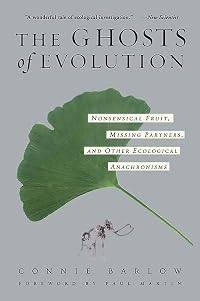
The Ghosts of Evolution: Nonsensical Fruit, Missing Partners, and Other Ecological Anachronisms
by Connie Barlow
On This Page
Description
A new vision is sweeping through ecological science: The dense web of dependencies that makes up an ecosystem has gained an added dimension-the dimension of time. Every field, forest, and park is full of living organisms adapted for relationships with creatures that are now extinct. In a vivid narrative, Connie Barlow shows how the idea of "missing partners" in nature evolved from isolated, curious examples into an idea that is transforming how ecologists understand the entire flora and show more fauna of the Americas. This fascinating book will enrich and deepen the experience of anyone who enjoys a stroll through the woods or even down an urban sidewalk. But this knowledge has a dark side too: Barlow's "ghost stories" teach us that the ripples of biodiversity loss around us now are just the leading edge of what may well become perilous cascades of extinction. show lessTags
Recommendations






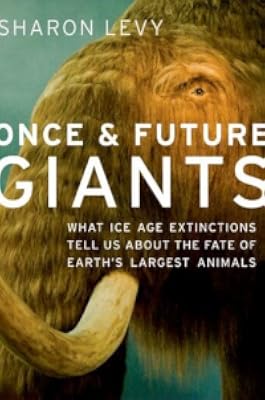

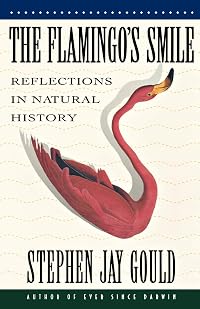
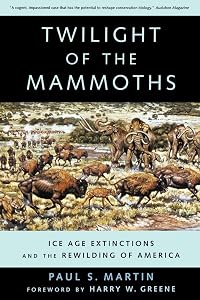


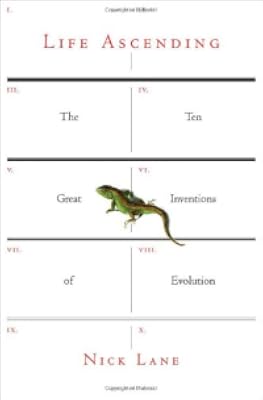


Member Recommendations
Member Reviews
Substance: Develops an idea proposed in 1982 in Science magazine, by ecologist Dan Janzen and paleontologist Paul Martin, that certain fruiting plants are "intended" for now-extinct dispersing agents, namely megafauna of the mammoth, giant sloth, etc. league, which made the plants anachronisms about 13,000 years ago. Interesting and plausible; I have no problem accepting their thesis. Curiously, they actually believe that the evolutionary development occurred far sooner than the nearest extinct dispersers, sometime in the age of the dinosaurs, which means there has been no evolutionary pressure on the plants to adjust to new, less-optimal agents.
In addition to the explication of the professionals evidence and arguments, Barlow also show more experiments and contributes personal anecdotes to the book.
Until reading this book, I did not know that horse and camel progenitors developed first on the American continents, and then moved to Asia before dying out here.
I like the idea or re-introducing camels into the western US to browse on mesquite and other noxious shrubs that have invaded the grasslands and are not eaten by cattle or horses.
Style: Barlow, a science writer and journalist, writes in an easily accessible, folksy manner; however, she repeats many of her major points over and over (fruitlessly?), and fails to define certain technical terms early on (or ever), leaving the reader to puzzle them out by the context. A time-line putting the named eras in order would have been helpful as well.
She is not the only "popular science" writer to belabor obvious or easily-stated points while neglecting to give needed back-story or definitions to the lay reader; it is a curious intellectual "bubble" or set of blinders. show less
In addition to the explication of the professionals evidence and arguments, Barlow also show more experiments and contributes personal anecdotes to the book.
Until reading this book, I did not know that horse and camel progenitors developed first on the American continents, and then moved to Asia before dying out here.
I like the idea or re-introducing camels into the western US to browse on mesquite and other noxious shrubs that have invaded the grasslands and are not eaten by cattle or horses.
Style: Barlow, a science writer and journalist, writes in an easily accessible, folksy manner; however, she repeats many of her major points over and over (fruitlessly?), and fails to define certain technical terms early on (or ever), leaving the reader to puzzle them out by the context. A time-line putting the named eras in order would have been helpful as well.
She is not the only "popular science" writer to belabor obvious or easily-stated points while neglecting to give needed back-story or definitions to the lay reader; it is a curious intellectual "bubble" or set of blinders. show less
The de-extinction crowd would like this if they haven't already read it (it's been out for 13 years, so probably already have). Why do gingkos smell of rotten meat, and why do the honey locust pods persist on the ground more than a year after falling? The answer, according to Jantzen & Martin in a 1982 paper is that their ecological partners are missing- animals with a gullet large enough to swallow the massive avocado seed and dump it with a nice patch of fertilizer, carnivores willing to take a chance on some pleasantly aroma'd fruit. Barlow looks at some interesting likely anachronisms in the American landscape- would be interesting to see how ecologists' views have shifted if any in the time between publication and this.
The author sets out to explore the possible missing links in the ecological chain of some unusual plants around the world. These plants are ones that appear to be missing a pollinator, but still put out the fruits that no critter disperses for them. Well written and easy to read, the author presents it almost as a mystery story - a scientific mystery.
The topic is interesting, but I was maybe not as deeply interested as I needed to be to truly enjoy. I liked the general information about adaptations such as pulp or thorns, the exhaustive listing of the various examples was more than I was looking for.
Good Information, and sobering, in its examination of future “widows”
Good Information, and sobering, in its examination of future “widows”
Enjoyable read. New material on plant survival strategies that is making me rethink trying pawpaw as my next fruit - it needs a bit more space for ideal survival than, say, Prunus.
Ratings
Members
- Recently Added By
Lists

Top Five Books of 2013
1,562 works; 721 members

For Science!
39 works; 5 members
Author Information

7 Works 385 Members
Common Knowledge
- Dedication
- To all who remember
Classifications
Statistics
- Members
- 174
- Popularity
- 188,081
- Reviews
- 5
- Rating
- (3.61)
- Languages
- English
- Media
- Paper, Ebook
- ISBNs
- 3
- ASINs
- 3