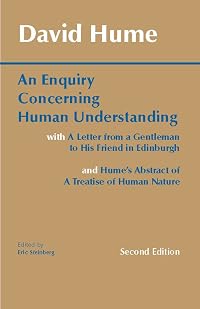
An Enquiry Concerning Human Understanding
by David Hume
On This Page
Description
The Enquiry considers the origin and processes of human thought and argues that we should liberate ourselves from the 'superstition' of false metaphysics and religion. This edition places the work in its historical and philosophical context. - ;'Commit it then to the flames: for it can contain nothing but sophistry and illusion.'. Thus ends David Hume's Enquiry concerning Human Understanding, the definitive statement of the greatest philosopher in the English language. His arguments in show more support of reasoning from experience, and against the 'sophistry and illusion' of religiously inspired philos show lessTags
Recommendations









Member Reviews
“If we take in our hand any volume; of divinity or school metaphysics, for instance; let us ask, Does it contain any abstract reasoning concerning quantity or number? No. Does it contain any experimental reasoning concerning matter of fact and existence? No. Commit it then to the flames: For it can contain nothing but sophistry and illusion” (114)
Such a remarkable book, this sturdy pillar of western philosophy.
Going in, I knew something of Hume’s basic arguments for empiricism and how he positioned that work in contrast with arguments for a reason-focused approach to knowledge and understanding. What I had not anticipated was how direct and plain spoken the arguments would be, how solid the thought experiments would be, and how show more close to the surface Hume’s atheism (or religious skepticism) would run.
The essential argument of the book is easily summarized and it begins with a distinction between the ways that mind perceives. One way is through IMPRESSIONS which are the sense data coming from direct experience. The other is IDEAS which are representations of impressions. Ideas are more unbounded than sense impressions in that we can imagine things that do not exist, but they are ultimately grounded in impressions and are the medium through which we apply reason to order and make sense of impressions. Hume writes that the “creative power of the mind amounts to no more than the faculty of compounding, transposing, augmenting, or diminishing the materials afforded us by the senses and experience” (11). If we trace the origins of ideas they always lead back to impressions.
To this point, Hume offers his famous thought experiment about the missing swatch of blue on a gradient of other blue shades. Questioning if a person could apply reason to determine the shade of that missing blue, the answer is “yes” but only because of the sense data provided by the darker and lighter swatches and the sense information from the gradient itself. In the absence of that sense data, the answer would be no. This observation raises all kinds of interesting questions about the necessity of sense information for knowing. Can we know things that are insensible? Can we know things that others have sensed but we have not? How does knowledge survive through successive generations in the absence of a chain of sense impressions?
This argument is also interesting for how it democratizes philosophical pursuits. The philosophical pursuit that Hume describes doesn’t require preternatural skill with reasoning to properly access our innate ideas about the nature of universe — it requires access to our senses and a few simple rules about how ideas about sense impressions form. We build up knowledge by considering how ideas about impressions 1) resemble other impressions, 2) are contiguous with other ideas, and 3) how that contiguity suggests cause and effect relationships. These are the moves of understanding that rationalize a connection between pieces of sense data. And this then opens up other interesting questions like how do go from this kind of understanding to conclusions that we can call knowledge or facts? And how do we establish facts that we can then build into more complex facts? Surely lines of inquiry need not always start from raw sense data and move up to complexity. Instead, it is an accumulation of inferences, grounded in an accumulation of sensory impressions that allows us to form expectations about what is true, probabilistically (you’ll recognize the move to inductive reasoning here; although Hume doesn’t use the term). Without the sense data, however, we would have no basis upon which to form these rational beliefs. Here, Hume uses another of his famous thought experiments about colliding billiard balls to show how we form beliefs about cause and effect based on past sense data. Imagine never having seen billiard balls collide before … where would our beliefs above effects and causes arise from? Would we have any reason to believe that the balls would do something other than collide and stop?
Latter sections of the book take on how knowledge becomes integrated into and preserved through civilization. He also takes on divine providence and miracles showing them to be impossibilities.
Well worth a read. show less
Such a remarkable book, this sturdy pillar of western philosophy.
Going in, I knew something of Hume’s basic arguments for empiricism and how he positioned that work in contrast with arguments for a reason-focused approach to knowledge and understanding. What I had not anticipated was how direct and plain spoken the arguments would be, how solid the thought experiments would be, and how show more close to the surface Hume’s atheism (or religious skepticism) would run.
The essential argument of the book is easily summarized and it begins with a distinction between the ways that mind perceives. One way is through IMPRESSIONS which are the sense data coming from direct experience. The other is IDEAS which are representations of impressions. Ideas are more unbounded than sense impressions in that we can imagine things that do not exist, but they are ultimately grounded in impressions and are the medium through which we apply reason to order and make sense of impressions. Hume writes that the “creative power of the mind amounts to no more than the faculty of compounding, transposing, augmenting, or diminishing the materials afforded us by the senses and experience” (11). If we trace the origins of ideas they always lead back to impressions.
To this point, Hume offers his famous thought experiment about the missing swatch of blue on a gradient of other blue shades. Questioning if a person could apply reason to determine the shade of that missing blue, the answer is “yes” but only because of the sense data provided by the darker and lighter swatches and the sense information from the gradient itself. In the absence of that sense data, the answer would be no. This observation raises all kinds of interesting questions about the necessity of sense information for knowing. Can we know things that are insensible? Can we know things that others have sensed but we have not? How does knowledge survive through successive generations in the absence of a chain of sense impressions?
This argument is also interesting for how it democratizes philosophical pursuits. The philosophical pursuit that Hume describes doesn’t require preternatural skill with reasoning to properly access our innate ideas about the nature of universe — it requires access to our senses and a few simple rules about how ideas about sense impressions form. We build up knowledge by considering how ideas about impressions 1) resemble other impressions, 2) are contiguous with other ideas, and 3) how that contiguity suggests cause and effect relationships. These are the moves of understanding that rationalize a connection between pieces of sense data. And this then opens up other interesting questions like how do go from this kind of understanding to conclusions that we can call knowledge or facts? And how do we establish facts that we can then build into more complex facts? Surely lines of inquiry need not always start from raw sense data and move up to complexity. Instead, it is an accumulation of inferences, grounded in an accumulation of sensory impressions that allows us to form expectations about what is true, probabilistically (you’ll recognize the move to inductive reasoning here; although Hume doesn’t use the term). Without the sense data, however, we would have no basis upon which to form these rational beliefs. Here, Hume uses another of his famous thought experiments about colliding billiard balls to show how we form beliefs about cause and effect based on past sense data. Imagine never having seen billiard balls collide before … where would our beliefs above effects and causes arise from? Would we have any reason to believe that the balls would do something other than collide and stop?
Latter sections of the book take on how knowledge becomes integrated into and preserved through civilization. He also takes on divine providence and miracles showing them to be impossibilities.
Well worth a read. show less
Do we have here the roots of modern scientific thinking? Writing at a time when the influence of Descartes was still major, Hume had the genius to go against the trend and to offer a radically new way of thinking!
In 1739-1740, he had published a treatise upon human nature, a work which, to his own admission, was way too long and too confusing to interest anyone. Undeterred, though, he decided to write it again, but this time by simplifying it and make it more straightforward and readable. And here we have it: his famous 'Enquiry Concerning Human Understanding'!
Drawing upon empiricism, he claims that our impressions only (our perception of our surrounding world through our senses) are the origin of our ideas. Such ideas, then, are not show more innate, as if planted in our minds by a benevolent God, but, on the contrary, the product of our experiences; experiences which are our only tool to understand our environment.
Put like this and from our vantage point, this sounds simple enough. Yet, at the time, here was a radically new perspective. Here's a new way open to us to try and understand the natural world (welcome to modern science, then...) but, also, our believes. A whole chapter is for instance dedicated to 'miracles', a section which, on its own, is an absolute must-read! The implications of such a new epistemology go way beyond this, though. The philosophe had indeed the audacity to discuss its consequences in fascinating arguments, tackling from the Induction Problem to determinism, and, even, animal intelligence. More than a century before Darwin and the quarrels that evolutionary biology has yet to bring about, this 'Enquiry' is the little blow which will contribute to seed a storm.
Absolutely brilliant, here is a major and revolutionary read. show less
In 1739-1740, he had published a treatise upon human nature, a work which, to his own admission, was way too long and too confusing to interest anyone. Undeterred, though, he decided to write it again, but this time by simplifying it and make it more straightforward and readable. And here we have it: his famous 'Enquiry Concerning Human Understanding'!
Drawing upon empiricism, he claims that our impressions only (our perception of our surrounding world through our senses) are the origin of our ideas. Such ideas, then, are not show more innate, as if planted in our minds by a benevolent God, but, on the contrary, the product of our experiences; experiences which are our only tool to understand our environment.
Put like this and from our vantage point, this sounds simple enough. Yet, at the time, here was a radically new perspective. Here's a new way open to us to try and understand the natural world (welcome to modern science, then...) but, also, our believes. A whole chapter is for instance dedicated to 'miracles', a section which, on its own, is an absolute must-read! The implications of such a new epistemology go way beyond this, though. The philosophe had indeed the audacity to discuss its consequences in fascinating arguments, tackling from the Induction Problem to determinism, and, even, animal intelligence. More than a century before Darwin and the quarrels that evolutionary biology has yet to bring about, this 'Enquiry' is the little blow which will contribute to seed a storm.
Absolutely brilliant, here is a major and revolutionary read. show less
My philosophical training was limited to passing first year at university. Even though I had two tutors who later became renowned Princeton professors. One, spent an hour with my one afternoon going over nuclear deterrence and as a result I felt relatively calm about the whole nuclear proliferation of the Reagan years. Philosophy works that some level to calm us and contain our irrational bits, ie the dominant bits. I had acquired knowledge, though not by sensory experience. But I didn’t want to be tested by actual experience on that occasion.
The 18thC Scot, David Hume, wanted no more than to state clearly and elegantly the way we acquire knowledge. For that he ran afoul of the church authorities that campaigned behind the scenes and show more openly to block his access to proper university posts. And that makes him as contemporary as can be. In any age.
How do we get knowledge? Hume wants to understand the simplest thing really, that we learn by experiencing. And the world of senses and stimuli take us there. Ie, we experience first then gain knowledge. The one phrase I recall fondly from PH101 is a priori. It refers to knowledge that is reasoned to exist before or prior to experience. As though it always existed. It’s a tempting idea that we receive by some pool of collective wisdom much of what we know. But, perhaps we can accept that we can also learn by absorbing knowledge through education as custom and practice. Which is like being given guiding principles to apply to experiences. But a priori knowledge sounds like a way of staying ignorant by not learning from what we sense, or apply our reasoning to through experiences. Hume instead wants to explore that knowledge is acquired by observation. Here is the idea in a Hume nutshell:
A man must be very sagacious, who could discover by reasoning, that crystal is the effect of heat, and ice of cold, without being previously acquainted with the operation of these qualities.
Though our senses can’t necessarily tell us that what we see, smell, taste etc allows us to gain knowledge. After all, knowing that bread once fed us, doesn’t explain how it will do so again. What is bread’s secret power to nourish, asks Hume. The mind takes certain processes to know that.
It is only after a long course of uniform experiments in any kind, that we attain and a firm reliance and security with regard to a particular event. or further:
From a body of like colour and consistence with bread we accept like nourishment and support.
While that sounds good, he goes on wanting to enquire further:
But this surely is a step or progress of mind which wants to be explained.
I can see how he ran into trouble with the received wisdom of his day:
I must confess that a man is guilty of unpardonable arrogance, who concludes, because an argument has escaped his own investigation, that therefore it does not really exist. I must also confess, that, though all the learned, for several ages, should have employed themselves in fruitless search upon any subject, it may still perhaps be rash to conclude positively, that the subject must, therefore, pass all human comprehension.
You can see why the church might want to obscure his work by denying him paid employment in his chosen field.
Hume lived through perhaps the era of the best English prose, too. He is quite a joy to read for the balance of his ideas contained in each sentence. He gives credit to the idea that the elegance of the idea should be delivered through an equivalent elegance of a sentence. As the above sentence demonstrates.
Hume is an interesting read today simply because I can read lines in his work that stimulate reflection on the contemporary world. But then, how we acquire knowledge is a timeless question. We fail or rise to the occasion continuously, too. Here’s a nice line:
The observation of human blindness and weakness is the result of all philosophy, and meets us, at every turn, in spite of our endeavours to elude or evade it.
Hume would likely walk down the street today looking for lampposts to beat his head against. We humans repeat ourselves, hence the problem of philosophical enquiry is relevant to each age. Hence Hume doesn’t get old.
All my review can offer is a sampler. He’s worth reading. His ideas are clean and polished as anything that survived 250 or so years.
Anyway, by the end of this work, I was calmed into understanding the faculty of using experience and reason to guide thinking on the one hand. Much as I had calmed myself that afternoon 40 years ago about nuclear deterrence. And on the other hand, I saw around me the absence of critical observation on the world and the proliferation of believing before knowing. I’m off to find a lamp post. At least I have a good idea why I want to beat my head against it. One pain distracts the mind from the other, perhaps worse pain. At least I read that in a credible medical article on pain. Someone had done the actual research on pain. show less
The 18thC Scot, David Hume, wanted no more than to state clearly and elegantly the way we acquire knowledge. For that he ran afoul of the church authorities that campaigned behind the scenes and show more openly to block his access to proper university posts. And that makes him as contemporary as can be. In any age.
How do we get knowledge? Hume wants to understand the simplest thing really, that we learn by experiencing. And the world of senses and stimuli take us there. Ie, we experience first then gain knowledge. The one phrase I recall fondly from PH101 is a priori. It refers to knowledge that is reasoned to exist before or prior to experience. As though it always existed. It’s a tempting idea that we receive by some pool of collective wisdom much of what we know. But, perhaps we can accept that we can also learn by absorbing knowledge through education as custom and practice. Which is like being given guiding principles to apply to experiences. But a priori knowledge sounds like a way of staying ignorant by not learning from what we sense, or apply our reasoning to through experiences. Hume instead wants to explore that knowledge is acquired by observation. Here is the idea in a Hume nutshell:
A man must be very sagacious, who could discover by reasoning, that crystal is the effect of heat, and ice of cold, without being previously acquainted with the operation of these qualities.
Though our senses can’t necessarily tell us that what we see, smell, taste etc allows us to gain knowledge. After all, knowing that bread once fed us, doesn’t explain how it will do so again. What is bread’s secret power to nourish, asks Hume. The mind takes certain processes to know that.
It is only after a long course of uniform experiments in any kind, that we attain and a firm reliance and security with regard to a particular event. or further:
From a body of like colour and consistence with bread we accept like nourishment and support.
While that sounds good, he goes on wanting to enquire further:
But this surely is a step or progress of mind which wants to be explained.
I can see how he ran into trouble with the received wisdom of his day:
I must confess that a man is guilty of unpardonable arrogance, who concludes, because an argument has escaped his own investigation, that therefore it does not really exist. I must also confess, that, though all the learned, for several ages, should have employed themselves in fruitless search upon any subject, it may still perhaps be rash to conclude positively, that the subject must, therefore, pass all human comprehension.
You can see why the church might want to obscure his work by denying him paid employment in his chosen field.
Hume lived through perhaps the era of the best English prose, too. He is quite a joy to read for the balance of his ideas contained in each sentence. He gives credit to the idea that the elegance of the idea should be delivered through an equivalent elegance of a sentence. As the above sentence demonstrates.
Hume is an interesting read today simply because I can read lines in his work that stimulate reflection on the contemporary world. But then, how we acquire knowledge is a timeless question. We fail or rise to the occasion continuously, too. Here’s a nice line:
The observation of human blindness and weakness is the result of all philosophy, and meets us, at every turn, in spite of our endeavours to elude or evade it.
Hume would likely walk down the street today looking for lampposts to beat his head against. We humans repeat ourselves, hence the problem of philosophical enquiry is relevant to each age. Hence Hume doesn’t get old.
All my review can offer is a sampler. He’s worth reading. His ideas are clean and polished as anything that survived 250 or so years.
Anyway, by the end of this work, I was calmed into understanding the faculty of using experience and reason to guide thinking on the one hand. Much as I had calmed myself that afternoon 40 years ago about nuclear deterrence. And on the other hand, I saw around me the absence of critical observation on the world and the proliferation of believing before knowing. I’m off to find a lamp post. At least I have a good idea why I want to beat my head against it. One pain distracts the mind from the other, perhaps worse pain. At least I read that in a credible medical article on pain. Someone had done the actual research on pain. show less
After his three-volume Treatise of Human Nature dropped like a rock to the bottom of the pool of British philosophic writing, Hume set out to write a briefer, more accessible version -- the Enquiry concerning Human Understanding. One of the early points it makes is that most endeavors to write about the nature of thought are hopeless and nearly impossible to understand. With that disclaimer, Hume sets out to contradict himself by writing lucidly about, while candidly acknowledging the severe limits of, this topic. He uses logic to show that most human understanding falls into two categories: a very small group of innate truths deducible by logic, like every triangle has three sides, and a much larger group -- nearly everything we "know" show more -- which is based on reality-based observation. This latter group always has, at a fundamental level, an element of probabilistic assumption: Things customarily happened this way before, so they probably will again. Thus almost everything we (think we) know about the world is based on empirical experience, not pure logic. So . . .how did he figure this all out? show less
The first philosophy book I can give 5 stars. I wish I had this as a young teen - it would have calmed and cleared my mind considerably. For a work over 250 years old, I was pleasently surprised by the style: for the most part he was direct, a little poetic, and with a wee bit of humour to help things along. His conquest of my heart got off to good start when he suggested that a lot of philosophy and writing done up to that point had been a wasted effort, as people simply hadn't defined their words properly. How can we have a Great Conversation without making sure we are talking about the same stuff?
He manages get an awful lot done in less than 100 pages: he clearly explains his ideas about experience, reasoning, causality, morality and show more religion, and unleashes the sceptic bombshell on the lot. I don't feel like he forced his ideas, but actually lays them out for full inspection, and for this he feels timeless. He admits the troubling truth that full scepticism can only lead to inaction, but that it seems to be our only reliable guide if we aim for pure truth. He ends by admirably shaking off the paradox-like bind, and happily revives common sense, restraining his scepticism to a more moderate range of enquiry thereafter - an invaluable point for a troubled, excited teen.
This sums it up for me nicely:
"Abstruse thought and profound researches I prohibit, and will severely punish, by the pensive melancholy which they introduce, by the endless uncertainty in which they involve you, and by the cold reception which your pretended discoveries shall meet with, when communicated. Be a philosopher; but, amidst all your philosophy, be still a man." show less
He manages get an awful lot done in less than 100 pages: he clearly explains his ideas about experience, reasoning, causality, morality and show more religion, and unleashes the sceptic bombshell on the lot. I don't feel like he forced his ideas, but actually lays them out for full inspection, and for this he feels timeless. He admits the troubling truth that full scepticism can only lead to inaction, but that it seems to be our only reliable guide if we aim for pure truth. He ends by admirably shaking off the paradox-like bind, and happily revives common sense, restraining his scepticism to a more moderate range of enquiry thereafter - an invaluable point for a troubled, excited teen.
This sums it up for me nicely:
"Abstruse thought and profound researches I prohibit, and will severely punish, by the pensive melancholy which they introduce, by the endless uncertainty in which they involve you, and by the cold reception which your pretended discoveries shall meet with, when communicated. Be a philosopher; but, amidst all your philosophy, be still a man." show less
I didn't particularly enjoy this book. Hume is both pretentious and self-indulgent. While he makes a good case for experience being a necessary prerequisite for knowing effect from cause, he also contradicts himself variously and accords to experience more authority than he accredits it in certain other parts of this book.
That a certain effect has happened numerous times before is no guarantee that it will happen again -true enough! Hume says that it is simply "custom" to credit any particular effect with empirical authority. But wait until he gets to the chapter on miracles; here he gives experience over arching authority to know exactly what nature and it's laws will give rise to. Hume argues that cause and effect are known only show more through experience and one experience will apply to other cause and effect occurrences when they are apparently similar. He admits that much of this cause/effect process occurs because of unintelligible "secret powers" that are inscrutable to reason. Whilst admitting that experience is more or less mere custom and admitting the inscrutability of secret processes, Hume undoes his argument and gauges the miraculous using the means he just put in doubtful standing! What an egregious error of logic; what a way to dig your own philosophical grave; to cast doubt on a particular method of reasoning and then endue it with absolute authority. Hume says no one has ever seen anyone rise from the dead anywhere, so presumes Hume who says that no occurrence is illogical that doesn't involve a contradiction. Hume presumes to use his customary experience to measure all events everywhere, regardless of whether he was present or not. He uses the example of an Indian disbelieving that water could become hard because of cold in his argument against miracles, when in fact it works against Hume. The example was to illustrate ignorance of physical laws that can seem miraculous when one has not experienced them. Same argument works against Hume. Hume thinks that a ship being suspended in air is a miracle; an example that is altogether ironic, given that in the 21st century we see jet airliners suspended in the air regularly. This would be a miracle to Hume, but all it really shows is Hume's 18th century ignorance of the principles of propulsion, aerodynamics and lift. Hume, as he admitted, has no means of knowing all natural laws and when and where they can be superseded because of other "secret powers" or laws coming into play. His chapter on miracles is a bit of a comical irony. Hume makes much of probability. A one thousand sided dye with nine hundred and ninety nine uniform sides with only one differentiated side figures in his argument regarding probability. It's an interesting analogy and example. Miracles by their very nature are not regular occurrences, just as the probability of one particular side appearing in a one thousand sided dye in a roll is not a regular occurrence. A miracle only has to happen once in experience to be an experimental fact. If it occurs even once, all arguments to the contrary are simply willful ignorance and, in Hume's case, pretentious sophistry.
The only thing that saves this book from a 2 star review is his chapter "Of The Idea Of Necessary Connexion" which I must admit was quite intriguing. If I ever re-read Hume, it will probably be only this chapter and little else. Hume, subsequently, became the darling of atheists and his arguments are often recycled by them ad nauseam still. This, once again, shows the ignorance of atheists and their tendency to cherry pick sources. Hume wasn't an atheist, if anything he was a deist; although, he seems to make some claims to Christian belief, which can only be seen as ridiculous given his above positions. show less
That a certain effect has happened numerous times before is no guarantee that it will happen again -true enough! Hume says that it is simply "custom" to credit any particular effect with empirical authority. But wait until he gets to the chapter on miracles; here he gives experience over arching authority to know exactly what nature and it's laws will give rise to. Hume argues that cause and effect are known only show more through experience and one experience will apply to other cause and effect occurrences when they are apparently similar. He admits that much of this cause/effect process occurs because of unintelligible "secret powers" that are inscrutable to reason. Whilst admitting that experience is more or less mere custom and admitting the inscrutability of secret processes, Hume undoes his argument and gauges the miraculous using the means he just put in doubtful standing! What an egregious error of logic; what a way to dig your own philosophical grave; to cast doubt on a particular method of reasoning and then endue it with absolute authority. Hume says no one has ever seen anyone rise from the dead anywhere, so presumes Hume who says that no occurrence is illogical that doesn't involve a contradiction. Hume presumes to use his customary experience to measure all events everywhere, regardless of whether he was present or not. He uses the example of an Indian disbelieving that water could become hard because of cold in his argument against miracles, when in fact it works against Hume. The example was to illustrate ignorance of physical laws that can seem miraculous when one has not experienced them. Same argument works against Hume. Hume thinks that a ship being suspended in air is a miracle; an example that is altogether ironic, given that in the 21st century we see jet airliners suspended in the air regularly. This would be a miracle to Hume, but all it really shows is Hume's 18th century ignorance of the principles of propulsion, aerodynamics and lift. Hume, as he admitted, has no means of knowing all natural laws and when and where they can be superseded because of other "secret powers" or laws coming into play. His chapter on miracles is a bit of a comical irony. Hume makes much of probability. A one thousand sided dye with nine hundred and ninety nine uniform sides with only one differentiated side figures in his argument regarding probability. It's an interesting analogy and example. Miracles by their very nature are not regular occurrences, just as the probability of one particular side appearing in a one thousand sided dye in a roll is not a regular occurrence. A miracle only has to happen once in experience to be an experimental fact. If it occurs even once, all arguments to the contrary are simply willful ignorance and, in Hume's case, pretentious sophistry.
The only thing that saves this book from a 2 star review is his chapter "Of The Idea Of Necessary Connexion" which I must admit was quite intriguing. If I ever re-read Hume, it will probably be only this chapter and little else. Hume, subsequently, became the darling of atheists and his arguments are often recycled by them ad nauseam still. This, once again, shows the ignorance of atheists and their tendency to cherry pick sources. Hume wasn't an atheist, if anything he was a deist; although, he seems to make some claims to Christian belief, which can only be seen as ridiculous given his above positions. show less
I wish Hume had taken Philosophy 101, with an emphasis on Logic, from Aristotle. That thought crossed my mind many times when reading the Enquiry. Hume should have known that Aristotle have defined long before him many ideas he had difficulty expressing. He could have saved himself some trouble reinventing the wheel. The reader could have saved some time clearing away the rubble of logical inconsistencies. They rather obscure Hume’s unique insights in and contributions to the philosophy of science.
Hume aims to undermine the epistemological certainty and conceit of philosophers and theologians. In doing so, however, he unwittingly, if not inevitably, shows his own conceit. As a caution against hubris, his skepticism is very humbling show more and refreshing, but that is the extent of its usefulness. Whenever Hume steps outside his own skepticism, and attempts to make assertions, he falls flat on his face.
In my readings and discussions about Hume, I find a very interesting pattern: Everybody interprets Hume from his own perspective. An observer can gauge a reader’s position on the spectrum of beliefs solely based on his interpretation of Hume. For it is rather a reflection of the reader than of Hume.
(Read full review at https://nemoslibrary.com/2017/07/30/an-enquiry-concerning-human-understanding-ii... show less
Hume aims to undermine the epistemological certainty and conceit of philosophers and theologians. In doing so, however, he unwittingly, if not inevitably, shows his own conceit. As a caution against hubris, his skepticism is very humbling show more and refreshing, but that is the extent of its usefulness. Whenever Hume steps outside his own skepticism, and attempts to make assertions, he falls flat on his face.
In my readings and discussions about Hume, I find a very interesting pattern: Everybody interprets Hume from his own perspective. An observer can gauge a reader’s position on the spectrum of beliefs solely based on his interpretation of Hume. For it is rather a reflection of the reader than of Hume.
(Read full review at https://nemoslibrary.com/2017/07/30/an-enquiry-concerning-human-understanding-ii... show less
Members
- Recently Added By
Lists

100 Books to Read in a Lifetime (That Are Older Than 200 Years)
415 works; 173 members

Filosofía - Clásicos
217 works; 1 member

Great Books Favorites
71 works; 6 members

Atheism, humanism, freethought, &c. — Best nonfiction books in favour of
167 works; 14 members

CCE 100 Great Books List
145 works; 8 members

Trinity College Booklist (1951): Class Three, Philosophy and Religion
80 works; 3 members

A Reading List
100 works; 3 members

How to Read a Book's Recommended Reading List
309 works; 10 members

Greatest Books, allegedly
484 works; 9 members

Philosophy, Politics and Economics
61 works; 1 member
My List
302 works; 1 member
New Lifetime Reading Plan by Fadiman and Major
225 works; 5 members

Books Read in 2023
5,547 works; 145 members

readingList
38 works; 1 member

el
1,139 works; 1 member
Author Information

414+ Works 17,869 Members
David Hume was born in Edinburgh to a minor Scottish noble family, raised at the estate of Ninewells, and attended the University of Edinburgh for two years until he was 15. Although his family wished him to study law, he found himself unsuited to this. He studied at home, tried business briefly, and after receiving a small inheritance traveled to show more France, settling at La Fleche, where Descartes had gone to school. There he completed his first and major philosophical work, A Treatise of Human Nature (1739--40), published in three volumes. Hume claimed on the title page that he was introducing the experimental method of reasoning into moral subjects, and further that he was offering a new way of seeing the limits of human knowledge. Although his work was largely ignored, Hume gained from it a reputation as a philosophical skeptic and an opponent of traditional religion. (In later years he was called "the great infidel.") This reputation led to his being rejected for professorships at both Edinburgh and Glasgow. To earn his living he served variously as the secretary to General St. Clair, as the attendant to the mad Marquis of Annandale, and as the keeper of the Advocates Library in Edinburgh. While holding these positions, he wrote and published a new version of his philosophy, the two Enquiries, and many essays on social, political, moral, and literary subjects. He also began his six-volume History of England from the Roman Invasion to the Glorious Revolution (1754--62), the work that made him most famous in his lifetime. Hume retired from public life and settled in Edinburgh, where he was the leading figure in Scottish letters and a good friend to many of the leading intellectuals of the time, including Adam Smith and Benjamin Franklin. During this period, he completed the Dialogues Concerning Natural Religion, which he had been working on for more than 25 years. Hume first worked on the Dialogues in the middle of his career, but put them aside as too provocative. In his last years he finished them and they were published posthumously in 1779. They are probably his best literary effort and have been the basis for continuous discussion and debate among philosophers of religion. Toward the end of Hume's life, his philosophical work began to be taken seriously, and the skeptical problems he had raised were tackled by philosophers in Scotland, France, and finally Germany, where Kant claimed that Hume had awakened him from his dogmatic slumbers. Hume was one of the most influential philosophers of modern times, both as a positive force on skeptical and empirical thinkers and as a philosopher to be refuted by others. Interpreters are still arguing about whether he should be seen as a complete skeptic, a partial skeptic, a precursor of logical positivism, or even a secret believer. (Bowker Author Biography) show less
Some Editions
Awards and Honors
Series
Belongs to Publisher Series
Work Relationships
Is contained in
The Empiricists : Locke, An Essay Concerning Human Understanding (Abridged) ; Berkeley, Principles of Human Knowledge, and 3 Dialogues ; Hume, An Enquiry Concerning Human Understanding, and Dialogues Concerning Natural Religion by Richard Taylor
English Philosophers of the Seventeenth and Eighteenth Centuries: Locke; Berkeley; Hume by Charles William Eliot
Is abridged in
Common Knowledge
- Original title
- Philosophical essays concerning human understanding
- Original publication date
- 1748
- First words
- Moral philosophy, or the science of human nature, may be treated after two different manners; each of which has its peculiar merit, and may contribute to the entertainment, instruction, and reformation of mankind. The one con... (show all)siders man chiefly as born for action; and as influenced in his measures by taste and sentiment; pursuing one object, and avoiding another, according to the value which these objects seem to possess, and according to the light in which they present themselves. As virtue, of all objects, is allowed to be the most valuable, this species of philosophers paint her in the most amiable colours; borrowing all helps from poetry and eloquence, and treating their subject in an easy and obvious manner, and such as is best fitted to please the imagination, and engage the affections. They select the most striking observations and instances from common life; place opposite characters in a proper contrast; and alluring us into the paths of virtue by the views of glory and happiness, direct our steps in these paths by the soundest precepts and most illustrious examples. They make us feel the difference between vice and virtue; they excite and regulate our sentiments; and so they can but bend our hearts to the love of probity and true honour, they think, that they have fully attained the end of all their labours.
- Quotations
- If we take in our hand any volume of divinity or school metaphysics, for instance, let us ask, Does it contain any abstract reasoning concerning quantity or number? No. Does it contain any experimental reasoning concerning ma... (show all)tter of fact and existence? No. Commit it then to the flames, for it can contain nothing but sophistry and illusion.
- Last words
- (Click to show. Warning: May contain spoilers.)When we run over libraries, persuaded of these principles, what havoc must we make? If we take in our hand any volume; of divinity or school metaphysics, for instance; let us ask, Does it contain any abstract reasoning concerning quantity or number? No. Does it contain any experimental reasoning concerning matter of fact and existence? No. Commit it then to the flames: for it can contain nothing but sophistry and illusion.
- Original language
- English
- Canonical LCC
- B1481
- Disambiguation notice
- The work generally known as An Enquiry Concerning Human Understanding was first published as Philosophical Essays Concerning Human Understanding (... (show all)l#ehu" rel="nofollow" target="_new">editorial notes at davidhume.org).
Classifications
Statistics
- Members
- 4,384
- Popularity
- 3,399
- Reviews
- 31
- Rating
- (3.95)
- Languages
- 12 — Catalan, Czech, Dutch, English, Finnish, French, German, Hungarian, Korean, Spanish, Turkish, Portuguese (Portugal)
- Media
- Paper, Audiobook, Ebook
- ISBNs
- 157
- UPCs
- 2
- ASINs
- 49