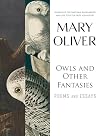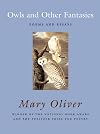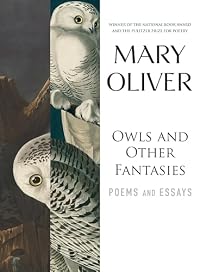
Owls and Other Fantasies: Poems and Essays
by Mary Oliver
On This Page
Description
A collection of poetry and essays celebrates the birds that have played an important role in the author's life, including the owl, goldfinch, swan, hummingbird, and loon.Tags
Recommendations


Member Reviews
I return sporadically to this book when I want a sense of calm. The calm of a knowing bird's silent gaze, the calm of a swan slipping along the top of a lake, the calm of birdsong coming from everywhere and nowhere at once. There's a peace in these poems that I fall into, whether reading it in glimpses or in whole.
Nature poetry doesn't always have the power (to me) of these poems. Often enough, I grow bored or annnoyed with it seemingly trying to do more than it does, or be more than it is. Pushing language too hard and erupting overtop what it's supposedly attempting. But Oliver's poems are something else, quiet and good and easy, but still with an awareness of the larger world even as she examines the simple forms, actions, and show more attentions described so beautifully here.
And of course there are the essays. When I come back to this work, I say I won't cry over a re-read of "Bird", and then of course I do indeed cry over a reread of "Bird." Perhaps one day I'll look up interviews or see what she's said more about this essay and the experience driving it, or perhaps I'll just reread it again and cry again with the imagining.
The poems here are gorgeous. And in a world so dark as it can be, sometimes the simplest glimpse of a bird, as in these pages, can mean everything.
Recommended. show less
Nature poetry doesn't always have the power (to me) of these poems. Often enough, I grow bored or annnoyed with it seemingly trying to do more than it does, or be more than it is. Pushing language too hard and erupting overtop what it's supposedly attempting. But Oliver's poems are something else, quiet and good and easy, but still with an awareness of the larger world even as she examines the simple forms, actions, and show more attentions described so beautifully here.
And of course there are the essays. When I come back to this work, I say I won't cry over a re-read of "Bird", and then of course I do indeed cry over a reread of "Bird." Perhaps one day I'll look up interviews or see what she's said more about this essay and the experience driving it, or perhaps I'll just reread it again and cry again with the imagining.
The poems here are gorgeous. And in a world so dark as it can be, sometimes the simplest glimpse of a bird, as in these pages, can mean everything.
Recommended. show less
I feel like a bad nature lover because I do not LOVE Mary Oliver's poetry as much as other people. Like I feel weird only rating this 3-stars, but given how much Oliver has written about nature, to only have 80-ish pages about birds feels like a letdown. I wasn't blown away and I wanted to be. In the essay about the gull, I just kept screaming, WHY AREN'T YOU CALLING A BIRD REHAB?!
My favorites:
From "The Kingfisher": "I think this is the prettiest world--so long as you don't mind a little dying, how could there be a day in your whole life that doesn't have its splash of happiness."
"Backyard" -- the idea she conveys here, I understand completely and the birds DO love it.
My favorites:
From "The Kingfisher": "I think this is the prettiest world--so long as you don't mind a little dying, how could there be a day in your whole life that doesn't have its splash of happiness."
"Backyard" -- the idea she conveys here, I understand completely and the birds DO love it.
This collection contains 26 poems and 2 essays about various species of birds. I was already a fan of Oliver's nature poetry about the many bird and animal species she observes in the marshlands of Cape Cod. This was the first time I'd read any of her essays. One of the essays, titled Bird, tells the tale of an injured gull Oliver found on the beach. The gull had an injured wing and two injured feet. It couldn't fly or walk. Despite her better judgement Oliver took the gull home. The gull lived in her home for months and became a part of her life as Oliver waited for him to die. I read this essay on the train on my way to see my mother for Mother's Day. This essay was so beautiful it made me cry. I sat on a NJ Transit train sobbing over show more an essay about a gull. This is how Oliver described the gull: Imagine lifting the lid from a jar and finding it filled not with darkness but with light. Bird was like that. Startling, elegant, alive. I loved this entire collection, but esp the gull essay. Highly recommended. show less
This is my first time reading anything by Mary Oliver and I was completely enchanted by the remarkable beauty of her poetry. Clear, simple, and so very wise, many of these poems left me sitting and staring at the images she paints so perfectly for the mind's eye.
A volume of poems about the natural world, not excluding its human inhabitants, by a talented observer. This contains "Wild Geese", which I have loved for ages, and "Some Herons', which was new to me, but hits all the same exquisitely right notes. These poems are all highly visual...if you've ever seen a catbird, you will recognize the movements described in its selection here, you will see her "flirting with her tail" as her suitor struts in the shadow of a lilac in his jaunty black cap. It requires very little effort to enjoy these deceptively simple offerings. Sheer beauty is an uncomplicated thing.
The best word for this collection is "delightful." Oliver sees wonders in mundane things; in these poems and two short essays, she sees them primarily in various types of birds and their habitats. Her literal descriptions and metaphorical references shine with meaning and music. Highly recommended no matter how much or how little poetry you've read.
Mary Oliver’s poetry is always sublime. This volume focused on avian wildlife entwined with musings about life and death. She takes the unknown of death and wraps it in a comforting blanket, reminding us (or me, at least) that there isn’t a need to fear it.
Members
- Recently Added By
Author Information

54+ Works 21,173 Members
Mary Oliver was born in Cleveland, Ohio on September 10, 1935. She attended Ohio State University and Vassar College, but did not receive a degree. Her first collection of poems, No Voyage and Other Poems, was published in 1963. She wrote more than 20 volumes of poetry including The River Styx, Ohio; The Leaf and the Cloud; Evidence; Blue Horses; show more and Felicity. She received several awards including the Pulitzer Prize for American Primitive, the Christopher Award and the L. L. Winship/PEN New England Award for House of Light, and the National Book Award for New and Selected Poems. Her books of prose include A Poetry Handbook, Rules for the Dance: A Handbook for Writing and Reading Metrical Verse, and Long Life: Essays and Other Writings. She held the Catharine Osgood Foster Chair for Distinguished Teaching at Bennington College from 1995 to 2001. She died on January 17, 2019 at the age of 83. (Bowker Author Biography) show less
Common Knowledge
- Epigraph
- Beloved of children, bards and Spring,
O birds, your perfect virtues bring,
Your song, your forms, your rhythmic flight,
Your manners for the heart's delight...
Ralph Waldo Emerson, "May-Day" - Dedication
- For Molly Malone Cook
- First words
- Wild Geese
You do not have to be good.
Classifications
Statistics
- Members
- 447
- Popularity
- 68,174
- Reviews
- 12
- Rating
- (4.27)
- Languages
- English
- Media
- Paper, Ebook
- ISBNs
- 3
- UPCs
- 2
- ASINs
- 2