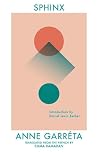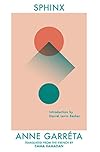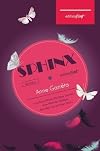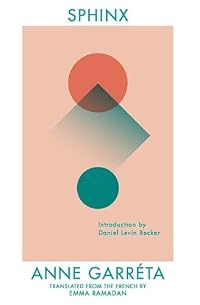
Sphinx
by Anne Garréta
On This Page
Description
Sphinx is the remarkable debut novel, originally published in 1986, by the incredibly talented and inventive French author Anne Garréta, one of the few female members of Oulipo, the influential and exclusive French experimental literary group whose mission is to create literature based on mathematical and linguistic restraints, and whose ranks include Georges Perec and Italo Calvino, among others.A beautiful and complex love story between two characters, the narrator, "I," and their lover, show more A***, written without using any gender markers to refer to the main characters, Sphinx is a remarkable linguistic feat and paragon of experimental literature that has never been accomplished before or since in the strictly-gendered French language.
Sphinx is a landmark text in the feminist and LGBT literary canon appearing in English for the first time.
Anne Garréta (b. 1962) is a lecturer at the University of Rennes II and research professor of literature and Romance studies at Duke University. She joined the Oulipo in 2000, becoming the first member to join born after the Oulipo was founded. Garréta won France's prestigious Prix Médicis in 2002, awarded each year to an author whose "fame does not yet match their talent," for her novel Pas un jour.
Emma Ramadan is a graduate of Brown University and received her master's in literary translation from the American University of Paris. Her translation of Anne Parian's Monospace is forthcoming from La Presse. She is currently on a Fulbright Fellowship for literary translation in Morocco.
. show less
Tags
Recommendations



























Member Reviews
The Publisher Says: Sphinx is the remarkable debut novel, originally published in 1986, by the incredibly talented and inventive French author Anne Garréta, one of the few female members of Oulipo, the influential and exclusive French experimental literary group whose mission is to create literature based on mathematical and linguistic restraints, and whose ranks include Georges Perec and Italo Calvino, among others.
A beautiful and complex love story between two characters, the narrator, "I," and their lover, A***, written without using any gender markers to refer to the main characters, Sphinx is a remarkable linguistic feat and paragon of experimental literature that has never been accomplished before or since in the show more strictly-gendered French language.
Sphinx is a landmark text in the feminist and LGBT literary canon appearing in English for the first time.
I RECEIVED A DRC FROM THE PUBLISHER VIA EDELWEISS+. THANK YOU.
My Review: First-novel longueurs are here, but they are eclipsed by the astonishingly ambitious project that it represents. It's not a spoiler, or if it is it's already occurred in the blurb above, to say that a sexy novel about lovers written without any gender markers is a very different challenge in English than in French, a very strictly gendered language.
Translator Ramadan took a trait that eased Author Garréta's trajectory to accomplish this complex feat, the use of a grammatical tense that English does not have and that makes the speaker sound ever so pretentious, and then she runs with its effect on the prose.
Soul heavy from too much knowing, body tired from feeling pensive and powerless at the same time, so riven by this obsessive ennui that nothing, or almost nothing, can distract from it anymore. Back then, if I recall correctly, I used to describe the world as a theater where processions of corpses danced in a macabre ball of drives and desires. My contempt and ennui did not, however, keep me from observing how this dance dissolved into an amorous waltz. Languid nights at the whim of syncopated rhythms and fleeting pulses; the road to hell was lit with pale lanterns; the bottom of the abyss drew closer indefinitely; I moved through the smooth insides of a whirlwind and gazed at deformed images of ecstatic bodies in the slow, hoarse death rattle of tortured flesh.
That is, I think you'll all agree with me, pretty mannered writing. I like it, but then I would; the semi-colons, the layering of clauses...well! My Christmas came early with this read! It felt like I was reading a good translation of Proust.
Yes, that is so a compliment.
What shines through in this croquembouche of a story is the way that eliminating the simple fact of gender enables a love story, a passionate, consummated love story, to take on layers of meaning that otherwise wouldn't be available to readers. It enables the narrator to muse on the unsuitability of their fellow theology student, a man, as a target for a fling, a little light sexual fun...but because the fellow student is set on becoming a celibate priest, or because he is a man? It doesn't necessarily matter, but the two possibilities are very different even today. They were even moreso in the France of 1986.
And now we butt up against the one real issue I can see someone taking with this read: A***, lover of our narrator, is Black. It's a fact that we're made aware of, and that plays a significant role in the narrator's attraction to and arousal with A***'s body. I'm not quite convinced it's exoticization, in the fetishistic sense. It's present in the narrator's arousal, though I can't see that being any other way...after all, the object of one's lust is always possessed of traits and qualities that are arousing, including physical ones; and there is not a single thing about the narrator's other appraisals of A*** that suggest a less-than-genuine interest in all their facets. What is more troubling is that the ending is what it is. There is a racialized account of violence and the actions in question take place in Harlem. Granted that the book appeared in 1986 and that was a historically extra-violent time in Harlem, in New York, and in multiple other major US cities as the crack epidemic was reaching its peak.
Still, it's a thing that is present in the story and that could present a very different impression to a Person of Color. I give the information to you for your consideration. I lived in New York City at that time and was routinely very cautious for my personal safety, so it's permaybehaps down to my own familiarity with the milieu that prevents me from seeing it as anything but a reflection of the reality I lived here, and then.
I will say that what happened, and how it went down, knocked a star off my rating. My respect for the project of creating an ungendered love story that still contained passionate pleasure is undimmed. It's the manner in which Author Garréta chose to dismount the story-horse that did not meet with my whole-hearted approval.
Nothing is ever exactly as one would wish it to be, though, is it. show less
A beautiful and complex love story between two characters, the narrator, "I," and their lover, A***, written without using any gender markers to refer to the main characters, Sphinx is a remarkable linguistic feat and paragon of experimental literature that has never been accomplished before or since in the show more strictly-gendered French language.
Sphinx is a landmark text in the feminist and LGBT literary canon appearing in English for the first time.
I RECEIVED A DRC FROM THE PUBLISHER VIA EDELWEISS+. THANK YOU.
My Review: First-novel longueurs are here, but they are eclipsed by the astonishingly ambitious project that it represents. It's not a spoiler, or if it is it's already occurred in the blurb above, to say that a sexy novel about lovers written without any gender markers is a very different challenge in English than in French, a very strictly gendered language.
Translator Ramadan took a trait that eased Author Garréta's trajectory to accomplish this complex feat, the use of a grammatical tense that English does not have and that makes the speaker sound ever so pretentious, and then she runs with its effect on the prose.
Soul heavy from too much knowing, body tired from feeling pensive and powerless at the same time, so riven by this obsessive ennui that nothing, or almost nothing, can distract from it anymore. Back then, if I recall correctly, I used to describe the world as a theater where processions of corpses danced in a macabre ball of drives and desires. My contempt and ennui did not, however, keep me from observing how this dance dissolved into an amorous waltz. Languid nights at the whim of syncopated rhythms and fleeting pulses; the road to hell was lit with pale lanterns; the bottom of the abyss drew closer indefinitely; I moved through the smooth insides of a whirlwind and gazed at deformed images of ecstatic bodies in the slow, hoarse death rattle of tortured flesh.
That is, I think you'll all agree with me, pretty mannered writing. I like it, but then I would; the semi-colons, the layering of clauses...well! My Christmas came early with this read! It felt like I was reading a good translation of Proust.
Yes, that is so a compliment.
What shines through in this croquembouche of a story is the way that eliminating the simple fact of gender enables a love story, a passionate, consummated love story, to take on layers of meaning that otherwise wouldn't be available to readers. It enables the narrator to muse on the unsuitability of their fellow theology student, a man, as a target for a fling, a little light sexual fun...but because the fellow student is set on becoming a celibate priest, or because he is a man? It doesn't necessarily matter, but the two possibilities are very different even today. They were even moreso in the France of 1986.
And now we butt up against the one real issue I can see someone taking with this read: A***, lover of our narrator, is Black. It's a fact that we're made aware of, and that plays a significant role in the narrator's attraction to and arousal with A***'s body. I'm not quite convinced it's exoticization, in the fetishistic sense. It's present in the narrator's arousal, though I can't see that being any other way...after all, the object of one's lust is always possessed of traits and qualities that are arousing, including physical ones; and there is not a single thing about the narrator's other appraisals of A*** that suggest a less-than-genuine interest in all their facets. What is more troubling is that the ending is what it is. There is a racialized account of violence and the actions in question take place in Harlem. Granted that the book appeared in 1986 and that was a historically extra-violent time in Harlem, in New York, and in multiple other major US cities as the crack epidemic was reaching its peak.
Still, it's a thing that is present in the story and that could present a very different impression to a Person of Color. I give the information to you for your consideration. I lived in New York City at that time and was routinely very cautious for my personal safety, so it's permaybehaps down to my own familiarity with the milieu that prevents me from seeing it as anything but a reflection of the reality I lived here, and then.
I will say that what happened, and how it went down, knocked a star off my rating. My respect for the project of creating an ungendered love story that still contained passionate pleasure is undimmed. It's the manner in which Author Garréta chose to dismount the story-horse that did not meet with my whole-hearted approval.
Nothing is ever exactly as one would wish it to be, though, is it. show less
An experiment that could have easily been a tepid exploration instead soars, buoyed by electric writing that hurls the reader through the relationship as it unfolds.
This was a satisfying read and I really liked how the use of language explored the nature of gender, though we get less about the actual relationship between the narrator and A*** than I was expecting--ultimately, it was more about the narrator and their whole process of being in this relationship and how they deal with the end of the relationship (I hope this isn't spoilers but it is a sad story). The afterword by the translator was also super helpful to me, a devout non-Francophile, for explaining what precisely the language is doing in the original, all working to illuminate why the narrator has a gloriously overblown vocabulary and bizarre syntax, even when talking about DJing in a Parisian nightclub.
One thing that stood out to me show more but didn't really develop very far in the story is how race influences the relationship. The narrator is white but somehow believes that their soul will someday become "black enough" for jazz and soul food. It was hard to say why this was important to the narrator--will it help them understand themselves better or will help them understand their beloved? All in all, not enough nuance on this topic at all. Gender is absent from the novel but racism isn't. show less
One thing that stood out to me show more but didn't really develop very far in the story is how race influences the relationship. The narrator is white but somehow believes that their soul will someday become "black enough" for jazz and soul food. It was hard to say why this was important to the narrator--will it help them understand themselves better or will help them understand their beloved? All in all, not enough nuance on this topic at all. Gender is absent from the novel but racism isn't. show less
It was really good, but now I want to read it in french. Not because the translation was bad, or anything, but because I didn't realize just how much the constraint the author placed on herself shaped the story and now I'm curious for the details on how she did it. It's a shame almost everyone who reads this is going to have the constraint spoiled, I imagine it would be very surprising to realize what's going on.
Review originally posted on Goodreads.
2.5 stars
Anne Garreta wrote a love story without using gender specific pronouns. That is amazing. The story on the other hand, was just average. I didn't hate it, but I didn't quite enjoy it either.
2.5 stars
Anne Garreta wrote a love story without using gender specific pronouns. That is amazing. The story on the other hand, was just average. I didn't hate it, but I didn't quite enjoy it either.
Een heel boek lang blijft onduidelijk of de verteller vrouw of man is, en of haar of zijn minnaar vrouw of man is. Een heuse meesterproef in het Frans, waar deze genderloosheid en de daaruit volgende noodzaak om op een bepaalde manier te schrijven - bvb. sommige werkwoordsvormen te vermijden en andere, minder alledaagse, te gebruiken - bepalend is voor hoe de verteller/vertelster praat, denkt en in het leven staat.
Dat komt er in het Engels - waar het gender van de personages minder en alleszins andere - eisen stelt dan het Frans - veel minder uit. De barokke taal van Garreta volgt uit de noodzaak in het Frans om een bepaalde werkwoordsvorm te gebruiken. In het Engels ontbreekt die noodzaak evenwel, want was 'Sphinx' oorspronkelijk in show more het Engels geschreven, de verteller/vertelster was een ander geweest, en de eisen die de Engelse taal had opgelegd hadden eveneens tot een ander - wellicht eenvoudiger - perspectief en andere - minder repetitieve - handelingen geleid. Dat leidt er misschien toe dat de Engelse vertaling van dit Franse meesterstukje minder indruk maakt dan eigenlijk zou moeten. show less
Dat komt er in het Engels - waar het gender van de personages minder en alleszins andere - eisen stelt dan het Frans - veel minder uit. De barokke taal van Garreta volgt uit de noodzaak in het Frans om een bepaalde werkwoordsvorm te gebruiken. In het Engels ontbreekt die noodzaak evenwel, want was 'Sphinx' oorspronkelijk in show more het Engels geschreven, de verteller/vertelster was een ander geweest, en de eisen die de Engelse taal had opgelegd hadden eveneens tot een ander - wellicht eenvoudiger - perspectief en andere - minder repetitieve - handelingen geleid. Dat leidt er misschien toe dat de Engelse vertaling van dit Franse meesterstukje minder indruk maakt dan eigenlijk zou moeten. show less
Jun 8, 2017 (Edited)Dutch
Ratings
Members
- Recently Added By
Author Information

10+ Works 561 Members
Some Editions
Awards and Honors
Awards
Series
Belongs to Publisher Series
edition fünf (29)
Common Knowledge
- Important places
- France
Classifications
- Genres
- General Fiction, Fiction and Literature, LGBTQ+
- DDC/MDS
- 843.914 — Literature & rhetoric French Literature French fiction 1900- 20th Century 1945-1999
- LCC
- PQ2667 .A7737 .S6513 — Language and Literature French, Italian, Spanish and Portuguese literatures French literature Modern literature 1961-2000
- BISAC
Statistics
- Members
- 350
- Popularity
- 89,786
- Reviews
- 6
- Rating
- (3.87)
- Languages
- 5 — English, Finnish, French, German, Spanish
- Media
- Paper, Ebook
- ISBNs
- 9
- UPCs
- 1
- ASINs
- 2