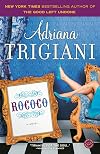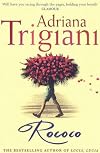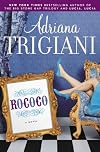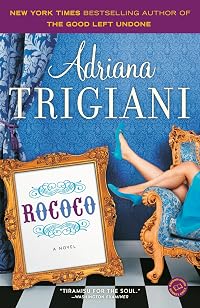
Rococo
by Adriana Trigiani 
On This Page
Description
New York times bestselling author Adriana Trigiani, beloved by millions of readers around the world for her humor, warmth, and captivating storytelling in the Big Stone Gap trilogy and Lucia, Lucia, takes on love, lust, tricky family dynamics, and home decorating in Rococo, the uproarious tale of a small Italian American town poised for a makeover it never expected. Bartolomeo di Crespi is the acclaimed interior decorator of Our Lady of Fatima, New Jersey. To date, Bartolomeo has show more hand-selected every chandelier, sconce, and ottoman in OLOF, so when the renovation of the local church is scheduled, he assumes there is only one man for the job. From the dazzling shores of New Jersey to the legendary fabric houses of New York City, from the prickly purveyors of fine art in London to luscious Santa Margherita on the Mediterranean coast of Italy, Bartolomeo is on a mission to bring talent, sophistication, and his aesthetic vision to his hometown. Trigiani's glittering mosaic of small-town characters sparkles: Bartolomeo's hilarious sister, Toot, is in desperate need of a postdivorce transformation--thirteen years after the fact; "The Benefactor," Aurelia Mandelbaum, the richest woman in New Jersey, has a lust for French interiors and a long-held hope that Bartolomeo will marry her myopic daughter, Capri; Father Porporino, the pastor with a secret, does his best to keep a lid on a simmering scandal; and Eydie Von Gunne, the chic international designer, steps in and changes the course of Bartolomeo's creative life, while his confidante, cousin Christina Menecola, awaits rescue from an inconsolable grief. Plaster of Paris, polished marble, and unbridled testosterone arrive in buckets when Bartolomeo recruits Rufus McSherry, a strapping, handsome artist, and Pedro Allercon, a stained-glass artisan, to work with him on the church's interior. Together, the three of them will do more than blow the dust off the old Fatima frescoes--they will turn the town upside down, challenge the faithful, and restore hope where there once was none. show lessTags
Recommendations





Member Reviews
This was my first Trigiani, and I'll definitely be keeping an eye out for more of her books. It tells the story of one Bartolomeo di Crespi, interior designer extraordinaire of coastal New Jersey. In between brief flirtations with beautiful women of the design world and dealing with the dramas of his boisterous Italian-American extended family, Bartolomeo manages to secure the job he has always dreamed about: the renovation of his beloved local church, Our Lady of Fatima. However, it soon becomes apparent that there will be huge obstacles to overcome in the quest to turn this old Gothic building into a heavenly haven, and Bartolomeo must bring together all the people he loves and learn a few lessons along the way in order to fulfil his show more dream.
The novel is, quite simply, delicious. It drips with colour and texture, fabrics and furniture, and our charismatic narrator's knowledge and passion for his work infuses every page. The characters are larger than life, and the dialogue within the feisty family just sparkles. I looked forward to returning to the book each time I had to set it aside, and thoroughly enjoyed savouring each and every moment I was reading it. I can't wait to see what else Trigiani has to offer! show less
The novel is, quite simply, delicious. It drips with colour and texture, fabrics and furniture, and our charismatic narrator's knowledge and passion for his work infuses every page. The characters are larger than life, and the dialogue within the feisty family just sparkles. I looked forward to returning to the book each time I had to set it aside, and thoroughly enjoyed savouring each and every moment I was reading it. I can't wait to see what else Trigiani has to offer! show less
Bartolomeo di Crespi thinks he's gotten his dream job when commissioned (after some finagling) to renovate his home parish church. As a successful and experienced interior decorator, he's thrilled that a bit of good old-fashioned Italian family influence has swayed the selection committee's choice. But he may have bitten off more than he can chew, especially while juggling family crises, various romantic entanglements (his and those of other family members), and a looming crisis that may put the whole thing in the dumpster.
Trigiani does a fine job here of creating the brawling, boisterous di Crespi family, complete with Bartolomeo's malaprop-ridden sister, a series of romantic entanglements, and a resolution that makes up in warm show more fuzzies for what it may lack in originality or believability.
Don't expect great literature here. Just enjoy. show less
Trigiani does a fine job here of creating the brawling, boisterous di Crespi family, complete with Bartolomeo's malaprop-ridden sister, a series of romantic entanglements, and a resolution that makes up in warm show more fuzzies for what it may lack in originality or believability.
Don't expect great literature here. Just enjoy. show less
The main character, B (short for Bartolomeo) is a decorator, and Trigiani has used first person to provide detailed descriptions of interiors and furnishings. Further, she uses marvelous metaphors and similes to do it.
This book has some things (especially from page 220 on) to say about friends, family, and faith; rebirth and renewal; love and money; and is an enjoyable read to boot. Finally, it weaves in some great recipes in the story, such as “Our Lady of (Drown Your) Sorrows Cake with Heavenly Frosting,” and a crab and multiple-cheese spread that, toasted with tomato on English muffins, is to die for. Recommended!
This book has some things (especially from page 220 on) to say about friends, family, and faith; rebirth and renewal; love and money; and is an enjoyable read to boot. Finally, it weaves in some great recipes in the story, such as “Our Lady of (Drown Your) Sorrows Cake with Heavenly Frosting,” and a crab and multiple-cheese spread that, toasted with tomato on English muffins, is to die for. Recommended!
Audio Book read by Stephen Hoye
Bartolomeo di Crespi is THE decorator in town, proprietor of “The House of B,” and a devout Italian-American Catholic. His dream is to renovate the Our Lady of Fatima parish church, creating an atmosphere of splendor, glory and sense of awe that will bring all the faithful closer to their God. This forms the basic plot line, but there’s a lot more going on. Trigiani has the usual cast of colorful characters, starting with B’s sister Toot (rhymes with “foot”), who is divorced and looking for companionship now that her boys are all out of the house. His fiancée (their parents betrothed them as babies) is Capri Mandelbaum; but they really are just going through the motions for her mother, Aurelia show more (who is financing the renovation as long as B does the job – and marries Capri). Throw in a nephew who has left college to hang drapes, a back-stabbing priest with his own secrets, an Irish artist/general contractor, a cousin who is bereft in her widowhood, a Mexican glass artist, and more relatives and parishioners than you can keep track of. It’s a loud, happy, emotional group.
So what’s not to like? I am a fan of Trigiani’s but this one just doesn’t do it for me. I’m not sure if it’s because her main character, and narrator, is a man, or if it is the abysmal job done by Stephen Hoye reading it. Hoye’s delivery is just too slow and one-note. Unless he was using an English accent for a particular character, I had a hard time distinguishing who was speaking. Everyone just sounded too alike. He has a faint note of depression or ennui, too. I just didn’t connect with the Bartolomeo, so the entire book fell flat for me. I know there is an audio version narrated by Mario Cantone; I would think his delivery would be much better suited to Trigiani’s work. show less
Bartolomeo di Crespi is THE decorator in town, proprietor of “The House of B,” and a devout Italian-American Catholic. His dream is to renovate the Our Lady of Fatima parish church, creating an atmosphere of splendor, glory and sense of awe that will bring all the faithful closer to their God. This forms the basic plot line, but there’s a lot more going on. Trigiani has the usual cast of colorful characters, starting with B’s sister Toot (rhymes with “foot”), who is divorced and looking for companionship now that her boys are all out of the house. His fiancée (their parents betrothed them as babies) is Capri Mandelbaum; but they really are just going through the motions for her mother, Aurelia show more (who is financing the renovation as long as B does the job – and marries Capri). Throw in a nephew who has left college to hang drapes, a back-stabbing priest with his own secrets, an Irish artist/general contractor, a cousin who is bereft in her widowhood, a Mexican glass artist, and more relatives and parishioners than you can keep track of. It’s a loud, happy, emotional group.
So what’s not to like? I am a fan of Trigiani’s but this one just doesn’t do it for me. I’m not sure if it’s because her main character, and narrator, is a man, or if it is the abysmal job done by Stephen Hoye reading it. Hoye’s delivery is just too slow and one-note. Unless he was using an English accent for a particular character, I had a hard time distinguishing who was speaking. Everyone just sounded too alike. He has a faint note of depression or ennui, too. I just didn’t connect with the Bartolomeo, so the entire book fell flat for me. I know there is an audio version narrated by Mario Cantone; I would think his delivery would be much better suited to Trigiani’s work. show less
At the center of this lively and expressive book is Bartolomeo de Crespi, a locally renowned interior designer living in a small New Jersey town. Bartolomeo, or B, as everyone calls him, is about to be given the opportunity of a lifetime. His Catholic Church is about to be renovated and as a member of church counsel, he's in a great position to be hired to do the job. He grew up in this church and has spent countless years yearning for the chance to leave his mark upon the building that has meant so much to him and his family.
Although it seems destined to be, B will have to overcome numerous obstructions to achieve his dream. For one thing, the priest doesn't seem to want B for the job. Then there will be the issue of developing the show more right vision and suitable craftsmen to carry it out. Finally, the issue of money will be raised once the primary financer backs out. Throughout all these challenges, B's large and dramatic family will be by his side to support and occasionally unintentionally obstruct him. But really, that's what having family is all about.
This book is definitely rich in detail - both decorative and familial. The drama amongst the family seemed rather over the top and then was very easily resolved, but then, so were all the other problems. The characters are as fantastical as the other events of the book. Don't analyze it too much, this book is meant to be enjoyed. It's is, in fact, a joyful book about finding happiness in labor and close family communities. show less
Although it seems destined to be, B will have to overcome numerous obstructions to achieve his dream. For one thing, the priest doesn't seem to want B for the job. Then there will be the issue of developing the show more right vision and suitable craftsmen to carry it out. Finally, the issue of money will be raised once the primary financer backs out. Throughout all these challenges, B's large and dramatic family will be by his side to support and occasionally unintentionally obstruct him. But really, that's what having family is all about.
This book is definitely rich in detail - both decorative and familial. The drama amongst the family seemed rather over the top and then was very easily resolved, but then, so were all the other problems. The characters are as fantastical as the other events of the book. Don't analyze it too much, this book is meant to be enjoyed. It's is, in fact, a joyful book about finding happiness in labor and close family communities. show less
When reading a book, I generally expect that within 100 pages, I'll have a plot or at least a general idea of where a plot might be. Rococo never seemed to acquire a plot. Mostly it was the story of a petulant bachelor who happened to try to decorate everything in his particular town in New Jersey. The bulk of this book was description - of food, of decor, of clothing, and I was left overwhelmed with description that felt unnecessary and underwhelmed by story that never seemed relevant or even linear.
The characters were interesting, but the secondary characters were far more interesting than 'B' who, as the main character, seems that he should be therefore the most interesting.
The story fell short of my expectations after reading show more Lucia, Lucia. show less
The characters were interesting, but the secondary characters were far more interesting than 'B' who, as the main character, seems that he should be therefore the most interesting.
The story fell short of my expectations after reading show more Lucia, Lucia. show less
This is set in 1970. It’s told in the first person by an Italian American called Bartolomeo, known as B to his friends and family. B is an interior designer, and he’s good. His dream for many years has been to redesign the Catholic church which he has belonged to, and loved, since he was a small child...
The interesting part of the story, to me, was B’s relationship with his extended family. I found him a likeable person, dedicated to his job. He tells the story well, with a light touch; I liked seeing his role as father-figure to his nephews, and best friend to his emotional sister Toot.
I wondered where the story was going at first, but soon realised that the novel is more like a work of art, painting a picture of family life in show more a small village. I found it impossible to keep track of who was whom, and didn’t feel particularly attached to anyone, but then I know almost nothing about Italians living in the US.
The blurb on the back calls this book a ‘comic masterpiece’. However the only parts I thought amusing were Toot’s malapropisms, but as B keeps correcting her, they didn’t have much humour value. I was mildly amused, too, at some recipes with vast quantities of ingredients, listed as serving 48.
The least appealing part of the book is the regular descriptions of people’s houses which B has decorated; he goes into great deal about colour schemes and designs, most of which didn’t interest me in the slightest.
Still, it makes pleasant enough light reading; no violence or horror, no bad language, and no detailed sex scenes. show less
The interesting part of the story, to me, was B’s relationship with his extended family. I found him a likeable person, dedicated to his job. He tells the story well, with a light touch; I liked seeing his role as father-figure to his nephews, and best friend to his emotional sister Toot.
I wondered where the story was going at first, but soon realised that the novel is more like a work of art, painting a picture of family life in show more a small village. I found it impossible to keep track of who was whom, and didn’t feel particularly attached to anyone, but then I know almost nothing about Italians living in the US.
The blurb on the back calls this book a ‘comic masterpiece’. However the only parts I thought amusing were Toot’s malapropisms, but as B keeps correcting her, they didn’t have much humour value. I was mildly amused, too, at some recipes with vast quantities of ingredients, listed as serving 48.
The least appealing part of the book is the regular descriptions of people’s houses which B has decorated; he goes into great deal about colour schemes and designs, most of which didn’t interest me in the slightest.
Still, it makes pleasant enough light reading; no violence or horror, no bad language, and no detailed sex scenes. show less
Members
- Recently Added By
Author Information

31+ Works 18,060 Members
Adriana Trigiani grew up in Big Stone Gap, Virginia and graduated from Saint Mary's College in South Bend, Indiana. After graduation, she moved to New York City and founded the all-female comedy troupe The Outcasts, which performed on the cabaret circuit for seven years. She was a writer/producer on The Cosby Show and A Different World and show more executive producer/head writer for City Kids for Jim Henson Productions. In 1996, she wrote and directed the documentary film Queens of the Big Time, which won the Audience Award at the Hamptons Film Festival. Her debut novel, Big Stone Gap, was published in 2001. Her young adult and adult novels include Big Cherry Holler, Milk Glass Moon, Home to Big Stone Gap, The Queen of the Big Time, Rococo, Encore Valentine, Viola in Reel Life, The Supreme Macaroni Company, The Shoemaker's Wife, and All the Stars in the Heavens. She wrote the film adaptation for her novels Big Stone Gap, Very Valentine, and Lucia, Lucia. She also wrote a cookbook entitled Cooking with My Sisters and a non-fiction book entitled Don't Sing at the Table: Life Lessons from My Grandmothers. (Bowker Author Biography) show less
Adriana Trigiani is a LibraryThing Author, an author who lists their personal library on LibraryThing.
Awards and Honors
Distinctions
Common Knowledge
- Canonical title
- Rococo
- Original publication date
- 2005
- People/Characters
- Bartolomeo di Crespi
- Dedication
- For my husband, who can fix anything
- First words
- I want you to imagine my house.
Classifications
Statistics
- Members
- 729
- Popularity
- 38,611
- Reviews
- 16
- Rating
- (3.48)
- Languages
- Dutch, English, German, Lithuanian
- Media
- Paper, Audiobook, Ebook
- ISBNs
- 22
- ASINs
- 2