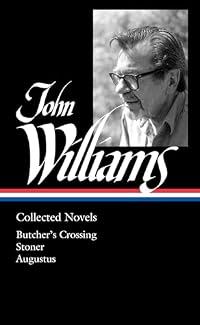
Collected Novels : Butcher's Crossing / Stoner / Augustus
by John Williams
On This Page
Description
"As the spirit of experimentation swirled around him in the 1960s and '70s, John Williams, working in relative obscurity as an English professor, wrote finely crafted novels distinguished by precise form, powerful but restrained prose, and close attention to physical detail and its symbolic import. His three major works Butcher's Crossing (1960), Stoner (1965), and the National Book Award-winning Augustus (1972) have come to be recognized as masterpieces of American fiction. This show more authoritative Library of America volume brings all three together for the first time, along with editor Daniel Mendelsohn's selection of essays in which Williams reflects on the context of his work."--Provided by vendor. show lessTags
Recommendations














Member Reviews
This volume in the Library of America series reprints three of the four novels Williams published, along with three essays related to them, as well as his brief remarks when accepting the National Book Award in 1973.
Butcher’s Crossing : This novel, set in the West a few years after the Civil War, was hard for me to get into, but I persevered, and it hooked me; the book ended powerfully and stayed with me after I finished it. At the time Williams wrote it, in the late 1950s, the Western genre dominated Hollywood movies and television with a romanticized mythology of the noble, incorruptible loner. Yet this was an overlay on a deeper stratum of Romanticism, the idealized view of Transcendentalists such as Emerson and Thoreau. In this show more novel, Williams subverts both layers. Will Andrews, the protagonist, comes West filled with the Emersonian ideal of Nature, but what he goes through takes him the final step, which Emerson called “the natural man,” but in a way Emerson would not have expected.
Will uses his inheritance to finance a buffalo-hunting expedition led by Miller, a frontiersman who foreshadows what Will becomes by the book’s conclusion. The four-man hunting party is forced to spend the winter snowbound in the Rocky Mountains, which, in the mythic terms Williams draws on for this quest, is like a descent into the underworld. By the time he and the others return to their starting point, Will has shed most of his identity. Burning the clothes he’d worn for half a year and two baths complete the process. An inferno set by Miller, who led the party, also takes on ritual character. In the end, Will rides away, having been reborn as the vacant-eyed loner, placing his faith in his instinct rather than his reason. As Williams wrote in his essay on the genre of the Western, also reprinted in this volume, “[t]he outcome of myth is always mixed; its quest is for an order of the self that is gained at the expense of knowing at least the essential chaos of the universe.”
Stoner recounts the life of an only child from a hardscrabble farm in Missouri who goes to university, falls in love with literature, and spends the rest of his life teaching there. His marriage is a failure, their only child turns from them, and he arouses the enmity of his department head, who stymies his career. From the outside, this seems like an obscure, meaningless life.
The incident that derails his career is his refusal to give a passing grade to the department head’s protege. This grad student is a satire of the Romantic sensibility, which, in Williams’s view (as becomes clear in his essay on the future of the novel, also reprinted in this volume), reduces literary sensibility to spasms of inspiration, while disregarding grammatical and phonetic demands and blithely ignoring the history of literature. This anti-Romantic polemic ties this novel to Williams’s earlier work, Butcher’s Crossing . By the way, Andrews and Stoner share the same given name, Will/Willy.
If asked to consider this novel in terms of the categories of imaginative literature, one has to rule out myth, epic, and tragedy, leaving comedy as the only possible descriptor. Yet there are few laughs along the way, and indeed no happy ending. In fact, it is one of the most unrelentingly sad books I can recall reading.
And yet the book shows how Stoner plods on, and displays a dogged Stoicism reminiscent of his dirt-farm father. When he looks back at the end of his life, Stoner realizes he had done it all out of love. Lying on his deathbed, he picks up his only published book, based on his dissertation. He knows both he and his book are destined for obscurity. Yet his fingers tingle as he touches the pages (he is beyond reading), suggesting a symbiotic relationship between hand/mind and book, making a case for the irreducible nobility of both life and literature.
Augustus is a historical novel about the first Roman emperor. It begins with the calm reaction of Octavian (who would come to be known as Augustus) to the assassination of his uncle, Julius Caesar, and his unlikely success, despite his youth, in grasping and holding the reins of power.
The book recalls Yourcenar’s Memoirs of Hadrian and Graves’s two novels about Claudius, but is different. Those are both cast as memoirs of the title figure. Rather than writing a narrative in temporal order, Williams creates a mosaic out of letters, diary entries, and other texts from a variety of witnesses. In this way, the reader sees Octavian from the outside, which is fitting for a man who was careful not to reveal his feelings or his plans. Only at the end of the book and the end of Octavian’s life do we have a text from his own hand, in the form of a lengthy letter to his only surviving friend.
The portrait that emerges is that of an Augustus whose acts are a recognition of his life as an instrument through which Rome unfolds its fate: “Destiny seized me,” he says.
There is a tender portrait of Julia, his only child. Julia is frank about her many affairs. Her status as beloved daughter of the emperor long shields her while she disregards the double morality of her era (noble women must be chaste, while the men are free to do what they like). Julia led a life that modern sensibilities might call liberated. Does Williams come closer to getting her right than Graves? We can’t know, of course. The only measure: does this recreation account for the few undisputed facts and make sense of them? I concluded that what rescued Williams from creating an anachronistic sensibility is that, in the end, in his telling, Julia shares her father’s assumption that the needs of the city take precedence over personal desire, and submits to her banishment.
I’m less sure that Williams evaded anachronism fully in the last section of the novel. As Yourcenar does to Hadrian, Williams grants Octavian, in his valedictory letter, prescience bordering on the prophetic. But in the context of the overall portrayal, in which Octavian’s life is enwrapped in the fate of Rome, even this made sense. show less
Butcher’s Crossing : This novel, set in the West a few years after the Civil War, was hard for me to get into, but I persevered, and it hooked me; the book ended powerfully and stayed with me after I finished it. At the time Williams wrote it, in the late 1950s, the Western genre dominated Hollywood movies and television with a romanticized mythology of the noble, incorruptible loner. Yet this was an overlay on a deeper stratum of Romanticism, the idealized view of Transcendentalists such as Emerson and Thoreau. In this show more novel, Williams subverts both layers. Will Andrews, the protagonist, comes West filled with the Emersonian ideal of Nature, but what he goes through takes him the final step, which Emerson called “the natural man,” but in a way Emerson would not have expected.
Will uses his inheritance to finance a buffalo-hunting expedition led by Miller, a frontiersman who foreshadows what Will becomes by the book’s conclusion. The four-man hunting party is forced to spend the winter snowbound in the Rocky Mountains, which, in the mythic terms Williams draws on for this quest, is like a descent into the underworld. By the time he and the others return to their starting point, Will has shed most of his identity. Burning the clothes he’d worn for half a year and two baths complete the process. An inferno set by Miller, who led the party, also takes on ritual character. In the end, Will rides away, having been reborn as the vacant-eyed loner, placing his faith in his instinct rather than his reason. As Williams wrote in his essay on the genre of the Western, also reprinted in this volume, “[t]he outcome of myth is always mixed; its quest is for an order of the self that is gained at the expense of knowing at least the essential chaos of the universe.”
Stoner recounts the life of an only child from a hardscrabble farm in Missouri who goes to university, falls in love with literature, and spends the rest of his life teaching there. His marriage is a failure, their only child turns from them, and he arouses the enmity of his department head, who stymies his career. From the outside, this seems like an obscure, meaningless life.
The incident that derails his career is his refusal to give a passing grade to the department head’s protege. This grad student is a satire of the Romantic sensibility, which, in Williams’s view (as becomes clear in his essay on the future of the novel, also reprinted in this volume), reduces literary sensibility to spasms of inspiration, while disregarding grammatical and phonetic demands and blithely ignoring the history of literature. This anti-Romantic polemic ties this novel to Williams’s earlier work, Butcher’s Crossing . By the way, Andrews and Stoner share the same given name, Will/Willy.
If asked to consider this novel in terms of the categories of imaginative literature, one has to rule out myth, epic, and tragedy, leaving comedy as the only possible descriptor. Yet there are few laughs along the way, and indeed no happy ending. In fact, it is one of the most unrelentingly sad books I can recall reading.
And yet the book shows how Stoner plods on, and displays a dogged Stoicism reminiscent of his dirt-farm father. When he looks back at the end of his life, Stoner realizes he had done it all out of love. Lying on his deathbed, he picks up his only published book, based on his dissertation. He knows both he and his book are destined for obscurity. Yet his fingers tingle as he touches the pages (he is beyond reading), suggesting a symbiotic relationship between hand/mind and book, making a case for the irreducible nobility of both life and literature.
Augustus is a historical novel about the first Roman emperor. It begins with the calm reaction of Octavian (who would come to be known as Augustus) to the assassination of his uncle, Julius Caesar, and his unlikely success, despite his youth, in grasping and holding the reins of power.
The book recalls Yourcenar’s Memoirs of Hadrian and Graves’s two novels about Claudius, but is different. Those are both cast as memoirs of the title figure. Rather than writing a narrative in temporal order, Williams creates a mosaic out of letters, diary entries, and other texts from a variety of witnesses. In this way, the reader sees Octavian from the outside, which is fitting for a man who was careful not to reveal his feelings or his plans. Only at the end of the book and the end of Octavian’s life do we have a text from his own hand, in the form of a lengthy letter to his only surviving friend.
The portrait that emerges is that of an Augustus whose acts are a recognition of his life as an instrument through which Rome unfolds its fate: “Destiny seized me,” he says.
There is a tender portrait of Julia, his only child. Julia is frank about her many affairs. Her status as beloved daughter of the emperor long shields her while she disregards the double morality of her era (noble women must be chaste, while the men are free to do what they like). Julia led a life that modern sensibilities might call liberated. Does Williams come closer to getting her right than Graves? We can’t know, of course. The only measure: does this recreation account for the few undisputed facts and make sense of them? I concluded that what rescued Williams from creating an anachronistic sensibility is that, in the end, in his telling, Julia shares her father’s assumption that the needs of the city take precedence over personal desire, and submits to her banishment.
I’m less sure that Williams evaded anachronism fully in the last section of the novel. As Yourcenar does to Hadrian, Williams grants Octavian, in his valedictory letter, prescience bordering on the prophetic. But in the context of the overall portrayal, in which Octavian’s life is enwrapped in the fate of Rome, even this made sense. show less
Why'd I walk into a Barne's and Noble and go "Yeah man I should totally read harder literature. I'm sure these 3 novels in one collection won't be too long"? What strange times that was many months ago.
Most of Williams's writing is slow paced. Methodical and thoroughly researched. Butcher's Crossing was the slowest of the three involving 3 cowboys in a dying idea of the west hunting buffalo for their pelts. An examination of greed and its costs in a defiance of the western genre. Which makes it very western. Heavy on the use of landscape and setting to convey ideas with a wonderfully explosive ending. After reading it, I wasn't too sure if I was going to like the rest of the collection. Plus, I was mostly buying this to read Stoner. show more
And Stoner delivers. The title character is constantly represented with care and humanity. Mistakes and all in plain view without apology to said character. Morris Dickstein called it a perfect novel. How could I pass that up? Stoner lives a life of constant failures. Marriage, academic career, familial relationships, etc. All constantly never going his way from page one. A love of learning and the process of learning deeply ingrained into him allows him strength to continue. From the outside, a story of a man that ends up not accomplishing much and living a mundane life before an uneventful death. From Stoner's perspective, a satisfying and full life buoyed by his craft and perseverance of it. It's a beautiful book. Augustus is the flipside and equally a masterpiece.
An impersonal look at power and the maintenance of power. How far will one go to get power and how ordinary will one's heinous actions be in doing so? This time, we are never actually seeing the writings of the title character until the very end. The entire novel told from the perspective of other people in relation to Octavious shows masterfully how power centralized consumes all the thoughts and actions of an inner circle vying for said power. A beautiful ending scene with metaphors on innocence vs ambition leaves an idea of just how easy it is to crave power and tip the scales towards your ambition without ever fully understanding the impact of one's choices until the very end.
One caveat is the selected writing on "The future of the Novel". I don't agree entirely with Williams's opinions on how novels don't work on style alone. On how substance is the most important thing and how the novel is defined via sequential plot within a recognizable standard of time. I think by defining the novel in this way he still has issues in classifying Ulysses and other novels like House of Leaves. The time period that he wrote that essay didn't see postmodernism. I'm not entirely convinced on his argument that stream of consciousness novels necessarily are epics.
Regardless, a fantastic collection. I'm glad I read this. show less
Most of Williams's writing is slow paced. Methodical and thoroughly researched. Butcher's Crossing was the slowest of the three involving 3 cowboys in a dying idea of the west hunting buffalo for their pelts. An examination of greed and its costs in a defiance of the western genre. Which makes it very western. Heavy on the use of landscape and setting to convey ideas with a wonderfully explosive ending. After reading it, I wasn't too sure if I was going to like the rest of the collection. Plus, I was mostly buying this to read Stoner. show more
And Stoner delivers. The title character is constantly represented with care and humanity. Mistakes and all in plain view without apology to said character. Morris Dickstein called it a perfect novel. How could I pass that up? Stoner lives a life of constant failures. Marriage, academic career, familial relationships, etc. All constantly never going his way from page one. A love of learning and the process of learning deeply ingrained into him allows him strength to continue. From the outside, a story of a man that ends up not accomplishing much and living a mundane life before an uneventful death. From Stoner's perspective, a satisfying and full life buoyed by his craft and perseverance of it. It's a beautiful book. Augustus is the flipside and equally a masterpiece.
An impersonal look at power and the maintenance of power. How far will one go to get power and how ordinary will one's heinous actions be in doing so? This time, we are never actually seeing the writings of the title character until the very end. The entire novel told from the perspective of other people in relation to Octavious shows masterfully how power centralized consumes all the thoughts and actions of an inner circle vying for said power. A beautiful ending scene with metaphors on innocence vs ambition leaves an idea of just how easy it is to crave power and tip the scales towards your ambition without ever fully understanding the impact of one's choices until the very end.
One caveat is the selected writing on "The future of the Novel". I don't agree entirely with Williams's opinions on how novels don't work on style alone. On how substance is the most important thing and how the novel is defined via sequential plot within a recognizable standard of time. I think by defining the novel in this way he still has issues in classifying Ulysses and other novels like House of Leaves. The time period that he wrote that essay didn't see postmodernism. I'm not entirely convinced on his argument that stream of consciousness novels necessarily are epics.
Regardless, a fantastic collection. I'm glad I read this. show less
Ratings
Members
- Recently Added By
Author Information

12 Works 13,599 Members
Common Knowledge
- Canonical title
- Collected Novels : Butcher's Crossing / Stoner / Augustus
Classifications
Statistics
- Members
- 100
- Popularity
- 324,371
- Reviews
- 2
- Rating
- (4.50)
- Languages
- English
- Media
- Paper
- ISBNs
- 1