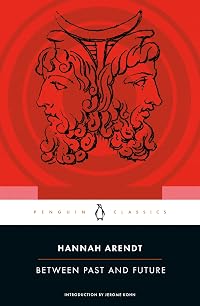
Between Past and Future
by Hannah Arendt 
On This Page
Description
From the author of Eichmann in Jerusalem and The Origins of Totalitarianism, "a book to think with through the political impasses and cultural confusions of our day" (Harper's Magazine) Hannah Arendt's insightful observations of the modern world, based on a profound knowledge of the past, constitute an impassioned contribution to political philosophy. In Between Past and Future Arendt describes the perplexing crises modern society faces as a result of the loss of meaning of the show more traditional key words of politics: justice, reason, responsibility, virtue, and glory. Through a series of eight exercises, she shows how we can redistill the vital essence of these concepts and use them to regain a frame of reference for the future. To participate in these exercises is to associate, in action, with one of the most original and fruitful minds of the twentieth century. show lessTags
Recommendations


Member Reviews
Csípem Hannah Arendtet. Nem csupán szikrázóan okos, de megvan benne az az intellektuális mersz is, ami nélkül a filozófia aligha művelhető. Enélkül hogy is lehetne bátorsága közvetlenül a második világháború után (az egyik totalitárius rendszer kimúlt, de a másik köszöni szépen, jól van) megragadni a jelenkor grabancát, a modern társadalom pillanatnyi állapotát, és a politika- és történetfilozófia eszközeivel visszafejteni, hogyan jutottunk el eddig. Hosszú és szerteágazó ösvény ez, ami valahol a humanizmusban kezdődött, de lehet, már az ókori görögöknél ott volt mindennek a magva, következésképp a szöveg is csak és kizárólag szerteágazó lehet, és ennek megfelelően igencsak show more sűrű, amolyan „na, ezt a bekezdést fussuk csak át még egyszer”-féle. Nem célja mindazonáltal, hogy jövőbe mutató próféciákkal vagy megoldási javaslatokkal traktáljon minket – egyszerűen csak elemzi a helyzetet, tárgyilagosan, veretesen. És bár nem tudjuk meg, mit tegyünk – a „Mit tegyünk?” kérdéskör amúgy is a forradalmárok és a politikusok homokozója, a filozófus legfeljebb talapzatot ácsol nekik –, de azt igen, honnan ered az illúzió, hogy ha a gondolkodók a passzív szemlélődésből a cselekvés mezejére lépnek, akkor egyszeriben megoldják azokat a kérdéseket, amelyekkel a filozófusok nem boldogultak. Pedig cselekvésükkel csak újabb folyamatokat indítanak el, amely folyamatok csak újabb kérdéseket szülnek – következésképpen a filozófus munkája nem szűnik meg, sőt, egyre bonyolultabbá és kilátástalanabbá válik. De Arendt azért megoldja.
Egyetlen fejezettel vannak fenntartásaim. Arendt kiválóan szlalomozik a gondolkodás akadálypályáján, ha absztrakciókról – tekintélyről, kultúráról, igazságról – van szó, de az egzaktabb kérdéseknél már nem ilyen egyértelmű a helyzet. Ez konkrétan az amerikai oktatással foglalkozó szöveghelynél zavart, ahol értelmezésemben szakpolitikáról van szó, amit szakpolitikai eszközökkel kéne bírálni, illetve szakpolitikai javaslatok segítségével kéne orvosolni, de Arendt inkább egyfajta általánosítást kísérel meg, amitől az egész homályos lesz és könnyű, mint egy üres tejfelespohár. Ez a rész nekem elavultnak és félreérthetőnek tűnik – de ezen nem berzenkednék sokat, hisz végtére is a csoda az, hogy az azóta eltelt évtizedek ellenére a többi milyen friss és ropogós maradt.
Szóval Arendt remek forma. Nem is értem, miért kavart azzal a Heideggerrel. show less
Egyetlen fejezettel vannak fenntartásaim. Arendt kiválóan szlalomozik a gondolkodás akadálypályáján, ha absztrakciókról – tekintélyről, kultúráról, igazságról – van szó, de az egzaktabb kérdéseknél már nem ilyen egyértelmű a helyzet. Ez konkrétan az amerikai oktatással foglalkozó szöveghelynél zavart, ahol értelmezésemben szakpolitikáról van szó, amit szakpolitikai eszközökkel kéne bírálni, illetve szakpolitikai javaslatok segítségével kéne orvosolni, de Arendt inkább egyfajta általánosítást kísérel meg, amitől az egész homályos lesz és könnyű, mint egy üres tejfelespohár. Ez a rész nekem elavultnak és félreérthetőnek tűnik – de ezen nem berzenkednék sokat, hisz végtére is a csoda az, hogy az azóta eltelt évtizedek ellenére a többi milyen friss és ropogós maradt.
Szóval Arendt remek forma. Nem is értem, miért kavart azzal a Heideggerrel. show less
This is an aptly named collection of essays on history, politics and culture. The author seems to have been a full-blooded representative of early 20th century German philosophy, fluent in ancient Greek and incredibly versed in the classics. In the first three or four essays I was a bit annoyed by her constant referrals to Plato (with Hegel as sidekick), but that's mostly a question of personal preference. The later essays on education and mass culture were less dependent on Plato. But the essay on Truth and Politics was by far the most interesting one to me. The author's real-life experience with totalitarian politics clearly contributes to her analysis an understanding which is absent from modern political theory. All in all this is a show more deep book which offers a lot to think about. show less
Another excellent contribution by Hannah Arendt. comprised of eight essays dealing with the modern concept of history, political authority and its decline in the modern world, freedom, education, culture, politics and space exploration.
To touch on just two of the above, the essay on freedom discusses how the ancient and explicitly political concept of freedom, which held that freedom existed only among men [sic], was gradually replaced by concepts drawn from philosophical and religious experience that affirmed freedom as a sort of sanctuary away from the interference and influence of others. Freedom thus became a feature of thought and perhaps individual behaviour, rather than of political action.
The essay on authority is apropos in show more Canada right now, as we re-evaluate the role of the Senate. Arendt argues that all modern concepts of authority are derivations of the ancient Greek efforts to work out what authority meant, and they in turn drew theres from two essentially anti-political relationships: that of the master to his slave, and that of the head of house to his family.
By contrast, only the Romans, Arendt argues, had a genuinely political concept of authority, which for them (as for some later, e.g. Machiavelli) was explicitly tied to the act of founding (the political act par excellence) and augmenting that foundation. show less
To touch on just two of the above, the essay on freedom discusses how the ancient and explicitly political concept of freedom, which held that freedom existed only among men [sic], was gradually replaced by concepts drawn from philosophical and religious experience that affirmed freedom as a sort of sanctuary away from the interference and influence of others. Freedom thus became a feature of thought and perhaps individual behaviour, rather than of political action.
The essay on authority is apropos in show more Canada right now, as we re-evaluate the role of the Senate. Arendt argues that all modern concepts of authority are derivations of the ancient Greek efforts to work out what authority meant, and they in turn drew theres from two essentially anti-political relationships: that of the master to his slave, and that of the head of house to his family.
By contrast, only the Romans, Arendt argues, had a genuinely political concept of authority, which for them (as for some later, e.g. Machiavelli) was explicitly tied to the act of founding (the political act par excellence) and augmenting that foundation. show less
Eight essays comprising thoughts on the nature and relationship of the past and the future. With essays on concepts including freedom, education, and culture. The essay "Truth and Politics" is particularly insightful.
Arendt never ceases to impress me with the depth and clarity of her thought. Recommended to all.
Arendt considers modernity in political thought. To be precise, she examines eight critical issues confronting the late twentieth century.
essay nr 6 in Verleden en toekomst / Between past and Future
Members
- Recently Added By
Lists

Writers In Public Domain 2026
90 works; 1 member

In Our Time books
4,934 works; 2 members
Author Information

260+ Works 26,245 Members
Born in Hanover, Germany, Hannah Arendt received her doctorate from Heidelberg University in 1928. A victim of naziism, she fled Germany in 1933 for France, where she helped with the resettlement of Jewish children in Palestine. In 1941, she emigrated to the United States. Ten years later she became an American citizen. Arendt held numerous show more positions in her new country---research director of the Conference on Jewish Relations, chief editor of Schocken Books, and executive director of Jewish Cultural Reconstruction in New York City. A visiting professor at several universities, including the University of California, Columbia, and the University of Chicago, and university professor on the graduate faculty of the New School for Social Research, in 1959 she became the first woman appointed to a full professorship at Princeton. She also won a number of grants and fellowships. In 1967 she received the Sigmund Freud Prize of the German Akademie fur Sprache und Dichtung for her fine scholarly writing. Arendt was well equipped to write her superb The Origins of Totalitarianism (1951) which David Riesman called "an achievement in historiography." In his view, "such an experience in understanding our times as this book provides is itself a social force not to be underestimated." Arendt's study of Adolf Eichmann at his trial---Eichmann in Jerusalem (1963)---part of which appeared originally in The New Yorker, was a painfully searching investigation into what made the Nazi persecutor tick. In it, she states that the trial of this Nazi illustrates the "banality of evil." In 1968, she published Men in Dark Times, which includes essays on Hermann Broch, Walter Benjamin, and Bertolt Brecht (see Vol. 2), as well as an interesting characterization of Pope John XXIII. (Bowker Author Biography) show less
Hannah Arendt has a Legacy Library. Legacy libraries are the personal libraries of famous readers, entered by LibraryThing members from the Legacy Libraries group.
Some Editions
Series
Belongs to Publisher Series
Common Knowledge
- Canonical title
- Between Past and Future
- Original publication date
- 1954
Classifications
Statistics
- Members
- 1,251
- Popularity
- 19,630
- Reviews
- 11
- Rating
- (4.04)
- Languages
- 14 — Catalan, Czech, Dutch, English, Estonian, French, German, Italian, Lithuanian, Polish, Portuguese, Spanish, Swedish, Turkish
- Media
- Paper, Audiobook, Ebook
- ISBNs
- 42
- ASINs
- 13