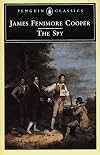
The Spy
by James Fenimore Cooper
On This Page
Description
Looking for a stiff dose of seat-of-your-pants wartime action and adventure? Check out The Spy from American literary master James Fenimore Cooper. This extensively researched tale of the Revolutionary War focuses on the exploits of protagonist Harry Birch, who is passionately devoted to the cause of American independence but nonetheless finds himself falsely accused of treason..
Tags
Recommendations














Member Reviews
Mark Twain was right about James Fenimore Cooper- he is not the best writer, and I really wished while reading this book that Cooper had had a stubborn and talented editor to help him polish his writing. The Spy is a great story, but told with a lack of grace that leaves the reader feeling a bit lost, disconnected and dissatisfied. Still, there are many modern authors who write just about as badly and become bestsellers, so there are always readers who will enjoy the story and not mind the poor craftsmanship in this novel.
"The Spy: A Tale of the Neutral Ground" was first published in 1821 and was the second of Cooper's published works and his first commercial success. The action of the novel takes place in Westchester ("West Chester") County, NY in 1780 not long after the defection of Benedict Arnold to the British and the capture and execution of his British contact, Major Andre.
As espionage tales go this is actually pretty thin on the activities of the protagonist as a spy. The hero is in fact a double agent who is apparently a spy working in the service of Sir Henry Clinton and wanted desperately for hanging by the Americans who are unaware that, in fact, he is an agent of George Washington. The plot, in so far as it chronicles the activities of the show more hero, consists of his efforts to elude the American forces or to escape his captors when taken prisoner. Along the way he distinguishes himself through services rendered to members of the Wharton family, whose only son is a British serving officer, taken while in civilian disguise, during a family visit and doomed to the same fate as Major Andre and our hero.
The Wharton family symbolizes the American people writ large. As is often the case in a civil conflict the family members are divided in their loyalties. The son, Henry, is a serving British officer. The loyalties of his sisters Sarah and Frances are divided between the King (Sarah) and native country (Frances). Their father strives to maintain a public facing neutrality while privately leaning toward the British cause. Their aunt Jeanette Peyton, a Virginia transplant, who is the younger sister of Mr. Wharton's late wife. It turns out that her relative, Peyton Dunwoodie, is a major in the American army and the ranking local commander of a troop of dragoons stationed in the area.
Major Dunwoodie is a childhood friend of Captain Henry Wharton, the British officer who is threatened with execution by hanging after his capture in civilian disguise by Dunwoodie's subordinate, Captain Lawton. Dunwoodie's difficulties are further complicated by his affections for young Frances.
The supporting cast of characters includes a Colonel Wellmere, a British officer, much admired by Sarah Wharton; a Captain Singleton who is seriously wounded during a battle that takes place near the Whartons' home, his sister Isabella who is transported to the scene to attend to her brother during his convalescence; Dr. Sitgreaves , a surgeon attached to the American army; Katy Haynes, the housekeeper to John Birch and his son Harvey (our protagonist); Betty Flanagan,a female sutler and perhaps camp follower of the American dragoons; the Wharton family's black slave, Caesar, and a mysterious gentleman named Harper who kicks off the story, but then disappears until near the end of the narrative.
Cooper writes in a style reminiscent of Jane Austen. His heroes and heroines are exemplars of manliness and the feminine virtues, and their dialogue is formal and moderate in tone at least as it concerns the Wharton family, the officers and Harvey Birch. The men are animated by honor, patriotism, loyalty (to their brethren and their duty), courage and regard for reputation. The ladies are modest, tender hearted, devoted to their family, and virtuous in love.
Like a good movie serial the action involves one near miraculous escape after another, romance, heroism above and beyond, and the threat to safety and happiness posed by cads, cowards and blackguards. This is clearly a tale that is out of fashion and is not for those readers who strive to be politically correct and as such consider concepts such as "gentlemen" and "ladies' to be modes of oppression. If you belong to the 1619 Project school of American history this is not for you.
For the rest of us, Cooper's "Tale of the Neutral Ground" is highly recommended. show less
As espionage tales go this is actually pretty thin on the activities of the protagonist as a spy. The hero is in fact a double agent who is apparently a spy working in the service of Sir Henry Clinton and wanted desperately for hanging by the Americans who are unaware that, in fact, he is an agent of George Washington. The plot, in so far as it chronicles the activities of the show more hero, consists of his efforts to elude the American forces or to escape his captors when taken prisoner. Along the way he distinguishes himself through services rendered to members of the Wharton family, whose only son is a British serving officer, taken while in civilian disguise, during a family visit and doomed to the same fate as Major Andre and our hero.
The Wharton family symbolizes the American people writ large. As is often the case in a civil conflict the family members are divided in their loyalties. The son, Henry, is a serving British officer. The loyalties of his sisters Sarah and Frances are divided between the King (Sarah) and native country (Frances). Their father strives to maintain a public facing neutrality while privately leaning toward the British cause. Their aunt Jeanette Peyton, a Virginia transplant, who is the younger sister of Mr. Wharton's late wife. It turns out that her relative, Peyton Dunwoodie, is a major in the American army and the ranking local commander of a troop of dragoons stationed in the area.
Major Dunwoodie is a childhood friend of Captain Henry Wharton, the British officer who is threatened with execution by hanging after his capture in civilian disguise by Dunwoodie's subordinate, Captain Lawton. Dunwoodie's difficulties are further complicated by his affections for young Frances.
The supporting cast of characters includes a Colonel Wellmere, a British officer, much admired by Sarah Wharton; a Captain Singleton who is seriously wounded during a battle that takes place near the Whartons' home, his sister Isabella who is transported to the scene to attend to her brother during his convalescence; Dr. Sitgreaves , a surgeon attached to the American army; Katy Haynes, the housekeeper to John Birch and his son Harvey (our protagonist); Betty Flanagan,a female sutler and perhaps camp follower of the American dragoons; the Wharton family's black slave, Caesar, and a mysterious gentleman named Harper who kicks off the story, but then disappears until near the end of the narrative.
Cooper writes in a style reminiscent of Jane Austen. His heroes and heroines are exemplars of manliness and the feminine virtues, and their dialogue is formal and moderate in tone at least as it concerns the Wharton family, the officers and Harvey Birch. The men are animated by honor, patriotism, loyalty (to their brethren and their duty), courage and regard for reputation. The ladies are modest, tender hearted, devoted to their family, and virtuous in love.
Like a good movie serial the action involves one near miraculous escape after another, romance, heroism above and beyond, and the threat to safety and happiness posed by cads, cowards and blackguards. This is clearly a tale that is out of fashion and is not for those readers who strive to be politically correct and as such consider concepts such as "gentlemen" and "ladies' to be modes of oppression. If you belong to the 1619 Project school of American history this is not for you.
For the rest of us, Cooper's "Tale of the Neutral Ground" is highly recommended. show less
I'm not fond of books that describe every minute detail like this one does, but when it was written, it would have given an excellent description of what life was like during the Revolutionary War. No other book that I've read gave a description of the Skinners, those who had loyalty to neither side & stole from both with no conscience, destroying property at will. This is one of the author's first novels & may (or may not) be based on a true story.
It's important to remember the time period that a book was written in when delving into a work of classical literature. For example, The Spy came out in 1821 when American novelists were still focused on telling stories about their brethren over the pond. It was quite revolutionary (pun sooo intended) to focus a story on American soil. The story is set during the American Revolution and opens at the end of 1780. Slavery clearly still practiced and attitudes about the slaves themselves were not altogether complimentary. If you go into a work of classic literature without remembering the context of the story itself then you are doomed to find the entire body of work unpalatable. With that being said, I must say I really enjoyed The Spy. show more True to the style of the time there was a lot of focus on unimportant details which made a majority of the tale drag on somewhat. I felt that it didn't really pick up steam (or grab my interest) until about 3/4 of the way through. There are two fantastic characters, however, which kept me turning those pages: Captain John Lawton (of the Continental Army who is fierce, brave, and impetuous) and Harvey Birch (the spy himself who is always full of wit and intensity). These two indomitable spirits are what make this story a classic piece of American literature. show less
It was a wonderful historically representative book of the Revolutionary War however, verbose, very detailed, and expressive. I found the pace of the book to be like waiting for a wave to appear and a brief ride of excitement while riding in, until I had to labor my paddle back out to catch another exciting section of the book. The pace was slow at times and the story appeared to be more of a random romp around the NY country side then a historical spy novel.
It kept me reading even though I got bored half way through. The story between the lines made me really feel I was back in time.
It kept me reading even though I got bored half way through. The story between the lines made me really feel I was back in time.
The style is very dated. I found it hard to read. The treatment and view of the slaves is very much a product of the time in which it was written
A good story and Cooper did a great job presenting it in a compelling way. A good dose of adventure and intrigue, but I'd recommend any of the leatherstocking tales before this.
Members
- Recently Added By
Lists

Best Spy Fiction
153 works; 102 members

Publisher's Weekly Bestsellers Prior to 1895 in Chronological Order
95 works; 6 members

Fiction (Mostly) in Selective Bibliography of American Literature 1775-1900
431 works; 3 members

F. B. Perkins' List of 100 Best Fiction
100 works; 5 members

Books mentioned in Julian Symons’ Bloody Murder
438 works; 6 members
150 Best Novels Selected by Brander Matthews (1883)
150 works; 7 members

Books Read in 2021
5,361 works; 113 members
Works in the game of Authors
44 works; 2 members
Author Information

501+ Works 30,630 Members
James Fenimore Cooper, acclaimed as one of the first American novelists, was born in Burlington, N.J., on September 15, 1789. When he was one year old, his family moved to Cooperstown, N.Y., which was founded by his father. Cooper attended various grammar schools in Burlington, Cooperstown, and Albany, and entered Yale University in 1803 at the show more age of 13. In 1806, Cooper was expelled from Yale for pushing a rag with gunpowder under a classmate's door, causing it to explode. He then spent some time as a merchant seaman and served as a midshipman in the U.S. Navy from 1808-1811. In 1811, Cooper married Susan De Lancey, and lived the life of a country gentleman until one day in 1820. Cooper and his wife were reading a book together. When Cooper told Susan that he could write a better book than the one they were reading, she challenged him to do so. Thus began his career as an author, with Precaution (first published anonymously). Cooper is known for writing more than 50 works under his own name, Jane Morgan, and Anonymous. His works included fiction, nonfiction, history, and travel sketches. He gained insight for his travel works while the Cooper family lived in Europe from 1826 to 1833. Cooper is best known for the novel The Last of The Mohicans, which has been made into several motion picture adaptations, the most recent starring Daniel Day-Lewis as Hawkeye. The Last of the Mohicans is part of The Leatherstocking Tales, which includes the other novels, The Pioneers, The Deerslayer, and The Pathfinder. Hawkeye, whose given name is Nathaniel Bumpo, is a recurring character in the series which accurately chronicles early American pioneering life and events during the French and Indian War. In 1851, Cooper developed a liver condition, dying on September 14th of that year, just one day before his 62nd birthday. (Bowker Author Biography) show less
Some Editions
Awards and Honors
Series
Belongs to Publisher Series
Work Relationships
Is contained in
Has the adaptation
Is abridged in
Has as a reference guide/companion
Common Knowledge
- Canonical title
- The Spy
- Original title
- The Spy
- Original publication date
- 1836
- Important events
- American Revolution
- Related movies
- The Spy (1914 | IMDb)
- First words
- It was near the close of the year 1780 that a solitary traveler was seen
pursuing his way through one of the numerous little valleys of
Westchester. - Last words
- (Click to show. Warning: May contain spoilers.)It was the SPY OF THE NEUTRAL GROUND, who died as he had lived, devoted
to his country, and a martyr to her liberties. - Canonical DDC/MDS
- 813.3
Classifications
- Genres
- General Fiction, Fiction and Literature, Historical Fiction
- DDC/MDS
- 813.3 — Literature & rhetoric American literature in English American fiction in English Middle 19th Century 1830-1861
- LCC
- PS1417 .S7 — Language and Literature American literature American literature Individual authors 19th century
- BISAC
Statistics
- Members
- 881
- Popularity
- 30,694
- Reviews
- 21
- Rating
- (3.27)
- Languages
- 10 — Czech, English, French, German, Hungarian, Italian, Lithuanian, Polish, Russian, Spanish
- Media
- Paper, Audiobook, Ebook
- ISBNs
- 83
- ASINs
- 95