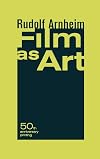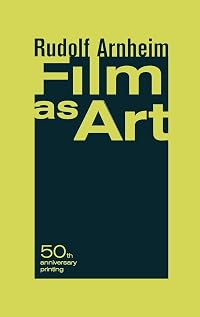
Film as Art
by Rudolf Arnheim
On This Page
Description
In the fall of 1957 the University of California Press expanded Arnheim's 1933 book Film by four essays and brought that landmark work back into print as Film as Art. Now nearly fifty years after that re-edition, the book continues to occupy an important place in the literature of film. Arnheim's method, provocative in this age of technological wizardry, was to focus on the way art in film was derived from that medium's early limitations: no sound, no color, no three-dimensional depth.Tags
Recommendations









Member Reviews
This book presents a theory of film. The greater part is an adaptation of the book originally published in 1933, long out of print but still in demand because it raises fundamental questions that the intervening years have by no means answered. Arnheim's provocative thesis is that the peculiar virtues of film as art derive from an exploitation of limitations of the medium: the absence of sound, the absence of color, the lack of three-dimensional depth. Silent-film artists made virtues of these necessities and were on their way to developing a new and distinctive art form. Mechanical advancement has led to greater realism, and a corresponding loss in artistry. The four essays which make up the rest of the book are supplementary in show more nature. The final one discusses the general aesthetic rules for the combination of different media--word, image, and sound--and leads to an evaluation of the talking picture as a medium for artistic expression.--Adapted from back cover. show less
classsic -- http://film.vtheatre.net
Arnheim defendia que o cinema alcança seu status artístico não pela imitação da realidade, mas por meio da manipulação criativa das limitações do meio (ausência de cor, profundidade, som), explorando a percepção através da psicologia Gestalt para criar novas realidades e significados. Sua teoria liga a percepção visual à cognição, afirmando que pensar e perceber são processos entrelaçados, e que o cinema, ao distorcer nossa percepção do mundo, torna-se uma forma de pensamento e conhecimento.
Jan 16, 2026English (UK)
Se presenta la evolución de del cine como arte desde la primera época del cine mudo, hasta la segunda época con la utilización de medios mecánicos. Permite entender la evolución del cine mudo al sonoro.
Oct 16, 2014Spanish
29,90€ Amazon
Mar 31, 2026German
Ratings
Members
- Recently Added By
Author Information

45+ Works 2,756 Members
Rudolf Arnheim (1904-2007) was Professor Emeritus of the Psychology of Art at Harvard University and the author of many books, including Art and Visual Perception, Film as Art, The Dynamics of Architectural Form, and Visual Thinking.
Series
Belongs to Publisher Series
Common Knowledge
- Canonical title*
- Film as Art
- Original title
- Film als Kunst
- Original publication date
- 1932 (German original) (German original); 1933 (English) (English); 1957 (English, revised) (English, revised)
- First words
- Film resembles painting, music, literature, and the dance in this respect - it is a medium that may, but need not, be used to produce artistic results.
- Last words
- (Click to show. Warning: May contain spoilers.)Beyond our blundering there are inherent forces that, in the long run, overcome error and incompleteness and direct human action toward the purity of goodness and truth.
*Some information comes from Common Knowledge in other languages. Click "Edit" for more information.
Classifications
Statistics
- Members
- 357
- Popularity
- 88,718
- Reviews
- 5
- Rating
- (4.00)
- Languages
- 9 — English, French, German, Greek, Hungarian, Italian, Portuguese, Spanish, Turkish
- Media
- Paper, Ebook
- ISBNs
- 18
- ASINs
- 6