
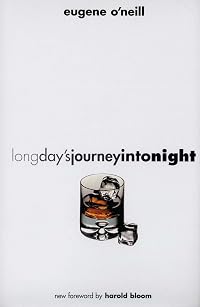
Long Day's Journey into Night
by Eugene O'Neill
On This Page
Description
Author Eugene O'Neill gives an autobiographical account of his explosive homelife. Fused by a drug-addicted mother, a father who wallows in drink after realizing he is no longer a famous actor, and an older brother who is emotionally unstable and misfit, the family is reflected by their youngest son, who at 23 is a sensitive and aspiring writer.Tags
Recommendations









Member Reviews
Don't read this play if you or your family have a history of drug addiction and/or alcoholism and you don't want to be reminded of it. This play is about the disintegration of a family whose members are, variously, addicted to drugs or alcohol; tormented by the failure of their dreams; or dying from disease on top of the other problems.
That said...this is a fascinating play with a explosive end. The first three acts are so quiet in comparison, in their depiction of the Tyrone family's individual miseries, that I was caught off guard and astonished by the end of Act IV.
I liked the play well enough after the first three acts, but I think I was vaguely disappointed and bored by the family members' endless tiptoeing around the sources of show more their misery and shifting back and forth between sniping at each other and trying to pretend nothing is wrong.
Everyone who reads about this play knows it is autobiographical, with the Tyrones representing Eugene O'Neill's family and the protagonist Edmund Tyrone representing Eugene O'Neill himself. With Eugene O'Neill being a famous playwright, you might think Edmund is the most interesting character; but I say no, not really. I find his older brother Jamie more complex and therefore more interesting. I'm not entirely sure why yet--I want to study Jamie more closely--but I think it has to do with the difference in Jamie's condition from Edmund's and Mary's. Jamie is a heavy drinker and possibly an alcoholic, but not terminally ill like Edmund or a drug addict like Mary. And since Jamie is out of favor with his father (who considers him a ne'er-do-well) and is receiving less attention because he's not dying, he is more distant from his family and often acts as a cynical observer. At the end, he seems the most emotionally tormented member of the family, certainly more tormented than Edmund. show less
That said...this is a fascinating play with a explosive end. The first three acts are so quiet in comparison, in their depiction of the Tyrone family's individual miseries, that I was caught off guard and astonished by the end of Act IV.
I liked the play well enough after the first three acts, but I think I was vaguely disappointed and bored by the family members' endless tiptoeing around the sources of show more their misery and shifting back and forth between sniping at each other and trying to pretend nothing is wrong.
Everyone who reads about this play knows it is autobiographical, with the Tyrones representing Eugene O'Neill's family and the protagonist Edmund Tyrone representing Eugene O'Neill himself. With Eugene O'Neill being a famous playwright, you might think Edmund is the most interesting character; but I say no, not really. I find his older brother Jamie more complex and therefore more interesting. I'm not entirely sure why yet--I want to study Jamie more closely--but I think it has to do with the difference in Jamie's condition from Edmund's and Mary's. Jamie is a heavy drinker and possibly an alcoholic, but not terminally ill like Edmund or a drug addict like Mary. And since Jamie is out of favor with his father (who considers him a ne'er-do-well) and is receiving less attention because he's not dying, he is more distant from his family and often acts as a cynical observer. At the end, he seems the most emotionally tormented member of the family, certainly more tormented than Edmund. show less
It had been so long that nothing could blow my mind the way this play did! And I regret putting it off for some time! Long Day's Journey into Night somehow reminded me of Salinger's Franny and Zooey, the picture of a family who hopelessly struggle to find their lost self. And the fact about these two works is that you won't find any sense in them, if you never shared the same kind of desperation.
The Tyrones - mother, father, and two sons - spend a day more or less together in the country. Within the course of that day, we see all sorts of nasty little secrets that were only suggested in the first act.
This is the first O'Neill play I have read, and I have to say that I found it excellent. Not much fun, but really well done. The theme, to me, was that of excuses, excuses. The entire family has someone - someone else, that is - to blame for being the way they are. Mary blames her husband, her dead son, Edmund, life in general, not having her own house, her circumstances. Tyrone senior blames his difficult childhood, his lost chances. Both sons blame their parents. But in the end, every character admits the truth of why they are show more the way they are.
Every character except Mary. Despite many chances to admit the truth - she is a drug addict - she denies to the very end. And it is the difference between the men in the play, with their ultimate honesty, and Mary's self-deception that makes me angry with her and feel empathy for the others.
There is a chance, a small one, but still a chance, that Edmund will get well, that Tyrone will stop drinking, that Jamie will branch out on his own. But Mary is stuck where she is, dreaming and lying through her life.
Like I said, this wasn't exactly a fun play, but it was extremely realistic. Very well done and highly recommended. show less
This is the first O'Neill play I have read, and I have to say that I found it excellent. Not much fun, but really well done. The theme, to me, was that of excuses, excuses. The entire family has someone - someone else, that is - to blame for being the way they are. Mary blames her husband, her dead son, Edmund, life in general, not having her own house, her circumstances. Tyrone senior blames his difficult childhood, his lost chances. Both sons blame their parents. But in the end, every character admits the truth of why they are show more the way they are.
Every character except Mary. Despite many chances to admit the truth - she is a drug addict - she denies to the very end. And it is the difference between the men in the play, with their ultimate honesty, and Mary's self-deception that makes me angry with her and feel empathy for the others.
There is a chance, a small one, but still a chance, that Edmund will get well, that Tyrone will stop drinking, that Jamie will branch out on his own. But Mary is stuck where she is, dreaming and lying through her life.
Like I said, this wasn't exactly a fun play, but it was extremely realistic. Very well done and highly recommended. show less
Maybe the most intimate and autobiographical of O'Neill's plays, his mastery is as clear here as it is in his other work. In the space of a summer home and with a single family as not only the focus, but the only cast (aside from one servant), this work is both powerful and heartwrenching.
Tinged with both poetry and humor, this journey is worth reading for any mature reader. As always, O'Neill's style also makes his plays easier to read than many other dramas--this one, especially, since the cast is so small. Absolutely recommended.
Tinged with both poetry and humor, this journey is worth reading for any mature reader. As always, O'Neill's style also makes his plays easier to read than many other dramas--this one, especially, since the cast is so small. Absolutely recommended.
This play had been on my list for a long while after finding out O’Neill wrote it at Tao House, which has been preserved near Las Trampas Wilderness Reserve in the East Bay, where I had been hiking. Unfortunately, I found it rather one-note and bleak, as if each new revelation about the members of the dysfunctional family were going to be scandalous and fascinating. The overly coy revelation of what was going on with the mother was particularly annoying, and piling on all of the other woes was a mistake. It felt like Tennessee Williams lite to me, and needed some other element to sustain itself.
Some nice quotes though:
On losing one’s way:
“None of us can help the things life has done to us. They’re done before you realize it, and show more once they’re done they make you do other things until at last everything comes between you and what you’d like to be, and you’ve lost your true self forever.”
On meaning; I absolutely loved the line “seeing the secret, are the secret”:
“Then the moment of ecstatic freedom came. The peace, the end of the quest, the last harbor, the joy of belonging to a fulfillment beyond men’s lousy, pitiful, greedy fears and hopes and dreams! And several other times in my life, when I was swimming far out, or lying alone on a beach, I have had the same experience. Became the sun, the hot sand, the green seaweed anchored to a rock, swaying in the tide. Like a saint’s vision of beatitude. Like the veil of things as they seem drawn back by an unseen hand. For a second you see – and seeing the secret, are the secret. For a second there is meaning! Then the hand lets the veil fall and you are alone, lost in the fog again, and you stumble on toward nowhere, for no good reason!”
On the past:
“Mary! For God’s sake, forget the past!”
“Why? How can I? The past is the present, isn’t it? It’s the future, too. We all try to lie out of that but life won’t let us.” show less
Some nice quotes though:
On losing one’s way:
“None of us can help the things life has done to us. They’re done before you realize it, and show more once they’re done they make you do other things until at last everything comes between you and what you’d like to be, and you’ve lost your true self forever.”
On meaning; I absolutely loved the line “seeing the secret, are the secret”:
“Then the moment of ecstatic freedom came. The peace, the end of the quest, the last harbor, the joy of belonging to a fulfillment beyond men’s lousy, pitiful, greedy fears and hopes and dreams! And several other times in my life, when I was swimming far out, or lying alone on a beach, I have had the same experience. Became the sun, the hot sand, the green seaweed anchored to a rock, swaying in the tide. Like a saint’s vision of beatitude. Like the veil of things as they seem drawn back by an unseen hand. For a second you see – and seeing the secret, are the secret. For a second there is meaning! Then the hand lets the veil fall and you are alone, lost in the fog again, and you stumble on toward nowhere, for no good reason!”
On the past:
“Mary! For God’s sake, forget the past!”
“Why? How can I? The past is the present, isn’t it? It’s the future, too. We all try to lie out of that but life won’t let us.” show less
An intense and heartbreaking iconic 20th Century American play that reads like a novel when taken with the meticulous stage directions. Autobiographical in nature, and meant to be released after the author's death, Long Day's Journey into Night shines a searing spotlight on addiction within a family of misfits. Dysfunctional doesn't start to describe these alternately repressed and emotionally brutal group. Grim, depressing, honest and brilliant.
I really like the structure of this play - how the story unfolds in the tiniest bits and pieces, edging along so that you never quite know what's entirely going on until the end of the play. Mary's addiction was heartbreaking, as were her confessions about what she felt drove her to them, and each of the other character's stories really broke my heart. It felt like they all hated the decisions they had made in the past, but couldn't repent them or change their direction - Tyrone would always be a tightwad, James wouldn't change his self-destructive nature, Edmund couldn't do anything for himself and didn't even try to.
Members
- Recently Added By
Lists

Plays I Like
230 works; 31 members

Mustich's 1000 Books to Read Before You Die: A Life Changing List
1,001 works; 19 members
r/acting on Reddit - Essential Plays
44 works; 2 members

The College Board: 101 Great Books Recommended for College-Bound Readers
111 works; 7 members
1:28 p.m.'s 350 Stage Plays Challenge
94 works; 3 members

Well-Educated Mind
150 works; 3 members

Greatest Books, allegedly
484 works; 9 members

AP Lit
363 works; 6 members
Essential/Recognized Stage Plays
115 works; 4 members
Stage Plays/Screenplays/Dialogues/Anything Dialogue-Storytelling Related
81 works; 2 members

Philip Ward's Lifetime Reading Plan
592 works; 22 members

New Lifetime Reading Plan by Fadiman and Major
225 works; 5 members

The Well-Educated Mind, Susan Wise Bauer, 2016
179 works; 3 members

Recommended Reading : 600 Classics Reviewed, Editors of Salem Press, 2015
634 works; 6 members

The Torchlight List
95 works; 1 member
My Play Collection
769 works; 3 members

Every Non-Musical Play Nominated for a Tony Award
64 works; 3 members

1950s
340 works; 22 members

20th Century Literature
1,161 works; 55 members

Amanda's Guaranteed Books
110 works; 5 members

Literary Works Read in College
316 works; 15 members

Books featuring alcoholics
103 works; 18 members
American Lit for Eng 11 Research Project
368 works; 6 members

Modernism
140 works; 8 members

Nobel Price Winners
222 works; 20 members
Harold Bloom - The Western Canon: D. The Chaotic Age
833 works; 24 members

Books I've Read More Than Once
602 works; 49 members

SHOULD Read Books!
354 works; 9 members
Mensa for Kids Excellence in Reading Award Program (Grades 9-12)
116 works; 5 members
1940s
221 works; 25 members

Books Read in 2019
4,052 works; 108 members
Mensa for Kids Excellence in Reading Award Program (Grades 9-12)
116 works; 3 members

Books With Time Words in the Title
160 works; 4 members
The Well-Educated Mind Reading Challenge
75 works; 7 members

My Favorite Plays
25 works; 1 member
Author Information

290+ Works 13,229 Members
Eugene O'Neill was born in New York City on October 16, 1888, the son of popular actors James O'Neill and Ellen Quinlan. As a young child, he frequently went on tour with his father and later attended a Catholic boarding school and a private preparatory school. He entered Princeton University but stayed for only a year. He took a variety of jobs, show more including prospecting for gold, shipping out as a merchant sailor, joining his father on the stage, and writing for newspapers. In 1912, he was hospitalized for tuberculosis and emotional exhaustion. While recovering, he read a great deal of dramatic literature and, after his release from the sanitarium, began writing plays. O'Neill got his theatrical start with a group known as the Provincetown Players, a company of actors, writers, and other theatrical newcomers, many of whom went on to achieve commercial and critical success. His first plays were one-act works for this group, works that combined realism with experimental forms. O'Neill's first commercial successes, Beyond the Horizon (1920) and Anna Christie (1921) were traditional realistic plays. Anna Christie is still frequently performed. It is the story of a young woman, Anna, whose hard life has led her to become a prostitute. Anna comes to live with her long-lost father, who is unaware of her past, and she falls in love with a sailor, who is also unaware. When Anna finds the two men fighting over her as though she were property, she is so angry and disgusted that she insists on telling them the truth. The man she loves rejects her at first, but then later returns to marry her. Soon O'Neill began to experiment more, and over the next 12 years used a wide variety of unusual techniques, settings, and dramatic devices. It is no exaggeration to say that, virtually on his own, O'Neill created a tradition of serious American theater. His influence on the playwrights who followed him has been enormous, and much of what is taken today for granted in modern American theater originated with O'Neill. A major legacy has been the nine plays he wrote between 1924 and 1931, tragedies that made heavy use of the new Freudian psychology just coming into fashion. His one comedy, Ah, Wilderness (1933), was the basis for the musical comedy, Oklahoma!, itself a groundbreaking event in American theater. O'Neill later began to write the intense, brooding, and highly autobiographical plays that are now considered to his best work. The Iceman Cometh (1946) is set in a bar in Manhattan's Bowery, or skid-row district. In the course of the play, a group of apparently happy men are forced to recognize the true emptiness of their lives. In A Long Day's Journey into Night (1956), O'Neill examines his own family and their tormented lives, a subject he continues in A Moon for the Misbegotten (1957). O'Neill's work was highly honored. He was awarded the Nobel Prize for literature in 1936 and Pulitzer Prizes for Anna Christie, Beyond the Horizon, Strange Interlude (1928), and A Long Day's Journey Into Night, which also received the New York Drama Critics Circle Award. O'Neill died in Room 401 of the Sheraton Hotel on Bay State Road in Boston, on November 27, 1953, at the age of 65. He was also born in a hotel room in Times Square, NYC. (Bowker Author Biography) show less
Some Editions
Awards and Honors
Awards
Distinctions
Series
Belongs to Publisher Series
Work Relationships
Is contained in
Has the (non-series) sequel
Has the adaptation
Has as a study
Has as a commentary on the text
Has as a student's study guide
Has as a teacher's guide
Common Knowledge
- Original title
- Long day’s journey into night
- Original publication date
- 1956
- Related movies
- Long Day's Journey Into Night (1962 | IMDb); Long Day's Journey Into Night (1973 | IMDb); Viaje por una larga noche (1977 | IMDb); Long Day's Journey Into Night (1982 | IMDb); Long Day's Journey Into Night (1987 | IMDb); Great Performances: Long Day's Journey Into Night (1996 | IMDb)
- First words
- Living room of James Tyrone's summer home on a morning in August, 1912.
- Last words
- (Click to show. Warning: May contain spoilers.)Edmund and Jamie remain motionless.
- Disambiguation notice
- This entry is for the script of the play; please do not enter any of the filmed or televised versions of the play here.
Classifications
Statistics
- Members
- 3,891
- Popularity
- 4,048
- Reviews
- 43
- Rating
- (4.06)
- Languages
- 12 — Czech, Dutch, English, Estonian, Finnish, French, German, Italian, Norwegian (Bokmål), Portuguese, Spanish, Swedish
- Media
- Paper, Audiobook, Ebook
- ISBNs
- 48
- UPCs
- 2
- ASINs
- 46