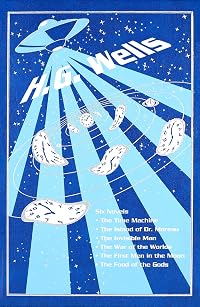
The Time Machine / The Island of Dr. Moreau / The Invisible Man / The War of the Worlds / The First Men in the Moon / The Food of the Gods
by H. G. Wells
On This Page
Description
He was the first to popularize the concept of time travel. He disturbed--and fascinated?us with a frightening doctor?s island. He wrote of an invisible man, of men on the moon, and of a war of the worlds. He has influenced countless other writers, artists, and even scientists. H. G. Wells is one of the most acclaimed science fiction writers who ever lived, and five of his classic tales are collected in this book for readers to treasure. --Amazon.com.Tags
Recommendations
























Member Reviews
My reaction to reading this omnibus in 1996. Spoilers follow.
“Introduction” -- Concise description of Wells’ early life and first six novels.
“Introduction” -- Anonymous and serviceable synopsis of Wells’ life through 1904 (The date of the last novel in the anthology) and the themes of his early sf novels.
The Time Machine -- I haven’t read this novel in 22 years. I got a lot more out of it this time, particularly the sense of modernity both in Wells’ scientific notions and his literary concerns. Technically, I was struck by how Wells gets to literarily have his cake and eat it too when the Time Traveler postulates explanations – which then turn out to be wrong – for the world of the Morlocks and Eloi – and then show more gives what is the presumably correct explanation. Wells was, of course, fascinated by Darwinian theory (and lectured on it) and its implications for human society. Many of his speculations in this novel are very reminiscent of the supposedly new field of evolutionary psychology (which obviously uses ideas at least 100 years old). Two in particular stood out. First, the idea that intelligence is not necessarily a survival trait. Second, that certain traits – like physical courage, jealousy, and love of battle – could be remnants of survival traits may be hindrances to civilization. Indeed, ambition, intelligence, physical and intellectual prowess could be anti-survival traits in the subjugated world of “perfect comfort and security” the Time Traveler wrongly theorizes led up to the Morlock-Eloi world. Wells the advocate of women’s rights and free love also has the Time Traveler throw out the proposition that when technology lessens the necessity of physical strength the traditional family for child rearing becomes unnecessary, and, indeed, the sexes becomes less physically differentiated. The actual origin of the Morlock-ELoi world is a bitter irony that owes something to Marx and Disraeli’s “Two Nations”. Communism is specifically mentioned by the Time Traveler as the Eloi’s mode of living. The irony is two-fold. First, the supposedly classless society that is the result of the final dialectic of Marxist history is never met. Man has evolved into two very definite (culturally and biologically) classes. Second, though the classless society is never built, the “balanced civilisation” is and is the result of a both a triumph over nature and Eloi over Morlock with both getting what they want – Eloi Capitalist get perfect security; Morlock Labourer (the Marxist terms are employed by the Time Traveler) gets job security; Eloi Haves get lesiure; Morlock Have Nots are controlled by the infrastructure they live in. The balanced civilization degenerates, though. The aristocratically descended Eloi become sheep-like, creatures of two word sentences, and, in a sort of twist on Johnathon Swift’s “A Modest Proposal”, literally food for the Morlock underclass. The book is pessimistic, a gloomy meditation on the insignificance of humanity and the futility of existence (the Time Traveler travels far ahead to view a dying sun and cold Earth.) The narrator concludes – after hearing from the Time Traveler “how brief the dream of the human intellect had been” and of the end of civilization – that it “remains for us to live as though it were not so” (Sort of like the remark that it would be best to behave as if God were real) and that, in the heart of vapid Weena, “gratitude and a mutual tenderness still lived on” after mind and strength died. Such an emotional and romantic ending seems odd coming from scientist and rationalist Wells. We expect no paens to emotion.
The Island of Dr. Moreau -- This novel is much grimmer than I remember. Essentially, using the metaphor of the Beast People, Wells argues that humans are beasts as well. At novel’s end, the narrator sees his fellow man as irrational, bestial, caught up in day to day cares, Man as animal “with some strange disorder in its brain”. Religion and moral education can not quell man’s bestial nature any more than the chanted dictums of Moreau pacify the Beast People. As critics have pointed out, Moreau is unapologetic unlike Victor Frankenstein. Moreau, like Frankenstein, creates uniquely alienated creatures, but he persists in his efforts, seeks to rule them. You can sort of see Moreau as some sort of gnostic god, the creator of flawed beings ruling over his island universe.
The Invisible Man -- The popular image – and the memory I had in my mind from reading this over 20 years ago (and also popularized in movies) – is a frightening novel of a menacing, egomaniacal mad scientist. That element is there, but the novel contains a great deal of humor (and perhaps some gentle satire against those of the poor working class he grew up with) – especially in the first part of the novel. There the menace is a burlesque one as Griffin knocks people over and such and commits burglary with his invisibility. However, after he flees town after being unveiled and meets Mr. Marvel – who he coerces into helping him – the tone of the book – becomes much more menacing in the traditional sense. When he tries to seek refuge with his old schoolmate, Dr. Kemp – who tries to turn him into the police, he is revealed as a petty, would-be tyrant who thinks that his invisibility – along with the help of a confederate (he offers the position to Dr. Kemp) – is enough to enable him to start a “Reign of Terror” in “some town”. I suspect that the sort of mad (the word is explicitly used in connection with Griffin), petty scientist bent on personal power depicted in Griffin is an important development in the stock image of the “mad scientist”, particularly in cinema. To be sure, “mad”, megalomaniac scientists had existed before – Jules Verne’s Robur the Conqueror comes to mind in sf. But Griffin is more obviously unbalanced, has smaller ambitions, and most importantly, is the victim of his own experiments unlike Robur or Victor Frankenstein. The novel ends on a humorous, yet disquieting note with Griffin’s ex-landlord trying to learn the dead scientist’s secret of invisibility. Humorous because he clearly has no idea what the coded book say. Disquieting because Wells makes a comment on the difficulty of suppressing scientific discoveries. When the landlord dies the books will pass into someone else’s hand, someone who may discover Griffin’s secrets.
The First Men in the Moon -- I had read this novel once long ago and found it boring. This time I liked it much better though I could not find much of the Jonathan Swift influence other critics have mentioned other than a certain parallel between Cavor and the Grand Lunar and Gulliver and the Houyhnhnms. The Grand Lunar criticizes man and finds him barbarous after talking to Cavor just at the Houyhnhnms do after talking to Gulliver. I suspect, with Cavor, Wells produced another influential depiction of the scientist for sf and popular culture: here the portrayal is of the naïve, unwordly, scientist purely interested in knowledge and eccentric to boot. I found it interesting that Wells appears to be one of the first to develop a relatively complicated ecology for life on the Moon and a relatively rigorous working out of its environment given his initial premises and the science of the time. Structurally, the novel is interesting in that most of the explication (and, indeed, political points and thematic workings) take place after Bedford has successfully escaped from the moon. Essentially, Wells drops the adventure format to settle the mystery of the Selenites in bald explication and half settle Cavor’s fate. Certain, satirical points are made in Cavor’s account of his time on the moon and their discrepancies with narrator Bedford’s account. Of course, Bedford is not exactly a most reliable narrator. He is somewhat rash and dishonest (in trying to dupe his creditors and evade blame for a boy being hurt in an accident with the Cavorite sphere when it returns to Earth), and he does provoke a fight with the Selenites. The First Men in the Moon can be read as a typically ambivalent Wells’ novel. Here the ambivalence is about a planned World State. It lacks the wars of Earth. But it also lacks individual freedom (ant societies are explicitly alluded to) with surgical techniques used to mold the minds and bodies of the Selenites to specific occupations. The novel not only foreshadows Aldous Huxley’s Brave New World with its genetically based castes and in vitro engineering but also (Huxley was a fan of Wells so he certainly read this novel) all those sf societies where engineered organisms replace mechanical devices. (One Selenite is even engineered to power small devices.) Cavor is put off by this (though he hopes to eventually feel more favorably about it). The whole biological caste system seems mediaeval. Wells, I don’t think, means us to view this favorably. I suspect he loved man’s adaptability and flexibility too much. However, he seems, like Swift (if one accepts the theory that his Houyhnhnms were not to be laudable but a manifestation of cold reason untempered by love) to be criticizing Selenite as well as man. Cavor sees one Selenite as a symbol of “lost possibilities”. Another time each Selenite is “ a perfect unit in a world machine”. The Selenite procedure of simply drugging a worker into sleep when “he is not needed is unsettling – but no worse, Cavor tells us, than laying off a worker. Cavor also speculates that humans are just as specialized as Selenites but in the hidden aspects of their brains. Cavor also says Selenite occupation training is more humane than the earthly method of letting children grow up and then “making machines.” (No doubt Wells resented his being forced to be a clerk at an early age.) However, there is little doubt that the Grand Lunar speaks for Wells in criticizing man’s lack of a global authority.
The Food of the Gods -- The recent arrest of the Unabomber was on my mind as I read this novel. According to his published manifesto, the Unabomber hated technologists and scientists wringing changes on the world – including those supposedly undesired by others. Wells, in this book, exhibits surprising (given his humble origins) contempt for the feelings of the common man, surprising but not unexpected (given his socialist leanings and his enthusiasm for central planning via a cult of professionals as exhibited in later novels). He plays into the Unabomber criticism of uncaring, socially disruptive scientists. I don’t think this book works on the two levels intended by Wells: satire (if you accept the notion that this is Wells’ satire on the public attitude towards change – I only think that’s partially correct) and another of Wells exploration of human biological/social evolution. The problem lies in the extreme shifts in tone. Wells’ spends a good portion of the novel showing the cavalier, harmful manner in which Bensington and Redwood slipshod handling of the Food. Ultimately, they wreck great changes on the ecosystem with giant weeds, ants, rats, wasps, etc. Dr. Winkles’ gives the Food to children unilaterally with no one’s consent. His motives are largely ambitious ones. We are meant to see the novel’s end – where the public has the Food forced on them -- as a solution to the conflict between Giants and regular humans. In effect, man will have this changed forced on them because it is for the race’s good; giganticness is the next step of evolution. (Wells doesn’t do a good job convincing me that a handful of humans a mere six to eight times larger than normal could be so powerful.) I walked away with a Unabomber-like feeling that the public’s hostility was justified. To be sure, Wells’ depiction of scientists and the public perception of change was accurate (though I think it may be changing with more scientists and laymen trying to forsee the consequences of technology, and more scientists becoming savvy of public relations.) Bensington is a common man (except for his scientific awareness and social awkwardness) with little feel for the significance of his work. Redwood is selected as the spokesmen for anything pertaining to “Boomfood”. The public at first sees the Food as little more than one more novelty, a subject of jokes, then a threat serious enough to organize politically against. (The character of Caterham seems a realistic portrayal of an opportunistic politician oblivious to and ignorant of physical and economic laws.) All the while some of the public (epitomized by the vicar who insists, in between bursts of classic Latin, that there is “something that defies all these forces of the New”) continue to insist little has changed while all around the ecosystem has changed.
The War of the Worlds -- I hadn’t read this novel since 3rd or 4th grade, so it’s about 25 years. I was interested to note that my impressions of the novel have been greatly colored by Jeff Wayne’s album War of the Worlds. For instance, the clergyman is a relatively minor character whereas the album affords him a song. George Orwell remarked that he liked reading Wells because Wells’ work had a sense that the smug complacency of English society could be shattered quickly. That is especially true of this novel. English society is destroyed in the course of a weekend (" … the rout of civilization” in Wells’ famous phrase). The Empire is militarily humiliated; English reserve, order, and politeness degenerate into anarchy. In essence, this is one of sf’s earliest disaster novels. (I don’t know exactly where Wells’ grew up, but he may have been one of the first writers to trash his hometown. The novel is also quite particular in its geographic descriptions, and I definitely think its psychological effect would have been even greater – and it’s a very good read even 98 years later – on a contemporary English audience.) It even features, in the mad artilleryman, a prototype to the survivalist of modern sf. Just like with the more modern examples, the artilleryman sees the invasion as a cleansing of the weak and degenerate from society leaving only him and his ilk to build a better, stronger society. (His actual potential to do so is pathetic.) I also had forgotten that the Martians bring along human-like food animals and that the Martians themselves are probably evolved from human like descendants. The narrator remarks that the Martians resemble the forecasts of a “certain speculative writer of quasi-scientific repute” who speculated on man’s evolutionary future in an 1893 issue of Pall Mall Budget. That writer was Wells whom the narrator recalls writing in a “foolish, facetious” tone. show less
“Introduction” -- Concise description of Wells’ early life and first six novels.
“Introduction” -- Anonymous and serviceable synopsis of Wells’ life through 1904 (The date of the last novel in the anthology) and the themes of his early sf novels.
The Time Machine -- I haven’t read this novel in 22 years. I got a lot more out of it this time, particularly the sense of modernity both in Wells’ scientific notions and his literary concerns. Technically, I was struck by how Wells gets to literarily have his cake and eat it too when the Time Traveler postulates explanations – which then turn out to be wrong – for the world of the Morlocks and Eloi – and then show more gives what is the presumably correct explanation. Wells was, of course, fascinated by Darwinian theory (and lectured on it) and its implications for human society. Many of his speculations in this novel are very reminiscent of the supposedly new field of evolutionary psychology (which obviously uses ideas at least 100 years old). Two in particular stood out. First, the idea that intelligence is not necessarily a survival trait. Second, that certain traits – like physical courage, jealousy, and love of battle – could be remnants of survival traits may be hindrances to civilization. Indeed, ambition, intelligence, physical and intellectual prowess could be anti-survival traits in the subjugated world of “perfect comfort and security” the Time Traveler wrongly theorizes led up to the Morlock-Eloi world. Wells the advocate of women’s rights and free love also has the Time Traveler throw out the proposition that when technology lessens the necessity of physical strength the traditional family for child rearing becomes unnecessary, and, indeed, the sexes becomes less physically differentiated. The actual origin of the Morlock-ELoi world is a bitter irony that owes something to Marx and Disraeli’s “Two Nations”. Communism is specifically mentioned by the Time Traveler as the Eloi’s mode of living. The irony is two-fold. First, the supposedly classless society that is the result of the final dialectic of Marxist history is never met. Man has evolved into two very definite (culturally and biologically) classes. Second, though the classless society is never built, the “balanced civilisation” is and is the result of a both a triumph over nature and Eloi over Morlock with both getting what they want – Eloi Capitalist get perfect security; Morlock Labourer (the Marxist terms are employed by the Time Traveler) gets job security; Eloi Haves get lesiure; Morlock Have Nots are controlled by the infrastructure they live in. The balanced civilization degenerates, though. The aristocratically descended Eloi become sheep-like, creatures of two word sentences, and, in a sort of twist on Johnathon Swift’s “A Modest Proposal”, literally food for the Morlock underclass. The book is pessimistic, a gloomy meditation on the insignificance of humanity and the futility of existence (the Time Traveler travels far ahead to view a dying sun and cold Earth.) The narrator concludes – after hearing from the Time Traveler “how brief the dream of the human intellect had been” and of the end of civilization – that it “remains for us to live as though it were not so” (Sort of like the remark that it would be best to behave as if God were real) and that, in the heart of vapid Weena, “gratitude and a mutual tenderness still lived on” after mind and strength died. Such an emotional and romantic ending seems odd coming from scientist and rationalist Wells. We expect no paens to emotion.
The Island of Dr. Moreau -- This novel is much grimmer than I remember. Essentially, using the metaphor of the Beast People, Wells argues that humans are beasts as well. At novel’s end, the narrator sees his fellow man as irrational, bestial, caught up in day to day cares, Man as animal “with some strange disorder in its brain”. Religion and moral education can not quell man’s bestial nature any more than the chanted dictums of Moreau pacify the Beast People. As critics have pointed out, Moreau is unapologetic unlike Victor Frankenstein. Moreau, like Frankenstein, creates uniquely alienated creatures, but he persists in his efforts, seeks to rule them. You can sort of see Moreau as some sort of gnostic god, the creator of flawed beings ruling over his island universe.
The Invisible Man -- The popular image – and the memory I had in my mind from reading this over 20 years ago (and also popularized in movies) – is a frightening novel of a menacing, egomaniacal mad scientist. That element is there, but the novel contains a great deal of humor (and perhaps some gentle satire against those of the poor working class he grew up with) – especially in the first part of the novel. There the menace is a burlesque one as Griffin knocks people over and such and commits burglary with his invisibility. However, after he flees town after being unveiled and meets Mr. Marvel – who he coerces into helping him – the tone of the book – becomes much more menacing in the traditional sense. When he tries to seek refuge with his old schoolmate, Dr. Kemp – who tries to turn him into the police, he is revealed as a petty, would-be tyrant who thinks that his invisibility – along with the help of a confederate (he offers the position to Dr. Kemp) – is enough to enable him to start a “Reign of Terror” in “some town”. I suspect that the sort of mad (the word is explicitly used in connection with Griffin), petty scientist bent on personal power depicted in Griffin is an important development in the stock image of the “mad scientist”, particularly in cinema. To be sure, “mad”, megalomaniac scientists had existed before – Jules Verne’s Robur the Conqueror comes to mind in sf. But Griffin is more obviously unbalanced, has smaller ambitions, and most importantly, is the victim of his own experiments unlike Robur or Victor Frankenstein. The novel ends on a humorous, yet disquieting note with Griffin’s ex-landlord trying to learn the dead scientist’s secret of invisibility. Humorous because he clearly has no idea what the coded book say. Disquieting because Wells makes a comment on the difficulty of suppressing scientific discoveries. When the landlord dies the books will pass into someone else’s hand, someone who may discover Griffin’s secrets.
The First Men in the Moon -- I had read this novel once long ago and found it boring. This time I liked it much better though I could not find much of the Jonathan Swift influence other critics have mentioned other than a certain parallel between Cavor and the Grand Lunar and Gulliver and the Houyhnhnms. The Grand Lunar criticizes man and finds him barbarous after talking to Cavor just at the Houyhnhnms do after talking to Gulliver. I suspect, with Cavor, Wells produced another influential depiction of the scientist for sf and popular culture: here the portrayal is of the naïve, unwordly, scientist purely interested in knowledge and eccentric to boot. I found it interesting that Wells appears to be one of the first to develop a relatively complicated ecology for life on the Moon and a relatively rigorous working out of its environment given his initial premises and the science of the time. Structurally, the novel is interesting in that most of the explication (and, indeed, political points and thematic workings) take place after Bedford has successfully escaped from the moon. Essentially, Wells drops the adventure format to settle the mystery of the Selenites in bald explication and half settle Cavor’s fate. Certain, satirical points are made in Cavor’s account of his time on the moon and their discrepancies with narrator Bedford’s account. Of course, Bedford is not exactly a most reliable narrator. He is somewhat rash and dishonest (in trying to dupe his creditors and evade blame for a boy being hurt in an accident with the Cavorite sphere when it returns to Earth), and he does provoke a fight with the Selenites. The First Men in the Moon can be read as a typically ambivalent Wells’ novel. Here the ambivalence is about a planned World State. It lacks the wars of Earth. But it also lacks individual freedom (ant societies are explicitly alluded to) with surgical techniques used to mold the minds and bodies of the Selenites to specific occupations. The novel not only foreshadows Aldous Huxley’s Brave New World with its genetically based castes and in vitro engineering but also (Huxley was a fan of Wells so he certainly read this novel) all those sf societies where engineered organisms replace mechanical devices. (One Selenite is even engineered to power small devices.) Cavor is put off by this (though he hopes to eventually feel more favorably about it). The whole biological caste system seems mediaeval. Wells, I don’t think, means us to view this favorably. I suspect he loved man’s adaptability and flexibility too much. However, he seems, like Swift (if one accepts the theory that his Houyhnhnms were not to be laudable but a manifestation of cold reason untempered by love) to be criticizing Selenite as well as man. Cavor sees one Selenite as a symbol of “lost possibilities”. Another time each Selenite is “ a perfect unit in a world machine”. The Selenite procedure of simply drugging a worker into sleep when “he is not needed is unsettling – but no worse, Cavor tells us, than laying off a worker. Cavor also speculates that humans are just as specialized as Selenites but in the hidden aspects of their brains. Cavor also says Selenite occupation training is more humane than the earthly method of letting children grow up and then “making machines.” (No doubt Wells resented his being forced to be a clerk at an early age.) However, there is little doubt that the Grand Lunar speaks for Wells in criticizing man’s lack of a global authority.
The Food of the Gods -- The recent arrest of the Unabomber was on my mind as I read this novel. According to his published manifesto, the Unabomber hated technologists and scientists wringing changes on the world – including those supposedly undesired by others. Wells, in this book, exhibits surprising (given his humble origins) contempt for the feelings of the common man, surprising but not unexpected (given his socialist leanings and his enthusiasm for central planning via a cult of professionals as exhibited in later novels). He plays into the Unabomber criticism of uncaring, socially disruptive scientists. I don’t think this book works on the two levels intended by Wells: satire (if you accept the notion that this is Wells’ satire on the public attitude towards change – I only think that’s partially correct) and another of Wells exploration of human biological/social evolution. The problem lies in the extreme shifts in tone. Wells’ spends a good portion of the novel showing the cavalier, harmful manner in which Bensington and Redwood slipshod handling of the Food. Ultimately, they wreck great changes on the ecosystem with giant weeds, ants, rats, wasps, etc. Dr. Winkles’ gives the Food to children unilaterally with no one’s consent. His motives are largely ambitious ones. We are meant to see the novel’s end – where the public has the Food forced on them -- as a solution to the conflict between Giants and regular humans. In effect, man will have this changed forced on them because it is for the race’s good; giganticness is the next step of evolution. (Wells doesn’t do a good job convincing me that a handful of humans a mere six to eight times larger than normal could be so powerful.) I walked away with a Unabomber-like feeling that the public’s hostility was justified. To be sure, Wells’ depiction of scientists and the public perception of change was accurate (though I think it may be changing with more scientists and laymen trying to forsee the consequences of technology, and more scientists becoming savvy of public relations.) Bensington is a common man (except for his scientific awareness and social awkwardness) with little feel for the significance of his work. Redwood is selected as the spokesmen for anything pertaining to “Boomfood”. The public at first sees the Food as little more than one more novelty, a subject of jokes, then a threat serious enough to organize politically against. (The character of Caterham seems a realistic portrayal of an opportunistic politician oblivious to and ignorant of physical and economic laws.) All the while some of the public (epitomized by the vicar who insists, in between bursts of classic Latin, that there is “something that defies all these forces of the New”) continue to insist little has changed while all around the ecosystem has changed.
The War of the Worlds -- I hadn’t read this novel since 3rd or 4th grade, so it’s about 25 years. I was interested to note that my impressions of the novel have been greatly colored by Jeff Wayne’s album War of the Worlds. For instance, the clergyman is a relatively minor character whereas the album affords him a song. George Orwell remarked that he liked reading Wells because Wells’ work had a sense that the smug complacency of English society could be shattered quickly. That is especially true of this novel. English society is destroyed in the course of a weekend (" … the rout of civilization” in Wells’ famous phrase). The Empire is militarily humiliated; English reserve, order, and politeness degenerate into anarchy. In essence, this is one of sf’s earliest disaster novels. (I don’t know exactly where Wells’ grew up, but he may have been one of the first writers to trash his hometown. The novel is also quite particular in its geographic descriptions, and I definitely think its psychological effect would have been even greater – and it’s a very good read even 98 years later – on a contemporary English audience.) It even features, in the mad artilleryman, a prototype to the survivalist of modern sf. Just like with the more modern examples, the artilleryman sees the invasion as a cleansing of the weak and degenerate from society leaving only him and his ilk to build a better, stronger society. (His actual potential to do so is pathetic.) I also had forgotten that the Martians bring along human-like food animals and that the Martians themselves are probably evolved from human like descendants. The narrator remarks that the Martians resemble the forecasts of a “certain speculative writer of quasi-scientific repute” who speculated on man’s evolutionary future in an 1893 issue of Pall Mall Budget. That writer was Wells whom the narrator recalls writing in a “foolish, facetious” tone. show less
I received this (faux) leather-bound hardback from Canterbury Classics for Christmas. I'd previously read five of the six novels included in this collection. It is a nice book and will replace the five paperbacks I have, freeing some room on my shelves. However, the sixth novel in this collection was one I had not read; Food of the Gods. I found this story a mix of humor, some horror adventure, and disturbing commentary on scientific discoveries that threaten life as we know it and our place within it. I enjoyed it. The novels included in this collection are:
The Time Machine
The Island of Dr. Moreau
The Invisible Man
The War of the Worlds
The First Men in the Moon
The Food of the Gods
The Time Machine
The Island of Dr. Moreau
The Invisible Man
The War of the Worlds
The First Men in the Moon
The Food of the Gods
A fine sampling of Wells’ novels and short stories.
First, I should note the contents of this collection. It contains three complete novels (THE WAR OF THE WORLDS; THE FIRST MEN IN THE MOON; and WHEN THE SLEEPER WAKES) and sixteen short stories. We are also promised in the table of contents a bibliographic note at the end of the collection, but this does not appear in my copy. Not sure what happened there. The short stories are as follows: The Country of the Blind; The Flowering of the Strange Orchid; Aepyornis Island; The Diamond Maker; The Story of the Inexperienced Ghost; The Empire of the Ants; Stories of the Stone Age (consisting of Ugh-Lomi and Uya; Ugh-Lomi and he Cave Bear; The First Horseman; The Reign of Uya the Lion; The show more Fight in the Lion’s Thicket); The Stolen Bacillus; In he Abyss; The Valley of Spiders; The Man Who Could Work Miracles; and The Land Ironclads. As many of these are relatively obscure tales, this is an excellent collection. I won't review each of the novels and stories individually here -- that would require a lengthy review essay. In any case, if you are already a fan of Wells' work, you won't be disappointed, and if not, you owe it to yourself to read the work of one of the most pivotal early science fiction authors.
This hardback treasury is a delight. Physically, It is a sturdy volume with good, thick paper that should hold up very nicely with extended readings. The facsimile images that accompany each story from their original magazine publications are splendid and genuinely evoke a sense of the period in which they were originally published.
Of course, we may quibble with the exclusion of some of our favorites -- I, for one, would have insisted on including THE TIME MACHINE in the collection, but non-illustrated copies of that novel-length work are readily available elsewhere -- but as a solid, single-volume introduction to the work of H. G. Wells, this collection is very hard to beat. Highly recommended for fans of classic science fiction.
Review copyright 2010 J. Andrew Byers show less
First, I should note the contents of this collection. It contains three complete novels (THE WAR OF THE WORLDS; THE FIRST MEN IN THE MOON; and WHEN THE SLEEPER WAKES) and sixteen short stories. We are also promised in the table of contents a bibliographic note at the end of the collection, but this does not appear in my copy. Not sure what happened there. The short stories are as follows: The Country of the Blind; The Flowering of the Strange Orchid; Aepyornis Island; The Diamond Maker; The Story of the Inexperienced Ghost; The Empire of the Ants; Stories of the Stone Age (consisting of Ugh-Lomi and Uya; Ugh-Lomi and he Cave Bear; The First Horseman; The Reign of Uya the Lion; The show more Fight in the Lion’s Thicket); The Stolen Bacillus; In he Abyss; The Valley of Spiders; The Man Who Could Work Miracles; and The Land Ironclads. As many of these are relatively obscure tales, this is an excellent collection. I won't review each of the novels and stories individually here -- that would require a lengthy review essay. In any case, if you are already a fan of Wells' work, you won't be disappointed, and if not, you owe it to yourself to read the work of one of the most pivotal early science fiction authors.
This hardback treasury is a delight. Physically, It is a sturdy volume with good, thick paper that should hold up very nicely with extended readings. The facsimile images that accompany each story from their original magazine publications are splendid and genuinely evoke a sense of the period in which they were originally published.
Of course, we may quibble with the exclusion of some of our favorites -- I, for one, would have insisted on including THE TIME MACHINE in the collection, but non-illustrated copies of that novel-length work are readily available elsewhere -- but as a solid, single-volume introduction to the work of H. G. Wells, this collection is very hard to beat. Highly recommended for fans of classic science fiction.
Review copyright 2010 J. Andrew Byers show less
This is an excellent collection of the best science fiction written by H. G. Wells. Notably includes The TIme Machine, The Island of Dr. Moreau, The Invisible Man, and others.
Members
- Recently Added By
Author Information

1,548+ Works 108,589 Members
H. G. Wells was born in Bromley, England on September 21, 1866. After a limited education, he was apprenticed to a draper, but soon found he wanted something more out of life. He read widely and got a position as a student assistant in a secondary school, eventually winning a scholarship to the Royal College of Science in South Kensington, where show more he studied biology. He graduated from London University in 1888 and became a science teacher. He also wrote for magazines. When his stories began to sell, he left teaching to write full time. He became an author best known for science fiction novels and comic novels. His science fiction novels include The Time Machine, The War of the Worlds, The Wonderful Visit, The Island of Doctor Moreau, The Invisible Man, The First Men in the Moon, and The Food of the Gods. His comic novels include Love and Mr. Lewisham, Kipps: The Story of a Simple Soul, The History of Mr. Polly, and Tono-Bungay. He also wrote several short story collections including The Stolen Bacillus, The Plattner Story, and Tales of Space and Time. He died on August 13, 1946 at the age of 79. (Bowker Author Biography) show less
Series
Belongs to Publisher Series
Work Relationships
Common Knowledge
- Canonical title
- The Time Machine / The Island of Dr. Moreau / The Invisible Man / The War of the Worlds / The First Men in the Moon / The Food of the Gods
- Original title
- H. G. Wells: Six Novels
- Original publication date
- 2012
- People/Characters
- The Time Traveller; Weena; Dr. Moreau; Edward Pendrick; Montgomery; Invisible Man (Griffin) (show all 20); Griffin (Invisible Man); Thomas Marvel; Dr. Kemp; Martians; Mr. Bedford; Mr. Cavor; Selenites; Julius Wendigee; Mr. Bensington; Professor Redwood; Dr. Winkles; Cossar; Caterham; Children of the Food
- Important places
- Horsell Common, Horsell, Surrey, England, UK; Surrey, England, UK; Iping, West Sussex, England, UK; West Sussex, England, UK; Weybridge, Surrey, England, UK; Great Portland Street, London, England, UK (show all 11); London, England, UK; Lympne, Kent, England, UK; The Moon; Hickleybrow Farm, Urshot, Kent, England (fictional place); The Island of Dr. Moreau (fictional place)
- Important events
- Victorian Era; Edwardian Era; Martian invasion of Earth
- First words
- H. G. Wells would likely be disappointed to know that he is remembered primarily as a science-fiction author on the basis of four novels that came out at the beginning of his career, all of which are included in this book.
- Quotations
- Not to go on all-fours; that is the Law. Are we not men?
Not to suck up Drink; that is the Law. Are we not men?
Not to eat Fish or Flesh; that is the Law. Are we not men?
Not to claw the Bark of Trees; that is the La... (show all)w. Are we not men?
Not to chase other Men; that is the Law. Are we not men?
--The Island of Dr. Moreau
~~*~~
Yet across the gulf of space, minds that are to our minds as ours are to those of the beasts that perish, intellects vast and cool and unsympathetic, regarded this earth with envious eyes, and slowly and surely drew their plans against us.
--The War of the Worlds - Last words
- (Click to show. Warning: May contain spoilers.)Then the light had passed, and he was no more than a great black outline against the starry sky—a great black outline that threatened with one mighty gesture the firmament of heaven and all its multitude of stars.
--The Food of the Gods - Original language
- British English
- Disambiguation notice
- This work contains 6 books by H. G. Wells, and should not be combined with any of the individual works:
- The War of the Worlds
- The Time Machine
- The Invisible Man
- The Island of Dr. More... (show all)au
- The First Men in the Moon
- The Food of the Gods
Classifications
Statistics
- Members
- 1,089
- Popularity
- 23,369
- Reviews
- 4
- Rating
- (4.36)
- Languages
- English, German
- Media
- Paper, Audiobook, Ebook
- ISBNs
- 18
- ASINs
- 16