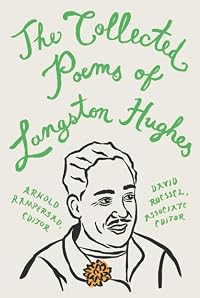
The Collected Poems of Langston Hughes (Vintage Classics)
by Langston Hughes 
On This Page
Description
"The ultimate book for both the dabbler and serious scholar. -- [Hughes] is sumptuous and sharp, playful and sparse, grounded in an earthy music -- This book is a glorious revelation." -- Boston Globe Spanning five decades and comprising 868 poems (nearly 300 of which have never before appeared in book form), this magnificent volume is the definitive sampling of a writer who has been called the poet laureate of African America--and perhaps our greatest popular poet since Walt Whitman. Here, show more for the first time, are all the poems that Langston Hughes published during his lifetime, arranged in the general order in which he wrote them and annotated by Arnold Rampersad and David Roessel. Alongside such famous works as "The Negro Speaks of Rivers" and Montage of a Dream Deferred, The Collected Poems includes the author's lesser-known verse for children; topical poems distributed through the Associated Negro Press; and poems such as "Goodbye Christ" that were once suppressed. Lyrical and pungent, passionate and polemical, the result is a treasure of a book, the essential collection of a poet whose words have entered our common language. show lessTags
Recommendations




Member Reviews
The Collected Poems of Langston Hughes edited by Arnold Rampersad, Editor, and David Roessel, Associate Editor covers the poetry Langston Hughes wrote during his life. Hughes tackled myriad issues throughout his lifetime without apology. His language, though lyrical, is also often blunt and leaves little to interpretation though it invokes intense imagery at times. I felt a wide range of emotions as I read The Collected Poems of Langston Hughes. The poems depicted a life I'll never life while offering insight into the reality of others in a way that forced me to think about my own existence in the world and how I interact with those around me. Authenticity rings through Hughes's work even when he paints moments that feel a bit show more fantastical. I took my time reading these poems because many are intense and require thought while others are lighthearted observations on life. I was, at times, surprised at how much punch some of Hughes's shorter works contained. The Collected Poems of Langston Hughes reminded me how important poetry is to the narrative of our lives and history being made around us even in the moments that seem the most ordinary to us. show less
"Let us take a knife / and cut the world in two- / and see what worms / are eating at the rind"
There are many reasons that Langston Hughes is one of the finest writers in American history. He is an exemplar of power and even nuance within simplicity. He was criticized for writing "easy" poems simply because he didn't sound like the other highly educated (primarily white) poets of his time. To this today he is criticized for that, and called a communist radical for being an anti-capitalist in the early 1900s.
Don't listen to the critics. And don't coast off of Hughes's reputation: perhaps you've heard of his Dream Deferred poem, but that's not enough. Truly dig into his writing, and you will find an incredible collection of musings on the show more American experience of oppression, imbued with bitter patriotism and pained love for community. Hughes is a titan, who dominated his era and stands as possibly the greatest artist of the Harlem Renaissance era (which is saying something, given how much great art we got from that period).
One of the most fundamental struggles of analyzing American history is defining what America is. Is it the system that marginalized and killed so many? Or is it the masses of people who were marginalized and killed by it, fighting for something better? In other words, is America the institution of slavery, or is it the slaves themselves, who fought to be part of American society? Langston Hughes would tell you the latter, as he fought for black writers to be accepted into the literary canon. He succeeded. Langston Hughes is one of the peaks of American literature, and should be treated as such.
This collection is a goliath, there is no reason to read it cover to cover. But if you enjoy reading, pick it up, and every once and a while read through a few pages. There's enough genius here to last a lifetime. show less
There are many reasons that Langston Hughes is one of the finest writers in American history. He is an exemplar of power and even nuance within simplicity. He was criticized for writing "easy" poems simply because he didn't sound like the other highly educated (primarily white) poets of his time. To this today he is criticized for that, and called a communist radical for being an anti-capitalist in the early 1900s.
Don't listen to the critics. And don't coast off of Hughes's reputation: perhaps you've heard of his Dream Deferred poem, but that's not enough. Truly dig into his writing, and you will find an incredible collection of musings on the show more American experience of oppression, imbued with bitter patriotism and pained love for community. Hughes is a titan, who dominated his era and stands as possibly the greatest artist of the Harlem Renaissance era (which is saying something, given how much great art we got from that period).
One of the most fundamental struggles of analyzing American history is defining what America is. Is it the system that marginalized and killed so many? Or is it the masses of people who were marginalized and killed by it, fighting for something better? In other words, is America the institution of slavery, or is it the slaves themselves, who fought to be part of American society? Langston Hughes would tell you the latter, as he fought for black writers to be accepted into the literary canon. He succeeded. Langston Hughes is one of the peaks of American literature, and should be treated as such.
This collection is a goliath, there is no reason to read it cover to cover. But if you enjoy reading, pick it up, and every once and a while read through a few pages. There's enough genius here to last a lifetime. show less
Very good collection, showing his poems through changing times. I especially liked the "Poetry for Children" in Appendix 2. His range was wide and there were no typical poems, but I selected this short one as an example:
Poem to Uncle Sam
Uncle Sam
With old Jim Crow --
Like a shadow
Right behind you --
Everywhere
You go.
Uncle Sam,
Why don't you
Turn around,
And before you
Tackle Hitler --
Shoot Jim down?
Poem to Uncle Sam
Uncle Sam
With old Jim Crow --
Like a shadow
Right behind you --
Everywhere
You go.
Uncle Sam,
Why don't you
Turn around,
And before you
Tackle Hitler --
Shoot Jim down?
I'd like to focus primarily on the symbolism of the church door in Hughes' "On the Road", which carries several implications. The door is all that is keeping Sargeant from a warm, dry place to sleep and thus from happiness, albeit only the temporary kind. The door acts in the same way as society has acted towards him, preventing him access in an unsympathetic, unyielding way. From this perspective, when Sargeant tears down the door, it could be interpreted as removing the impediment to the happiness which society strived to keep from him. From another point of view, tearing down the church door could be interpreted as breaking down the barrier between Christ and his people, Sargeant in particular. From this view, Hughes seems to be show more saying that the wealthy white people had locked Christ away for themselves did not allow other people access, and that by breaking down the door, Sargeant was freeing Christ and allowing him to help his people. Furthermore, this interpretation suggests that Christ’s true people are the ones who have been denied his presence by the oppressive upper classes, an idea that is solidified by Christ’s intention of continuing on to Kansas City, which harbored many transients during the Depression. Both of these interpretations involve metaphors regarding the barriers placed around black people and minorities at this time in history, preventing them from things like education, religion, and prosperity, allowing the reader insight into Hughes’ perspective of society at the time in the story. show less
Simply amazing. The poet grows before your eyes. From simple poems to lynchings, to communism, to the realization that democracy and Jim Crow should not have anything in common. A powerful and moving voice.
This is probably my favorite collected collection of poetry. As a whole, Hughes' work is more worthwhile and musical than any other poet I can think of, and is capable of working on the most inexperienced reader of poetry just as much as the more experienced reader. I believe anyone can find something they'll love in this book, and will have to be touched by his words and thoughts, as well as the jazz that floats throughout the whole collection. Absolutely worthwhile to add to any collection.
This collection and Langston Hughes took me out of my comfort zone, as far as American Poets. I am grateful it was required reading for my literature class. His mesmerizing words gave me insight into a world other than my own.
Members
- Recently Added By
Lists

42 Books Every Clevelander Should Read
42 works; 3 members

Well-Educated Mind
150 works; 3 members

The Well-Educated Mind, Susan Wise Bauer, 2016
179 works; 3 members
Books in Riverdale
123 works; 3 members
Author Information

253+ Works 14,604 Members
Langston Hughes, February 1, 1902 - May 22, 1967 Langston Hughes, one of the foremost black writers to emerge from the Harlem Renaissance, was born on February 1, 1902, in Joplin, Mo. Hughes briefly attended Columbia University before working numerous jobs including busboy, cook, and steward. While working as a busboy, he showed his poems to show more American poet Vachel Lindsay, who helped launch his career. He soon obtained a scholarship to Lincoln University and had several works published. Hughes is noted for his depictions of the black experience. In addition to the black dialect, he incorporated the rhythms of jazz and the blues into his poetry. While many recognized his talent, many blacks disapproved of his unflattering portrayal of black life. His numerous published volumes include, "The Weary Blues," "Fine Clothes to the Jew," and "Montage of a Dream Deferred." Hughes earned several awards during his lifetime including: a Guggenheim fellowship, an American Academy of Arts and Letters Grant, and a Spingarn Medal from the NAACP. Langston Hughes died of heart failure on May 22, 1967. (Bowker Author Biography) show less
Langston Hughes has a Legacy Library. Legacy libraries are the personal libraries of famous readers, entered by LibraryThing members from the Legacy Libraries group.
All Editions
Some Editions
Awards and Honors
Awards
Notable Lists
Series
Belongs to Publisher Series
Common Knowledge
- Original publication date
- 1994
- People/Characters
- Langston Hughes
- Important events
- Harlem Renaissance
- Original language
- English
Classifications
Statistics
- Members
- 1,646
- Popularity
- 13,633
- Reviews
- 17
- Rating
- (4.36)
- Languages
- English, French
- Media
- Paper, Ebook
- ISBNs
- 4
- ASINs
- 5