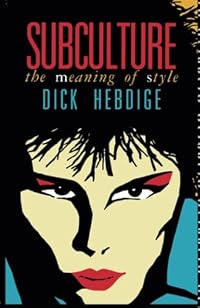
Subculture: The Meaning of Style
by Dick Hebdige, Olaph-Dante Marx
On This Page
Description
'Hebdige's Subculture: The Meaning of Style is so important: complex and remarkably lucid, it's the first book dealing with punk to offer intellectual content. Hebdige [...] is concerned with the UK's postwar, music-centred, white working-class subcultures, from teddy boys to mods and rockers to skinheads and punks.' - Rolling Stone With enviable precision and wit Hebdige has addressed himself to a complex topic - the meanings behind the fashionable exteriors of working-class youth show more subcultures - approaching them with a sophisticated theoretical apparatus that combine show lessTags
Recommendations






































Member Reviews
Hebdige's thesis in this text that subcultures form out of different and often oppositional reactions to the hegemonic social structure (as informed by any number of socio-political variables). As the reaction materializes into a subculture it represents danger that the hegemonic structure seeks to make "normal" in response.
this text for good reason is looked upon as must read in terms of studying culture. It certainly hold but most writers on subcultures reference Hebdige's work making it worth a least perusing. What I found most interesting was Hebdige's explanation of cultural diffusion (or perhaps more accurately cultural appropriation) of black subcultural styles in order to add weight and legitimacy to subcultures generally show more thought of as white (e.g. Rastas & Rude Boys influence on Punk and its children). In a time where there's a lot of discussion about cultural appropriation and the framework with which to point it out is still on somebodies anvil somewhere (as far as I am aware) this is worth sinking your teeth into. show less
this text for good reason is looked upon as must read in terms of studying culture. It certainly hold but most writers on subcultures reference Hebdige's work making it worth a least perusing. What I found most interesting was Hebdige's explanation of cultural diffusion (or perhaps more accurately cultural appropriation) of black subcultural styles in order to add weight and legitimacy to subcultures generally show more thought of as white (e.g. Rastas & Rude Boys influence on Punk and its children). In a time where there's a lot of discussion about cultural appropriation and the framework with which to point it out is still on somebodies anvil somewhere (as far as I am aware) this is worth sinking your teeth into. show less
Hebdige's text, my own personal introduction into cultural studies, was something of an enigma to me because my initial thought, and the one that sustained itself throughout my reading (up until the penultimate page), was, "Why write a book on punk?" Because, I answered to myself, once you define what punk is and explain how to be punk, doesn't punk self-destruct?
The answer, as it turns out, is yes, but the way in which Hebdige explores the artificiality of punk and the manner in which it has become an empty amalgamation of many different, more meaningful subcultures, offers an interesting take on WHY that emptiness exists.
To that end, though this text really applies only to its cultural moment (late 1970s England), it has a certain show more amount of relevance to the American punk scene as it has survived today.
A concise, clear, and surprisingly complex study, well worth the brief amount of time it will take to read. show less
The answer, as it turns out, is yes, but the way in which Hebdige explores the artificiality of punk and the manner in which it has become an empty amalgamation of many different, more meaningful subcultures, offers an interesting take on WHY that emptiness exists.
To that end, though this text really applies only to its cultural moment (late 1970s England), it has a certain show more amount of relevance to the American punk scene as it has survived today.
A concise, clear, and surprisingly complex study, well worth the brief amount of time it will take to read. show less
Hebdidge wrote this while the events, trends and practices he describes were all pretty recent and he tries very hard to imbue the punk and post-punk world with a social and political relevance that I'm afraid it just didn't have. Not that what Hebdidge talks about meant nothing, just it didn't really carry the deep, mainly political, significance he'd have liked it to. Style has a meaning, but we always knew it did--we just thought it was ephemeral meaning. Hebdidge doesn't manage to disabuse us of this notion.
Like Owen Coggins, author of Mysticism, Ritual and Religion in Drone Metal says, pioneering, but ends up focusing more on fashion than music.
Seminal and Invigorating!
sociology
Ratings
Members
- Recently Added By
Lists

culture
320 works; 1 member
Author Information

12+ Works 894 Members
1 Work 731 Members
Series
Belongs to Publisher Series
Common Knowledge
- Canonical title
- Subculture: The Meaning of Style
- Original publication date
- 1979 (New Ed.) (New Ed.)
Classifications
- Genres
- Nonfiction, Anthropology, Sociology, General Nonfiction, Music
- DDC/MDS
- 306.1 — Society, government, & culture Social sciences, sociology & anthropology Social Behavior - Dating, Marriage, Divorce Subcultures
- LCC
- HQ799 .G7 .H4 — Social sciences The family. Marriage, Women and Sexuality The Family. Marriage. Women The family. Marriage. Home Adulthood
- BISAC
Statistics
- Members
- 732
- Popularity
- 38,452
- Reviews
- 6
- Rating
- (3.79)
- Languages
- 8 — Chinese, English, French, German, Greek, Italian, Spanish, Turkish
- Media
- Paper, Audiobook, Ebook
- ISBNs
- 22
- ASINs
- 6