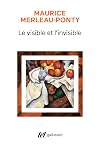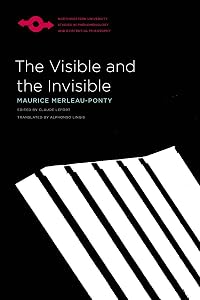
The Visible and the Invisible
by Maurice Merleau-Ponty
On This Page
Description
The Visible and the Invisible contains the unfinished manuscript and working notes of the book Merleau-Ponty was writing when he died. The text is devoted to a critical examination of Kantian, Husserlian, Bergsonian, and Sartrean method, followed by the extraordinary "The Intertwining--The Chiasm," that reveals the central pattern of Merleau-Ponty's own thought. The working notes for the book provide the reader with a truly exciting insight into the mind of the philosopher at work as he show more refines and develops new pivotal concepts. show lessTags
Recommendations














Member Reviews
german idealism but if it was incredibly boring
Merleau-Ponty, Maurice
> Maurice Merleau-Ponty, Le visible et l'invisible, Gallimard, 1964, 360
Se reporter au compte rendu de F. KAPLAN
In: Revue Philosophique de la France et de l'Étranger, T. 161 (1971), pp. 497-504… ; (en ligne),
URL : https://drive.google.com/file/d/14vUwiohHWOh3w737RvdpWiXY-uKb2iR0/view?usp=shari...
> Maurice Merleau-Ponty, Le Visible et l'invisible, suivi de Notes de travail. Texte établi par Claude Lefort, accompagné d’un avertissement et d’une postface, i vol. de 14 X 22,5 cm, 360 p., Paris, Gallimard, 1964. Prix : 18 F.
Se reporter au compte rendu de Claude LEFORT
In: Les Études philosophiques, Nouvelle Série, 19e Année, No. 3, PERSPECTIVES SUR LA PHILOSOPHIE NORD-AMÉRICAINE-II (JUILLET-SEPTEMBRE 1964), p. 469… ; (en show more ligne),
URL : https://drive.google.com/file/d/1G7GGN6BJSn2btJj_vANsbjvZSqeQGy6m/view?usp=shari... show less
Se reporter au compte rendu de F. KAPLAN
In: Revue Philosophique de la France et de l'Étranger, T. 161 (1971), pp. 497-504… ; (en ligne),
URL : https://drive.google.com/file/d/14vUwiohHWOh3w737RvdpWiXY-uKb2iR0/view?usp=shari...
> Maurice Merleau-Ponty, Le Visible et l'invisible, suivi de Notes de travail. Texte établi par Claude Lefort, accompagné d’un avertissement et d’une postface, i vol. de 14 X 22,5 cm, 360 p., Paris, Gallimard, 1964. Prix : 18 F.
Se reporter au compte rendu de Claude LEFORT
In: Les Études philosophiques, Nouvelle Série, 19e Année, No. 3, PERSPECTIVES SUR LA PHILOSOPHIE NORD-AMÉRICAINE-II (JUILLET-SEPTEMBRE 1964), p. 469… ; (en show more ligne),
URL : https://drive.google.com/file/d/1G7GGN6BJSn2btJj_vANsbjvZSqeQGy6m/view?usp=shari... show less
Dec 3, 2020French
Cajas
Apr 16, 2020Spanish
Ratings
Members
- Recently Added By
Author Information

91+ Works 4,980 Members
Appointed Professor at the College de France in 1952, Maurice Merleau-Ponty was a highly esteemed professional philosopher because of his technical works in phenomenology and psychology. He was also an activist commentator on the significant cultural and political events of his time, as well as a collaborator with Jean-Paul Sartre and Simone de show more Beauvoir in the founding and editing of Les Temps Modernes in Paris immediately after World War II. Besides being influenced by Edmund Husserl and Martin Heidegger, Merleau-Ponty assimilated the contributions of experimental philosophy and Gestalt psychology to focus on perception and behavior. His work "The Structure of Behavior," although centering on the body, presented an interpretation of the distinctions among the mental, the vital (biological), and the physical that ruled out the reductionist inclinations of behaviorism. With the appearance of his work on the phenomenology of perception in 1945, his position as a philosopher ranking beside Heidegger and Sartre was established. He unveiled a theory of human subjectivity similar to theirs but with greater technical precision. From the standpoint of an existentialist thinker whose conception of subjectivity stressed the primacy of freedom, he examined Marxism and the political factions and movements fostered in the name of Karl Marx. The resulting studies, always insightful and provocative, satisfied neither the right nor the left. In the foreword to the English translation of Merleau-Ponty's inaugural lecture at the College de France, In Praise of Philosophy, John Wild and James Edie praised him for having made "important contributions to the phenomenological investigation of human existence in the life-world and its distinctive structures. He was a revolutionary, and his philosophy, even more than that of his French contemporaries, was a philosophy of the evolving, becoming historical present." Merleau-Ponty views man as an essentially historical being and history as the dialectic of meaning and non-meaning which is working itself out through the complex, unpredictable interaction of men and the world. Nothing historical ever has just one meaning; meaning is ambiguous and is seen from an infinity of viewpoints. He has been called a philosopher of ambiguity, of contradiction, of dialectic. His search is the search for "meaning."' show less
Awards and Honors
Notable Lists
Series
Belongs to Publisher Series
Common Knowledge
- Canonical title
- The Visible and the Invisible
- Original publication date
- 1964
Classifications
Statistics
- Members
- 442
- Popularity
- 69,326
- Reviews
- 5
- Rating
- (4.00)
- Languages
- 11 — Czech, English, Estonian, French, German, Hungarian, Italian, Polish, Portuguese, Serbian, Spanish
- Media
- Paper, Ebook
- ISBNs
- 17
- ASINs
- 4