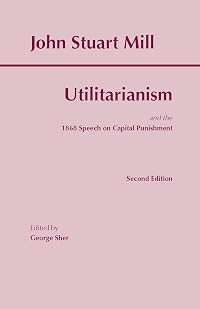
Utilitarianism
by John Stuart Mill
On This Page
Description
Utilitarianism is philosopher John Stuart Mill's defense and advocacy of utilitarian ethics. First appearing in three magazine articles, this essay was first gathered into a single book in 1863. While Mill discusses utilitarian ethical principles in some of his other writings such as On Liberty and The Subjection of Women, Utilitarianism is Mill's only major discussion of the theory's fundamental grounds..
Tags
Recommendations













Member Reviews
Mill's inspired attempt to rescue, revive, & update Bentham's raw Enlightenment utilitarianism. As fundamental to modern ethics as his On Liberty is to modern political thought, Utilitarianism surely is the more controversial & flawed text. Notably, Mill's attempt to found "higher" vs "lower" forms of pleasure philosophically, essential to his entire project, is not just unconvincing; its thinness seems conspicuously at odds with the robustness built into so much of his other work.
I didn't expect to like this very much. To my surprise, following on from Bentham's An Introduction to the Principles of Morals and Legislation, I am liking Victorian philosophy. And while I admired Bentham's work, I loved Mill's. Is the Victorian period the last point where philosophers write things they expect laymen to read and enjoy reading? I don't know enough to answer that question, actually, but Mill certainly writes in such a way. I found myself fairly well-convinced by utilitarianism as an ethical and moral approach.
Much of Utilitarianism is an attempt to justify and execute a "scientific" approach to morals. From reading A System of Logic later, I would learn that this is about induction and deduction for Mill, but though he show more mentions them here, I don't think they're a key part of his argument. Rather, he clarifies what utilitarianism actually is, and attempt to reclaim it against charges of being centered on immediate physical pleasures, proposing that the quality of pleasure is more important to the greatest-happiness principle than the quantity. I don't know how true it is, but I want it to be true, and I think that this observation is even more true now than in 1863: "In a world in which there is so much to interest, so much to enjoy, and so much also to correct and improve, every one who has this moderate amount of moral and intellectual requisites is capable of an existence which may be called enviable..."
Of course the supposed danger of "rational" systems of morality is coldness, as Mill points out: "It is often affirmed that utilitarianism renders men cold and unsympathizing; that it chills their moral feelings towards individuals; that it makes them regard only the dry and hard consideration of the consequences of actions, not taking into their moral estimate the qualities from which those actions emanate." But as always, he's got a comeback at the ready: "this is a complaint not against utilitarianism, but against having any standard of morality at all"! And when you might complain that he's breaking happiness down into a bunch of smaller things that aren't happiness (the Victorians were really into the idea that science was about breaking things into smaller things), he shoots back, "Happiness is not an abstract idea, but a concrete whole." Oh yeah, I guess it is. Let's all try to increase everyone's happiness!
What's less convincing is the last chapter, which is almost 40% of the book. Mill works really hard to show that utilitarianism doesn't have to be unjust, and though I want him to be right, I'm not sure that he's right for these reasons. show less
Much of Utilitarianism is an attempt to justify and execute a "scientific" approach to morals. From reading A System of Logic later, I would learn that this is about induction and deduction for Mill, but though he show more mentions them here, I don't think they're a key part of his argument. Rather, he clarifies what utilitarianism actually is, and attempt to reclaim it against charges of being centered on immediate physical pleasures, proposing that the quality of pleasure is more important to the greatest-happiness principle than the quantity. I don't know how true it is, but I want it to be true, and I think that this observation is even more true now than in 1863: "In a world in which there is so much to interest, so much to enjoy, and so much also to correct and improve, every one who has this moderate amount of moral and intellectual requisites is capable of an existence which may be called enviable..."
Of course the supposed danger of "rational" systems of morality is coldness, as Mill points out: "It is often affirmed that utilitarianism renders men cold and unsympathizing; that it chills their moral feelings towards individuals; that it makes them regard only the dry and hard consideration of the consequences of actions, not taking into their moral estimate the qualities from which those actions emanate." But as always, he's got a comeback at the ready: "this is a complaint not against utilitarianism, but against having any standard of morality at all"! And when you might complain that he's breaking happiness down into a bunch of smaller things that aren't happiness (the Victorians were really into the idea that science was about breaking things into smaller things), he shoots back, "Happiness is not an abstract idea, but a concrete whole." Oh yeah, I guess it is. Let's all try to increase everyone's happiness!
What's less convincing is the last chapter, which is almost 40% of the book. Mill works really hard to show that utilitarianism doesn't have to be unjust, and though I want him to be right, I'm not sure that he's right for these reasons. show less
Okay, so in one way Utilitarianism is the manifesto, the ludicrous 19th-century positivist lego castle where Mill tries - as-fucking-if - to construct his expediency argument from first principles, and On Liberty is where he gets real with you, like "but of course in the actual non-theoretical world it's more like-a this. Minority rights."
But on the other hand, there's this: "The truths which are ultimately accepted as the first principles of a science, are really the last results of metaphysical analysis, practised on the elementary notions with which the science is conversant; and their relation to the science is not that of foundations to an edifice, but of roots to a tree, which may perform their office equally well though they be show more never dug down to and exposed to light."
Oooooooooh. What an amazingly utilitarian approach to theory and the foundations of knowledge in your utilitarianism book, John. This essay puts its own discomfort with isms aside in the name of a systematic sanity that's probably the only kind that had a chance of going over with Mill's Victorian peers. It sure as shit isn't the last word in morals that it postures at being, but hey, man: Do something that leads to an increase of pleasure and a decrease of pain in your world today. You won't be sorry. Hug a seal. show less
But on the other hand, there's this: "The truths which are ultimately accepted as the first principles of a science, are really the last results of metaphysical analysis, practised on the elementary notions with which the science is conversant; and their relation to the science is not that of foundations to an edifice, but of roots to a tree, which may perform their office equally well though they be show more never dug down to and exposed to light."
Oooooooooh. What an amazingly utilitarian approach to theory and the foundations of knowledge in your utilitarianism book, John. This essay puts its own discomfort with isms aside in the name of a systematic sanity that's probably the only kind that had a chance of going over with Mill's Victorian peers. It sure as shit isn't the last word in morals that it postures at being, but hey, man: Do something that leads to an increase of pleasure and a decrease of pain in your world today. You won't be sorry. Hug a seal. show less
The trouble with Mill is that you if read a few of his then-contemporary critics, and then you think you have his measure with all your modern day access to knowledge, but all along he was throwing "mind grenades" set on "delay" and they sit in your head while you go on thinking you are rather smart. So Mill mentions the Stoics and how virtue is only a means to happiness and that there are other things, too. He mentions the Sophists and how Socrates (allegedly) challenged their ancient equivalent of what is happening in higher education today. But in mentioning the development of utilitarianism from Epicurus to Bentham (and unfortunately I have not read Bentham cover-to-cover as I will do in the future), so just when I think to myself: show more "Mill, you really are 'drawing a long bow here' [a favourite saying of one of my favourite professors]", the mind grenade goes off and my hubris is dashed and I am glad I didn't say it out loud but there you have it - it was certainly there. There is no mention of Aristotle and the "golden mean" and how achieving a mean across the spectrum of virtues achieves happiness, but, as Mill says, there are many things that amount to happiness in addition to leading a virtuous life, so bringing up Aristotle doesn't make a good deal of sense. One interesting aspect of the essay is the long note in the last few pages where Mill extends a good deal of courtesy to Herbert Spencer, someone I have read more about in Jack London's Martin Eden than I ever did in all the other secondary sources I have read put together. While Mill does not quite agree with Spencer, Spencer claims (according to Mill) that he was never against the doctrine of utilitarianism. So the Greatest Happiness Principle it is but if we do not also take into account Mill's ideas of liberty (in On Liberty), then the present-day situation where we are told what to like and what will make us happy and many of us go along with that and eat our smashed avocado, living in our high density housing, and paying for cups of coffee that we could make at home for a fraction of the price, which are not only much better, but we could also be happier because we were actually doing something for ourselves, while, as Tolstoy or even my mother would say, "in reality", we are succumbing to the biggest scam ever and then wondering why we are not happy at all. And J.S. Mill says all this in just under 122 pages of thick paper dating from 1895, which is nice, but with each cover-to-cover completion of classic works I edge ever-closer to the abyss of what I don't know and it scares me. show less
Very clear; topical in light of the EA movement; insightful into the nuances of utilitarianism. Fails to provide a convincing argument of happiness being the "first principle", but presents a sort of genealogy of justice (in the way Nietzsche wrote the Genealogy of Morals).
Dense at some points, but an interesting read that's a perfect primer on the foundations of utilitarianism. If you're at all interested in the topics considered, particularly intersections of ideas of justice with utilitarian principles, I recommend this. Mill also gives an interesting look at perceptions and basis of the idea of "justice" that might be of interest to readers who aren't directly interested the utilitarian philosophy.
Not my favorite of Mill's writings, but this one is definitely a bit more complex than the excerpts in textbooks would suggest. It is not a long read, and if not entertaining, it is at least well enough written to be readable without too much tedium. Mill does tend to repeat himself a lot, as do a lot of authors from his time, but it is interesting to see what ideas he promotes besides the notion of utilitarianism in this document.
Members
- Recently Added By
Lists

Filosofía - Clásicos
217 works; 1 member

Great Books Favorites
71 works; 6 members

Generation Joshua
115 works; 3 members

Books Read in 2017
4,249 works; 130 members

10 Books that Screwed Up the World (And 5 Others that Didn't Help)
15 works; 1 member

Literary Works Read in College
316 works; 15 members

How to Read a Book's Recommended Reading List
309 works; 10 members

Greatest Books, allegedly
484 works; 9 members

Philosophy, Politics and Economics
61 works; 1 member

Philip Ward's Lifetime Reading Plan
592 works; 22 members

Philosophy
23 works; 1 member

In Our Time books
4,934 works; 2 members
Author Information

298+ Works 19,780 Members
John Stuart Mill, Classical economist, was born in 1806. His father was the Ricardian economist, James Mill. John Stuart Mill's writings on economics and philosophy were prodigious. His "Principles of Political Economy, With Some of Their Applications to Social Philosophy," published in 1848, was the leading economics textbook of the show more English-speaking world during the second half of the 19th century. Some of Mill's other works include "Considerations on Representative Government," "Auguste Comte and Positivism," "The Subjection of Women," and "Three Essays on Religion." John Mill died in 1873. (Bowker Author Biography) show less
Awards and Honors
Notable Lists
Series
Belongs to Publisher Series
Work Relationships
Is contained in
Is abridged in
Has as a commentary on the text
Common Knowledge
- Canonical title
- Utilitarianism
- Original title
- Utilitarianism
- Original publication date
- 1863
- First words
- There are few circumstances among those which make up the present condition of human knowledge more unlike what might have been expected, or more significant of the backward state in which speculation on the most important su... (show all)bjects still lingers, than the little progress which has been made in the decision of the controversy respecting the criterion of right and wrong.
- Blurbers
- Sher, George
Classifications
Statistics
- Members
- 2,935
- Popularity
- 6,143
- Reviews
- 17
- Rating
- (3.40)
- Languages
- 18 — Catalan, Chinese, Czech, Danish, Dutch, English, Finnish, French, German, Greek, Hebrew, Italian, Lithuanian, Romanian, Spanish, Swedish, Turkish, Portuguese (Portugal)
- Media
- Paper, Audiobook, Ebook
- ISBNs
- 135
- UPCs
- 1
- ASINs
- 31