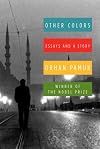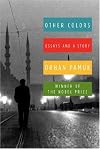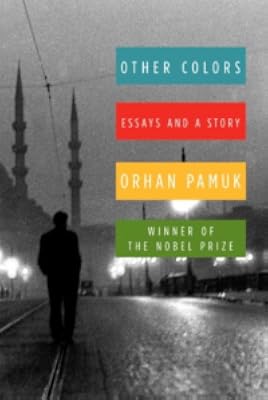
Other Colors: Essays and a Story
by Orhan Pamuk
On This Page
Description
"Orhan Pamuk's first book since winning the Nobel Prize, Other Colors is a collection of essays on his life, his city, his work, and the example of other writers."--Jacket.Tags
Recommendations


Member Reviews
I am truly touched with his sensitive and thoughtful views of the small things around him. I particularly liked his essay on happiness and how he related happiness to his daughter and their trip to the beach listing out the 'routine' of this trip in point form. Pamuk believes in the lonely writer, the writer who must lock himself away to practice his craft. While locked in his writing prison he wanders to the window and looks at a seagull perched on the roof. Out of this simple gesture comes two essays about seagulls; one about life and birth, the other about death. Still reading through this one. Taking my time with it. I'm in love with his writing. Engaging stuff. I'll read a couple of his essays and they'll stew in my head for days. show more I like it when that happens.
I started this book near the end of 2007 and just finished. Not because it was slow reading, I just didn’t want to end it. Reading this book was like sitting in a teahouse with Mr Pamuk, listening to him tell stories. It is a book of essays, his thoughts on family, country, writing, reading, painting, and all of the small details around him. After reading this book, Orhan seems like an old friend. To quote from his Nobel Prize acceptance speech, “I am most surprised by those moments when I have felt as if the sentences, dreams, and pages that have made me so ecstatically happy have not come from my own imagination - that another power has found them and generously presented them to me.”
This book made me happy. It numerous times brought me to the brink of tears, joyful tears. The stories about his daughter and father will be with me a long time; so will this book. It is one that will stay on my bedside table. show less
I started this book near the end of 2007 and just finished. Not because it was slow reading, I just didn’t want to end it. Reading this book was like sitting in a teahouse with Mr Pamuk, listening to him tell stories. It is a book of essays, his thoughts on family, country, writing, reading, painting, and all of the small details around him. After reading this book, Orhan seems like an old friend. To quote from his Nobel Prize acceptance speech, “I am most surprised by those moments when I have felt as if the sentences, dreams, and pages that have made me so ecstatically happy have not come from my own imagination - that another power has found them and generously presented them to me.”
This book made me happy. It numerous times brought me to the brink of tears, joyful tears. The stories about his daughter and father will be with me a long time; so will this book. It is one that will stay on my bedside table. show less
Pamuk has inspiring observations about other writers. His short story is autobiographical and presented from both a naive and scheming viewpoint. His repeated considerations of why he writes do wear thin, but each one has a small, creatively inspirational gem within.
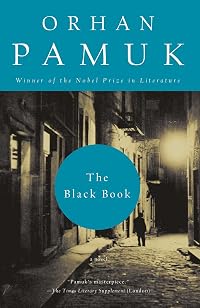
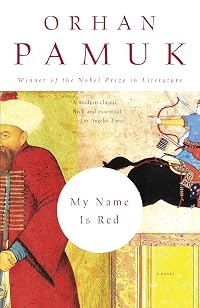
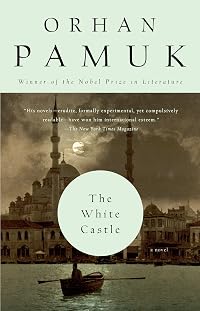
This book by Orhan Pamuk was published after he won the Nobel Prize in Literature in 2006. The title is a reference to the titles of his other books, most of which contain a color in their names. For example, The White Castle, The Black Book, and My Name is Red. Pamuk says Other Colors is a compilation of essays organized in such a way that they mimic the narrative flow of a novel. He includes essays on his love of books, his favorite authors such as Dostoyevsky, Turkish politics, and his relationship with his father.
While this book is one of the less satisfying of the many published by Pamuk, it reveals many sides of him as a writer. He says he always wanted to be a novelist, and so he has made himself famous through his novels. As a show more collection of short essays, this book reveals why he has not earned much success as an essayist. Many of these pieces are clearly writing exercises or thought pieces that Pamuk perhaps uses as warm ups to his novel writing. They provide brief and not very deep or powerful reflections on a variety of topics of interest to Pamuk. Most of these essays are forgetable.
Still, we learn much about Pamuk and we see some of his true gifts as a writer come through. He has an uncanny ability to be intimate and tender with his reader. He says he locks himself in a room ten hours a day every day. It is a lonely life, one that he questions regularly in these essays. But it is one that creates a stillness necessary for a writer to communicate one-on-one with his or her reader.
Pamuk was twenty-three when he abandoned a potential career as an architect and decided to become a novelist. It wasn't until he was about 27 that he wrote his first novel, Cevdet Bey and Sons, which is not yet translated into English. His next book, The White Castle, was published when he was thirty. This second book launched his writing career. It is sobering to learn how much time it took for Pamuk to achieve the fame he needed to convince others he could be a writer. Thirty years later, he became the second youngest person to receive the Nobel Prize for Literature. show less
While this book is one of the less satisfying of the many published by Pamuk, it reveals many sides of him as a writer. He says he always wanted to be a novelist, and so he has made himself famous through his novels. As a show more collection of short essays, this book reveals why he has not earned much success as an essayist. Many of these pieces are clearly writing exercises or thought pieces that Pamuk perhaps uses as warm ups to his novel writing. They provide brief and not very deep or powerful reflections on a variety of topics of interest to Pamuk. Most of these essays are forgetable.
Still, we learn much about Pamuk and we see some of his true gifts as a writer come through. He has an uncanny ability to be intimate and tender with his reader. He says he locks himself in a room ten hours a day every day. It is a lonely life, one that he questions regularly in these essays. But it is one that creates a stillness necessary for a writer to communicate one-on-one with his or her reader.
Pamuk was twenty-three when he abandoned a potential career as an architect and decided to become a novelist. It wasn't until he was about 27 that he wrote his first novel, Cevdet Bey and Sons, which is not yet translated into English. His next book, The White Castle, was published when he was thirty. This second book launched his writing career. It is sobering to learn how much time it took for Pamuk to achieve the fame he needed to convince others he could be a writer. Thirty years later, he became the second youngest person to receive the Nobel Prize for Literature. show less
Bab terakhir merupakan klimaks kepada buku ini. Teks ucapan Orhan Pamuk semasa menerima Hadiah Nobel. Esei bertajuk My Father's Suitcase ini sudah cukup untuk saya anjakkan rating saya dart 4 bintang ke 5 bintang.
Mr Pamuk; dalam dunia kata, nyata kamu adalah salah seorang pemegang tongkat kekuasaannya.
Short stories of the (at the time) young Turkish best selling author
started but need to restart
Members
- Recently Added By
Lists

Art of Reading
188 works; 5 members
Author Information

107+ Works 32,903 Members
Orhan Pamuk was born in Istanbul, Turkey on June 7, 1952. After graduating from Robert College in Istanbul, he studied architecture at the Istanbul Technical University. After three years, he decided to become a writer and graduated from the Institute of Journalism at the University of Istanbul in 1976. In 1982, he published his first novel Cevdet show more Bey and His Sons, which received both the Orhan Kemal and Milliyet literary prizes. His novel, My Name Is Red, won the French Prix Du Meilleur Livre Etranger, the 2002 Italian Grinzane Cavour, and the 2003 International IMPAC Dublin Literary Award. He has received numerous Turkish and international literary awards for his works including the 2006 Nobel Prize in Literature. His recent work includes A Strangeness in My Mind. (Bowker Author Biography) Orhan Pamuk is the author of six previous novels, including "The White Castle" & "The New Life". He lives in Istanbul with his family. (Publisher Provided) show less
Some Editions
Awards and Honors
Distinctions
Series
Belongs to Publisher Series
L'eclèctica (157)
Work Relationships
Contains
Has as a commentary on the text
Common Knowledge
- Canonical title*
- Muita värejä : kirjoituksia elämästä, taiteesta, kirjoista ja kaupungeista
- Original title
- Ötenki renkler
- Original publication date
- 1999
- First words*
- Scrivo da trent'anni ed è da molto tempo che ripeto questa frase.
- Last words*
- (Click to show. Warning: May contain spoilers.)Onorevoli membri dell'Accademia svedese che mi avete conferito questo prestigioso premio, questo onore, e gentili ospiti, avrei tanto voluto che mio padre oggi fosse qui con noi.
- Original language
- Turkish
*Some information comes from Common Knowledge in other languages. Click "Edit" for more information.
Classifications
- Genres
- Literature Studies and Criticism, Biography & Memoir, Fiction and Literature
- DDC/MDS
- 894.3533 — Literature & rhetoric Literatures of other languages Literatures of Altaic, Uralic, Hyperborean, Dravidian languages; literatures of miscellaneous languages of south Asia Turkic languages Turkish Turkish fiction 1850–2000
- LCC
- PL248 .P34 .O8413 — Language and Literature Languages and literatures of Eastern Asia, Africa, Oceania Languages of Eastern Asia, Africa, Oceania Turkic languages
- BISAC
Statistics
- Members
- 847
- Popularity
- 32,269
- Reviews
- 11
- Rating
- (3.88)
- Languages
- 17 — Bulgarian, Catalan, Czech, Danish, Dutch, English, Finnish, French, Greek, Italian, Norwegian (Bokmål), Polish, Portuguese, Russian, Spanish, Swedish, Turkish
- Media
- Paper, Audiobook, Ebook
- ISBNs
- 41
- ASINs
- 9