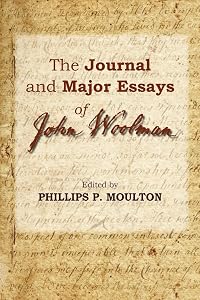
The Journal and Major Essays of John Woolman
by John Woolman, Phillips P. Moulton (Editor)
On This Page
Description
The secret of Woolman's purity of style is that his eye is single, and that conscience dictated his words. This Quaker preacher and tailor was a man of wisdom and true philosophy. These pages are, filled with insight and messages for our time. A major classic of American spirituality.Tags
Recommendations























Member Reviews
John Woolman was born in 1720 of Quaker parents in Burlington County, New Jersey. His call to preach the Quaker way happened when in his mid-twenties and journeyed extensively throughout the American colonies. His Journal—a recognised American classic-- portrays an ethical sensitivity comparable to that of St Francis or Albert Schweitzer, and his keen sense of social justice speaks directly to today’s affluent and increasingly divided mass society. His essays widely influenced social thought both in the United States and in England where he was much esteemed by figures such as the essayist Charles Lamb and Samuel Coleridge.
Woolman’s analyst of the roots of social evil carefully trace individual responsibility from motive to show more action and follow the ever-widening consequences of that action. In his essay ‘’ A Plea for the Poor’’ (published posthumously in 1774), he relates poverty to wasteful consumption, bringing the rich and powerful to account and calls for simplicity as a style of life. Published in 1754, his ‘essay ’Considerations on Keeping Negroes’’ published in 1754 and one of the earliest attacks on slavery, he confronts the corruption of the oppressors and the demoralization of the oppressed, and he even raises the question of reparations to the Blacks. This edition of the Journal includes Woolman’s discussion on tax refusal as a form of anti-war protest and civil disobedience. An edition of Woolman's Journal is also published by Pendle Hill (pamphlet 357). show less
Woolman’s analyst of the roots of social evil carefully trace individual responsibility from motive to show more action and follow the ever-widening consequences of that action. In his essay ‘’ A Plea for the Poor’’ (published posthumously in 1774), he relates poverty to wasteful consumption, bringing the rich and powerful to account and calls for simplicity as a style of life. Published in 1754, his ‘essay ’Considerations on Keeping Negroes’’ published in 1754 and one of the earliest attacks on slavery, he confronts the corruption of the oppressors and the demoralization of the oppressed, and he even raises the question of reparations to the Blacks. This edition of the Journal includes Woolman’s discussion on tax refusal as a form of anti-war protest and civil disobedience. An edition of Woolman's Journal is also published by Pendle Hill (pamphlet 357). show less
Edited by Phillips Moulton, John Woolman very carefully wrote and edited his own Journal. Moulton has updated spelling and added notes.
Central documents of Quaker spirituality. A major figure in the Quaker tradition, particularly with regard to the American issues of slavery and the poor. Woolman is often referred to colloquially as "a Quaker saint."
Ratings
Members
- Recently Added By
Author Information

19+ Works 2,187 Members
Some Editions
Series
Belongs to Publisher Series
Work Relationships
Classifications
- Genres
- Nonfiction, Religion & Spirituality, Biography & Memoir, History
- DDC/MDS
- 289.6 — Religion Christian denominations Other denominations and sects Quaker
- LCC
- BX7795 .W7 .A3 — Philosophy, Psychology and Religion Christian Denominations Christian Denominations Protestantism Other Protestant denominations Friends. Society of Friends. Quakers
- BISAC
Statistics
- Members
- 363
- Popularity
- 86,896
- Reviews
- 3
- Rating
- (4.59)
- Languages
- English
- Media
- Paper, Ebook
- ISBNs
- 3
- ASINs
- 6