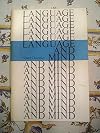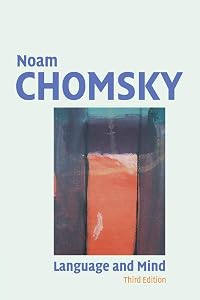
Language and Mind
by Noam Chomsky
On This Page
Description
This is the third edition of Chomsky's outstanding collection of essays on language and mind, first published in 2006. The first six chapters, originally published in the 1960s, made a groundbreaking contribution to linguistic theory. This edition complements them with an additional chapter and a new preface, bringing Chomsky's influential approach into the twenty-first century. Chapters 1-6 present Chomsky's early work on the nature and acquisition of language as a genetically endowed, show more biological system (Universal Grammar), through the rules and principles of which we acquire an internalized knowledge (I-language). Over the past fifty years, this framework has sparked an explosion of inquiry into a wide range of languages, and has yielded some major theoretical questions. The final chapter revisits the key issues, reviewing the 'biolinguistic' approach that has guided Chomsky's work from its origins to the present day, and raising some novel and exciting challenges for the study of language and mind. show lessTags
Recommendations






















Member Reviews
I am not generally sympathetic to Chomsky's view of language as an emergent property of the architecture of the mind (I think that is true but largely trivial at best and pernicious in terms of diverting attention from the social aspects at worst), but this series of lectures presents him in a flattering light. The first one, "Past," is about his view of the history of linguistics as largely a tug-of-war between rationalist and structuralist approaches that does not get into the excesses of misrepresentation of his fuller treatment in Cartesian Linguistics; the second, "Present," is a primer of various issues in generative syntax circa 1968 that you can absolutely skip, and the third, "Future," forecasts his move from a rule-based show more conception of language acquisition to an "abductive" one of principles and parameters, hypotheses and testing, to which I am relatively sympathetic (as I think are the facts)--certainly language is more a matter of childlike exploration (and collective evolution, the piece he disesteems) than emanation from the wetware (the classic nativist conception) or simple conditioning, per a naive empiricism. show less
I studied Linguistic and it was a must-read and I really loved it.
I need to buy it and reread it again.
I need to buy it and reread it again.
es un excelente autor americano actividad que elevó definitivamente a la categoría de ciencia moderna. contribuyo en el ambito de las ciencias cognitivas
Aug 24, 2007Spanish
Ratings
Members
- Recently Added By
Lists

Literary Works Read in College
316 works; 15 members

Books Read in 2011
684 works; 19 members

Best Sellers / Popular 1968
237 works; 5 members

Books in the Bibliography of The Mind in the Cave by David Lewis-Williams
257 works; 1 member
Author Information

584+ Works 47,593 Members
Noam Chomsky was born in Philadelphia, Pennsylvania on December 7, 1928. Son of a Russian emigrant who was a Hebrew scholar, Chomsky was exposed at a young age to the study of language and principles of grammar. During the 1940s, he began developing socialist political leanings through his encounters with the New York Jewish intellectual show more community. Chomsky received his Ph.D. from the University of Pennsylvania, where he studied linguistics, mathematics, and philosophy. He conducted much of his research at Harvard University. In 1955, he began teaching at MIT, eventually holding the Ferrari P. Ward Chair of Modern Language and Linguistics. Today Chomsky is highly regarded as both one of America's most prominent linguists and most notorious social critics and political activists. His academic reputation began with the publication of Syntactic Structures in 1957. Within a decade, he became known as an outspoken intellectual opponent of the Vietnam War. Chomsky has written many books on the links between language, human creativity, and intelligence, including Language and Mind (1967) and Knowledge of Language: Its Nature, Origin, and Use (1985). He also has written dozens of political analyses, including Manufacturing Consent: The Political Economy of the Mass Media (1988), Chronicles of Dissent (1992), and The Prosperous Few and the Restless Many (1993). (Bowker Author Biography) show less
Common Knowledge
- Canonical title
- Language and Mind
- Original title
- Language and Mind
- Original publication date
- 1968
Classifications
- Genres
- Nonfiction, Philosophy, General Nonfiction, Science & Nature
- DDC/MDS
- 401.9 — Language Language Philosophy and theory; international languages Psychological principles, language acquisition, speech perception
- LCC
- P106 .C52 — Language and Literature Philology. Linguistics Language. Linguistic theory. Comparative grammar
- BISAC
Statistics
- Members
- 570
- Popularity
- 51,941
- Reviews
- 4
- Rating
- (3.60)
- Languages
- 9 — Danish, Dutch, English, Esperanto, Italian, Portuguese, Serbian, Swedish, Turkish
- Media
- Paper, Ebook
- ISBNs
- 25
- UPCs
- 1
- ASINs
- 6