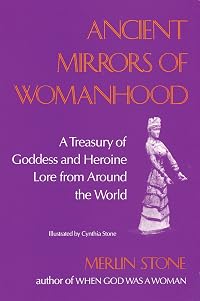
Ancient Mirrors of Womanhood: A Treasury of Goddess and Heroine Lore from Around the World
by Merlin Stone
On This Page
Description
This collection of ancient images of women as goddesses and heroines brings together legends, rituals, and prayers from China, Celtic Europe, South America, Africa, India, North America, Scandinavia, Japan, and elsewhere.Tags
Recommendations























Member Reviews
What language was this originally written in?
That was my first thought on reading this... curiosity. My second was, Where's the documentation?
This book is devoted primarily to the idea that, although most major religions of today involve masculine gods, there was a time when many of the world's people believed in feminine gods.
In some ways, the whole idea is silly. For starters, people today are coming to realize that, if they worship a single god, that god isn't going to be male or female anyway, because it doesn't reproduce! Plus most westerners have at least enough knowledge of classical mythology to realize that the Greeks and Romans had male and female gods. So did (e.g) the Norse, the Egyptians, and the Babylonians.
So this book, show more having pointed out what we already realize, decides to tell us what we already know.
Which isn't a bad thing, actually, except for the way it is conducted. There is a real place for an anthology of texts regarding female deities -- allowing them to be compared and contrasted. But this anthology of texts should be properly translated, properly documented, not merged by the modern editor, and fully explained. Instead, what we get is introductions followed by texts which look like they're translations but which in fact are still the author's own opinions of what the ancient texts say, and these are not documented.
So how can you trust the result? How much of what is written about, say, Atargatis is actual ancient tradition, and how much is Merlin Stone?
As best I could tell from checking other sources, in the case of Atargatis (a real Mesopotamian goddess), the Stone fraction was about a third. Certainly too much was asserted without qualification.
And if an author is going to do that, at least do it in a way that is readable, not something that looks like a machine translation. Or, if you can't do it, get an editor who can!
I am, of course, being extremely harsh. Because I really wanted this book to be good. But, obviously, I was deeply disappointed. I hope someone else is out there who will eventually do it right. show less
That was my first thought on reading this... curiosity. My second was, Where's the documentation?
This book is devoted primarily to the idea that, although most major religions of today involve masculine gods, there was a time when many of the world's people believed in feminine gods.
In some ways, the whole idea is silly. For starters, people today are coming to realize that, if they worship a single god, that god isn't going to be male or female anyway, because it doesn't reproduce! Plus most westerners have at least enough knowledge of classical mythology to realize that the Greeks and Romans had male and female gods. So did (e.g) the Norse, the Egyptians, and the Babylonians.
So this book, show more having pointed out what we already realize, decides to tell us what we already know.
Which isn't a bad thing, actually, except for the way it is conducted. There is a real place for an anthology of texts regarding female deities -- allowing them to be compared and contrasted. But this anthology of texts should be properly translated, properly documented, not merged by the modern editor, and fully explained. Instead, what we get is introductions followed by texts which look like they're translations but which in fact are still the author's own opinions of what the ancient texts say, and these are not documented.
So how can you trust the result? How much of what is written about, say, Atargatis is actual ancient tradition, and how much is Merlin Stone?
As best I could tell from checking other sources, in the case of Atargatis (a real Mesopotamian goddess), the Stone fraction was about a third. Certainly too much was asserted without qualification.
And if an author is going to do that, at least do it in a way that is readable, not something that looks like a machine translation. Or, if you can't do it, get an editor who can!
I am, of course, being extremely harsh. Because I really wanted this book to be good. But, obviously, I was deeply disappointed. I hope someone else is out there who will eventually do it right. show less
I really enjoyed reading this book - a survey of Goddess images around the world
Ratings
Members
- Recently Added By
Lists

LQW Research Reading List
75 works; 1 member
Author Information

6+ Works 2,487 Members
Common Knowledge
- Original publication date
- 1979
- People/Characters
- Astarte; Bridget; Hathor; Inanna; Ishtar; Isis (show all 12); Cybele; Maat; Nammu; Nina, Sumerian goddess; Themis; Wadjet/Ua Zit
- Important places
- Anatolia; Babylon; Egypt; Greece, Ancient; Sumeria
- First words
- Preface
There has been an ever growing consciousness of the advantages of being able to personally identify with positive images and role model, in developing the self-esteem that encourages the fulfillment of individual p... (show all)otential. - Last words
- (Click to show. Warning: May contain spoilers.)Athena, proud in my helmet of Valour,
Athena, proud in my name of Wisdom --
reaching out to you from the page,
filling you with a woman strength
that no one else would give. - Blurbers
- Jong, Erica
Classifications
- Genres
- Nonfiction, Religion & Spirituality, Sexuality and Gender Studies, History
- DDC/MDS
- 291.2 — Religion Other religions [Formerly: General Religious Topics] [formerly: Doctrines. Relocated to 202]
- LCC
- BL325 .F4 .S76 — Philosophy, Psychology and Religion Religions. Mythology. Rationalism Religions. Mythology. Rationalism The myth. Comparative mythology
- BISAC
Statistics
- Members
- 371
- Popularity
- 85,052
- Reviews
- 2
- Rating
- (3.55)
- Languages
- English
- Media
- Paper
- ISBNs
- 4
- UPCs
- 1