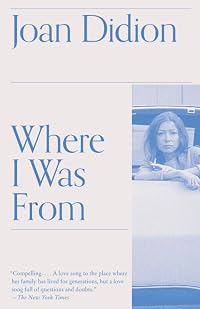
Where I Was From
by Joan Didion
On This Page
Description
In her moving and insightful new book, Joan Didion reassesses parts of her life, her work, her history and ours. A native Californian, Didion applies her scalpel-like intelligence to the state's ethic of ruthless self-sufficiency in order to examine that ethic's often tenuous relationship to reality. Combining history and reportage, memoir and literary criticism, Where I Was From explores California's romances with land and water; its unacknowledged debts to railroads, aerospace, and big show more government; the disjunction between its code of individualism and its fetish for prisons. Whether she is writing about her pioneer ancestors or privileged sexual predators, robber barons or writers (not excluding herself), Didion is an unparalleled observer, and her book is at once intellectually provocative and deeply personal. show lessTags
Recommendations


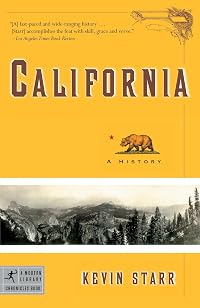
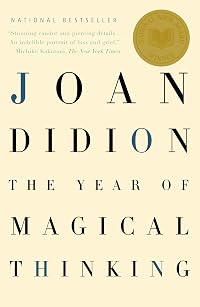
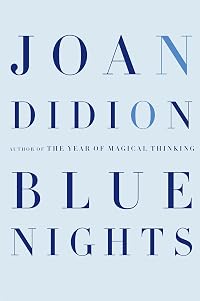

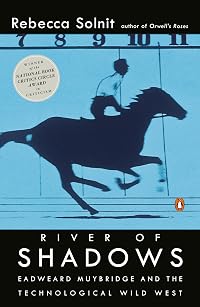















Member Recommendations
Member Reviews
There is no real way to deal with everything we lose.
Written in Didion’s wonderful conversational prose and published in 2003, this short book of interconnected essays starts by Didion, born in Sacramento, describing her perception of Californian history as a child. She critically analyses this as an adult, placing emphasis on the disconnect between owners of land and farming, and also on the blaming of this generation’s immigrants by the children or grandchildren of immigrants.
The second section centres on the reasons, including economic reasons, for the national US attention attracted by the Lakewood Spur posse in 1993, coming from a community who considered themselves middle class American. As a British reader, I was unaware of show more these incidents, but Didion discusses this young criminal gang as a symptom of the failure of the Californian community created after the Second World War to successfully reinvent itself following the contraction of the airforce defence industry.
The third section discusses Didion’s descriptions of California in her first novel, River Run, published in 1963. This seeks to tease out the contradictions between the California Didion wished to portray in her book and her current (2003) perception of what California was then.
The final section touches on her mother and father’s deaths.
Although each section is discrete, together Didion creates a powerful picture of the Californian dream and its more complex reality. show less
Written in Didion’s wonderful conversational prose and published in 2003, this short book of interconnected essays starts by Didion, born in Sacramento, describing her perception of Californian history as a child. She critically analyses this as an adult, placing emphasis on the disconnect between owners of land and farming, and also on the blaming of this generation’s immigrants by the children or grandchildren of immigrants.
The second section centres on the reasons, including economic reasons, for the national US attention attracted by the Lakewood Spur posse in 1993, coming from a community who considered themselves middle class American. As a British reader, I was unaware of show more these incidents, but Didion discusses this young criminal gang as a symptom of the failure of the Californian community created after the Second World War to successfully reinvent itself following the contraction of the airforce defence industry.
The third section discusses Didion’s descriptions of California in her first novel, River Run, published in 1963. This seeks to tease out the contradictions between the California Didion wished to portray in her book and her current (2003) perception of what California was then.
The final section touches on her mother and father’s deaths.
Although each section is discrete, together Didion creates a powerful picture of the Californian dream and its more complex reality. show less
I was captivated by this total immersion into her state’s history, as well as the place of her youth. She covers so much without making it a dry telling of dates, names, and facts. The drive for fortune and fame covers the motivations for most histories, but it’s certainly even bigger for California. Gold. Gold. Gold. Fame. Celebrity. Even schoolchildren in Vermont knew of 49ers and the lust for gold, knew of the corrupt land and water deals, and knew about Hollywood. I remember the thrill of just seeing a California license plate when I was a young punk watching the tourists drive by in Newport, Vermont. This was a well-written telling of a land that had such promise, but Didion kept it real, she didn’t make it magical or show more spiritual.
I would have loved to have had Vicky by my side so that I could bounced lines and reflections off her agile and opinionated mind. This is easily one of my favorite books by Didion. “Compelling…. A love song to the place where her family has lived for generations, but a love song full of questions and doubts.” –The New York Times. She kept out of the way of the material, even when that material was as personal as her own family’s history. show less
I would have loved to have had Vicky by my side so that I could bounced lines and reflections off her agile and opinionated mind. This is easily one of my favorite books by Didion. “Compelling…. A love song to the place where her family has lived for generations, but a love song full of questions and doubts.” –The New York Times. She kept out of the way of the material, even when that material was as personal as her own family’s history. show less
Didion explores the uneasy, unarticulated, and ultimately tragically ironic relationship between Calif.'s citizens and the state. She uses the story about her family and its long history with Calif. to describe the values of Californians, especially among those whom have a long history with the state, as including rugged individualism, resilience, and taking care of ones own. But, as Didion explains, those values run counter with the state's dependence on the federal government for its economic well being. The defense industry, especially aerospace, followed the railroad industry in creating one of the world's biggest economies. Huge ranches were purchased with government support, then sold off as housing parcels and commercial real show more estate. The rich farmland (shades of Steinbeck) was made possible by federal investment in dams and irrigation technology and the diversion of water from other states. Didion is uneasy about this unspoken relationship between values and economics. Is it easier to be a pioneer when the government fills your packhorse with supplies? Didion doesn't give us an answer. She never does. She asks the question. One line I will treasure (paraphrased as I don't have my copy in front of me): "It's not really possible to deal with all the things we lose." That line captures the themes Didion has been exploring in several of her most recent books. She remains one of the finest American writers at work. show less
I found this to be quite an interesting reflection on the author's understanding of and relationship to the myths of her homeland (California). I found the pieces about Josiah Royce (originator of the phrase/concept of "beloved community") especially interesting, as he wrestled with his own picture of California (vs. the reality of it) and also admitted equivocal feelings about community vs. solitude. Living here now (but a newbie...only 9 years), I laughed at the "should have been here when things were good and right and beautiful and real" sections. Sometimes voiced by people even newer to the state than I. As James McMurtry sings, "I'm not from here; I just live here." But I love learning more about how people see this place, even so.
The best thing about this book is Didion's knowing but understated reflection on her own involvement in what we might call the primary sins of California, it's lack of humor/irony about itself and its shallow self-absorption. My chief problem with the book is that it reads like a collection of previously published essays which are used to illustrate the critique of California and Californians.
Joan Didion discusses her family and their migration to California. She separates fact from fiction in the stories told, not only about her own family, but also about her native California. Exploring bits and pieces from the 19th century to 21st, readers are treated to well-written essays showing the spirit of true Californians.My favorite essays, of course, were those exploring her own family or which included information on the family of her subjects. Thomas Kincade was the starting point of one of her essays. This one appealed to me because our family usually puts together a puzzle at Christmas, and it is often one based on a Thomas Kincade print. This was my introduction to Didion, but I hope to explore some of her other writings as show more time permits. show less
I was wondering more than once about that difference between the mythical and the real California, so this book was spot on. As Didion puts it: "things don't add up", and she goes to retell bits of the California history (and more recent events) giving a very different perspective on this place and how it got here.
Good selection of stories that illustrate well her points.
Good selection of stories that illustrate well her points.
Members
- Recently Added By
Published Reviews
Where I Was From seems to promise the story of a fall, the vanishing of some Eden, but as always with Didion, it’s not so simple. The question quickly arises: Fall from what? ... California is always a mistake, though Didion’s far from saying how it could have been gotten right.
added by Lemeritus
Lists

Short Nonfiction Collections
51 works; 4 members

Books Read in 2021
5,361 works; 113 members

Books Read in College
80 works; 5 members
Author Information

56+ Works 36,425 Members
Born in Sacramento, California, on December 5, 1934, Joan Didion received a B.A. from the University of California, Berkeley in 1956. She wrote for Vogue from 1956 to 1963, and was visiting regent's lecturer in English at the University of California, Berkeley in 1976. Didion also published novels, short stories, social commentary, and essays. Her show more work often comments on social disorder. Didion wrote for years on her native California; from there her perspective broadened and turned to the countries of Central America and Southeast Asia. Her novels include Democracy (1984) and The Last Thing He Wanted (1996). Well known nonfiction titles include Slouching Towards Bethlehem (1968), The White Album (1979), The Year of Magical Thinking (2005) and Blue Nights (2011). In 1971 Joan Didion was nominated for the National Book Award in fiction for Play It As It Lays. In 1981 she received the American Book Award in nonfiction, and was nominated for a National Book Critics Circle Prize in nonfiction for The White Album. Didion has received a great deal of recognition for The Year of Magical Thinking, which was awarded the National Book Award for Nonfiction in 2005. In 2007, Didion received the National Book Foundation's annual Medal for Distinguished Contribution to American Letters. In 2009, Didion was awarded an honorary Doctor of Letters degree by Harvard University. On July 3, 2013 the White House announced Didion was one of the recipients of the National Medals of Arts and Humanities presented by President Barack Obama. (Bowker Author Biography) show less
Some Editions
Awards and Honors
Work Relationships
Is contained in
Common Knowledge
- Original publication date
- 2003
- Important places
- California, USA
- Dedication
- This book is for my brother James Jerrett Didion, and for our mother and father, Eduene Jerrett Didion and Frank Reese Didion, with love.
- First words
- My great-great-great-great-great-grandmother Elizabeth Scott was born in 1766, gre up on the Viriginia and Carolina frontiers, at ag sixteen married an eighteen-year-old veteran of the Revolution and Cherokee expeditions name... (show all)d Benjamin Hardin IV, moved him into Tennessee and Kentucky and died on still another frontier, the Oil Trough Bottom at the south bank of the White River in what is now Arkansas but was then Missouri Territory.
- Last words
- (Click to show. Warning: May contain spoilers.)I was still pretending that she would get through the Sierra before the snows fell. She was not.
- Canonical DDC/MDS
- 979.405
- Canonical LCC
- F861
Classifications
- Genres
- Biography & Memoir, Nonfiction, General Nonfiction, History
- DDC/MDS
- 979.405 — History & geography History of North America Great Basin and Pacific Slope region of United States California General California History
- LCC
- F861 — Local History of the United States, Canada and Latin America United States local history California
- BISAC
Statistics
- Members
- 944
- Popularity
- 28,160
- Reviews
- 16
- Rating
- (3.81)
- Languages
- 5 — English, German, Italian, Spanish, Swedish
- Media
- Paper, Audiobook, Ebook
- ISBNs
- 14
- ASINs
- 7