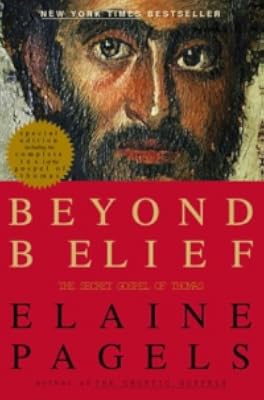
Beyond Belief: The Secret Gospel of Thomas
by Elaine Pagels
On This Page
Description
[This book] explores how Christianity began by tracing its earliest texts, including the secret Gospel of Thomas, rediscovered in Egypt in 1945 ... [The author explores] historical and archeological sources to investigate what Jesus and his teachings meant to his followers before the invention of Christianity as we know it ... [She] compares such sources as Thomas' gospel ... with the canonic texts to show how Christian leaders chose to include some gospels and exclude others from the show more collections we have come to know as the New Testament. To stabilize the emerging Christian church in times of devastating persecution, the church fathers constructed the canon, creed, and hierarchy--and, in the process, suppressed many of its spiritual resources.-Dust jacket. show lessTags
Recommendations

Member Reviews
This book had been on my wishlist for a while, as I've always been interested in the "disappeared" books of the Bible. (Well, always... at least as long as I knew such things existed, anyway!) So, when perusing the religion section of the Mecosta library, this title jumped out at me. (Additionally, the rest of their religion section is rather un-challenging, conventional mainstream to right wing Christianity.)
So, I broke my long standing rule to not check out library books (due to my extended history of large library fines) and picked it up. It was immediately fascinating and I found myself reading it at every spare moment. I do have to say, however, that the subtitle is a bit misleading. This book is more about how the Gospels came to show more be the Gospels and how the others, the Gospel of Thomas, Gospel of Mary, etc., came to be forgotten. There is some particular focus on Thomas, but really only a small portion of that gospel makes it into the book.
But that's okay, because what was most interesting to me was the church history and how the issues the church is dealing with today are the same issues it's been dealing with since the dawn of Christianity -- who belongs and who doesn't, what beliefs are approved of and which aren't, and what's to be done about those we disagree with. Linked to that is how certain interpretations of texts came to be thought of as essential to Christian faith -- even those that were at one time highly controversial and aren't necessarily explicitly stated in the texts themselves -- most notably the idea that Jesus = God.
Highly recommended to all those who question. show less
So, I broke my long standing rule to not check out library books (due to my extended history of large library fines) and picked it up. It was immediately fascinating and I found myself reading it at every spare moment. I do have to say, however, that the subtitle is a bit misleading. This book is more about how the Gospels came to show more be the Gospels and how the others, the Gospel of Thomas, Gospel of Mary, etc., came to be forgotten. There is some particular focus on Thomas, but really only a small portion of that gospel makes it into the book.
But that's okay, because what was most interesting to me was the church history and how the issues the church is dealing with today are the same issues it's been dealing with since the dawn of Christianity -- who belongs and who doesn't, what beliefs are approved of and which aren't, and what's to be done about those we disagree with. Linked to that is how certain interpretations of texts came to be thought of as essential to Christian faith -- even those that were at one time highly controversial and aren't necessarily explicitly stated in the texts themselves -- most notably the idea that Jesus = God.
Highly recommended to all those who question. show less
The title, or maybe it's only the subtitle of this book is misleading, since Pagels' subject is to examine how a diversity of Christian communities with differing practices and sacred writings became a unified whole. Most of the history of the first centuries of Christianity I have read assume what is today the orthodox consensus was in place from the earliest days of Christianity, making any history by default a tale of how divergent teachings arose and were suppressed. Pagels takes a different approach, starting with the reality of diverse communities of Christians and showing something of the way a majority held version of Christianity prevailed and then suppressed competing interpretations of the life and teaching of Jesus. This is show more intended for a popular readership and it is fascinating. show less
Not so much about Thomas (whose real name was Judas) but ultimately about the spiritual politics of the early church and its stand against epinoia, the possibility of spiritual development allowing one to intuit divine knowledge in addition to what has been revealed via scripture. The gospel of John rules this out and perhaps does so explicitly in response to Thomas (or was redacted to read so--a possibility not discussed in this book). Ms. Pagels and I side with Thomas.
Beyond Belief: the Secret Gospel of Thomas
Elaine Pagels
Elaine Pagel’s book Beyond Belief is somewhat a continuation of her book, the Gnostic Gospels. It was written more than 20 years later, and in addition to being a historical account of the Gospel of Thomas, it also includes elements of a memoir. The results is a book that doesn’t quite know what it wants to be. It isn’t a memoir, however, the elements of memoir make it so that it doesn’t quite read as history either.
Pagels’ focus, “is how certain Christian leaders from the second century through the fourth came to reject many other sources of revelation and construct instead, the New Testament gospel canon of Matthew, Mark, Luke, and John, along with the ‘canon of show more truth,’ which became the nucleus of the later creeds that have defined Christianity to this day.” Pagels chooses the Gospel of Thomas as a vehicle for comparison to the canonical gospels, particularly the Gospel of John. Of all the canonical gospels, John is the gospel believed by most scholars, to have been most heavily influenced by the gnostics. Pagels describes the process by which canonical and gnostic gospels, rather than being complementary, were set up to be rivals by the men who were intent on establishing a universal Christian church.
Her protagonist is not Thomas but instead, Irenaeus, the 2nd century BCE Bishop of Lyons. Despite his hard-line orthodoxy, Pagels portrays his motives with sensitivity and understanding. He was the primary architect of the four-Gospel canon. She points out that he wasn’t opposed to diverse interpretations of scripture; what he opposed was the gnostics’ methods. The gnostics were what we might today call elitist. For example, they believed that there were two levels of baptism. The basic level required a person to repent past sins, confess his faith to Jesus Christ, and promise to live according to that faith. The second level required “soul-searching” - asking question after question to know oneself (gnosis) and attain spiritual transformation, therefore becoming Christ-like. This division of the congregation into “basic” and “higher level” Christians greatly concerned Irenaeus because of its exclusivity. Pagels does a wonderful job explaining Irenaeus’s motives. He was not a philosopher, but instead was a person thrust into a leadership position at a young age who had grown up watching his teachers and mentors violently persecuted and killed. Any threat to Christian unity was concerning to him. He believed unity was needed to create a strong community assured in the strength of its common faith against Roman foes.
As Pagels shows the progression of the orthodoxy and its growing strength against the decline of gnosticim, she incorporates pieces of her own spiritual evolution. Like Irenaeus, her own journey is rooted in grief. She must navigate the impact of the death of her young son on her personal beliefs. While I sympathized with her personal journey, I felt that it was a bit misplaced in this particular book. She didn’t focus on it enough. However, if she had, the historicism of the journey away from gnosticism and toward orthodoxy would have lost its focus and therefore power. It would have been better to write a separate and more in-depth memoir. Instead, she inconsistently sprinkled in personal thoughts and feelings that felt out of place. I enjoyed reading the historical aspects of Beyond Belief. And I would have loved to read more about her own personal journey. Just not in the same book. show less
Elaine Pagels
Elaine Pagel’s book Beyond Belief is somewhat a continuation of her book, the Gnostic Gospels. It was written more than 20 years later, and in addition to being a historical account of the Gospel of Thomas, it also includes elements of a memoir. The results is a book that doesn’t quite know what it wants to be. It isn’t a memoir, however, the elements of memoir make it so that it doesn’t quite read as history either.
Pagels’ focus, “is how certain Christian leaders from the second century through the fourth came to reject many other sources of revelation and construct instead, the New Testament gospel canon of Matthew, Mark, Luke, and John, along with the ‘canon of show more truth,’ which became the nucleus of the later creeds that have defined Christianity to this day.” Pagels chooses the Gospel of Thomas as a vehicle for comparison to the canonical gospels, particularly the Gospel of John. Of all the canonical gospels, John is the gospel believed by most scholars, to have been most heavily influenced by the gnostics. Pagels describes the process by which canonical and gnostic gospels, rather than being complementary, were set up to be rivals by the men who were intent on establishing a universal Christian church.
Her protagonist is not Thomas but instead, Irenaeus, the 2nd century BCE Bishop of Lyons. Despite his hard-line orthodoxy, Pagels portrays his motives with sensitivity and understanding. He was the primary architect of the four-Gospel canon. She points out that he wasn’t opposed to diverse interpretations of scripture; what he opposed was the gnostics’ methods. The gnostics were what we might today call elitist. For example, they believed that there were two levels of baptism. The basic level required a person to repent past sins, confess his faith to Jesus Christ, and promise to live according to that faith. The second level required “soul-searching” - asking question after question to know oneself (gnosis) and attain spiritual transformation, therefore becoming Christ-like. This division of the congregation into “basic” and “higher level” Christians greatly concerned Irenaeus because of its exclusivity. Pagels does a wonderful job explaining Irenaeus’s motives. He was not a philosopher, but instead was a person thrust into a leadership position at a young age who had grown up watching his teachers and mentors violently persecuted and killed. Any threat to Christian unity was concerning to him. He believed unity was needed to create a strong community assured in the strength of its common faith against Roman foes.
As Pagels shows the progression of the orthodoxy and its growing strength against the decline of gnosticim, she incorporates pieces of her own spiritual evolution. Like Irenaeus, her own journey is rooted in grief. She must navigate the impact of the death of her young son on her personal beliefs. While I sympathized with her personal journey, I felt that it was a bit misplaced in this particular book. She didn’t focus on it enough. However, if she had, the historicism of the journey away from gnosticism and toward orthodoxy would have lost its focus and therefore power. It would have been better to write a separate and more in-depth memoir. Instead, she inconsistently sprinkled in personal thoughts and feelings that felt out of place. I enjoyed reading the historical aspects of Beyond Belief. And I would have loved to read more about her own personal journey. Just not in the same book. show less
I admire the work of Elaine Pagels and look forward to future works. However, this is not my favorite Pagels book. Though interesting, I found it unfocused and lacking an overarching unifying theme as in, say, THE ORIGIN OF SATAN or THE GNOSTIC GOSPELS. I did not find, except for chapter 2, that there was even much discussion of The Secret Gospel of Thomas; though a complete translation of that work is given in an appendix at the end of the book. The title and cover seem to suggest, however, that this is book's raison d'etre. I feel a little bait and switched, if that's a phrase. There is a lot here about Irenaeus, a major figure in the standardization of the New Testament, which was later writ in stone at the Council of Nicea (325). show more There is also very interesting material on Emperor Constantine. I had not known, for example, that his support of the early church had so pervaded the everyday administration of his empire. In addition to sponsoring the Council of Nicea, he ruled the empire from the perspective of a Christian, issuing numerous edicts favorable to the church and Christians. The book is worthwhile reading for it's filled with interesting bits, but it is not a cohesive work. As for the preceding "review", I must confess to finding it rather astonishing. BEYOND BELIEF has very little to do with Ms. Pagels own religious search. That was not the reason it was written. It is religious scholarship of a very high order and its utmost goal is truth, not the freestyle construction of a personal spiritual code. show less
Pagels is a recognized scholar of religion, and the author of The Gnostic Gospels, among others. This book might be her best.
Don't buy this expecting a dull, scholarly exposition on the Gospel of Thomas. It's hardly that. It's sort of an unobtrusive evangelism for unorthodox Christianity, a plea for the kind of "religious truth" that can never hide behind a stale set of doctrine.
Pagels bares her soul in this book, and her passion for spirituality, religion and Christianity shines. The result is inspirational. This is the book that turned me on to Pagels' scholarship, and I've felt a distant kinship ever since. It's really less about the Gospel of Thomas and more about diversity and meaning within the early Christian movement. John's show more Gospel actually gets as much attention as the Gospel of Thomas. While John hints of gnostic influence, it also finds itself in direct opposition to Thomas on many topics, such as the divinity of Christ. Pagels embraces this diversity of ideas, and spends a great deal of time discussing how the canon of acceptable scripture grew.
I love engaging, thought-provoking books, and Pagels never disappoints. show less
Don't buy this expecting a dull, scholarly exposition on the Gospel of Thomas. It's hardly that. It's sort of an unobtrusive evangelism for unorthodox Christianity, a plea for the kind of "religious truth" that can never hide behind a stale set of doctrine.
Pagels bares her soul in this book, and her passion for spirituality, religion and Christianity shines. The result is inspirational. This is the book that turned me on to Pagels' scholarship, and I've felt a distant kinship ever since. It's really less about the Gospel of Thomas and more about diversity and meaning within the early Christian movement. John's show more Gospel actually gets as much attention as the Gospel of Thomas. While John hints of gnostic influence, it also finds itself in direct opposition to Thomas on many topics, such as the divinity of Christ. Pagels embraces this diversity of ideas, and spends a great deal of time discussing how the canon of acceptable scripture grew.
I love engaging, thought-provoking books, and Pagels never disappoints. show less
Beyond Belief is the sort of book that should be read by those who believe that the bible, as currently constructed, is the immutable word of God, rather than an artifact that emerged as much from interpretive and institutional struggles in the early history of the church, as it did from any divinely inspired gospels. This is particularly true when the formation of the institution of the church required the intimidation of other believers and the destruction of their texts. Pagels notes that her focus in the book is:
"...how certain Christian leaders from the second century through the fourth came to reject many other sources of revelation and constructed instead the New Testament gospel canon of Matthew, Mark, Luke and John along with show more the ‘canon of truth' which became the nucleus of the later creeds that have defined Christianity to today."
Principal among those other sources is the gospel of Thomas, part of the gnostic gospels discovered at Nag Hammadi in Egypt in 1945, thanks to the efforts of some unknown persons who defied the order to destroy all non-sanctioned texts.
Pagels argues that:
"What John opposed...includes that which the Gospel of Thomas teaches–that God's light shines not only in Jesus but, potentially at least, in everyone. Thomas's gospel encourages the hearer not so much to believe in Jesus, as John requires, as to seek to know God through one's own, divinely given capacity, since all are created in the image of God. For Christians in later generations, the Gospel of John helped provide a foundation for a unified church, which Thomas, with its emphasis on each person's search for God, did not." (emphasis in the original)
The Gospel of Thomas teaches that recognizing one's affinity with God is the key to the kingdom of God, and in this and other sayings and approaches, it is remarkably similar to some of the core teachings of Buddhism. But this is not a good foundations for the machinery of an institution: if people can come to God on their own, what need do they have for priests and hierarchy and orthodoxy? This was the nightmare of Irenaeus, Bishop of Lyon, and leader of an important Christian group in provincial Gaul in the second century. He championed the gospel of John as the basis for orthodoxy and fought long and hard to establish what became known as the canon of truth: that God the Father is also the Creator who "made all things through his word" (John 1:3), and the word became incarnate in Jesus Christ. Irenaeus's dream of a united church took a huge step forward with the conversion of the Emperor Constantine in 313, and his calling together of bishops from churches throughout the empire to meet at Nicea in 325, to work out a standard formulation of the Christian faith.
"From that meeting and its aftermath, during the tumultuous decades that followed, emerged the Nicene Creed that would effectively clarify and elaborate the ‘canon of truth', along with what we call the canon–the list of twenty-seven writings which would become the New Testament. Together these would help establish what Irenaeus had envisioned–a worldwide communion of ‘orthodox' Christians joined into one ‘catholic and apostolic' church."
Pagels does a good job of sketching the internecine struggles that took place in the first four centuries of Christianity where the interpretation of scripture became a central feature in a much larger political struggle. Once the canon was defined, anything that deviated from it, and from the interpretations given by the hierarchy, was heresy. Thus, the intolerance that the church demonstrated bloodily through many subsequent centuries, against Christians and non-Christians alike, was part of its birth.
"The framework of the canon, creed, and ecclesiastical hierarchy that Irenaeus and others began to forge in the crucible of persecution and that his successors...worked to construct after Constantine's conversion now gained enormous appeal. The ‘universal' church could invite potential converts to join an assembly that not only claimed to possess certain truth and to offer eternal salvation but had also become socially acceptable, even politically advantageous."
Two other interesting points: the word "heresy" originally meant an act of choice....as many early Christians did with their own approaches to worship and to Christ, but it took on a much more sinister connotation in the hands of the orthodox church. Also, the miracle of the virgin birth, which many will still swear by, is a mistranslation from the original Hebrew, through Greek. The original meaning was "a young woman shall conceive and bear a son".
An excellent and thought-provoking book. show less
"...how certain Christian leaders from the second century through the fourth came to reject many other sources of revelation and constructed instead the New Testament gospel canon of Matthew, Mark, Luke and John along with show more the ‘canon of truth' which became the nucleus of the later creeds that have defined Christianity to today."
Principal among those other sources is the gospel of Thomas, part of the gnostic gospels discovered at Nag Hammadi in Egypt in 1945, thanks to the efforts of some unknown persons who defied the order to destroy all non-sanctioned texts.
Pagels argues that:
"What John opposed...includes that which the Gospel of Thomas teaches–that God's light shines not only in Jesus but, potentially at least, in everyone. Thomas's gospel encourages the hearer not so much to believe in Jesus, as John requires, as to seek to know God through one's own, divinely given capacity, since all are created in the image of God. For Christians in later generations, the Gospel of John helped provide a foundation for a unified church, which Thomas, with its emphasis on each person's search for God, did not." (emphasis in the original)
The Gospel of Thomas teaches that recognizing one's affinity with God is the key to the kingdom of God, and in this and other sayings and approaches, it is remarkably similar to some of the core teachings of Buddhism. But this is not a good foundations for the machinery of an institution: if people can come to God on their own, what need do they have for priests and hierarchy and orthodoxy? This was the nightmare of Irenaeus, Bishop of Lyon, and leader of an important Christian group in provincial Gaul in the second century. He championed the gospel of John as the basis for orthodoxy and fought long and hard to establish what became known as the canon of truth: that God the Father is also the Creator who "made all things through his word" (John 1:3), and the word became incarnate in Jesus Christ. Irenaeus's dream of a united church took a huge step forward with the conversion of the Emperor Constantine in 313, and his calling together of bishops from churches throughout the empire to meet at Nicea in 325, to work out a standard formulation of the Christian faith.
"From that meeting and its aftermath, during the tumultuous decades that followed, emerged the Nicene Creed that would effectively clarify and elaborate the ‘canon of truth', along with what we call the canon–the list of twenty-seven writings which would become the New Testament. Together these would help establish what Irenaeus had envisioned–a worldwide communion of ‘orthodox' Christians joined into one ‘catholic and apostolic' church."
Pagels does a good job of sketching the internecine struggles that took place in the first four centuries of Christianity where the interpretation of scripture became a central feature in a much larger political struggle. Once the canon was defined, anything that deviated from it, and from the interpretations given by the hierarchy, was heresy. Thus, the intolerance that the church demonstrated bloodily through many subsequent centuries, against Christians and non-Christians alike, was part of its birth.
"The framework of the canon, creed, and ecclesiastical hierarchy that Irenaeus and others began to forge in the crucible of persecution and that his successors...worked to construct after Constantine's conversion now gained enormous appeal. The ‘universal' church could invite potential converts to join an assembly that not only claimed to possess certain truth and to offer eternal salvation but had also become socially acceptable, even politically advantageous."
Two other interesting points: the word "heresy" originally meant an act of choice....as many early Christians did with their own approaches to worship and to Christ, but it took on a much more sinister connotation in the hands of the orthodox church. Also, the miracle of the virgin birth, which many will still swear by, is a mistranslation from the original Hebrew, through Greek. The original meaning was "a young woman shall conceive and bear a son".
An excellent and thought-provoking book. show less
Members
- Recently Added By
Author Information

32+ Works 15,533 Members
Elaine Pagels is the Harrington Spear Paine Professor of Religion at Princeton University. She is the recipient of a MacArthur Fellowship best known for her studies and writing on the Gnostic Gospels. Pagels graduated from Stanford University receiving a B.A. in 1964 and an M.A. in 1965. She received a Ph.D in religion from Harvard University in show more 1970. She is the author of The Gnostic Gospels (1979), which won the National Book Award (Religion 1980) and the National Book Critics Circle Award (Criticism 1979). Pagels is also the author of Adam, Eve and the Serpent (1988), The Origin of Satan (1995), Beyond Belief: The Secret Gospel of Thomas (2003), Reading Judas: The Gospel of Judas and the Shaping of Christianity (2007), and Revelations: Visions, Prophecy, and Politics in the Book of Revelation (2012). (Bowker Author Biography) show less
Some Editions
Awards and Honors
Distinctions
Series
Belongs to Publisher Series
Common Knowledge
- Original title
- Beyond Belief
- Alternate titles
- The Complete Gospels: Annotated Scholar's Version
- Original publication date
- 2003; 2004
- Important places
- Sea of Galilee
- Important events
- Nicene Creed; Q source
- Dedication
- For Kent with love
- First words
- On a bright Sunday morning in February, shivering in a T-shirt and running shorts, I stepped into the vaulted stone vestibule of the Church of the Heavenly Rest in New York to catch my breath and warm up.
- Quotations
- There is an invisible world out there, and we are living in it.
- Last words
- (Click to show. Warning: May contain spoilers.)Thus they encourage those who endeavor, in Jesus' words, to "seek, and you shall find."
Classifications
Statistics
- Members
- 2,920
- Popularity
- 6,139
- Reviews
- 39
- Rating
- (3.69)
- Languages
- 7 — Dutch, English, German, Italian, Portuguese, Slovenian, Spanish
- Media
- Paper, Audiobook, Ebook
- ISBNs
- 22
- ASINs
- 10