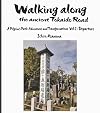
Walking Along the Ancient Tokaido Road: A Pilgrim's Path: Adventures and Transformations (Vol.1: Departure)
by Ichiro Asanuma 
Walking Along the Ancient Tokaido Road (1)
On This Page
Recommendations












































Member Reviews
Walking Along the Ancient Tokaido Road, Vol. 1 is a gentle, inviting journey into Japan’s historic heart. The author’s warmth and curiosity shine through every page, turning travel into something deeply human—an exploration of landscapes, traditions, and the quiet beauty of everyday encounters. This first volume feels like walking beside a thoughtful friend who notices the small details that make a place come alive. It’s calming, insightful, and full of grace.
 This review was written for LibraryThing Early Reviewers.
Most of the books I read are illustrated books—architecture, mainly, but other subjects too. While I don’t buy such illustrated books that are self-published, I’m always hoping to come across one whose values in editing, image reproduction, and page design come close to traditional publishing—perhaps signaling that, as publishers put out fewer illustrated books each year over the year before, there is a future for illustrated books to be found in self-publishing. This is not that book.
The author’s account of walking from Tokyo to Shizuoka along the Tokaido Road (the first of three such books (!), extending all the way to Kyoto) is in dire need of an(other) editor to help keep him on point and make his statements clearer. Some show more of the many photos he took make me wonder what they’re meant to show or question why they’re even in the book, but some are truly captivating, only to suffer from poor reproduction in color and contrast. Some of the page layouts seem more accidental than actually designed, though I did appreciate that text and corresponding images tend to be found on the same page or spread, not pages apart as I’ve encountered in many books from traditional publishers.
But my biggest issue with the book is just not being able to grasp its point or its justification for being. It is a memoir/travelogue that follows the Tokaido Road famously depicted by Hiroshige in woodcut prints of 53 stations between Tokyo and Kyoto. While the author includes the appropriate paintings for this book’s stretch, they are not found until the back of the book and they come with captions that don’t reveal much more beyond what readers see with their own eyes. Encountering these images after reading the author’s equal-parts physical and mental account of the journey made me think he should have integrated these two parts of the book, not separated them: showing/discussing the path as it is today (or in 2006, when he did the walk) and then, when Hiroshige beautifully depicted the people and places along Tokaido Road. Such a book would have made a lot more sense and probably been a lot more interesting—one I might have recommended to others, unlike the version the author created. show less
The author’s account of walking from Tokyo to Shizuoka along the Tokaido Road (the first of three such books (!), extending all the way to Kyoto) is in dire need of an(other) editor to help keep him on point and make his statements clearer. Some show more of the many photos he took make me wonder what they’re meant to show or question why they’re even in the book, but some are truly captivating, only to suffer from poor reproduction in color and contrast. Some of the page layouts seem more accidental than actually designed, though I did appreciate that text and corresponding images tend to be found on the same page or spread, not pages apart as I’ve encountered in many books from traditional publishers.
But my biggest issue with the book is just not being able to grasp its point or its justification for being. It is a memoir/travelogue that follows the Tokaido Road famously depicted by Hiroshige in woodcut prints of 53 stations between Tokyo and Kyoto. While the author includes the appropriate paintings for this book’s stretch, they are not found until the back of the book and they come with captions that don’t reveal much more beyond what readers see with their own eyes. Encountering these images after reading the author’s equal-parts physical and mental account of the journey made me think he should have integrated these two parts of the book, not separated them: showing/discussing the path as it is today (or in 2006, when he did the walk) and then, when Hiroshige beautifully depicted the people and places along Tokaido Road. Such a book would have made a lot more sense and probably been a lot more interesting—one I might have recommended to others, unlike the version the author created. show less
I’ve just returned from two weeks in East Asia (South Korea), and I’m delighted to review Departure, the first volume of Ichiro Asanuma’s Walking Along the Ancient Tokaido Road, a trilogy that’s subtitled “A Pilgrim’s Path: Adventures and Transformations.” It’s a travel narrative of sorts; but it’s primarily a rather oddly designed book of occasionally captivating photographs taken by the author during his travels. This volume takes the author qua photographer from Tokyo to Shizuoka; the second volume, from Shizuoka to Nagoya; the third, from Kuwana to Kyoto. The trips were completed piecemeal over many years, beginning in 2006. Anyone who has peregrinated in Japan (as I have: 1991, 1996–98, 2000, 2001, 2005, 2019) show more will find at least some of the photos capable of invoking nostalgia.
The English in the book has that subtle offness of ideas in translation, leading me to believe that the text would have greater impact in Japanese. Readers need to fill in some blanks, connect some dots, make sense in places of the ineffable. But such is the message underscoring the work, which is that journeys don’t end once intended destinations are reached; transformations continue beyond arrival. Sure, there’s something profound to those insights, and readers might appreciate treating the perusal of Asanuma’s text as a journey of their own.
I especially appreciated the appendix: reproductions of nineteen of Utagawa Hiroshige’s Fifty-three Stations of the Tokaido Road, with brief commentaries by Asanuma. Perhaps volumes 2 and 3 of the trilogy include the remaining thirty-four prints?
Thank you to the LibraryThing Early Reviewers scheme for a review copy of this most curious book. show less
The English in the book has that subtle offness of ideas in translation, leading me to believe that the text would have greater impact in Japanese. Readers need to fill in some blanks, connect some dots, make sense in places of the ineffable. But such is the message underscoring the work, which is that journeys don’t end once intended destinations are reached; transformations continue beyond arrival. Sure, there’s something profound to those insights, and readers might appreciate treating the perusal of Asanuma’s text as a journey of their own.
I especially appreciated the appendix: reproductions of nineteen of Utagawa Hiroshige’s Fifty-three Stations of the Tokaido Road, with brief commentaries by Asanuma. Perhaps volumes 2 and 3 of the trilogy include the remaining thirty-four prints?
Thank you to the LibraryThing Early Reviewers scheme for a review copy of this most curious book. show less
I appreciate the concept behind the book: the promise of a contemporary journey through the ancient Tōkaidō Road sounds fascinating for a travelogue. Documenting a 16-year journey, begun from a place of ill-health, and explaining some of the history behind the stops along the Tōkaidō Road is a compelling idea. However, the translation into English often felt awkward, preventing readers from genuinely engaging with the flow of this memoir. Overall, I felt the organization of the ebook content doesn't live up to this promise. It was unclear what the author wants the reader to take away from the collage of text and images, and providing more context using some of the historical Edo period woodblock prints contrasting side-by-side with show more the contemporary photographs of how those locations would change would help draw readers in. Having a graphic designer to help with the fonts and image presentation as well as an English-language editor to assist with the flow of the text would turn what feels like a rough-draft idea into an incredible publication. show less
This review was written for LibraryThing Early Reviewers.Interesting blend of history, travel guide and personal experience. Would have been good to have more context about all of that at the start though.
This book doesn't fit neatly into any genre: its various parts could be described as travelogue, personal philosophy, cultural history of pre-modern Japan, photography book, and ukiyo-e art book. The various sections are not especially integrated into a coherent whole, so it's a bit difficult to understand the connections. It's described as "volume 1", although it's not clear why the work was separated into multiple parts nor how many there are. I came away with a much better sense of what the sections of trail the author hiked look like (and how that region was depicted by Hiroshige in the early 19th century) than exactly where the author was or what his hike was actually like. Overall, this seemed a bit more serious than a vanity show more project, but less coherent than a better-edited travel book. Still not without merits, but a bit of a mess that would have benefited from an ordered structure.
I received this book as a free advanced reading copy, but this review is my own opinion. show less
I received this book as a free advanced reading copy, but this review is my own opinion. show less
This was a very chaotic book. It's not well organized and could've used more editing. There are lots of pictures, to help put you in the scene. I guess I was expecting more of a classic travelogue.
Members
- Recently Added By
Author Information
5 Works 26 Members
Ichiro Asanuma is a LibraryThing Author, an author who lists their personal library on LibraryThing.
Series

Common Knowledge
- Canonical title
- Walking Along the Ancient Tokaido Road: A Pilgrim's Path: Adventures and Transformations (Vol.1: Departure) (Vol.1: Departure)
Statistics
- Members
- 20
- Popularity
- 1,234,448
- Reviews
- 13
- Rating
- (2.75)
- Languages
- English
- Media
- Paper
- ISBNs
- 1
- ASINs
- 1