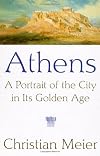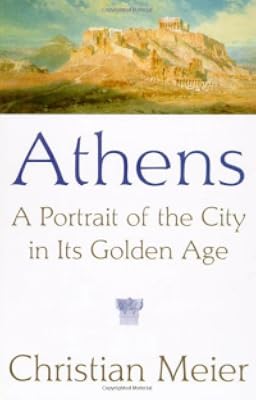
Athens: A Portrait of the City in Its Golden Age
by Christian Meier
On This Page
Description
The definitive account of Athens in the age of Pericles, Christian Meier's gripping study begins with the Greek triumph over Persia at the Battle of Salamis, one of the most significant victories in history. Meier shows how that victory decisively established Athens' military dominance in the Mediterranean and made possible its rise to preeminence in almost every field of human endeavor - commerce, science, philosophy, art, architecture, and literature. Within seventy-five years, Athens had show more become the most original and innovative civilization the ancient world ever produced. Meier traces the birth of democracy and the flourishing of Greek culture in the fifth century B.C., as well as Athens' slow decline and defeat in the Peloponnesian War. show lessTags
Recommendations






































Member Reviews
Athens was a book I was really looking forward to reading. I mean, how exciting is the Greek Golden Age? Pretty exciting is the correct answer. So what a letdown this monster-sized thing by Heier was. I didn’t think that such boring history books got published anymore, but I guess I was wrong. Actually the book was heavy on the research synthesis but not organized well and seemed overly cautious in tone for the sweeping generalizations he was making. Heier seemed to want to downplay Greek religion as a real human phenomenon. He notes in an aside how the Israelite's had their God (Yahweh) use the Persians as a punishing force for Israelite disobedience. This is meant to show how theology of any God was self-contradictory and therefore show more of little practical use. The section on the Sophists seemed to exist to show how they made religion as a ritual cult ultimately unnecessary for life in the city. This book is moderately interesting but hardly worth the effort to plow through so many pages to finish it. Skip this and read Greek Religion: Archaic and Classical by Walter Burkert. show less
I would have to start by saying that this is a pretty good overview for a serious scholar. There is a pretty dense opening with a detailed study of the earlier Greek societies, not so much the dreaded Names and Dates history stuff, but the underlying social conditions and world view of the Mycenaeans and the northern Greek ancestors of the Classical Athenians. The book then turns into a pretty enjoyable general history of Athens and its relations with its neighbors in the 'known world'. Every facet of the city's people is examined in at least some detail, from the origin of it's government to the arts, and how the cultural concept of beauty and equality of all men demanded a representative government to rule over it. Even the tragedies show more by the great playwrights are summarized and helpfully placed in their proper social context as satires worthy of anything on The Daily Show or Countdown or whatever particular program you enjoy that puts the government in its place. The period covered is the Golden Age (as the title claims) of Athens and its rapid and fortuitous rise to unequalled heights, to its equally rapid fall back into anarchy and despotism. There is much ego and self-serving politics in the meantime. In the span of literally a few generations (about 80 years), Athens morphs from a tyranny consolidating power for itself by giving rights and responsibilities to the lower classes, to a city that demanded freedom for all, then to an angry and stubborn military power that promised freedoms to those conquered as long as the local governments met the approval of the Athenian councils. This did not work too well then, or now frankly. Eventually, the Spartans and a coalition of almost every other Greek city and even the old enemy, the Persians forced Athens back into its little britches that were long outgrown. The irony is that Athens was the only city (polis to be proper) that had the means to stop the Persians in the beginning (480 BC), which led to the organization of the 'Delian League' that made Athens rich and powerful, enabling them to try to rule over the whole region. Which they successfully did under men like Pericles for about fifty years or so, by the way. As you would imagine, there are many lessons to be learned from the example of Athens and I believe that it should be studied in depth in all high schools (along with mandatory readings of Sherlock Holmes). The lessons of fairness, equality and friendship, both passed and failed by the Athenians, are equal cultural legacies to their arts, sciences and philosophies. show less
Ratings
Members
- Recently Added By
Published Reviews
ThingScore 100
"Meticulously researched and engrossing, this is likely to become a standard popular history of Athens during its century of greatness."
added by bookfitz
Lists

Works Cited in The Life and Death of Democracy by John Keane
278 works; 1 member
Author Information

32+ Works 1,318 Members
Some Editions
Common Knowledge
- Canonical title
- Athens: A Portrait of the City in Its Golden Age
- Original title
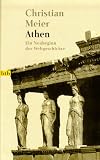
- Athen: Ein Neubeginn der Weltgeschichte
- Original publication date
- 1993
- People/Characters
- Aristotle, 384-322; Aristophanes; Cimon; Pericles; Themistocles; Alcibiades (show all 11); Socrates, 469-399 BC; Solon; Sophocles; Xanthippus; Plato
- Important places
- Athens, Greece; Corinth, Greece; Marathon, Greece; Sicily, Italy; Sparta, Greece
- Important events
- Persian War; Peloponnesian War; Battle of Marathon; Battle of Salamis; Sicilian Expedition
- Dedication
- Pour comprendre il faut aimer.
- First words
- In the late summer of 480 B.C., most likely toward the end of September, a dramatic, heartrending scene played out on the coast of Attica.
- Last words
- (Click to show. Warning: May contain spoilers.)It had simply ceased to be a major political power.
- Original language
- German
Classifications
- Genres
- History, Nonfiction, General Nonfiction
- DDC/MDS
- 938.04 — History & geography History of ancient world (to ca. 499) Greece to 323 Greece to 323 Athenian Supremacy (479-431 BC)
- LCC
- DF227 .M4313 — History of Europe, Asia, Africa and Oceania Greece History of Greece History By period Athenian supremacy. Age of Pericles. 479-431 B.C.
- BISAC
Statistics
- Members
- 194
- Popularity
- 168,684
- Reviews
- 2
- Rating
- (3.92)
- Languages
- English, German, Italian
- Media
- Paper, Ebook
- ISBNs
- 11
- ASINs
- 3